
In his well-known 2008 essay “1000 True Fans,” Kevin Kelly foresaw that the internet would reshape the economics of creative work:
To succeed as a creator, you don’t need millions. You don’t need millions of dollars or millions of customers, millions of clients or millions of fans. To earn a living as a craftsperson, photographer, musician, designer, author, animator, app maker, entrepreneur, or inventor, you need just thousands of true fans.
A true fan is a fan who will buy anything you make. These devoted fans will drive 200 miles to hear you sing; they will buy the hardback and paperback and audible editions of your book; they will buy your next figurine without seeing it first; they will pay for the “best-of” DVD version of your free YouTube channel; they will show up at your chef’s table once a month.
Kelly’s idea was that the internet would be the ideal matchmaker, making 21st century patronage possible. Creators, however niche they might seem, could find their true fans, who would then show their enthusiasm through direct financial backing.
But the internet went in a different direction. Centralized social platforms became the main way creators and fans connected. Those platforms used that position to become the new middlemen — placing ads and algorithmic recommendations between creators and users while keeping most of the income for themselves.
The encouraging part is that the internet is moving back toward Kelly’s vision. For instance, many leading writers on Substack make much more than they did in salaried roles. The economics of low take rates plus eager fandom work remarkably well. On Substack, 1,000 newsletter subscribers paying $10/month nets over $100K/year to the writer.
Crypto, and especially NFTs (non-fungible tokens), can speed up the shift toward creators monetizing directly with their fans. Social platforms will still be helpful for audience building (though these too should likely be replaced by better decentralized options), but creators can increasingly depend on other tools including NFTs and crypto-enabled economies to earn money.
NFTs are blockchain-based entries that uniquely stand for pieces of media. The media may be anything digital, including art, videos, music, gifs, games, text, memes, and code. NFTs include very reliable records of their history and origin, and can have code attached to do almost anything programmers imagine (one common feature is code that makes sure the original creator gets royalties from secondary sales). NFTs are secured by the same technology that allowed Bitcoin to be owned by hundreds of millions of people around the world and represent hundreds of billions of dollars of value.
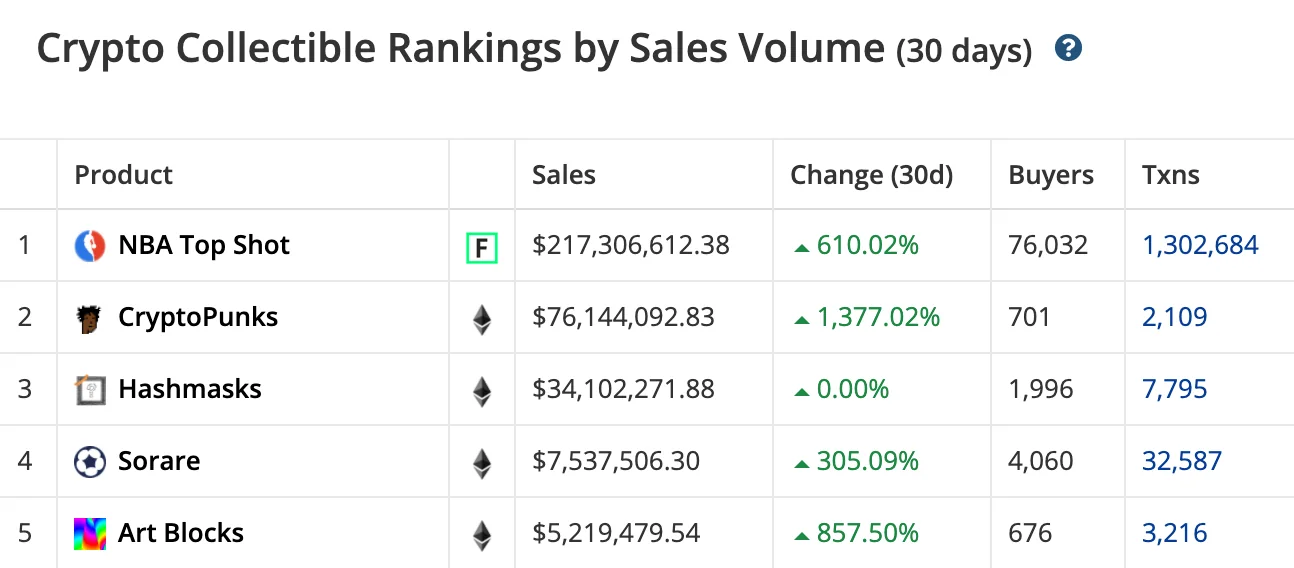
NFTs have attracted a lot of attention lately because of high sales volumes. In the past 30 days there has been over $300M in NFT sales:
Crypto has a record of boom and bust cycles, and it’s very possible NFTs will have their own ups and downs.
That said, there are three important reasons why NFTs provide fundamentally better economics for creators. The first, already hinted at above, is by eliminating rent-seeking intermediaries. The logic of blockchains is that once you buy an NFT it belongs to you to fully control, just as when you buy books or sneakers in the real world. There are and will continue to be NFT platforms and marketplaces, but they will be limited in what they can charge because blockchain-based ownership shifts the balance back to creators and users — you can shop around and make the marketplace earn its fees. (Note that reducing intermediary fees can have a multiplier effect on creator disposable income. For example, if you make $100K in revenue and have $80K in costs, cutting out a 50% take rate raises your revenue to $200K, multiplying your disposable income 6x, from $20K to $120K.)
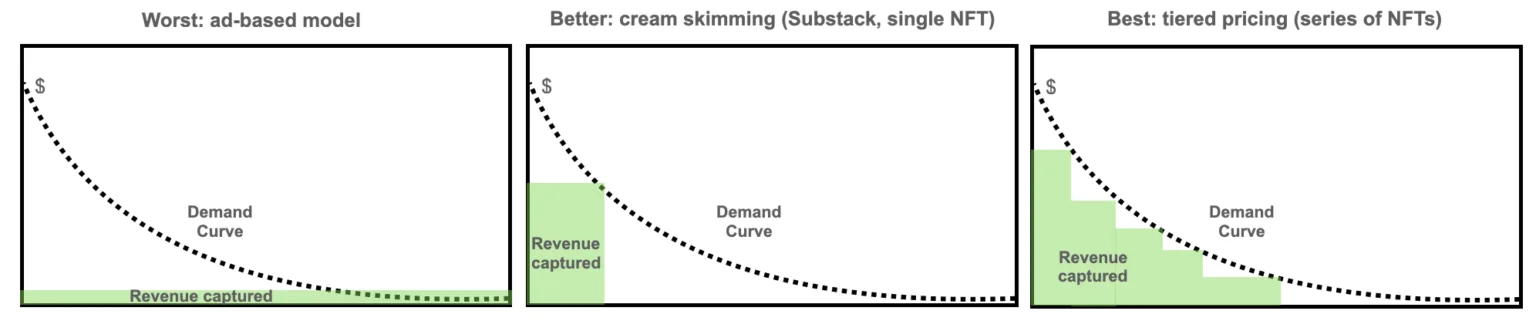
The second way NFTs alter creator economics is by allowing granular price tiering. In ad-based models, revenue is produced more or less evenly regardless of the fan’s enthusiasm level. As with Substack, NFTs let the creator “cream skim” the most passionate users by offering them special items that cost more. But NFTs go further than non-crypto products in that they are easily broken into a descending series of pricing tiers. NBA Top Shot cards range from over $100K to a few dollars. Fan of Bitcoin? You can buy as much or little as you want, down to 8 decimal points, depending on how enthusiastic you are. Crypto’s fine-grained granularity lets creators capture a much larger area under the demand curve.
The third and most important way NFTs change creator economics is by turning users into owners, which reduces customer acquisition costs to near zero. Open any tech S-1 filing and you’ll see huge user/customer acquisition costs, usually going to online ads or sales staff. Crypto, by contrast, has grown to over a trillion dollars in aggregate market capitalization with almost no marketing spend. Bitcoin and Ethereum don’t have organizations behind them let alone marketing budgets, yet are used, owned, and loved by tens of millions of people.
The highest revenue NFT project to date, NBA Top Shot, has generated $200M in gross sales in just the past month while spending very little on marketing. It’s been able to grow so efficiently because users feel like owners — they have skin in the game. It’s true peer-to-peer marketing, fueled by community, excitement, and ownership.
NFTs are still early, and will change. Their usefulness will rise as digital experiences are built around them, including marketplaces, social networks, showcases, games, and virtual worlds. It’s also likely that other consumer-facing crypto products emerge that pair with NFTs. Modern video games like Fortnite contain sophisticated economies that mix fungible tokens like V-Bucks with NFTs/virtual goods like skins. Someday every internet community might have its own micro-economy, including NFTs and fungible tokens that users can use, own, and collect.
The thousand true fans thesis extends the original ideals of the internet: users and creators globally connected, free of intermediaries, sharing ideas and economic upside. Incumbent social media platforms derailed this vision by locking creators into a bundle of distribution and monetization. There are, correspondingly, two ways to challenge them: take the users, or take the money. Crypto and NFTs give us a new way to take the money. Let’s make it happen.
(Image: CryptoPunks — Larva Labs)