
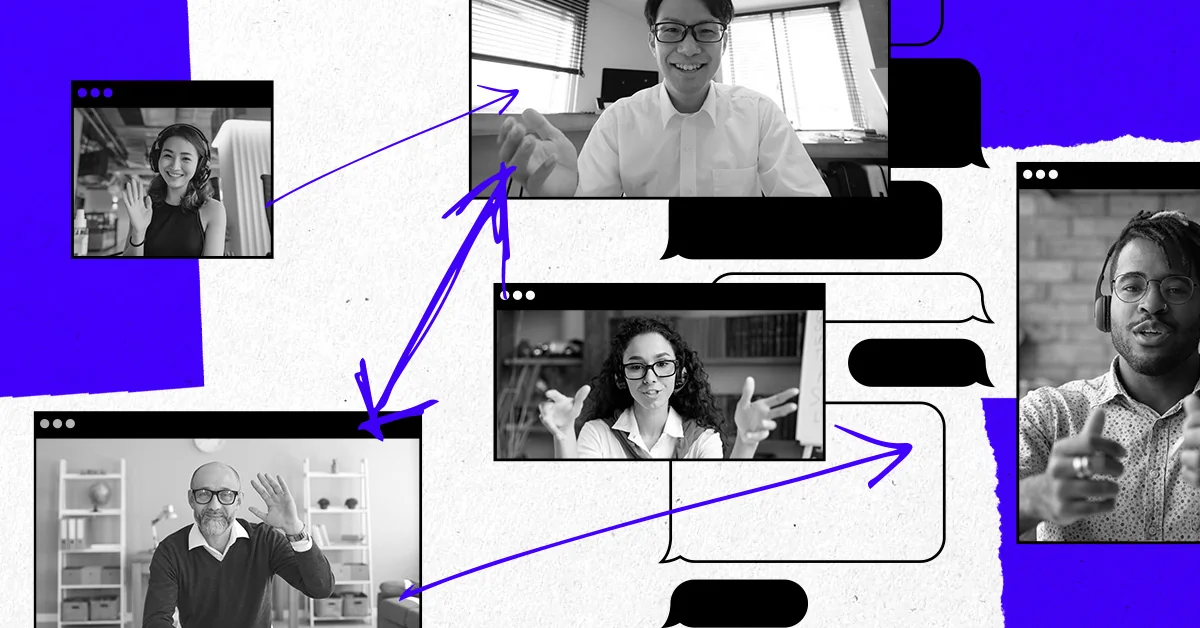
We live in a post-content era. Once, original educational material was scarce: ten years ago, it was a major draw for universities and accelerators.
Now, though, educational material is inexpensive and plentiful on YouTube, in newsletters, on blogs, and across social media. People watch learning-focused videos on YouTube 500 million times each day; the free YouTube channel Crash Course, for example, includes instructors with PhDs in fields ranging from physics to organic chemistry.
Also, dozens of accelerators, incubators, low-cost or free online classes, and alternative education offerings have emerged to meet the needs of working professionals who want to learn. On Udemy, for instance, students pay an average of only $10 to $20 to pick up skills like coding in JavaScript or delivering a strong presentation. On Udacity, students can earn so-called “nanodegrees,” built for companies that want to upgrade the skills of current employees. And LinkedIn Learning (formerly Lynda, one of the earliest online learning platforms) concentrates on narrow professional-development skills.
In the middle of this oversupply of free material and affordable online learning channels, it has become almost impossible for instructors to stand out — much less earn a living — from what they know, despite what they’ve been told. For many makers, the result is bleak: producing content is a losing game. Conventional social platforms separate monetization from community-building; you share your expertise on YouTube or Twitter, then must look for other routes — brand deals, low-margin merchandise — to truly benefit from it. Creators are effectively handing away valuable material, which means learners no longer have to pay a premium (or anything at all).
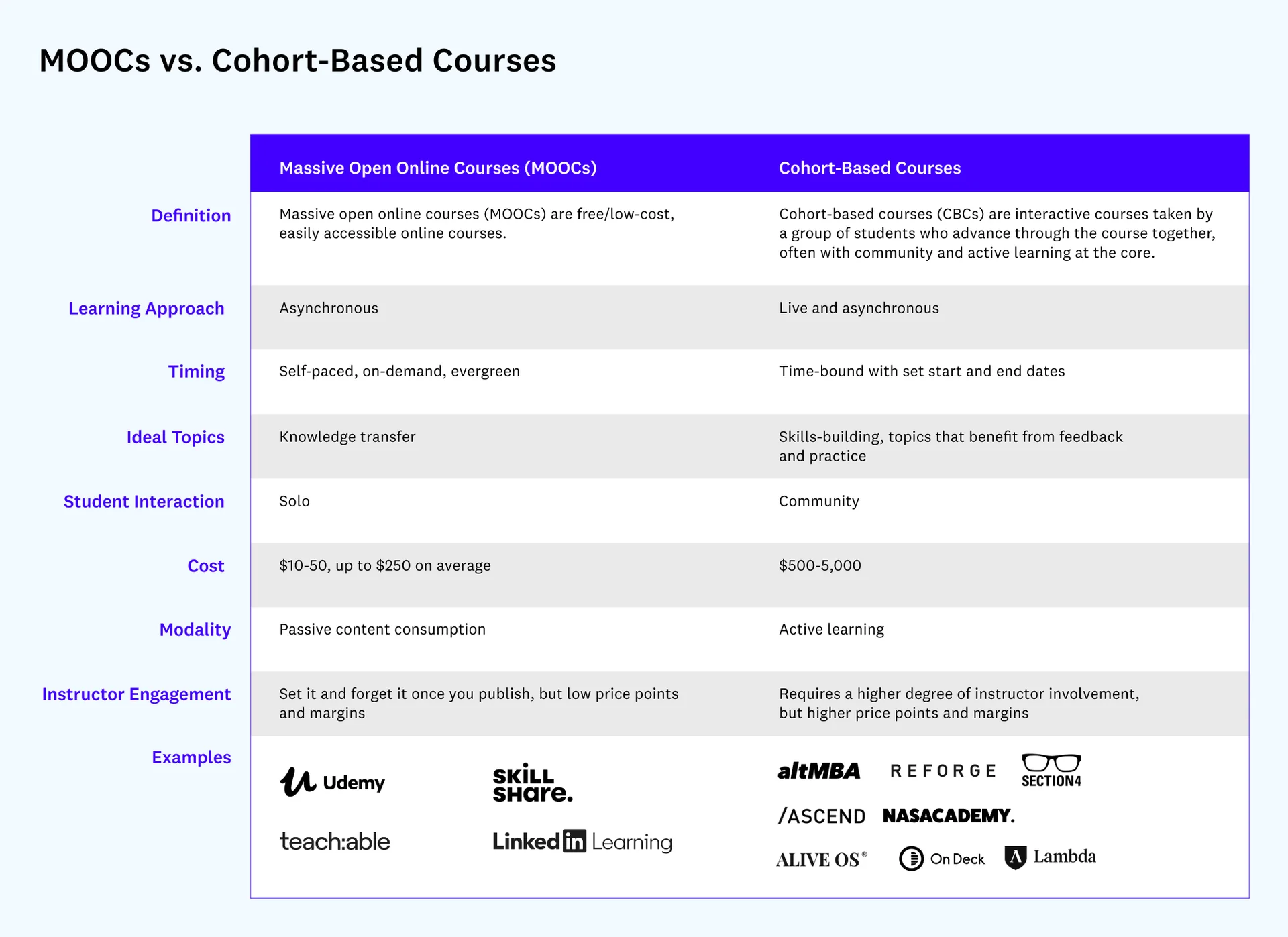
Oddly enough, most learners are in fact worse off because of all this cheap, abundant content — over time, it has become obvious that greater access does not lead to greater engagement. Many online course providers that rose to prominence in the aughts sold the idea that people could learn anything, but depended on learners’ own discipline and drive to finish a course. It’s the same in other self-guided programs: anyone can get a workout or diet plan, but very few stick with it long enough to get results. Likewise, MOOCs — the massively open online courses that became popular in the 2010s and still exist today in other forms — provide evergreen, on-demand, recorded videos, often with a clear syllabus. Yet their completion rate, as has been widely reported, is only 3 to 6 percent.
That disconnect between the big promise of online education and its outcomes has fueled the rise of cohort-based courses (CBCs), interactive online courses in which a group of students moves through the material together — in “cohorts” — with hands-on, feedback-driven learning at the center. The main difference between this stage of online ed and the MOOCs of the last decade? They are engaging and real-time, not merely self-paced, and they rely on community-led, active learning rather than solitary, passive content consumption. Cohort-based courses have a fixed beginning and ending, which enforces the real-time element and creates scarcity inside the abundance of content available, and they are often delivered live. It is like attending a college seminar discussion — led by an expert in the subject, regardless of geography or school prestige — instead of viewing a frozen video. And, crucially, the cohort itself creates a built-in social contract.
People pay for what is scarce. And in today’s content-saturated world, the scarce thing in online learning is community.
MOOCs vs. CBCs: The shift from content to communities
Over the past decade, on-demand courses made popular by platforms such as Udemy, Masterclass, and LinkedIn Learning allowed creators to earn money by teaching pre-recorded online classes. These courses gave learners unprecedented access to knowledge from experts around the globe at accessible price points (though that is not always true of university MOOCs). The MOOC idea was hopeful: if learners are given access to content and expertise, they will be self-motivated to study, participate, and master the topic.
But while these platforms opened the door to both creators and learners, they did not deliver the promised student transformation. Looking back, that promise was rather naive. There are many reasons for this failure:
- MOOCs are asynchronous and self-paced. In years of research on distraction, focus, and motivation — let’s be honest, everyone has put things off until the last minute at some point — we have learned that tasks without a fixed timeline often lose out to those that feel more urgent. Because MOOCs can be watched and studied at any time, there is no built-in pressure. This also has longer-term dropout consequences: one recent study by MIT researchers found that online courses had an average dropout rate of about 96 percent over five years, and that most MOOC learners never came back after their first year. (By contrast, in 2015 when marketing expert Seth Godin and I co-founded the altMBA, a cohort-based course that compressed the workplace so-called “soft skills” usually taught in a two-year MBA program into a four-week class, we achieved a 96 percent completion rate.) MOOCs’ low (or zero) cost shapes how quality is perceived. While low pricing is clearly beneficial and important for accessibility, the low cost of MOOCs and the absence of quality filters can also hurt them. Many MOOCs are cheap enough to feel like an impulse buy, which has contributed to brand erosion and discouraged some creators. Others say we have now reached MOOC saturation — $18.99 to learn animal telepathy! — which creates an impression opposite to exclusivity and appeal, especially because the aggressive marketing approach often reinforces that view. For example, I have heard creators say, “I don’t want to be one of those people who tries to spam everyone with Facebook ads to sell their $97 video course.” MOOCs communicate “knowledge transfer,” but not necessarily higher-order skills. Because MOOC content is pre-recorded, it is one-way, so there is no chance to ask questions in real time. That limits the format’s ability to teach anything requiring more feedback, discussion, or hands-on practice. So MOOCs work well for subjects that are mainly “knowledge transfer,” such as how to sort data in Excel or similar skills. But they do not work well for higher-order skills — those that demand analysis, evaluation, synthesis, judgment, and creativity. Using the Excel example again, a higher-order version might involve how to divide the data strategically to search for patterns and reach a recommendation.
In short: on many MOOC platforms, the main learning mode is passive content consumption; there is no interaction or real community; and there is no deadline. Together, these factors leave only a very small share of learners who actually finish.
The case for cohort-based courses
So, are cohort-based courses really that different from MOOCs? Some skeptics brush them off as MOOCs in different packaging; basically the same thing brought back with a costly makeover. But the underlying structure, format, and delivery methods of cohort-based courses are very different:
CBCs emphasize active, hands-on learning
In medical school, third- and fourth-year students usually rotate through hospitals. Rather than reading about skin disorders or diseases, students examine a live patient or work through a case study to practice diagnosing it. In the same way, cohort-based courses give students learning experiences that are active and hands-on.
Instead of taking a course on sales strategy, students must actually close the sale and report back to their peers. Instead of watching videos on color theory in graphic design, students create a flyer and critique one another’s work. Instead of watching videos about how bonsai trees grow, students actually grow their own bonsai.
This method has been proven effective: a 2019 Harvard study, for example, found that students in an introductory physics class scored higher on tests after active-learning sessions. Students must work harder in this format; they will trip up and make errors. While this is undeniably tougher than listening to a charismatic “sage on stage” lecturer — where some students in the same study even thought they were retaining more knowledge when taught by “superstar lecturers” than they really were — the research showed that students actually learned more from the hands-on experience.
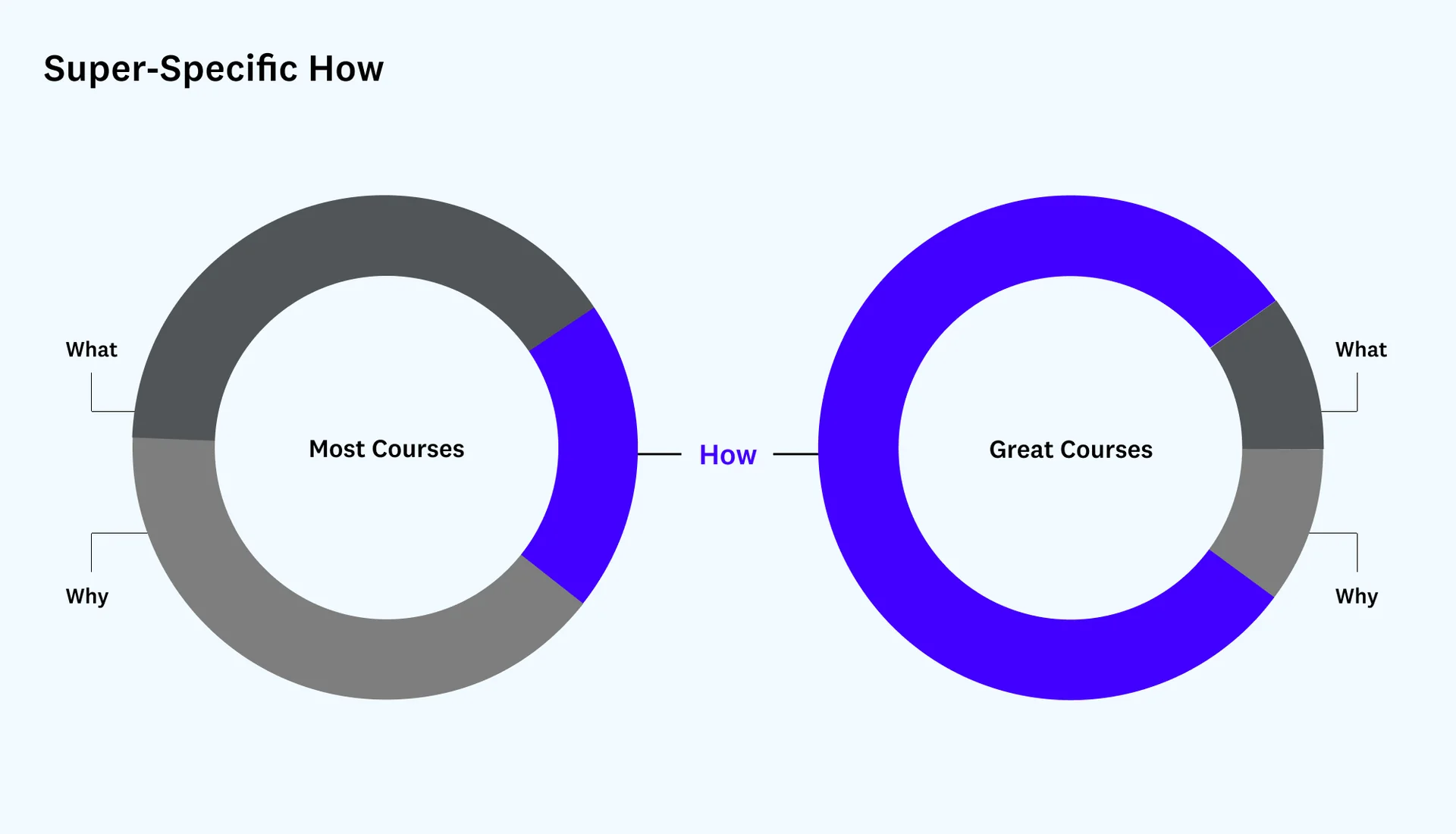
From a professional’s perspective, cohort-based courses also extend the network benefits of startup accelerators to a broader audience. The value of accelerators is not only content, but community. Y Combinator alumni point to factors such as the network, exposure to new ideas, community, and even access. Founder Gym is a cohort-based school that offers a 6-week course teaching under-represented founders how to raise capital that would otherwise be harder to obtain. With a cohort model, professionals can use the same tactics founders do — pitching, iterating, drawing inspiration and learning from one another — and, in the process, form industry micro-communities that help support and sustain them after the program or course ends.
Live, bi-directional learning increases accountability
The built-in scarcity of fixed start and end dates creates urgency and focus. Cohort-based courses also provide live lectures with instructors, active participation in discussions, applied learning exercises, and breakout groups.
In his book Cooperative Learning, clinical psychologist and psychology professor Spencer Kagan says that the single most powerful route to understanding and retention is interactive processing, which happens when “students engage in interaction with partners or teammates over the content.” One reason this approach is so effective is that classroom debates and discussions generate fresh ideas and perspectives; that back-and-forth keeps students engaged in a way no lecture can.
Another reason cohort-based courses can create more accountability is that they are bi-directional rather than one-way, meaning knowledge flows between instructor and students, and among the students themselves. It is a dialogue, not a static lecture. While some MOOCs may also provide this as a feature, it is often secondary rather than a core element as it is in cohort-based courses.
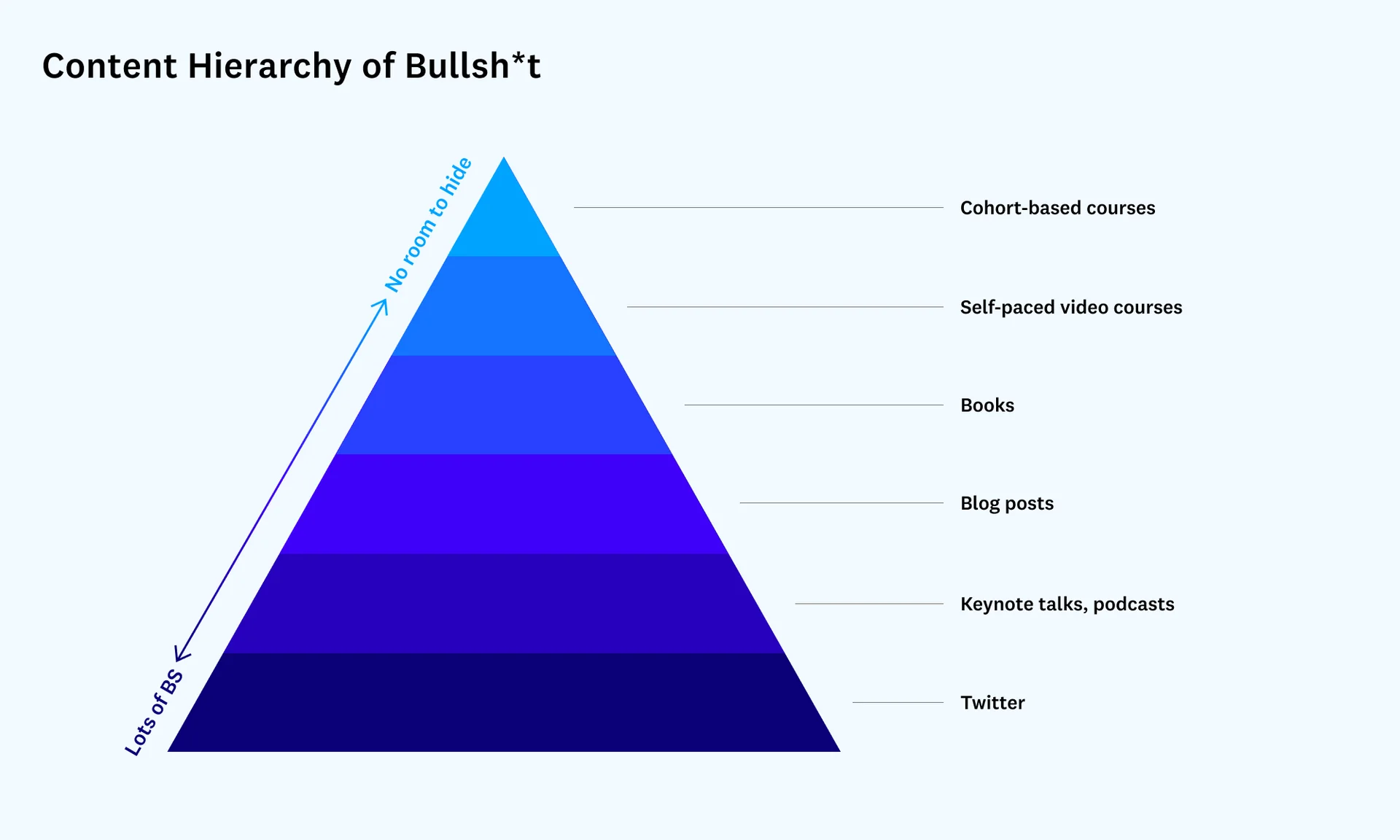
This exchange also makes the instructor more accountable. As I have written before, when there is nowhere to hide, you have to show up and do the work. Cohort-based courses motivate instructors to make their material more usable for students. In turn, this can produce higher-quality educational experiences.
Research also indicates that what psychologists and neuroscientists term “interleaving” learning — in which teachers blend different topics, ideas, and activities during study, requiring students to deliberately move from one to another instead of staying on one subject — can lead to stronger learning results for students. A Brazilian jiu jitsu athlete, for example, cycles through chokes, locks, escapes, and take-downs in practice. Cohort-based courses are naturally interleaved, allowing students to work across different modalities — breakouts, role-playing, discussions, debates — with the instructor, coaches, and one another.
Community building supports learning outcomes through social features
Cohort-based courses are built around a small to midsize peer community, often around 100 students per cohort. This shared experience group pushes students, keeps them engaged, and creates a broader focus on community and the student experience. MOOCs, by contrast, often enroll thousands of students per course all at once, with little or no interaction among classmates, or only optional interaction added on.
Research has confirmed the impact of collaboration. Dr. Lori Breslow, the founding director emeritus of the MIT Teaching & Learning Laboratory, found that edX students who worked with a fellow student to complete course material scored almost 3 points higher on average than those who worked alone. Norman Triplett, who published what many view as one of the first experiments in social psychology, found that cyclists did better when others were present, concluding that even the “bodily presence of another contestant participating simultaneously in the race serves to liberate latent energy not ordinarily available.” (Triplett conducted his study 100 years ago; we can see the evidence in the popularity of Peloton’s social-exercise model today.) Keith Humphreys, a Stanford professor of psychiatry and behavioral sciences who studied Alcoholics Anonymous, found that the group program was more effective than therapy at helping people stay sober — which he linked to social interaction and shared emotional support. Social interaction helps students reach their learning goals, too.
When I designed cohort-based courses, I also spent a lot of time studying institutions outside education — the military, dance-a-thons, Crossfit, and even cults — to learn what drives groups. All of them were “sticky” for the people involved, for good or ill. But while most traditional education makes students learn, it is clear that continuing education and adult learning need to be engaging and carrot-driven, not stick-driven.
There’s an elephant in the room, though: Why spend $750 to $5,000 on a cohort-based course when you can take a MOOC for $10 to 50?
Cohort-based courses attract learners who are prepared to pay a premium for the perceived quality of the material and the follow-through. Most learners probably need the accountability and urgency that come from a live course’s time limits, with a clear start and end date, and from learning alongside a peer group. When Harvard famously moved its case-method courses online and added peer collaboration in 2014, its completion rate climbed to 85 percent, while most MOOCs at the time had single-digit completion rates. At Juno School, a cohort-based coding boot camp, data from 116 students who graduated in the first half of 2020 showed an employment rate of 74.1 percent within 9 months of graduation.
Cohort-based courses may realize online education’s promise, especially as students keep helping one another after the course ends — and as the cohort becomes a close-knit, internet-native alumni network.
A new model for creator monetization
Today, there are thousands of experts with useful knowledge to share, but they are not traditional teachers. They come in all shapes and sizes, from focused subject-matter experts and operators — like Li Jin, who wrote about the Passion Economy for a16z and now runs a solo VC firm; or “knowledge” influencers like Khe Hy, a former Wall Street analyst who earns a living teaching a productivity course; or full-time operators like Noam Segal, a director of user research at Wealthfront who runs his course on UX fundamentals as a side gig. There are also solopreneurs like Tara Reed, who teaches a cohort-based course called Apps Without Code, along with many others.
For most creators, though, turning expertise into income is genuinely difficult, especially if they lack an established audience or network.
First, mainstream social platforms — Instagram, TikTok, Twitter — split the activities meant for monetization from those meant for community building. Creators give away valuable content, but most do not have enough volume to earn a living from advertising alone.
In practice, monetizing all of this takes volume. The idea of 1,000 true fans has remained the holy grail because most creators have not reached it yet. Research shows that even YouTubers with more than 1 million monthly viewers earn under $17,000 a year. This means content creators often must monetize through other channels such as brand partnerships or low-margin merchandise — efforts that often pull away from community building.
Cohort-based courses offer an appealing way to monetize expertise directly — without needing volume. They may therefore be the next stage of creator monetization, not only for traditional educators, as more “knowledge” influencers launch cohort-based courses. Cohort-based learning opens a new quadrant of creator monetization:
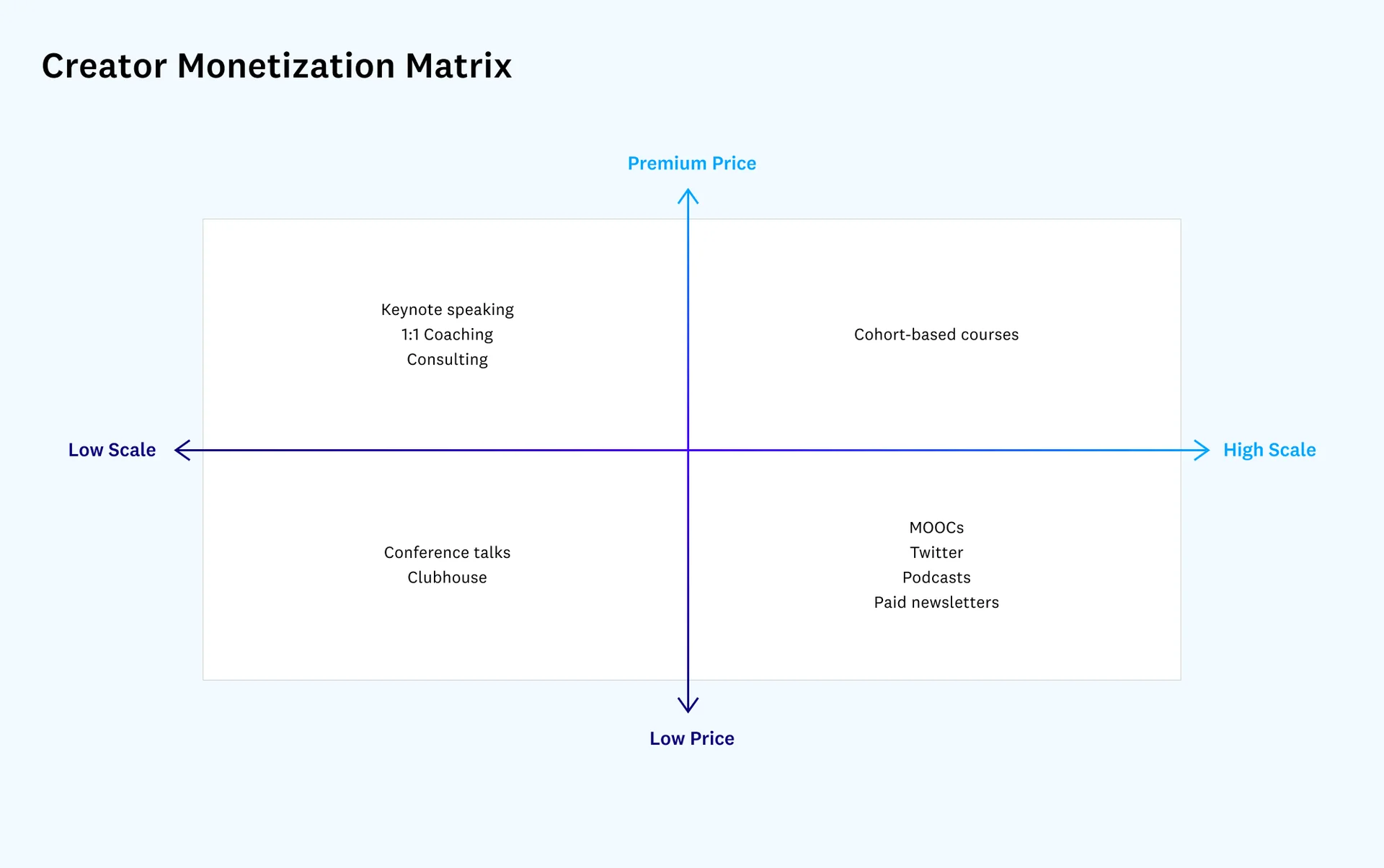
Instructors can earn a substantial amount of money: In just the first few months, four instructors each made over $100,000 in course sales on Maven (full disclosure: my company). Cohort-based courses often quickly become the largest revenue stream for many creators, for example (and none of the following are on Maven):
- David Perell, the creator of Write of Passage, is a 20-something without formal training who teaches a cohort-based writing course twice a year and makes seven figures in revenue. Joe Hudson is an executive coach who taught his first cohort because his in-person coaching business dried up during COVID-19. He built his course in six weeks and earned $200,000 in his first cohort. Ali Abdaal is an influencer who teaches a cohort-based course about becoming a YouTuber — he made $1.5 million in revenue within nine months of launching his course.
Meanwhile, those who only monetize at $8/month per subscriber are always chasing volume and leaving money on the table — not to mention the long-term benefits of community building.
Creators gain more leverage with a productized offering: Instead of “feeding the content monster,” CBCs are productized offerings that provide leverage in terms of creator time and effort. Anthony “Pomp” Pompliano and Lenny Rachitsky are two creators who have been open about the fact that content creation requires ongoing, weekly effort. Pompliano keeps Wednesdays blocked off all day for content creation, including recording podcast episodes, writing his newsletter, and more. Rachitsky makes a full-time living from his Substack newsletter — if he does not write every week, he risks his publishing schedule.
Both have said their original interest in creating a cohort-based course was to create more leverage for their time and to build an asset they could reuse for years. Creators do not need to build a course from scratch every time they run a cohort. And the work of creating a cohort-based course is front-loaded: 80 percent of the effort goes into building the course, and 20 percent can go into running or updating the course in later cohorts. Since launching his first cohort in late January 2021, Pompliano has completed three cohorts in four months — and was able to do so because these courses, in a sense, gave him back time.
Consumers get more value, creators get higher monetization potential and scalability: Cohort-based courses give creators the chance to charge premium price points and an uncapped path to scale. For instance, by engaging with a diehard community and building his brand as the go-to expert, YouTuber Ali Abdaal reportedly made about $140,000 from three MOOCs over four years compared with the $1.5 million he made in nine months with his cohort-based course. Another example is Tiago Forte, founder of the productivity startup Forte Labs, who made $5 million in five years from 3,500 total students — a tiny audience by internet standards. Most channels for creators need volume in the hundreds of thousands or even millions on YouTube, Instagram, or TikTok to make this kind of revenue. And I am not even counting the lifetime value or “subscription” benefits of community members, long term, in these monetization examples.
* * *
Cohort-based courses are still a young category. As with any popular trend, we will likely see prominent failures, too — but as the kinds of courses offered change, the definition of cohort-based courses will change, as well.
If a course includes pre-recorded lectures and an ongoing community that gathers for Q&A and monthly live calls, is it a course or a community? Likewise, the boundary may blur between an event series, a webinar, or even simply a networking event versus a course. What matters at a fundamental level, though, are student engagement and learning outcomes, no matter how they change. As cohort-based courses — the blend of live instruction, cohorts of peers, community, accountability, and hands-on active learning — challenge long-held beliefs in traditional online education, they will create new opportunities for learners and creators alike, redefining what success looks like in online learning.