
Over the last year, social tokens — the ones creators and communities issue to unlock special perks and put money into works — have surged across crypto and beyond. Well-known artists and athletes like rapper Lil Yachty, Grammy-award winning musician RAC, and NBA point guard Spencer Dinwiddie have each launched tokens to let fans own a piece of their work. And although community tokens are still a growing (and changing) idea, a number of notable examples have appeared: there are tokens aimed at optimizing yield (aka “yield farming” on DeFi or decentralized finance protocols); token-gated communities such as Friends With Benefits (FWB), which is connected to a private Discord server for creators; and full platforms for creating token economies.
Even though their shapes and uses differ, the shared belief behind social tokens is that they bring participants together around a common mission through participation or ownership. That community-first mindset is held by many early crypto adopters; it’s seen as a fundamental part of cryptocurrency resilience and governance. Decentralization signifies community ownership, and the idea is that this can only exist if the token is owned and run by that community itself.
But what hardline believers overlook in their loyalty to the collective is that every community begins with one creator. For instance, the yield farming token YFI came from Andre Cronje, the founder of Yearn Finance; FWB was started by Cooper Turley, who heads crypto strategy at Audius, and Brud CEO Trevor McFedries, the co-creator behind the digital influencer Miquela and friends. Would any of these communities have grown without visionary individual creators?
That’s why I think creator tokens are not just the strongest way to launch a social token, but that, as the “minimum-viable DAO,” they will reach mainstream adoption before community tokens do. In an industry that outsiders often see as confusing or annoying, the idea behind a creator token is easy to grasp: backing a person — human capital — instead of a company or a group. I should know.
I, token
Last year I “tokenized” myself, which means I made a tradable cryptocurrency whose ticker, utility, and purpose were centered on me. I brought in $20,000 in only four days. Unlike a more collaborative, community-oriented ethos, my aim was plainly self-interested: to raise enough money to relocate to San Francisco and start a crypto startup.
At the time, I was an ambitious founder going to Ethereum conferences and hoping to break into Silicon Valley. Although I was involved in the Ethereum community and had launched a project to make loans against NFTs, I was looking for a bigger, mission-driven project. Then in March, at the beginning of the pandemic, I lost every bit of my savings in one DeFi transaction. But even though I was low on cash, I was high on social capital — I had built up more than 17,000 followers on Twitter alone. So that week, onstage at an Ethereum conference in my hometown of Paris, I unveiled my private token, $ALEX. The aim was simple: to earn enough money to independently pay for an immigration lawyer and a flight to the U.S.
Structured as an informal Income Sharing Agreement (ISA), $ALEX was backed by patrons who would get 15 percent of my income over the next three years, in $ALEX, up to $100,000. The income airdrop would be sent to shareholders every quarter at Uniswap market price. Although I originally took 30 $ALEX backers, I later introduced experiments for non–ISA holders, including a monthly newsletter, a private Telegram group, and, most successfully, a voting system called “Control My Life” that let people decide my daily habits. (The latter was inspired by Mike Merrill, the “world’s first publicly traded person,” who allowed people to shape his life decisions.) Others have created “personal tokens” as well, selling their skills and services: The designer Matthew Vernon, for example, did this a couple years ago with his DappBoi experiment.
In my situation, my token holders decided on one habit in my personal life, such as whether I ought to become vegan or whether I should run 3 miles every day for a month.
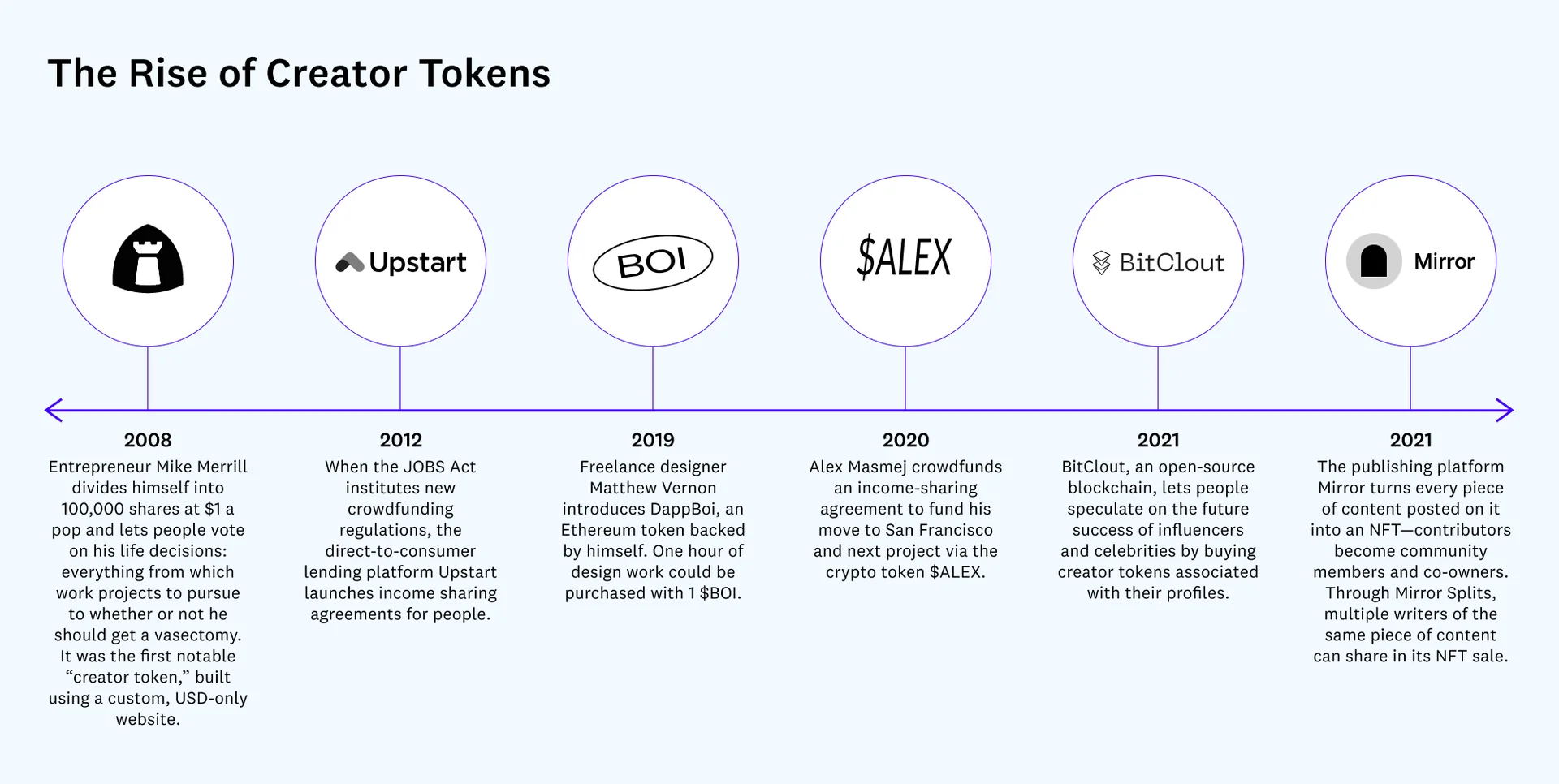
I moved from the first idea to hitting my fundraising target in under a week with only a blog post and social currency — I used Twitter to share a basic Google form. At present, there are more than 600 $ALEX holders, and all of them have access to my private Telegram group chat.
This low hurdle to participate is a major reason I think creator tokens will move faster than community tokens and DAOs, at least during the bootstrapping stage. The Power Law idea applies to community participation too: the top 1 percent will always be more engaged, because leaders emerge naturally, and there will be more social tokens that reach the mainstream. While my own “human IPO” took less than a week, community tokens often take months to design, coordinate, and teach members about the admission and voting process. Of course, critics may say that this is because building a community demands much more care and planning, which is indeed true. But even communities that appear to be “bottoms-up” and “leaderless” are still initiated by a creator’s early effort and developed around that central authority.
Why did I do this through crypto instead of crowdfunding or a more conventional ISA? Because of the speed, the worldwide reach, and the absence of fees. In five days, strangers from all over the world sent a total of $20,000 to my Ethereum wallet. Although I am a French citizen, my audience is not mainly French, so extra fees and currency conversions would have made traditional routes more expensive. And let’s face the elephant in the room: at 23 years old, most of my peers are taking out student loans, which often leaves them buried in debt no matter how much money (or not) they earn later. I believe a crypto ISA really is the best option, not only technologically but also in terms of financial alignment: People are now incentivized to want me to succeed.
Creator + community
Personal and clout-driven creator tokens are often attacked as dystopian, like a social credit score or a review system for people, especially because decentralization (and therefore community ownership) is the intended end state. But the vision behind creator tokens and community tokens are not, in fact, in conflict. While the notion of a “human IPO” may look like a stunt at first, I believe it is a sign of what’s ahead. With my seemingly superficial “Control My Life” experiment, for example, the Ethereum developer Austin Griffith and I were among the first to use the sign-to-vote “snapshot” governance that is now employed in major DeFi protocols. Through this approach, protocol users can vote on governance decisions without paying the Ethereum network’s expensive gas fees — this lets crypto projects more effectively measure community sentiment when making decisions.
If you examine closely enough, every successful community — from creator fanbases to thriving open source projects — is first set in motion by a single leader who represents a set of values that then draws others in. Crypto may have added economic incentives to speed up and fund this process, but the natural pull toward a leader still remains.
I believe community tokens ought to begin small, with one or a few founding creators, much like a compelling founder draws users toward his or her company’s mission. Projects often grow and scale, but you need singular focus and cohesion at the start. This is why I argue that the entry point to community tokens is the individual, not the community itself.
- The Creator Phase: This is the stage where the solo creator links themselves to a simple use case with a strong hook, whether an income sharing agreement, exclusive content rights (unlockable for holders), or voting rights. The artist Connie Digital, for instance, rewarded his community with $HUE for a shout-out on a virtual billboard; the rapper Lil Yachty issued exclusive surprise boxes and virtual parties to $YACHTY holders. The Community Phase: Once a project matures, a founding creator can decide to empower his or her community, rewarding contributors for their efforts and/or making them active participants. More contributors lead to more investment in the project and more use cases that engage community members over time.
For one example, FWB’s original use case was access to a Discord server run by its creators. Its “Season Two” plan added a broader group of leaders who curate content from the community, alongside hosting group chats. This is not unusual in open source projects and other strong communities, but with tokens, incentives are aligned with economics.
As I point out above, moving from a creator to a collective requires community members who are committed enough — who can help educate, pass along information, proactively send feedback and more. If this engagement does not emerge organically, then the creator could set up paid jobs with crypto incentives that push people into more active roles. The creator leadership gradually expands to include more people, and the mission statement widens so that it no longer depends on a single person, ultimately meeting the purist crypto vision of a Decentralized Autonomous Organization (DAO).
The act of rallying community members is not new, but the ability to align incentives while doing it — and grow from there — opens up all kinds of possibilities. Take, for example, an index of young founders on Pioneer, the online network platform for “outsiders”: musicians could build community-owned labels and bands; newsletter writers could build community-owned media publications (and already are); and so on. It’s just one of many examples showing how lowering the barrier to entry lets people align their goals and interests. Since anyone anywhere can create and support a creator’s community, this model is especially attractive to outsiders without existing connections or similar resources.
* * *
Communities — both crypto and cultural — are built from individuals. The word “community” tends to smooth over a group of people who are more than the sum of their parts, but those parts are where it’s at. That’s where we need to begin if we want social tokens to reach the mainstream. I believe it’s the future not only for creators, but for many social networks, where the individual sits at the center of every node.