
Each day, we take in popular entertainment built around characters. A set of hit characters can become the core of a franchise — for example Star Wars, Marvel, Harry Potter — that lasts for decades and can be turned into successful products across platforms and media forms.
But now, most successful characters are intellectual property controlled by one company. That leaves fans with no governance, much less direct ownership, of these characters, and makes them only passive consumers of the products and stories the company chooses to produce. Even when fans purchase public equity in firms to signal support or alignment, it is hard to place a focused bet on one character or franchise, because many companies are large, diversified, vertically integrated businesses that own and run many product lines. Shareholder voting was not, and probably never will be, meant for fans and investors to decide which actor should portray their favorite character in the next film in a series, or to help shape other decisions with similar impact.
Some may say it sounds absurd to ask for this, but the most devoted fans are already building online communities, running campaigns, and even posting their own fanfiction online. Rather than brushing aside these communities, character IP owners could include them in the creative process, giving them a place to test and extend ideas in ways that would have been extraordinarily hard to manage at scale with legacy tools and technologies.
Today, crypto technologies such as decentralized autonomous organizations (DAOs) and non-fungible tokens (NFTs) make possible a new approach to character development and ownership that could not only separate creative media, but also reduce the barrier for online communities to introduce new characters into the world. It could also produce characters that more fully reflect the communities that back them.
Opening the closed loop of ‘character governance’
A wider cultural change is already underway in corporations and elsewhere — just consider the growth of environmental, social, and corporate governance (ESG) investing, or activist investing, or fan communities for many kinds of creators. What these varied forms of participation share is stakeholders or communities looking for new ways to organize and put both time and money into supporting people and causes they care about.
We are close to seeing the same shift take place with intellectual property tied to cultural characters.
Early in my career at TrialPay, an e-commerce payments and advertising platform (acquired by Visa), I worked with some of the most successful free-to-play game developers to help them expand and monetize their virtual economies. One game in particular offered an early example of the power of letting fans feel they had “single player” control of a popular character from their mobile phone. It was Kim Kardashian: Hollywood (released by Glu Mobile in 2014), a straightforward choose-your-own-adventure-style game in which players act like they are a Kardashian and make choices about avatar clothing, invented film shoots, and appearances.
Although the game became a huge success, its currency — and every result of the countless choices and decisions made by fans — stayed within a closed-loop world: These early gaming experiences showed the promise of simulated governance through an existing popular “character” that each player could individually enjoy, but they never gave people the chance to work together with a community in a more genuinely creative way.
What if, instead, fans could have brought a new character into the real world, with anyone able to take part in the fun, and the financial upside, of its success?
DAOs and the economic incentive of tokens
Enter DAOs. These decentralized autonomous organizations provide creative people around the world with a way to build communities, and new characters, using real money — much as fantasy sports taps sports fans’ latent desire for team ownership (and possibly financial gain).
There is also a market for a decentralized version of a “fantasy Hollywood” — it simply has not been filled yet.
How would DAOs make this happen? Put simply, DAOs are networks governed by smart contracts, or self-executing code on a blockchain, which can establish commitments for certain rights and responsibilities if you are a member of that decentralized organization — with little or no active oversight from a central figure. Anyone anywhere with a mobile phone and internet access can join such a network, and the network may give tokens to participants based on their contributions (or on any other factors the protocol’s creators choose). Those tokens can provide certain voting or governance rights, and the tokens may increase in value (not only monetary value) if more and more people want to join the network. Because the token itself creates an economic incentive, participants are motivated to maximize the network’s utility, including by using their “stake” to make sound collective decisions about ongoing operations.
The earliest successful DAOs have mostly been built around financial protocols, such as letting a community of token holders govern decentralized lending and borrowing by proposing and voting on specific protocol changes. While this structure has supported the growth and operation of new protocols in the decentralized finance, or DeFi, ecosystem, most mainstream consumers lack the financial knowledge or interest needed to weigh in on specific governance choices like collateralization ratios.
But the DAO idea is useful in a broader sense as well, and it can also be used in other contexts where a network of people shares incentives and common interests. The next stage of DAOs is therefore taking shape around creative communities, to support crowdsourced creativity and coordination (aka “creator DAOs” and similar).
But communities can gather around characters, not only creators, and those communities can work together to bootstrap these characters toward a mainstream audience.
Building communities around characters
Today there are at least two ways communities can form around characters, improve their IP, create digital identities around them, and financially gain from a character’s market success. Additional paths are sure to appear in the years ahead, but I will use current examples to show each of the models.
CryptoPunks
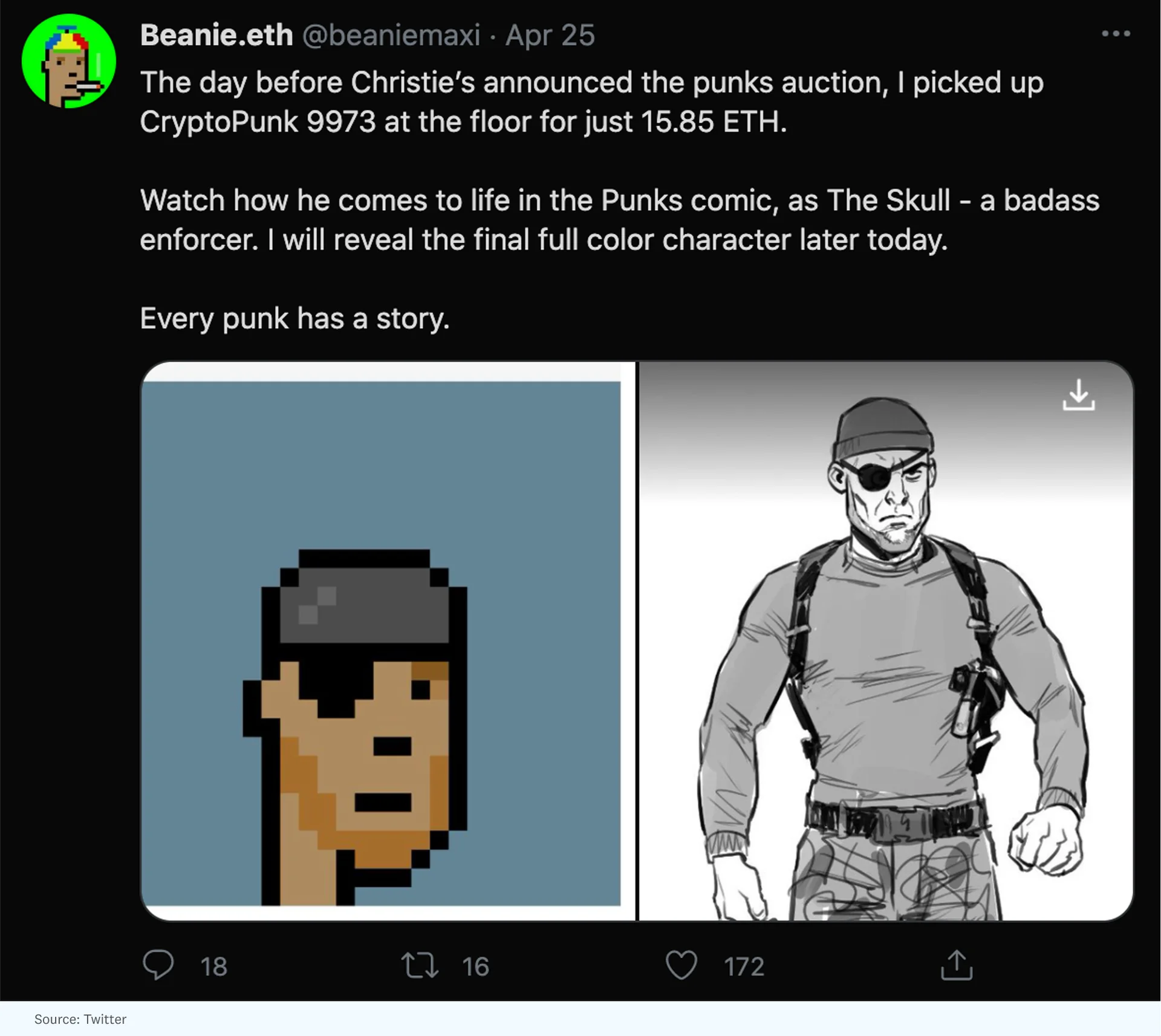
CryptoPunks shows one path in which the developer, Larva Labs, made the art for 10,000 characters, each existing as an NFT with distinct traits. A decentralized community of collectors formed around the CryptoPunk NFTs, with their own cultural habits and norms, such as using a punk as a profile picture across social media platforms. Although CryptoPunks were first released for free in 2017, the community bootstrapped the project to more than $680 million in lifetime sales (with the rarest individual punks selling for more than $7 million).
Instead of simply holding punks passively, though, collectors have also started working with one another to create stories inspired by the CryptoPunk character art and bring their punks “to life.” The NFT art acts like a digital LEGO-like building block, or a kind of creative stem cell — either way, it gives fertile imaginations a base from which to develop in many different directions and forms. For example, a group of collectors made a PUNKS Comic featuring 16 punks, complete with backstories and story arcs that will build complete character identities for these punks.
Such community efforts are entirely independent of the original developers behind CryptoPunks, however. The community produces brand new art using the original punks only as inspiration as they move into new forms beyond the creative control and oversight of Larva Labs. These new punk-inspired stories can themselves become new NFTs that community members can monetize and sell as fan art without needing licensing agreements. In the case of fanfiction for traditional, corporate-owned characters, fan creativity may raise value and exposure for these characters, but it does not let those fans share in that upside. With PUNKS Comic, however, fans already own the core CryptoPunk NFTs. As a result, the success of their punk-based characters and stories creates more awareness and demand for the underlying original punks — benefiting the PUNKS Comic creators, the original developers, and the wider punks community.
Aku
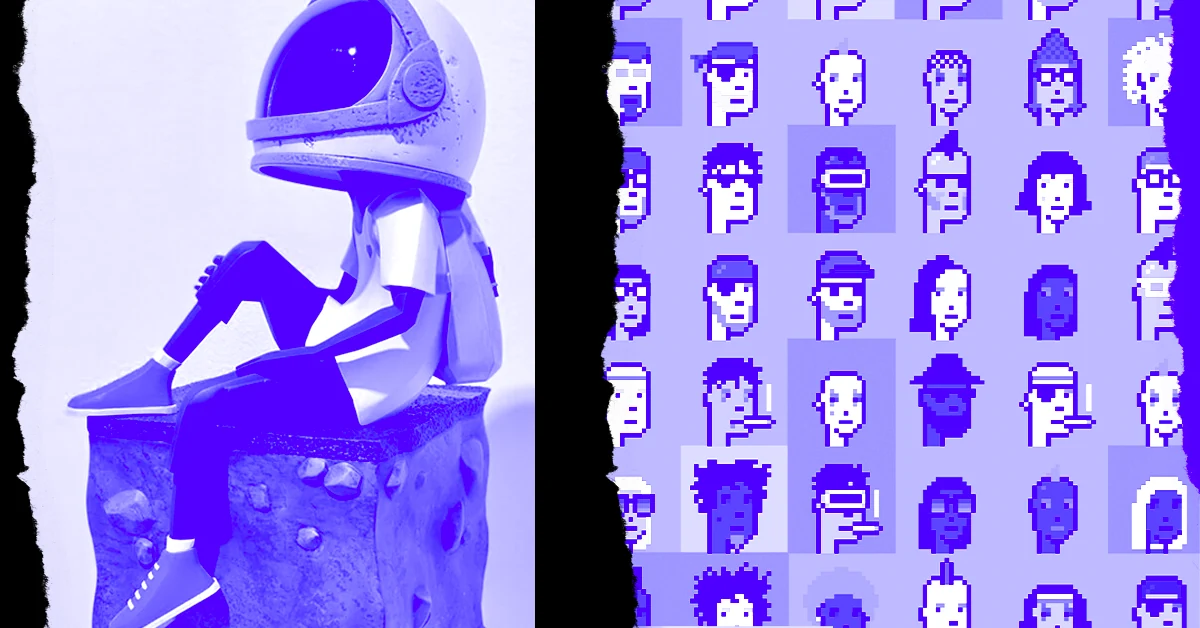
Another route to community-owned characters begins with a specific character that already carries a backstory and identity that sparks NFT creation, while also letting a collector community shape how it develops. Aku is one example: a young Black astronaut character made by former major league baseball player (and self-taught artist) Micah Johnson.
Johnson had heard his nephew ask his mother if astronauts could be Black. That pushed him to begin painting his nephew in an astronaut helmet — with so few other role models and narrative characters like this already available — to foster hope and confidence that he could reach this dream. Johnson then created the new NFT-based character of a Black boy wearing an astronaut helmet.
When I encountered Johnson’s work, and engaged with the community around it, I was struck by the possibility that hundreds of millions of internet users — rather than private institutions — could decide an artwork’s value, and also directly own a token that stands for it. In addition, they could use that token, which represents membership in this community, to build a digital cultural identity.
This matters for artists like Johnson, and for all artists who are building a community or have fans. Black culture and creative expression across music, literature, and visual arts have flourished and shaped mainstream global culture for generations, but historically Black artists and creators have found it hard to capture, much less own, even part of the value they generate through that culture. Seeing a gifted Black artist sell an NFT representing an inspiring Black character to a largely Black collector base felt like the opening stage of a new movement, a Black digital renaissance, as I’ve written about before.
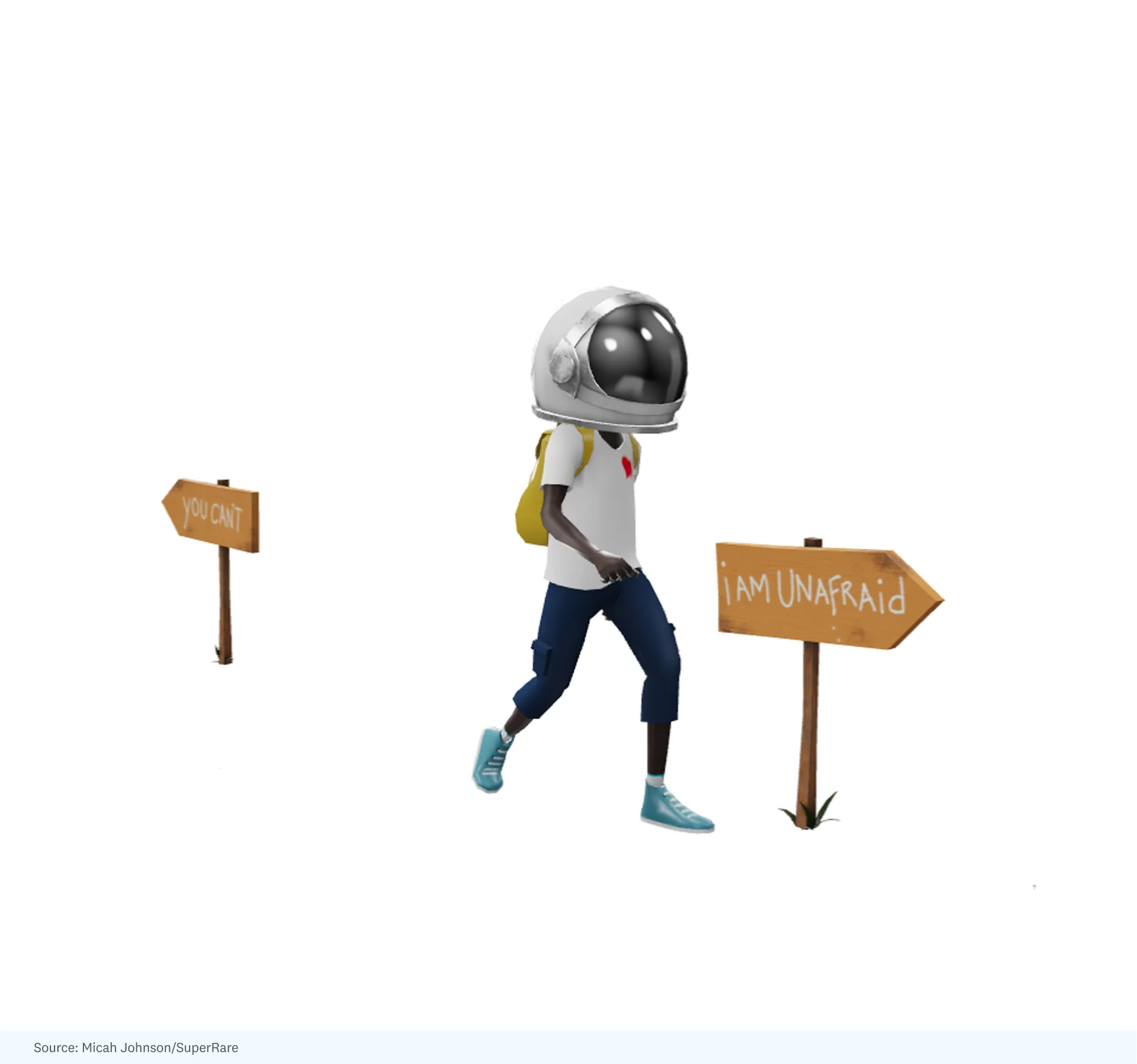
Just a couple months ago, Johnson said he would unveil Aku’s story one chapter at a time by making ten short-form animated video chapters of limited edition NFTs that show Aku interacting with different people and places. Not only did Aku NFTs generate more than $2 million in sales through the first two chapters, the NFTs have a devoted community of supporters who want Aku to succeed as a positive image for Black kids and a symbol of Black economic empowerment. Through owning these NFTs, early Aku collectors gain financially from Aku’s success, which could in turn raise demand for and the value of Aku digital memorabilia.
The potential for community-owned and -operated character IP also has echoes in traditional media: Johnson not only partnered with a 3D sculptor to make a physical version of Aku, but it is also apparently the first NFT to be optioned for film and TV.
“Skin in the character”: The business case for community-owned character IP
In both pathways described above — whether by creating or extending character stories — NFTs act as a strong way for an artist to gauge market demand for early versions of their characters. In a way, it’s an audition, or minimum viable product (MVP), before “character-market fit” for their creative idea — where the NFT’s early collectors signal that the art’s style, traits, and message may resonate with a wider audience.
Unlike traditional focus groups, though, where there is no skin in the game, this model sends a stronger signal to the artist and to other collectors. If market demand for that character is strong enough — strong enough that people are ready to spend hundreds to thousands of dollars to collect those NFTs — then the creator knows there is “skin in the character,” much like skin in the game.
Once the NFTs can support a community of passionate early collectors who have skin in the character, the next challenge is how to expand that community, develop the character, and spread it to a broad audience across mainstream media platforms. In fact, I think this model could help large corporations too, because under the current system it is hard to coordinate and carry out creative collaborations among multiple characters owned by different corporations that see one another as direct rivals. Even when two characters owned by two separate companies have significant fanbase overlap, it is difficult if not impossible to organize these collaborations. Sure, crossovers can happen (as DC and Marvel occasionally did), but it is hard to do so in a way that also leaves enough upside for the corporations while reducing possible competitive issues on the products they own. NFTs and DAOs offer a path forward.
But first, what are the differences with this new way of doing creative work?
In conversations with artists like Micah, his decentralized storytelling model creates a “choose your own adventure” framework in which community members could propose many different stories or experiences for their character. But how would that work? The communities could give governance tokens to holders of character NFTs, which then can be used to vote on major creative decisions. These collaborative ties between creator and community are already happening and will only grow as participants explore the possibilities, both creative (including governance) and financial.
Isn’t this simply another form of crowdsourcing — the worst way to make high-quality character IP — and wouldn’t it weaken the creator’s vision? No, because the new, crypto-native focus on aligned network incentives changes everything: It actually opens up a broad range of new models in which the creator becomes more of a community leader for a decentralized community of fans. We may soon begin to see community members jointly issue public requests for proposals (RFPs) to artists and agencies for specific kinds of digital content built around a character, just as people already do (and have done for decades) when developing software in open source projects.
The rise of character DAOs
But the technology is also here to make much more possible. Here is one model, fully feasible with current technology:
- A community member writes a brief for a short film or animated series. Token holders — community members who have acquired either NFTs or fungible “social tokens” that give multiple holders equal governing weight — could vote to approve the brief, and set an initial budget for it. Production companies could then answer it, making a trailer with their vision of how they would bring the brief to life. The community reviews every trailer submitted and votes with their tokens on which one to fund. The founding artist serves as creative director working for the token holders to help oversee the RFP process, and then works closely with the winning company to carry out the series. Money used by collectors to buy the initial NFTs as well as ongoing drops could be put back into a community treasury, which could then be used to crowdfund more digital content around that NFT character, to raise brand awareness and grow the community around it.
This may seem far off, but it is not. Think about how eagerly artists of every kind are already exploring NFTs and other new ways to connect with fan communities. Crypto’s interoperability simply lets innovations and ideas stack on top of one another at a fast pace.
What are the benefits of such a model? Here are a few:
Faster creative iteration. By owning the character — but outsourcing the creative execution of series, movies, or video games that feature it — communities could potentially build new global franchises, and do so faster than single corporations can. Rather than carrying out one content activation at a time aimed at a single market, a “character DAO” could finance multiple shows, films, video games, and merchandise (both physical and digital) that independent teams focused on different markets execute — all at once. Small, modular communities support more experimentation, and crypto aligns all the incentives.
Streamlined collaboration. As multiple independent creative DAOs appear around different characters, there will be some overlap in ownership between them. But that is not a bug, it is a feature: These overlaps create chances for collaboration among characters across DAOs, for example by making digital content that includes both characters, allowing them to drive distribution across different communities and create shared audiences (and brand ambassadors) without competitive concerns.
Aligned incentives among DAOs. Community members would be motivated to support collaboration as customers, and to promote it as brand ambassadors. Each successful media activation would then bring a new audience into the community who also want to get involved, helping to own and govern the character they just saw in that movie they loved.
Better cultural representation. Beyond creating characters with positive portrayals of distinct cultures (ethnic and religious minorities, for example), such models democratize the kinds of stories that get told. Instead of trying to find existing characters, parents with similar values can now actually work together and pool creative and financial resources to create their own characters, aligned with their values for their kids.
Value capture and revenue growth. This is not just a feel-good effort — there is real market-making potential here. As the global community and audience expand, and demand for governance tokens and NFTs rises, it could generate additional revenue that can be used to finance even more stories and media around character(s).
The governance questions
Of course, it is not all fun and games: DAOs are not merely an abstract crypto idea, but systems made up of people. And although they open new ways for people to coordinate around shared principles or goals, they also bring new problems for good governance, daily execution, and scale. Some of those include the questions below, which will take substantial experimentation, but I offer a few thoughts here:
What kinds of decisions should DAOs be built around? If communities must vote on every small character detail, the experience will be less engaging, less efficient, and likely draw less participation. If the items that get voted on are too broad, though, members may feel they do not have enough control or ownership.
Who will handle day-to-day administrative and community management work? I would argue that DAOs work better as a “creative board,” voting on major high-level strategy choices and roles while handing off product management and creative development to third parties through RFPs.
How will DAOs preserve quality control around the IP? Big character franchises have firm rules about what characters can and cannot do or say, in order to create consistency, identity, and, yes, quality too. Communities will need to set their own guidelines or principles for their characters that members can rely on when judging new proposals. In the end, if communities run many different activations of the character across multiple media at the same time, some will work better and create better experiences than others. The important point is that all of these experiments can take place in a way that they cannot inside corporations.
How will DAOs turn revenue from character IP generated off-chain back into the on-chain treasury? NFT sales make it easy to fund an on-chain treasury managed by token holders. But DAOs may need third-party administrators that can offer payments and contract services at the DAO’s direction to connect off-chain (e.g., real world) and on-chain revenue, expenses, and treasury management.
***
The costs and hurdles of introducing a new character to the world, testing whether it resonates with a particular audience, and bootstrapping the many forms of media and stories built around that character are falling sharply — thanks to crypto, as new tools like NFTs and DAOs emerge.
Not only will individual artists have a huge chance to build communities around their work, consumers will be able to shift from passive to active participants — storytellers alongside the artists they support — and stakeholders who were previously left out, like parents, underrepresented creators and consumers, and others, can find new paths and a voice.
Thanks to Chris Lyons and Micah Johnson for conversations that sparked these ideas. The views here are my own and do not represent my employer.