
Although many people in tech and elsewhere know about bitcoin, cryptocurrency, and the idea of a blockchain, smart contracts — Ethereum’s key breakthrough — are less familiar. These are programs that anyone can create and launch on a public blockchain, opening the door to all sorts of innovation. Catchy acronyms such as NFTs, DeFi, and DAOs — standing for new ways to own anything, better financial systems for everyone, and new ways for people to organize and work together, respectively — are all driven by smart contracts.
Smart contracts enable new forms of transactions with obvious benefits over those provided by legacy systems. In the past, for instance, a bank might need weeks and stacks of documents to confirm a person’s assets and approve a loan. With a smart contract, code could automatically approve a loan based on the collateral the person supplies.
Smart contracts do more than simply make transactions instant and verifiable for different uses — they can also be built to work with one another. Put differently, they make crypto programs composable, like parts that fit together. This quality of composability is one of the most discussed topics among tech fans, and not discussed enough more widely, yet it is among the most powerful features of crypto. Since composability lets anyone in a network reuse existing programs and modify or layer new ones on top, it creates entirely new use cases that do not exist in our world.
Put another way: composability is innovation.
Why composability is possible and what it makes possible
The fact that anyone in a huge network of separate, distributed participants can build on the work of others to make new applications did not happen by itself — it took many people working together. Over time, Ethereum smart contract developers made composability possible by settling on community standards that define how certain contract types should act. For instance, the ERC-20 token standard, first suggested by developer Fabian Vogelsteller in November 2015 and formalized in September 2017, sets out how Ethereum tokens should behave, including core features such as token transfers and permission to spend tokens. It makes it simple for third-party developers to support any token that follows the ERC-20 standard.
This sort of standardization is essential for composability, just as standardizing internet, email, and other protocols was essential to the web’s expansion. With these token standards established, smart contracts can function as building blocks that can be combined into larger systems. Like a software library, smart contracts for different protocols and applications can readily connect with one another like Lego pieces. In fact, smart contracts inside decentralized finance (DeFi) — one of the earliest and liveliest examples of composability — are often called “money legos.”
How composability works in decentralized finance
Financial positions in DeFi protocols — which let users lend, borrow, trade, or otherwise transact without central financial institutions in the middle — can be expressed as ERC-20 tokens redeemable for the underlying funds. For example, if you deposit USDC (a tokenized U.S. dollar) into the lending protocol Compound, you get cUSDC, which represents your position earning interest inside Compound. Likewise, when you deposit funds into the decentralized exchange protocol Uniswap to supply liquidity to a particular market, you receive ERC-20 tokens that stand for your share of the funds pooled in the related Uniswap market.
Importantly, these tokens are not “locked” inside a single protocol — they can now be used in other DeFi protocols. For example, you can use your Uniswap Liquidity Provider tokens as collateral in the lending protocol Aave. Smart contracts let developers build on top of other protocols so they can interact easily across multiple applications; in decentralized finance, that covers everything from lending to derivatives.
Although some of these DeFi transactions have not been easy for many people to access — either because certain applications are complex or because technical know-how is needed to use the protocols — usability keeps improving significantly. The sequence of transactions involved in combining different DeFi building blocks can be created and shown with projects such as Furucombo and DeFi Saver, which hide the development work required to merge and interact with different smart contracts. A user can simply drag and drop different actions into a sequence or use combinations made by other people.
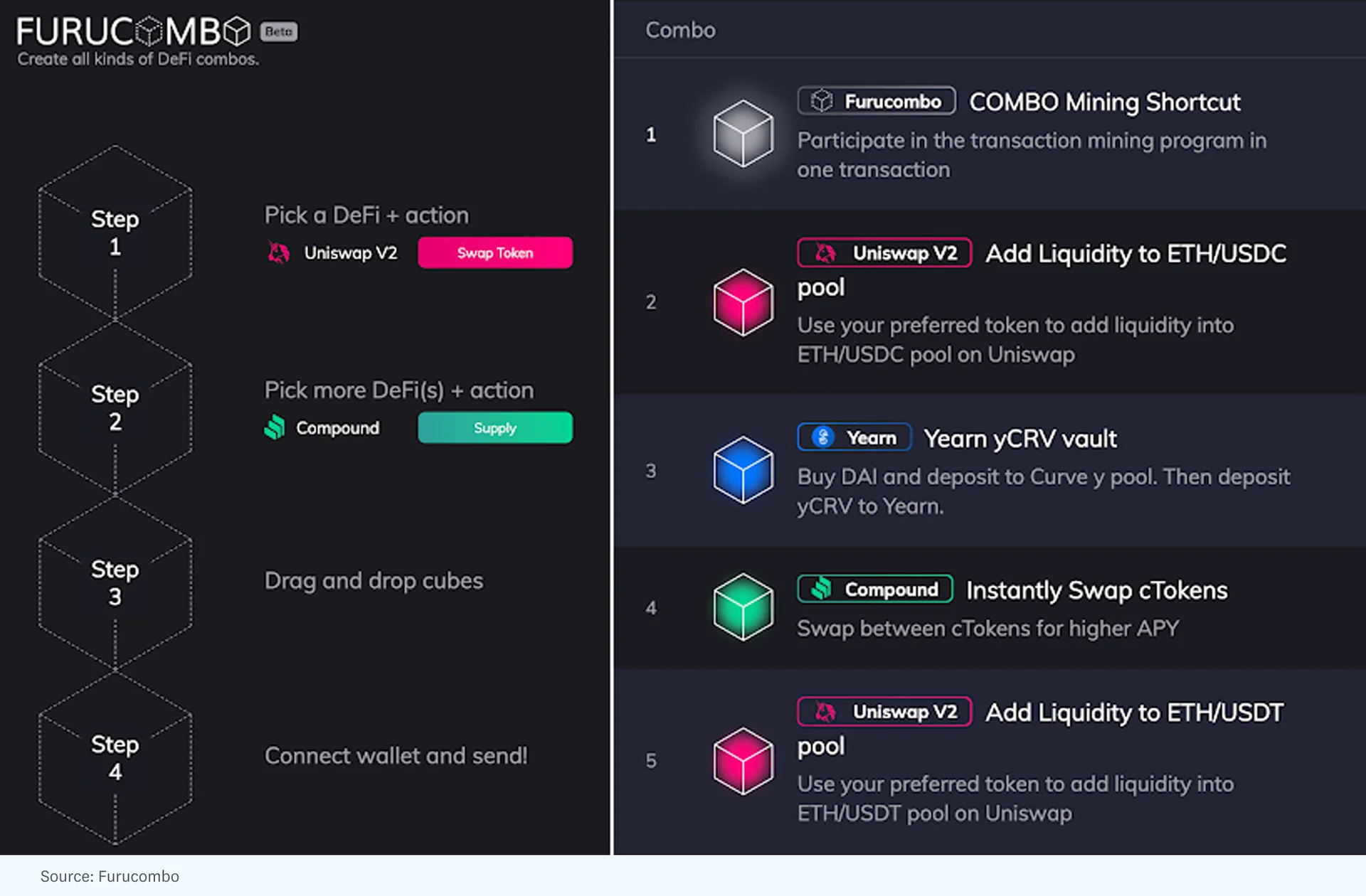
Composability inevitably produces more choice and better user experiences, because nothing stops someone from taking an existing idea and making it easier to use, or adapting it for new use cases. As more of the underlying technology is hidden away, attention will move toward what people can do with their money, rather than the inefficiency that characterizes much of the traditional finance world.
So what does composability really mean for builders and developers?
There are many possibilities, most of which will only be revealed by people experimenting, but some examples of what it makes possible for builders include:
Developers can launch their own projects and communities without needing to build everything from the ground up, because smart contract platforms like Ethereum are huge, open sandboxes for creating systems that can reach a built-in global audience. This is a major reason for the fast pace of innovation in crypto, allowing small teams to quickly get their own projects off the ground. For instance, a new video game maker could easily give users the ability to trade in-game items by connecting a decentralized exchange protocol instead of having to create a new marketplace from scratch.
Non-crypto businesses can gain efficiency and added functionality by plugging into open ecosystems like Ethereum — much as the API economy allowed companies of all kinds, including mom-and-pop shops and small businesses, to access data and capabilities they otherwise would not have been able to reach. A tech example is Reddit’s trial of Community Points, tokens that reward users for posting high-quality content and can be redeemed for unique items inside the community. Reddit intends to launch Community Points as ERC-20 tokens, which would allow them to work in existing wallets and applications on Ethereum. This opens up many more functions for Community Points that Reddit does not need to create itself. Even if it is not a crypto company, it can still give users the benefits of crypto applications, such as Redditors using decentralized exchanges on Ethereum to trade their points for other tokens. That would give them liquidity for their points from the outset. Also, once connected to the Ethereum ecosystem, anyone can include Community Points in their own project to build on them and create additional use cases.
Developers can take concepts from a wide range of industries, including tech, finance, gaming, and art, and apply them, which leads to a deeper grasp of each, new ways of thinking, and new uses for people. For instance, by bringing DeFi elements into gaming, we may better understand incentives and marketplaces; and by bringing gaming elements into DeFi, we may make finance more approachable and interesting to a wider audience than finance insiders. Communities that do not usually interact — because they spend time on different platforms or cannot interoperate — can also talk and exchange ideas this way, which leads to even more innovation. Smart contracts make this sharing of information more open, efficient, and trusted even among strangers.
There are many interesting examples of composability use cases in crypto today besides the DeFi example I already shared; some of these include:
Earning yield through “no-loss” lotteries
PoolTogether is a project that uses decentralized finance protocols to build “no-loss” lotteries. Users can buy tickets, and all funds collected from ticket sales are placed into a prize pool that earns yield from the decentralized finance protocols Compound and yEarn Vaults. Everyone gets their funds back, but one person wins all of the accumulated interest earned on the pooled money. No one loses the money they originally contributed, so it is a “no-loss” lottery. Anyone in the world with an Ethereum address can take part in the no-loss lottery, and anyone can create a no-loss lottery for any token, which makes taking part in these systems more accessible and safer.
NFTs as collateral
Non-fungible tokens (NFTs) have attracted a great deal of attention lately. Unlike the interchangeable, “fungible” tokens in the ERC-20 token standard, an NFT is a one-of-a-kind digital asset whose ownership is recorded on a blockchain. But even though the tokens themselves are not interchangeable, they still live in a composable ecosystem. That means that when they are issued on a smart contract platform, anyone can own or trade an NFT for any other asset that exists on the same platform.
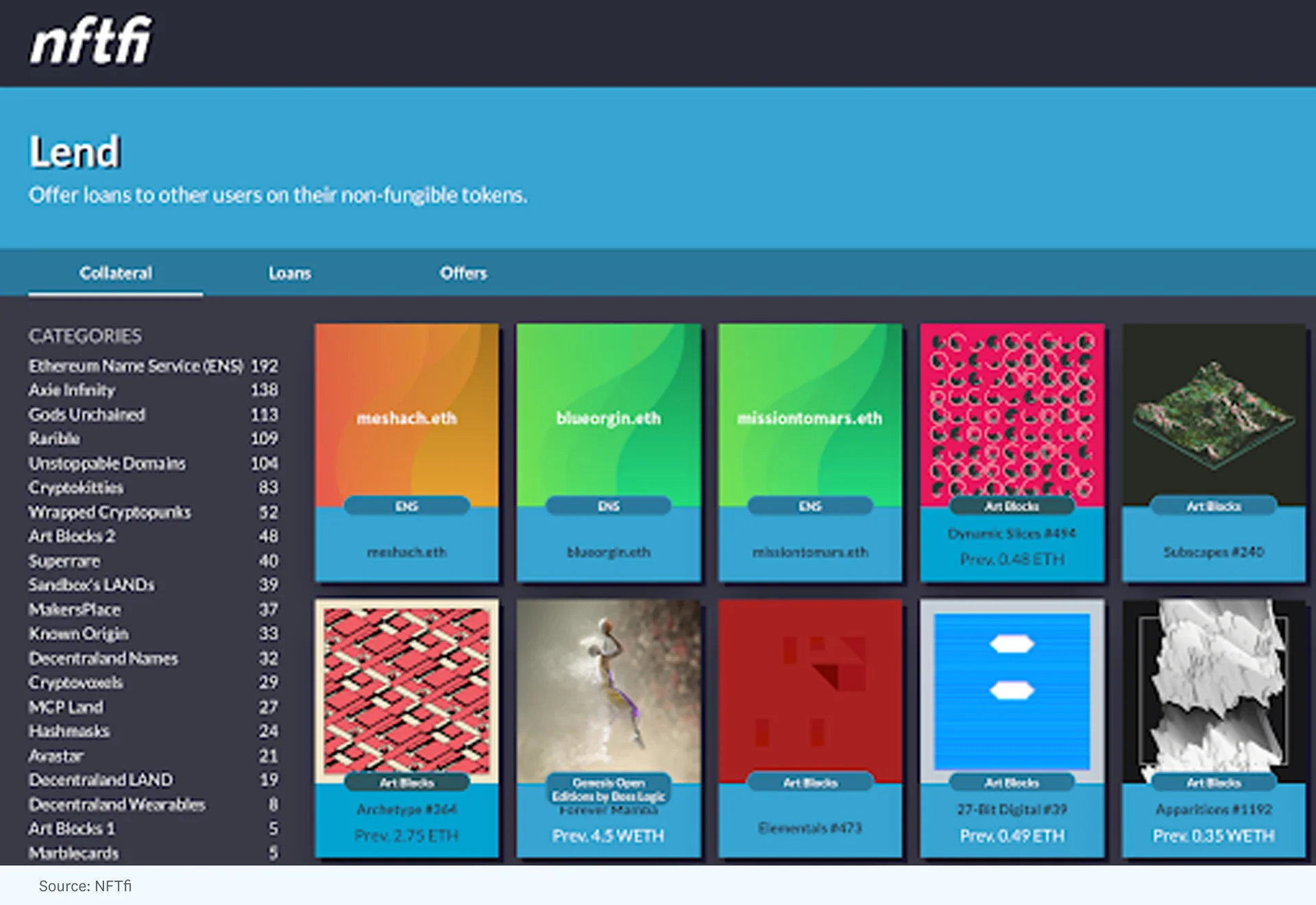
When “composed” (plugged into, combined) with decentralized finance building blocks, NFT activity can go far beyond trading and can include actions like using the NFT as collateral to take out a loan (e.g. NFTfi) or renting out or earning interest on the NFT (e.g. RenFT, Charged Particles).
Suppose you own a valuable piece of real estate in a virtual world like Decentraland or Cryptovoxels. You could actually borrow USDC against that asset to help fund a down payment on a house in real life. Or suppose you own a desirable skin in a video game — you could rent that item to other players for temporary use, much like you might rent a room in an Airbnb.
Publishing
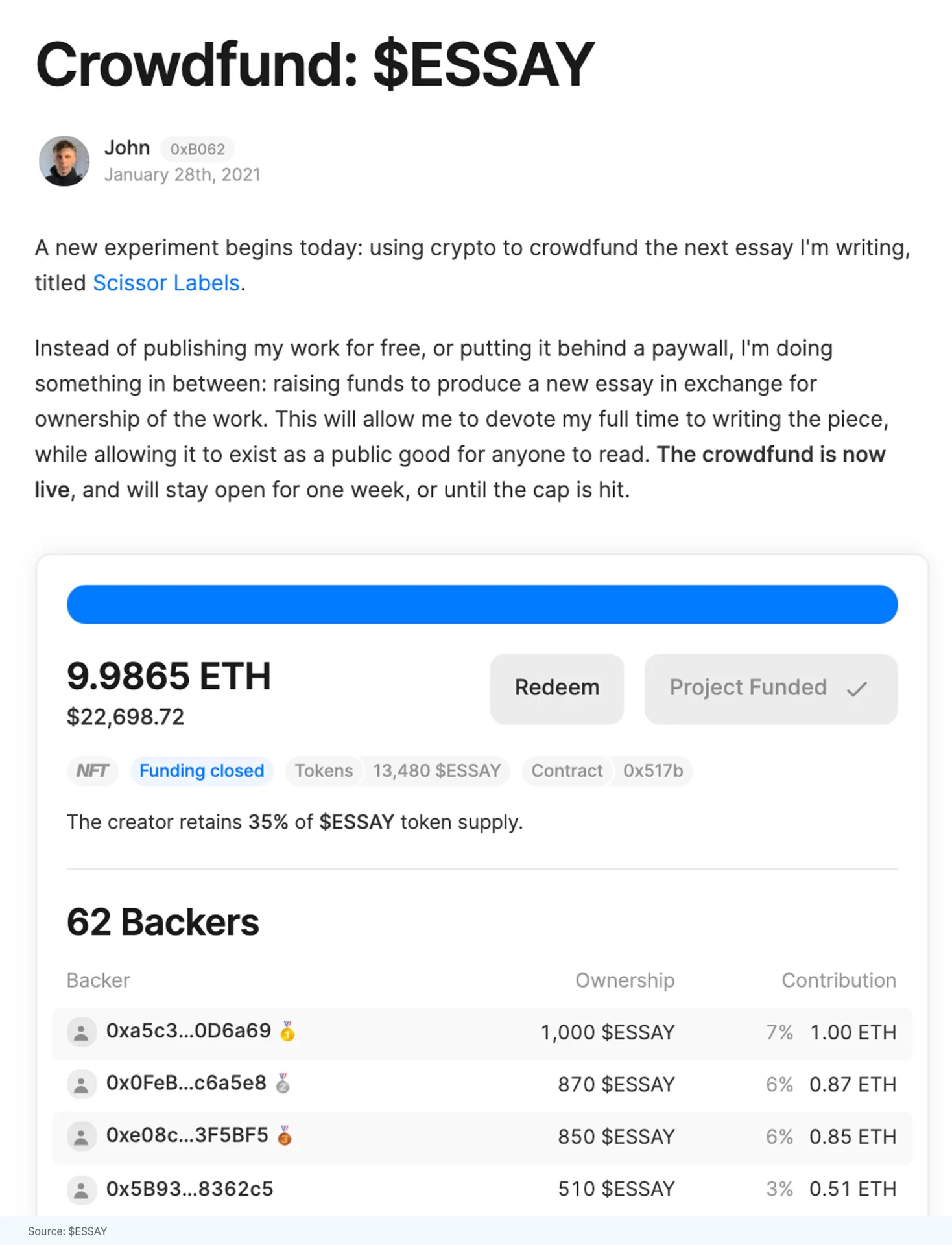
Another illustration of joining two applications together through the property of composability is the partnership between Mirror, a decentralized publishing platform, and Zora, a protocol for creating and exchanging NFTs. These projects have linked up to let Mirror writers turn any of their posts into an NFT, and add an auction for an NFT directly into their post. This in turn lets creators crowdfund works such as novels and blog posts or even research papers or similar artifacts, where buying the NFT helps finance the creator.
At times the NFT gives contributors the chance to receive a share of the proceeds if the NFT is resold. Imagine if early Kickstarter backers of Oculus, for example, could have gained as well when Oculus was sold to Facebook, because of their early faith and support. Recently $ESSAY by John Palmer was the first community-owned essay crowdfunded on Ethereum. The essay, released through Mirror, was minted as an NFT on Zora and backers are embedded in the essay forever. People contributed to the crowdfunding to back the writer and also to own a piece of history — the first community-owned essay. But in other cases, early contributors (alongside the creator) could also share a piece of that secondary value.
Flash loans
Flash loans are one of the most distinctive abilities made possible by crypto — there’s nothing comparable to flash loans in the traditional system. Flash loans let someone borrow funds and repay the loan within the same transaction; if it is not repaid in that same transaction, then the transaction fails.
This makes it possible for loans to be uncollateralized, which means these flash loans are available to anyone in the world no matter how much capital they have. Flash loans go very deep into crypto’s weeds, but they are used regularly in the DeFi space to capture arbitrage opportunities.
***
As crypto matures, we should expect these composable smart contract building blocks to begin being used beyond the crypto community. In time, developers will be able to add just one line of code to plug a full decentralized marketplace into a video game, or another line of code to let merchants in their ecommerce store earn interest on their balance. For institutions, composability places crypto at the center of revolutions in finance and other industries — reshaping industries at a fundamental level, much as the internet did. And for consumers, it will unlock an entirely new world of possibilities.
I’ve only scratched the surface of what could be possible in the future here. The next step is further experimentation. I’ve discussed the technology, but it’s human ingenuity that comes next.
Thanks to Will Warren for reviewing this post.
Disclosures: Linda Xie is a Managing Director of Scalar Capital Management, LLC, an investment manager focused on cryptoassets that holds ETH and Ethereum tokens. This post is not investment advice.