

Although COVID-19 vaccinations are moving ahead quickly in the U.S., pressure is mounting for a bolder approach to immunize the whole planet as fast as possible, especially in developing countries. The legal fight over this began last October, when India and South Africa put forward a WTO Trade-Related Aspects on IP Rights (TRIPS) proposal urging that intellectual property (IP) protections for COVID-19 vaccines be put on hold for the rest of the pandemic. Over 100 countries backed the measure, some because they worried about vaccine rollout speed at home and others as a protest against a global IP system they think works in favor of rich countries. This year, as second waves hit India and elsewhere, the White House cautiously supported a plan to suspend the vaccines’ intellectual property (IP) protections through the World Trade Organization (WTO).
But this has received pushback by many economists and, of course, the pharmaceutical industry, as not necessarily effective, and as counterproductive given the need to incentivize medical R&D in the future. Ultimately, what we need is more manufacturing firepower. The U.S. can best unleash it by coordinating a global technology transfer by purchasing intellectual property and by creating incentives for producers to share their know-how with the rest of the world. Additionally, the U.S. should use its considerable purchasing power to help alleviate supply shortages by paying much more on a per-dose level.
This is an urgent humanitarian, moral, and public health emergency that calls for an international response on the scale of the Marshall Plan. The longer the virus lingers, the greater the chance of a dangerous mutation that could set the pandemic back in motion. Put simply, we are not safe from COVID until everyone is safe. So we should remove any red tape or obstacles that may be holding back vaccine production and deployment worldwide. But what is the best way to do that? Here, I set out the case and the arguments for how we might reach a Marshall Plan-level ambition to address the global vaccine shortage.
The case for suspension of IP
The pro-suspension side is relatively straightforward. While wealthy countries have been able to receive quick access to the vaccine (indeed, near-miraculous progress compared to the normal vaccine creation timeline), deployment has been sluggish around the rest of the world and especially in developing nations:
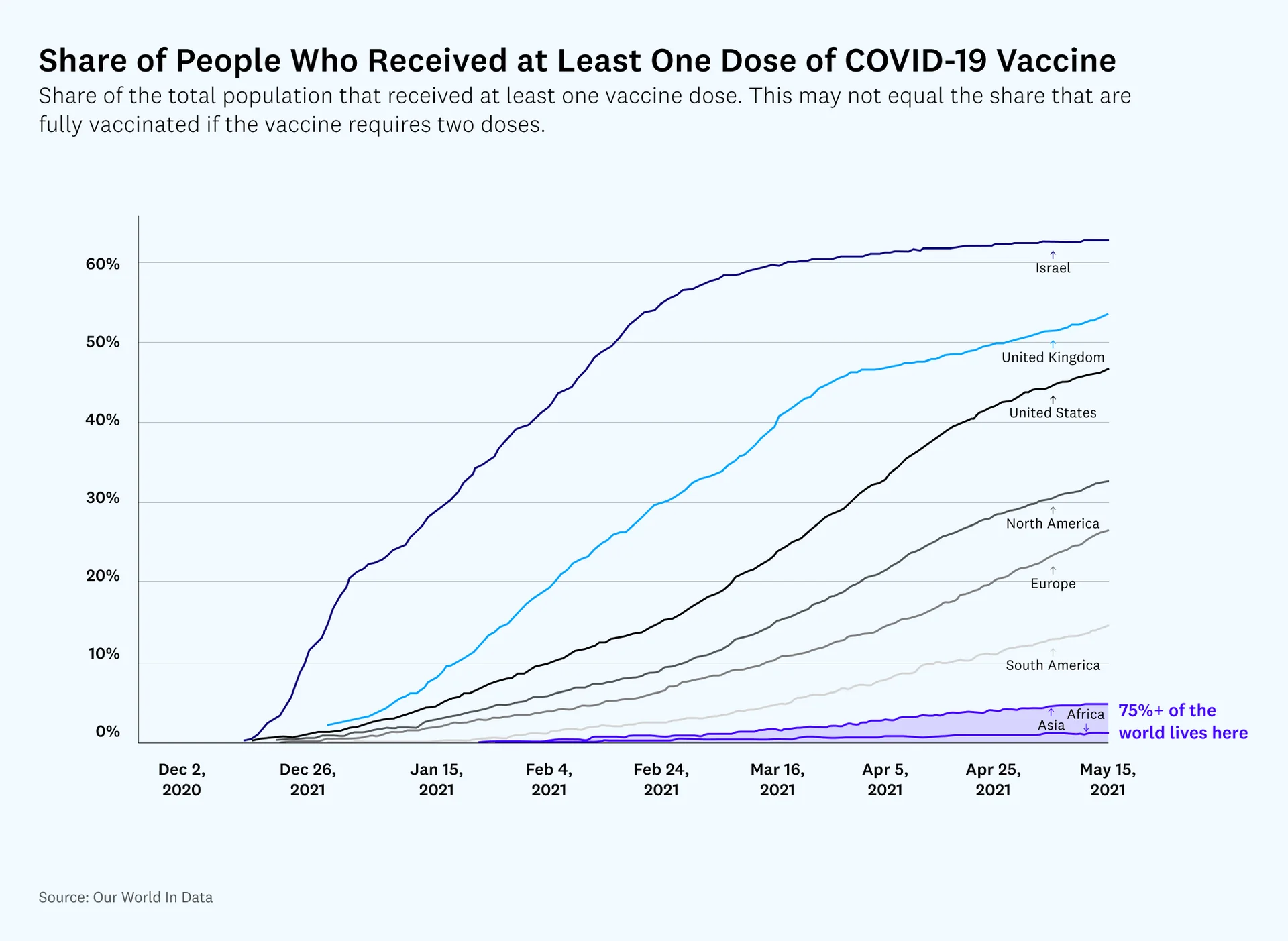
It is hard to predict vaccine production schedules precisely, but experts commonly estimate that many low-income countries will not be fully vaccinated until the end of 2022. Others are even less optimistic, projecting immunity as late as 2024. Either way, that is still a long way off, and plenty of time for new COVID variants to appear and punch holes in our defenses. Even though we can always develop new vaccines or boosters to respond to new variants, the supply map will likely remain tilted toward rich countries. A situation in which rich countries keep getting vaccines (and boosters) first, while failing to ramp up production enough to cover poorer nations in time to stop mutations, is both plainly unjust and self-defeating. We are racing against the clock, and the costs of speeding global vaccine production are in the billions, while the gains from reaching global immunity a few months sooner are in the trillions.
A range of organizations and pharmaceutical companies have responded by creating COVAX (for “COVID Vaccine Access”), a pool of pledged vaccines designed specifically to help immunize low-income countries. (It is co-led by the Coalition for Epidemic Preparedness Innovations, the vaccine alliance Gavi, and the World Health Organization). This is a crucial program and the U.S. government’s recent $4 billion investment in it helps, but its scale is nowhere near what is required. The program’s goal is to provide vaccines so participating counties can vaccinate only 20% of their population. COVAX also recently faced a major setback after news that the Serum Institute of India, intended to be one of COVAX’s biggest vaccine producers, will not be able to restart exports until the end of the year because of the current crisis in India.
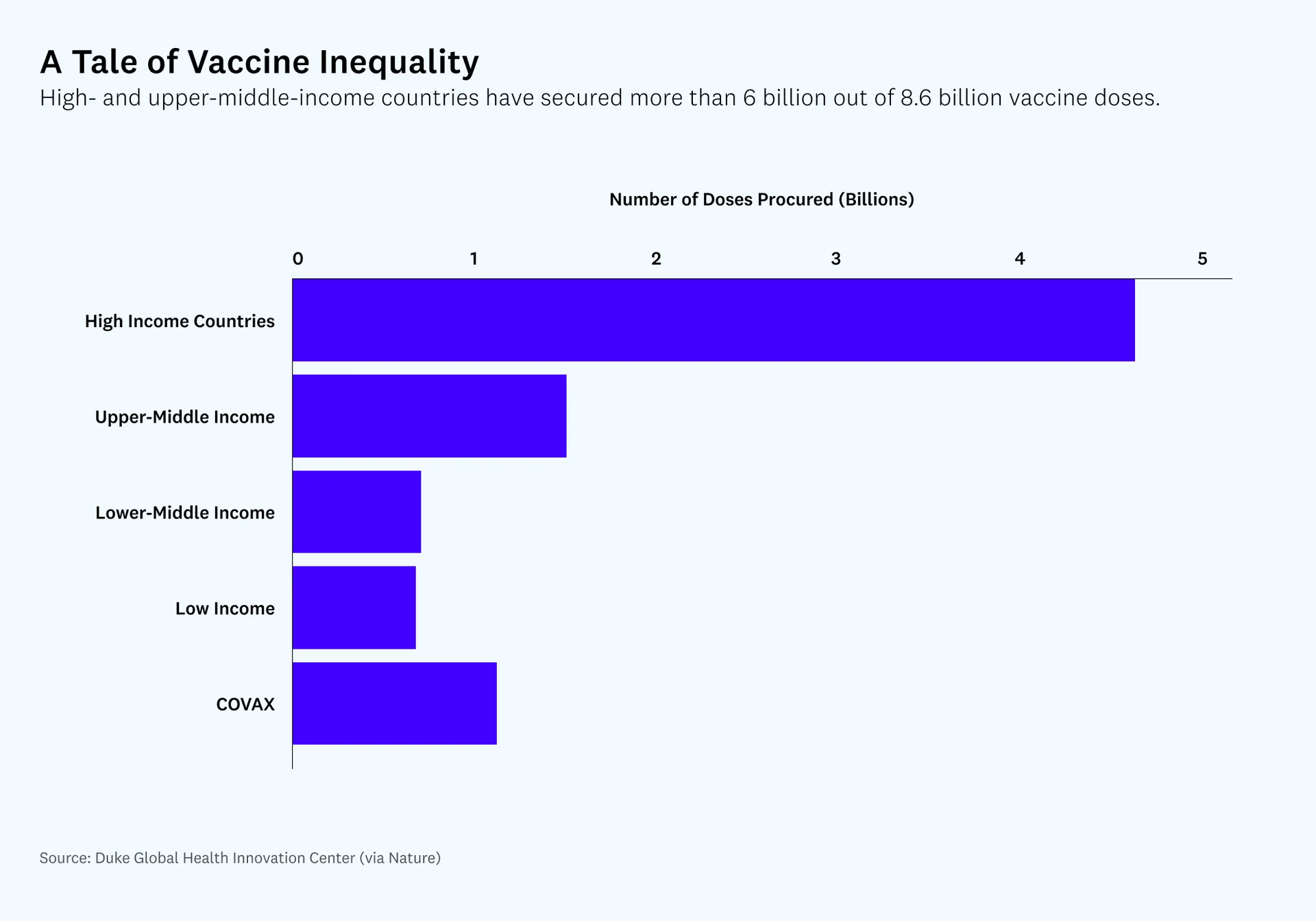
In the end, we need to produce more vaccines in less time. One route is to make it easier for rival vaccine manufacturers to join in. More specifically, if there is unused vaccine production capacity (a disputed point, discussed later), we could go all out by suspending intellectual property protections. That should help accelerate vaccination efforts around the globe, and if that spare manufacturing capacity is in the Global South, it could help make future rounds of booster shots more fairly distributed given current producers’ apparent home-market bias.
The bigger question here is around self-sufficiency and national sovereignty in vaccine and pharmaceutical production.
Much of this discussion is shaped by the HIV/AIDS epidemic from the 1990s into the early 2000s, which devastated countries across Africa while the U.S. and other wealthy nations were able to reduce the harm with antiretroviral treatments. A mix of strict IP enforcement, insufficient foreign aid, and weak manufacturing capacity caused millions of deaths that may have been avoidable. In 2003, the U.S. launched PEPFAR, a highly effective public health initiative that made major progress in the crisis by sharing medicine and technical assistance with partner countries. To address fears that IP problems would cripple future public health responses, the WTO adopted the “Doha Declaration”, which set rules for compulsory licensing of medical technology during a public health emergency (though advocates say it does not go far enough for this situation). Given that history, developing nations are understandably wary of the idea that they should simply wait for Western pharmaceutical companies to make enough vaccines for them and would prefer to build their own manufacturing capacity.
Finally, advocates for suspension typically point out that many of the pharmaceutical companies received R&D funding from the federal government and/or large market commitments through the public-private initiative Operation Warp Speed, which guaranteed them some baseline level of confidence and profitability. Furthermore, the mRNA vaccines themselves are partially the result of decades of public investment in science, and the National Institutes of Health may own some parts of the relevant IP in the case of Moderna.
If you think pharma R&D mostly rides on the coattails of basic science, then this is a fairly straightforward case for suspending the IP.
The case against suspension of vaccine IP
On the anti-suspension side, one argument is that these new vaccines (especially the new mRNA vaccines) required billions of dollars and decades of uncertain private investment to reach the technical breakthroughs that have given us a chance to end this pandemic. Basic science work funded by the government helped a lot and certainly established a strong foundation for much of this work. But enterprising individuals with a profit motive played just as large a role. Katalin Karikó, the Hungarian scientist who helped pioneer mRNA vaccines spent most of the 1990s receiving rejection letters for government grants, and ultimately turned to the private sector where she co-founded her own company in 2006.
But even if every bit of basic vaccine research had been paid for by the federal government, the case for suspension would still raise incentive problems. Turning scientific breakthroughs into working products and selling them is essential, and it costs a lot of money. There is an entire chain of hard engineering, logistics, and optimization problems that must be solved when moving a complex biological product like a vaccine from the lab into real-world use. They do not simply emerge fully formed from a peer-reviewed scientific journal article.
It’s also not an accident that the countries with the most well-developed biotechnology and pharmaceutical clusters are the ones that produced these wonders.
Where most public health interventions failed miserably, the pharmaceutical companies worked around the clock to develop, test, and roll out a whole new genre of vaccine in record-breaking time and at high private cost. Intellectual property helps protect the whole investment pipeline (including the time and cost of failures), making it worth it in the first place; expropriating IP places future R&D investments under a great shadow.
And this will not be the last global pandemic we face. We were fortunate that COVID-19 has a relatively low fatality rate and that we could so easily target its spike protein, which is where most vaccines focused their efforts. In an unlucky Earth Two, these companies spent billions of dollars on a vaccine that failed and then lost billions more in wasted vaccine development and early preparation.
To make sure our biology and technology clusters keep investing in R&D for new vaccine and therapeutic methods in the future, we need to align incentives and make it profitable for them to pour billions into the problem… years before they may ever show up. In addition, concentrating on intellectual property misses the fact that the formal information that can be written into a patent application is not very useful by itself. Moderna actually announced in October that it would not enforce the IP rights tied to its COVID vaccine. The underlying spike-encoding sequence had already been published online by Stanford researchers. Yet no new Moderna knock-offs have appeared since that October announcement. Why? Because the company has not shared any details about the manufacturing or design process, which suggests that underlying technical expertise and production-process knowledge — the know-how — are just as important, if not more so.
To make the vaccine, Rachel Silverman of the Center for Global Development notes, manufacturers need access “to the developer’s ‘soft’ IP — the proprietary recipe, cell lines, manufacturing processes and so forth.” Usually, this kind of soft IP is passed to the new firm through a technology transfer process that takes place as part of a licensing agreement. Process specialists from the licensing company will sometimes go to the licensee’s facilities and supervise operations for the first few batches to help communicate the kind of tacit knowledge that is hard to transfer unless you have physically done the task yourself. In return, the licensing company receives a share of the revenue from each dose, usually 5-10%. And even when these licensing deals are in place, it is easy for the new firm to make serious mistakes because the margin for error is razor-thin.
All of this means that even if the TRIPS proposal were adopted on its own this month when the WTO meets, it would probably bring little noticeable change in vaccine production unless it were paired with major incentives for manufacturers to take part in a more formal technology transfer process.
The open question: Is there latent capacity?
In some sense, the easiest thing to do would be to plow many billions more into programs like COVAX, which reserves vaccine doses for developing nations. That would be good, but it just extends the length of vaccine production rather than increases the rate of production.
Maybe we could specifically help fund existing vaccine makers so they can expand their capacity even further? That would also be worthwhile. After all, from a social welfare point of view, it is hard to imagine having too much vaccine capacity. But even then, constructing new factories and equipment can take months or years, and we need something that works faster. This approach also keeps vaccine production concentrated in incumbent firms and in wealthy countries, which weakens the self-sufficiency concern that helped spark the debate in the first place.
The main benefit of some form of IP suspension is that it unlocks manufacturing capacity that already exists but is not being used. How much unused capacity is there?
For the mRNA vaccines from Pfizer and Moderna, production bottlenecks seem quite severe. A strong piece by Derek Lowe explains how specialized the supply chains and manufacturing steps for mRNA vaccines are, especially their use of lipid nanoparticles. Lowe says that only a few firms worldwide could have stepped in and begun making mRNA vaccines right away, and it is likely that all of them already have.
Still, that may be too pessimistic about our ability to bring in new manufacturers over a somewhat longer timeframe. With enough investment and learning by doing, production bottlenecks will gradually loosen. After all, nobody was making mRNA vaccines before the crisis, yet we have clearly been able to build new capacity over time. And there is massive investment right now to expand production of scarce raw materials. We are watching supply-chain maturity through fire.
It seems more likely, however, that there is unused capacity for the more conventional adenoviral vector vaccines such as Johnson & Johnson and AstraZeneca, or the protein subunit vaccines such as Novavax. Because these older vaccine approaches have been around longer, more vaccine manufacturers across the world can produce them than can produce mRNA vaccines today. Their supply chains are also more developed, which means a sudden jump in demand can be handled better.
Meanwhile, current and recent voluntary licensing deals appear to be leaving out willing manufacturers who want to join in. The Canadian company Biolyse Pharma, for instance, can make about 50 million vaccines a year, and has spent months trying to secure a license but has gotten no offers. Based on the machinery they already have on site, they think they could manufacture the Johnson & Johnson vaccine in as little as 3-6 months if they had access to the underlying IP. In an unusual move, they have already signed a contract with the government of Bolivia to make at least 15 million vaccines if the WTO waiver takes effect.
The managing director of Bangladesh-based Incepta Pharmaceuticals has said they have the capacity to produce 350 million protein subunit vaccines, like those used by Novavax, as well as the capacity to fill and finish 500 million vaccine doses (taking the bulk vaccine containers and moving them into final vials). As the company’s chairman told the Wall Street Journal, “We have a tremendous facility here lying idle. It is very frustrating.” They are willing to pay IP fees, but have not heard back from U.S. manufacturers. Similarly, Teva Pharmaceutical Industries in Israel recently said that they have stopped looking for a vaccine partnership because all the main manufacturers were basically booked up.
What these examples, and others like them, show is that there is physical manufacturing capacity that could plausibly be activated, especially for adenoviral or subunit vaccines. But the bottleneck is whether and/or whether the main vaccine makers are willing and able to take on new voluntary licensing deals with outside partners.
There may also be capacity that is not exactly unused, but is not being used very well. If the chance arose, we could see some vaccine manufacturers now running vaccine trials abandon their research trials and concentrate on producing known and already approved vaccines. Sanofi and GlaxoSmithKline, for example, started a phase 2 clinical trial in February that, if all goes well, will only be ready in Q4 of this year. There is no particular reason to believe this new vaccine will be better than the existing ones. It is more likely that they are pursuing this path because they want proprietary IP to offer. Although both Sanofi and GSK have signed agreements to help manufacture other vaccines in the meantime, these are fairly narrow and the companies are probably preserving capacity so they can quickly retool if their own trials look promising. But it would certainly be more socially valuable if we could push them to abandon these trials and fully scale up production of proven vaccines now.
The case for patent buyouts
The economist Michael Kremer wrote a paper in 1997 setting out the idea of using patent buyouts as a way to keep strong incentives for innovation while still bringing crucial information into the public domain as quickly as possible. In essence, a government could offer to pay the present value of the expected future revenue stream that would come from the temporary monopoly a patent sometimes provides. While the patent holder should be indifferent to the result, the general public could gain more value from having unrestricted access to the information and the ability to modify it without permission before the patent expired. In these situations, a patent buyout can clearly improve outcomes for everyone, and Kremer notes that pharmaceuticals may be a particularly suitable case.
Patent buyouts maximize the number of players that can legally make vaccines while preserving strong incentives for future innovation. Of course, in this case it is only partly about intellectual property, and partly about the manufacturing know-how that must be transferred, which means we need a broader idea here — a more full-stack “technology buyout” that covers both the IP and the process knowledge transfer.
Basically, the U.S. government, or even a group of governments, could offer a lump-sum payment to the firm or firms that accept in order to make the scientific and production process as explicit as possible and then also make it publicly available. We could offer an additional payment for sharing hands-on technical expertise to help set up manufacturing operations, either at the level of a single factory or based on vaccine doses administered. A per-vaccine-dose-administered basis aligns incentives properly for the firm or firms sharing technology, maximizing their impact by transferring to partners that can actually get shots into arms as fast as possible and make sure they do a good job.
To put some rough numbers on this, the initial lump-sum payment to make the IP public would be in the range of $10-20 billion per firm, and the extra per-dose-administered prize would be around $0.50-$2. Assuming this program could administer vaccines for an additional 4 billion people (8 billion doses) across the developing world, we are talking in the range of $36-56 billion.
And we should overpay. In a situation like this, we should lean toward overcompensating, and risking some economic rents, rather than accidentally undercompensating and damaging the long-run incentives for innovation. The key is not to kill the goose that lays the golden egg. In any case, we should be willing to pay an order of magnitude more than $36 billion to definitively end COVID, so this program is a bargain under a wide range of possible cost assumptions. One estimate from a group of economists and public health officials puts the global monthly cost of the pandemic at about $1 trillion per month.
Payments for each vaccine dose administered may sound very close to the voluntary licensing agreements that manufacturers around the world have already signed. It is a closely related mechanism; commentators like Rachel Silverman (quoted above) have in fact suggested that the best path forward may be to have the federal government use its political leverage to pressure U.S. pharmaceutical companies to accept more licensing deals with manufacturers in developing countries. Which raises the question: why bother with the additional lump-sum buyout to make the information public? Shouldn’t we focus all our efforts on encouraging licensing?
I would distinguish the technology buyout I am proposing from voluntary licensing on a few dimensions:
- First, buying out the IP may be a decisive factor in persuading large, established manufacturers like GSK and Sanofi to drop their own duplicate vaccine trials and go full steam into producing existing vaccines, because it removes any competitive disadvantage in paying the licensing fee. Second, because these voluntary licensing deals are usually set as a percentage of the dose cost, they create an incentive for licensing firms to favor deals that charge a higher price to the local governments buying them, where that may not be best. If the U.S. government is instead paying for each dose administered in these developing nations, then the transferring firm or firms should be neutral about the sale price. Third, this structure lets the federal government selectively overpay on a per-dose basis if the U.S. firm is truly helping a developing country jumpstart new manufacturing capacity rather than helping an existing manufacturer retool. Fourth, individual countries and foreign manufacturers know their own capacity better than U.S. government officials or even U.S. firms do, so opening up the IP could help them find latent manufacturing opportunities more effectively than a top-down approach. Fifth, opening up the IP at least gives every nation the ability to try to make its own vaccine if it wants, which helps address self-sufficiency concerns.
A buyout also offers several key advantages over IP suspension, even setting aside the incentive issues:
- First, speed. Even if the U.S. reverses course and backs the WTO proposal, it will take quite a lot of time to negotiate and bring all the other countries to the table. Remember, the proposal must be supported unanimously, so there is no assurance that all the other opposed nations will reverse course just because the U.S. did. A buyout, by contrast, can be done unilaterally by the U.S. at least for the U.S.-based vaccine firms. Second, in the unfortunate event that a new variant requires a booster shot, a buyout preserves the incentive to quickly create a solution so that the new booster shot can also be bought out. Under the WTO petition, the IP suspension would stay in effect for the duration of the crisis, which would reduce the urgency and resources pharma companies are willing to devote to the problem, given fewer chances to recoup their costs.
While a technology buyout would help speed the sharing of technical know-how with the world, it does not necessarily solve the supply chain bottlenecks for critical ingredients. These shortages range from ingredients as ordinary as plastic bags to as unusual as Chilean tree bark. To help deal with these shortages, the single best thing the U.S. could do is offer to pay much higher prices for each vaccine dose produced, since that would let the higher price signal move through the supply chain and give manufacturers more financial room to pay suppliers higher prices for ingredients.
Building for the long term
The question is whether a technology buyout would be more appropriate for the mRNA vaccines from Moderna and Pfizer, or for a more conventional vaccine such as Johnson & Johnson. To answer that, we need to ask a more basic question: what exactly are we trying to accomplish here? There is probably more near-term capacity to expand adenoviral vector vaccines, so if the goal is simply to vaccinate the world against COVID-19 as fast as humanly possible, then a technology buyout for the J&J vaccine likely makes the most sense.
But if we take a broader view and use this crisis as a chance to build new, adaptable vaccine manufacturing capacity around the globe for the future, then mRNA vaccines have a range of strengths that make them the better long-run choice. (Naturally, we can try to do both and capture the distinct benefits of each vaccine type, but it is helpful to have a longer-term guiding objective to work toward.) I would make a few arguments for the future-focused strategy:
- First, it is a serious risk to hope the adenoviral vector vaccines remain effective long enough against possible variants. As mentioned earlier, the mRNA vaccines seem to be more robust against the recent COVID variants and are much easier to alter if a new variant emerges that our current vaccines cannot address. Second, mRNA vaccines could open the door to a much wider set of medical advances, including possible vaccines for multiple sclerosis, certain cancers, malaria, and HIV. Taken together, that suggests mRNA is likely to be a more general-purpose vaccine platform and makes it nearly impossible to picture having too much capacity at this stage. Third, apart from supply-chain concerns, new mRNA plants are actually far less expensive to construct and run than conventional vaccine factories. From an article in the Journal of Advanced Manufacturing and Processing: “Based on our techno-economic assessment, the RNA vaccine production process can be two to three orders of magnitude smaller than conventional vaccine production processes in terms of facility scale, and can be constructed in less than half the time with 1/20 to 1/35 of the upfront capital investment… Due to its small scale, the RNA vaccine drug substance production process could be placed in a small part of an existing conventional vaccine facility, for example in a room, and still produce more doses worth of drug substance than the entire original conventional vaccine production facility.” Fourth, we should see this as a chance to build goodwill in the developing world. The total U.S. foreign aid budget was around $40 billion in 2019, which is right in the range of what we are suggesting here. I am inclined to think that sharing new, highly effective technology across the world during this unusual crisis would bring a much greater diplomatic return than the projects we typically get at this level of funding. We have already seen China and Russia try to use their vaccine exports for diplomatic ends. Much like the Belt and Road initiative, which has helped China gain a foothold across Africa, the U.S. would be contributing technological infrastructure investment.
In the end, it is in the long-term interest of all humanity to develop a coordinated ability to respond to new diseases worldwide. Viruses do not recognize national borders, and the danger of a global pandemic has only grown over time as our world has become more interconnected. This capability by its nature must be spread across the world if it is to work at maximum effectiveness, so we might as well begin building it now. The ability to quickly develop and distribute new mRNA vaccines could help us remove much of the long-term threat from bioweapons and natural pandemics. That is the real goal worth striving for here.
* * *
The U.S. should be trying not just to vaccinate the whole world, but to show the world how to produce vaccines. As the saying goes: Give the world vaccines and you stop one pandemic; teach the world how to manufacture vaccines and you stop pandemics forever.