
What does it mean to be productive? At the start of the pandemic, when many workers shifted remote, some managers were tempted to begin tallying things — whether hours, items, or other things. But they’re about 100 years and two industrial revolutions too late: In the mechanical and electrical revolutions, productivity really was a measure of output, and it helped propel the economy. We made cars, machines, widgets by measuring things successfully this way.
But most economies are far past that kind of measurement mindset now, with companies and even national economies (measured by GDP) depending on knowledge work and efficiencies from digital technologies to run all our systems, whether healthcare and banking or retail. It’s not only a mindset of efficiency, though, but also one of abundance. Take photography: Doing so used to be relatively costly and more scarce (film, not bits), so the number of pictures taken and printed could count as a productivity measure. But when everyone can take pro-grade photos on their phones, see them right away, and keep them for almost nothing, better productivity is not about taking more pictures. It’s more about the opportunities that open up from having the enormous number of pictures — for example, medicine using photos to diagnose cancer earlier (via machine learning).
And yet, if we were to measure that camera productivity by output, it wouldn’t tell us anything about consumer well-being let alone GDP. The economist Hal Varian has been trumpeting the horn about this so-called “productivity paradox” for years, as have others who are at the forefront of modern economic research and value creation. But now that our baselines for remote, cloud-based, distributed work have accelerated, the question of how we value work (and the systems powering this work) means we must shift how we measure and think about productivity, finally going beyond the relics of the past.
If leaders and managers want to be able to make decisions or understand what is happening in their systems (or among their workers), they have to use better measures. Measures matter: they shape what we pay attention to and how we act. But when you use only one or even a few activity-based metrics about what workers do — lines of code, number of commits, number of private repositories — you don’t actually know what’s happening; it’s not enough to make an informed decision or move the needle.
To understand, reason about, and improve complex multidimensional work and systems, we must have multidimensional measures.
A framework for measuring workplace productivity
Even the most advanced AI systems require humans in the loop, drawing on their creativity, ingenuity, or just their willingness to classify pictures for hours (so we can have better search results or predictive algorithms). If we ignore the well-being of the people running these systems, fatigue and burnout result. An overly simplistic or reductionist take — where leaders measure only one dimension — will break the system. And when things fail in complex systems, they often fail in messy, difficult, spectacular ways.
Workplace surveys or assessments aren’t enough; they don’t tell us how to improve. The same is true for telemetry: Recording or transmitting from the tools we use can tell us how fast teams are submitting code, or how fast (or slow) a test suite is running. But in isolation, this data can’t tell us what is actually slowing down our teams, help us understand our development environment, or what factors would allow us to improve test execution and run times.
A more holistic framework for productivity — one that shows a fuller picture — must include several dimensions, including satisfaction and well-being, performance, activity, communication and collaboration, and efficiency and flow. It can be summed up by the acronym SPACE. And while I focus on developer and IT productivity here (something I’ve spent over a decade measuring across organizations of all types), the reality is that developer work is creative work, so much of this framework can also be applied beyond developers.
Satisfaction and well-being captures how fulfilled and happy people are with their work or the systems they use to do their work, and how that work affects them. These signals are intrinsically tied into how we typically think of productivity, with several studies showing that satisfaction is correlated with output, and may be a leading indicator for increases in work — such as output and innovation — and for decreases, such as burnout and its impacts on work. But these measures are about much more than how happy a person is; satisfaction and well-being are about how people and teams work together to create value. It’s also about how well we can work with our systems, in the context of technology. For example, creating a superior developer experience allows companies to develop and deliver software faster, whether that’s new features to customers and end users, critical digital infrastructure, or patching security vulnerabilities in systems.
Performance measures outcomes — how well a system or process performs — and includes metrics like quality, speed, and impact. These measures are often left out of how we think about productivity. But if we want to use data to make decisions or improve, performance is essential to understanding if our work efforts had the desired, intended effect.
Activity measures a count of things that are done. These are the most common productivity measures, because they’re the most familiar due to their historical familiarity, and are also the most easily automated. However, it’s almost impossible to fully capture the multidimensional and complex nature of work based on the number of things submitted/done/clicked. Our systems are rife with blind spots and inconsistencies, and therefore not even that good at these easy, automated counts.
Communication and collaboration is about how people and teams work together, and it may be the most overlooked dimension in the framework. (Relatedly, pioneering workplace anthropologist Lucy Suchman’s early studies of “invisible work” also highlighted the importance of unearthing underlying work practice, because the ways people work and how that work supports team productivity are not always apparent.) Talking and connections are often not “counted” in traditional measures of productivity. Communication and collaboration also needs to include system documentation that allows for easy use and sharing, as well as modular system design and searchability, which enables developers to find, share, and reuse code.
Efficiency and flow capture progress in work; this can include measures of time or speed through a system, number of handoffs, interruptions, and one’s ability to stay “in the flow”. Efficiency is also very related to all the other dimensions outlined above: Better flow is correlated with increased satisfaction, for instance. Balancing efficiency becomes critical when we consider the other factors. For example, optimizing for individual flow by reducing interruptions and maximizing coding time can block others’ work and interrupt overall team flow by making others wait for code or design reviews. Or, maximizing flow through a system could be taken to an extreme, with teams opting to push all code to production by default, regardless of testing or defects found, increasing the number of errors and bugs found by customers.
All of the above metrics should be tailored and adjusted according to changing team/ organizational priorities or needs. Simply adopting the same standard set of metrics may be handy for a baseline, but if your data doesn’t help you make critical decisions — or if it focuses your developers’ attention on the wrong things, shifting their behavior the wrong way — these measures, just like any others, can work against you.
Remote development, collaboration, and productivity
How did knowledge workers (again, primarily developers) do on these measures during the pandemic? COVID-19 and work-from-home lockdowns offered an unprecedented chance to measure how people work in highly uncertain conditions, as well as remote ones. For instance, research I led with GitHub last year showed that teams worked longer hours and pushed more code compared to the year before, across four time zones around the world: UK Time Zone, US Eastern Time Zone, US Pacific Time Zone, and Japan Standard Time Zone.
Using “push window” — the time between first and last push to a developer’s main branch or repository — as a rough approximation of time spent working, we saw developers across all time zones working longer compared to the previous year when lockdown started, with many developers working 10-20 minutes more per day, and then jumping to 60-80 minutes more per day during June and July 2020.
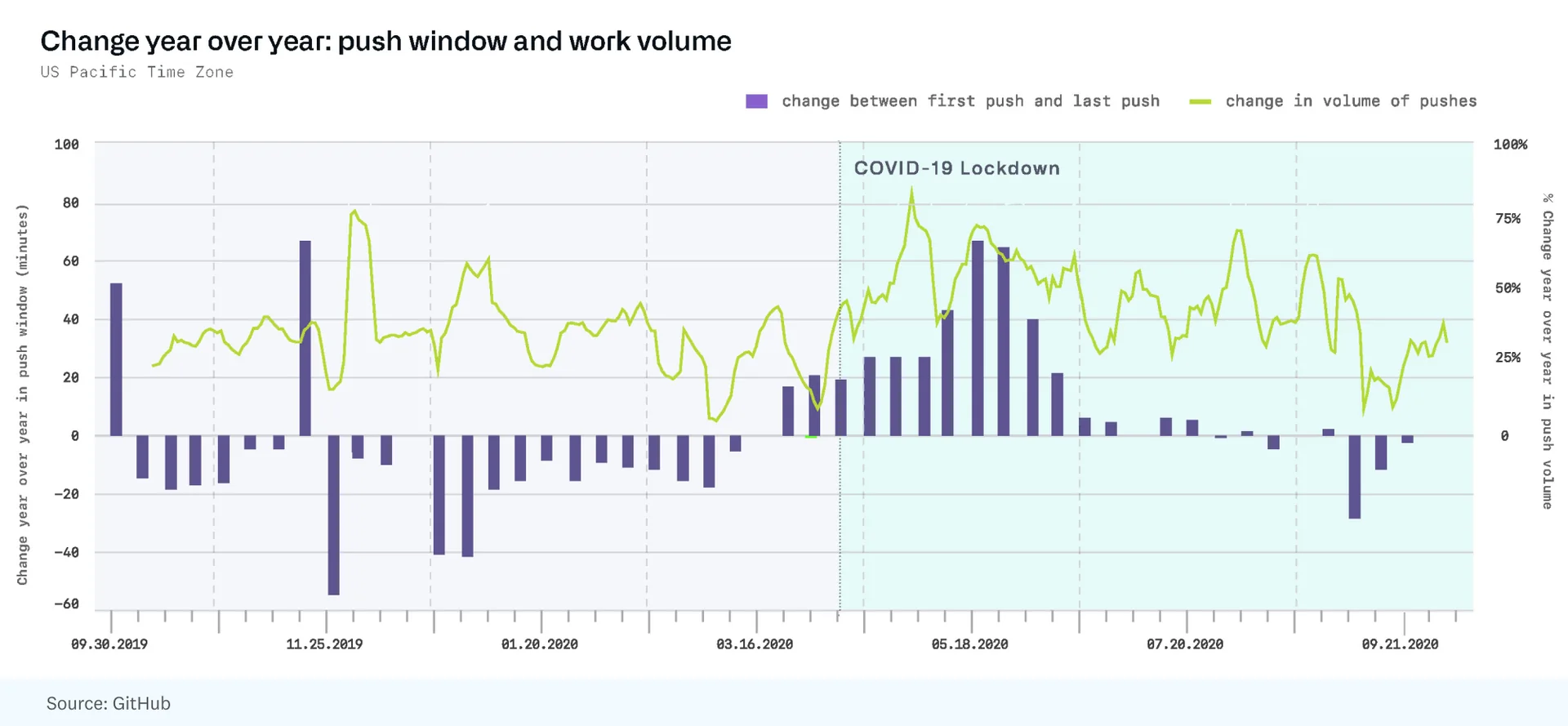
In other words: people were working more as the pandemic went on.
To see if this was just developers spreading their work out while they adjusted to new work routines and schedules, we looked at how much work they did, using the number of pushes as a rough proxy. Again, we saw largely consistent work compared to the previous year across the time zones we studied, with some showing jumps until it leveled out — but we didn’t observe any notable decreases.
But this work doesn’t happen in isolation; development is about collaboration. And even in a year with our routines upended, developers collaborated more, and faster. One of the major ways that developers collaborate is through pull requests. Merging a pull request involves a group of developers on a project reviewing changes, discussing the code, and sometimes following up with additional commits; finally, the pull request is merged. To proxy this collaborative process, we measured how long it took teams to merge pull requests and compared it to the previous year.
Open source teams, who have been used to working and collaborating remotely, started merging code 3.5 hours faster in April as lockdowns started happening, and throughout the rest of 2020 ranged from 1-7 hours faster compared to the year before. Even teams working in more traditional workplace settings saw faster collaboration, with initial improvements to merge time in April jumping about one hour, then ranging from two hours slower to five hours faster, with most time periods showing improvement compared to the year before.
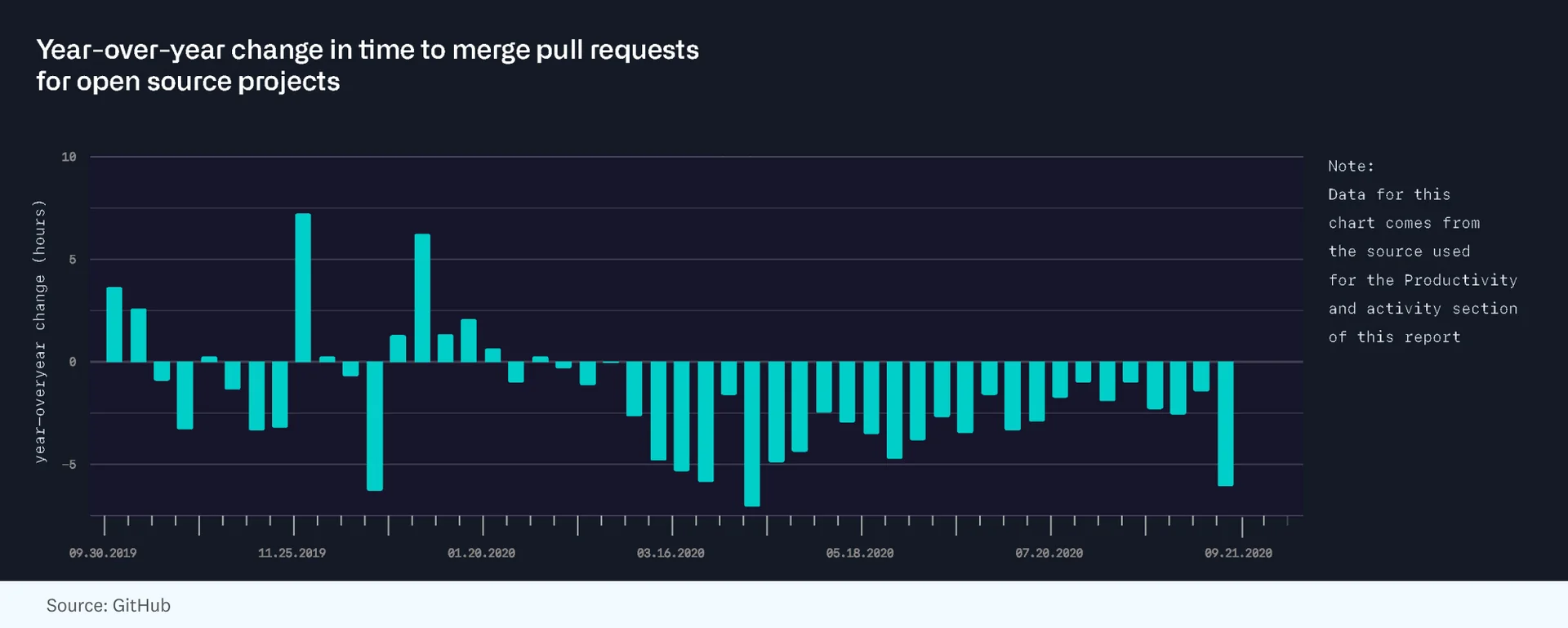
At a quick glance, one could walk away from this data and declare “productivity is up!”
However, we also know that continued work under pressure isn’t sustainable. Recent findings from the 2021 Work Trend Index — based on a Microsoft study of more than 30000 people in 31 countries and on an analysis of trillions of productivity and labor signals across Microsoft 365 and LinkedIn — highlighted that “high productivity is masking an exhausted workforce”. The report also noted that over 40% of the global workforce is considering leaving their employer this year.
If we don’t take seriously the need to rethink how we measure — and thus more effectively aim remedies at — our productivity problem, we won’t have a productivity problem left to worry about.
Remote work has shown us a few things. For one, we discovered how to back entirely new ways of working (with many companies doing it almost overnight): We can build teams from people anywhere, using technology to enable flexible approaches. Companies are taking cues from open source — the original testing ground for distributed development, where collaborators are not in the same organization, let alone the same place — and adapting those ideas for rapid, high-trust, collaborative work. We can move to the cloud and tune for clean, fast tooling and intuitive developer experiences that let people create solutions — even when they don’t think of themselves as “developers”, because low-code and no-code tools are making it possible for everyone to use technology to build.
At the same time, we have to reflect that in the way we measure. The intricate work behind our knowledge and digital economy is more than sitting in a chair, joining a Zoom call, or shipping more lines of code. It calls for creativity and problem-solving; a blend of collaboration and deep focus time; and balancing individual and team needs to reach the best results. Most of our measurement systems are not prepared for full telemetry, and some things are best assessed by asking people rather than relying on the tooling — because only people can tell you what it feels like to build systems, and only people can point out the blind spots in your systems.
Remote work has also made it very clear that productivity is personal — some people flourished in the move to working from home, while others really had a hard time.
Productivity is personal
So far, I’ve been looking at the manager/ organizational angle on the question of how to measure productivity best. But there is also a personal angle. In a recent study (published just a few weeks ago) Eirini Kalliamvakou and I ran, we asked whether developers care about productivity and how we can help them improve it.
We found that they don’t trust the word “productivity”, and they wanted assurance that the project and data would stay private, after a year of being watched and tracked. But they all liked the idea of getting better insight into their work, and a way to have “good days” more often. Since the two-week study asked GitHub developers to take a short survey at the end of each day about their work (using the SPACE framework), and paired it with their engineering data, we were able to show them patterns and suggestions for improving their days. Some things we found:
- Getting into flow matters, and interruptions are costly. Few or no interruptions give developers an 82% chance of having a good day, but interruptions across the day cut the chance of a good day to just 7%. Meetings are both great and awful. Collaboration helps our work, but too many meetings can become a blocker; moving from two to three meetings per day reduced the chances of making progress toward their goals by 60%. A two-minute daily reflection can help improve your days. Developers said daily reflection was a strong new habit, and seeing patterns gave them clear ideas about what to change in their days.
Other research has shown that developers who use reflections improve their productivity and well-being, and reflections near the end of the day tend to be less stressful than setting goals at the start of the day. Short, daily surveys and reflections provide high-fidelity data while keeping disruptions to a minimum. This points to the power of personal metrics, provided we get privacy and trust right as well.
* * *
Once the knowledge workforce went home — out of sight, but certainly not out of mind — many managers who had relied on physical presence in the office to reassure themselves that their teams were working now struggled to find ways to communicate that work and progress. Their earlier methods of “monitoring” were gone.
But were those methods really any good in the first place? Counting hours or widgets is not what shows an individual’s or a team’s productivity — and in fact, studies have shown that these naive metrics can be gamed and used to fool management. We may have fancy tech, but we need better measures to use it correctly.
Our technology has changed; now it is time to change the game for measuring workplace productivity. Finally.