

“There is a saying that fire and water are good servants but bad masters. To a much milder degree, it may be said that speculation is a good servant but a bad master. It is potent for evil, or it is beneficent, depending on how it is used. It cannot be eliminated. It can be checked. To a certain extent it can be directed into useful channels.” — Speculation and The Chicago Board of Trade (1921)
No matter the era or the technology, one thing in markets never changes: human nature. Consider this observation about the mindset and conduct of speculators:
“I wish to describe the nervous condition of the speculators and the restlessness of their behavior at their business. … The speculator fights his own good sense, struggles against his own will, counteracts his own hope, acts against his own comfort, and is at odds with his own decisions. …There are many occasions in which every speculator seems to have two bodies so that astonished observers see a human being fighting himself …” — Joseph de la Vega, Confusion de Confusiones
What stands out most in this passage is when it appeared: 1688. Though the stock exchange in 17th-century Amsterdam is very unlike today’s NASDAQ and NYSE, investors’ conduct is far too familiar. Yet, despite overwhelming historical proof to the contrary, investors keep hoping that the newest invention or technology will fix our behavioral flaws.
After 19th-century advances in communication, for instance, one writer boldly predicted in 1874 that the transatlantic cable would “diminish the effects of what we understand by commercial crises.” Only 11 days before the 1929 crash, economist Irving Fisher famously said that “stock prices have reached what looks like a permanently high plateau.” In interwar Britain, the typical investor had an extraordinary amount of information and investment options available because “the telegraph and telephone meant that it became possible to conduct far more trade remotely from outside London.”
Still, this flood of information and choices did not create a more informed investing public. Instead, fraud increased as investors became overwhelmed by choice and handed their savings to outside “experts.” There are many more examples of investors falling prey to the boom-and-bust cycle of speculation.
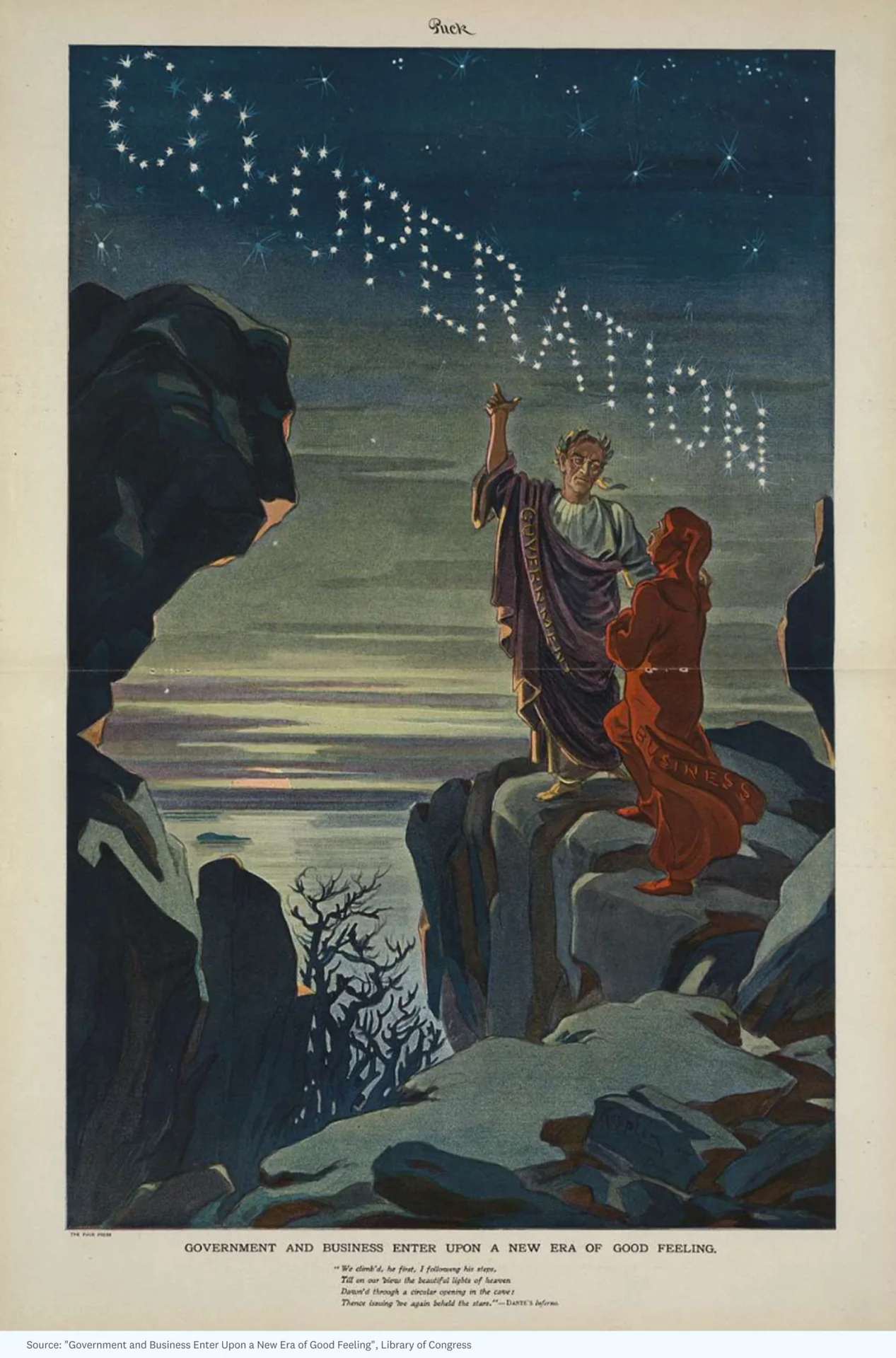
In today’s language, this is a market feature, not a flaw. While individual investors who get caught in a mania will always suffer losses and hardship, speculation is essential to driving economic growth and prosperity at the national scale. A quote from The New York Herald in 1854 captures this well:
“Although much embarrassment has and will continue to result as a necessary consequence to the extravagant speculative mania which has run over the land from one section to another, still we have to record the gratifying fact that, notwithstanding there must be enormous personal sacrifices, the country will, as a whole, derive much benefit from the immense internal improvements which have been undertaken …”
So what? Rather than spending resources on efforts to wipe out speculative manias, we should figure out how investors’ natural inclination toward speculation can be guided into productive undertakings that serve society.
The ‘Bubble Triangle’ and democratizing speculation
In their excellent book Boom and Bust: A Global History of Financial Bubbles, authors John Turner and William Quinn present a way to understand how and why bubbles develop. Their model borrows from the “Fire Triangle,” which consists of oxygen, fuel, and heat: “Given sufficient levels of these three components, a fire can be started by a simple spark. Once the fire has begun, it can then be extinguished by the removal of any one of the components.”
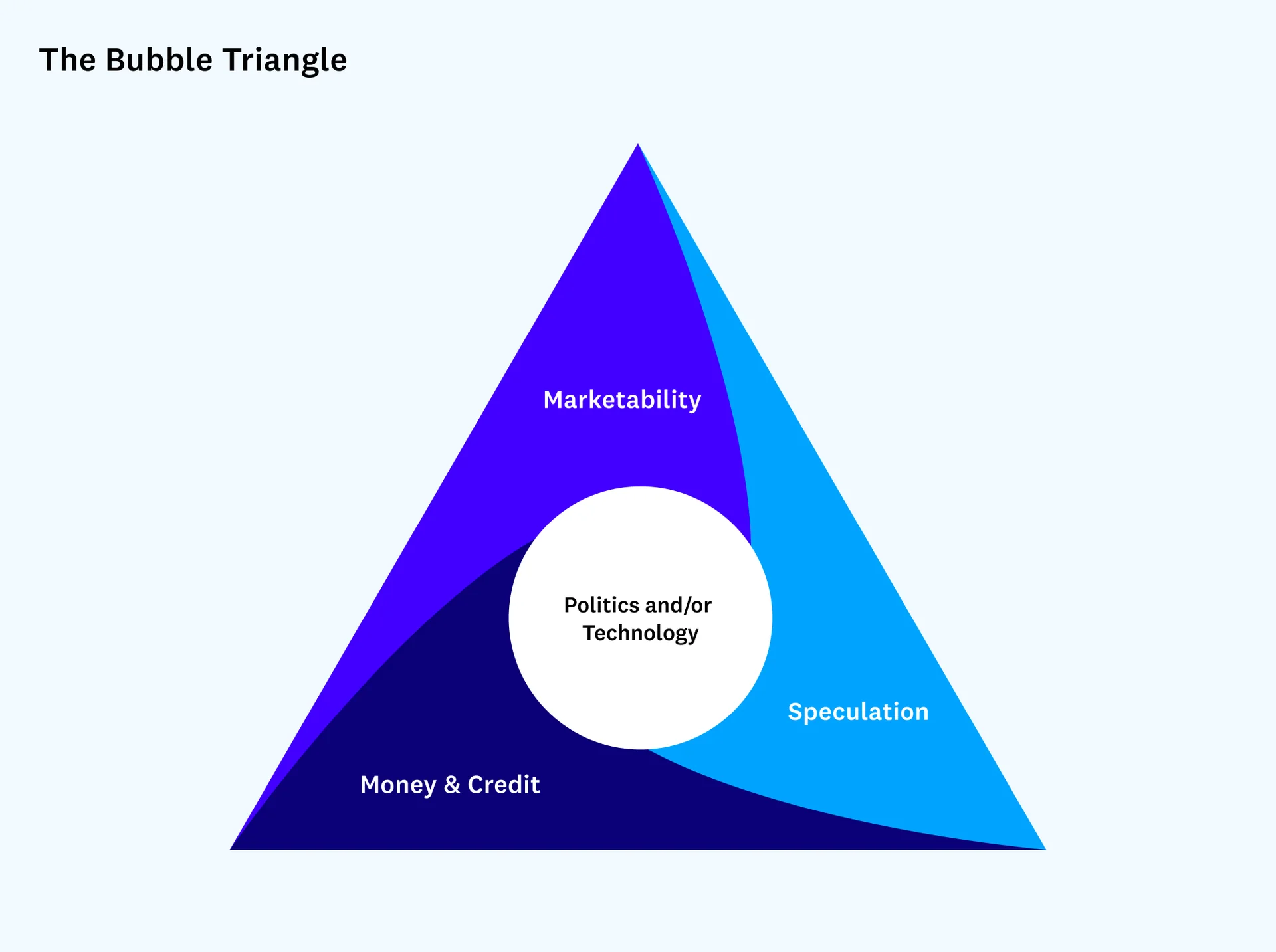
Turner and Quinn’s Bubble Triangle swaps oxygen, fuel, and heat for marketability, money & credit, and, notably, speculation.
- Marketability (the oxygen): “The ease of which an asset can be freely bought and sold. … Another factor is divisibility: if it is possible to buy only a small portion of the asset, that makes it more marketable.”
- Money & credit (the fuel): “Low interest rates and loose credit conditions stimulate the growth of bubbles … bubble assets themselves may be purchased with borrowed money, driving up their prices … low interest rates on traditionally safe assets [i.e., government debt] … push investors to ‘reach for yield’ by investing in risky assets instead … funds flow into riskier assets, where a bubble is much more likely to occur.”
- Speculation (the heat): “The purchase of an asset with a view to selling the asset at a later date with the sole motivation of generating a capital gain … during bubbles, large numbers of novices become speculators … as a fire produces its own heat once it starts, speculative investment is self-perpetuating: early speculators make large profits, attracting more speculative money, which in turn results in further price increases …”
As with the Fire Triangle, removing any one component will put out a bubble. Of course, the first — and most necessary — element for the creation of fire is a spark. For the initial “spark” setting Bubble Triangles alight, Turner and Quinn identify two culprits: technological innovation and government policy.
Technological innovation can supply a spark by creating substantial profits at firms using new technology, which leads to large capital gains. These gains draw in speculative momentum traders who purchase shares because the stock price is rising sharply. New firms appear to exploit the excitement, optimism grows, and a “new era” story takes shape.
Government policy can supply a spark when policy shifts lift asset prices in service of a specific aim. (For example, policies to increase home ownership contributed to the housing bubble.) Governments can affect different parts of the Bubble Triangle through tools such as lower interest rates, a larger money supply, or deregulation.
We can examine this through the building of America’s railroad system in the 19th century to see what ignited it, and how the interaction of marketability, money & credit, and speculation created a huge national project that pushed America ahead.
The Bubble Triangle: Railway mania and channeling speculation
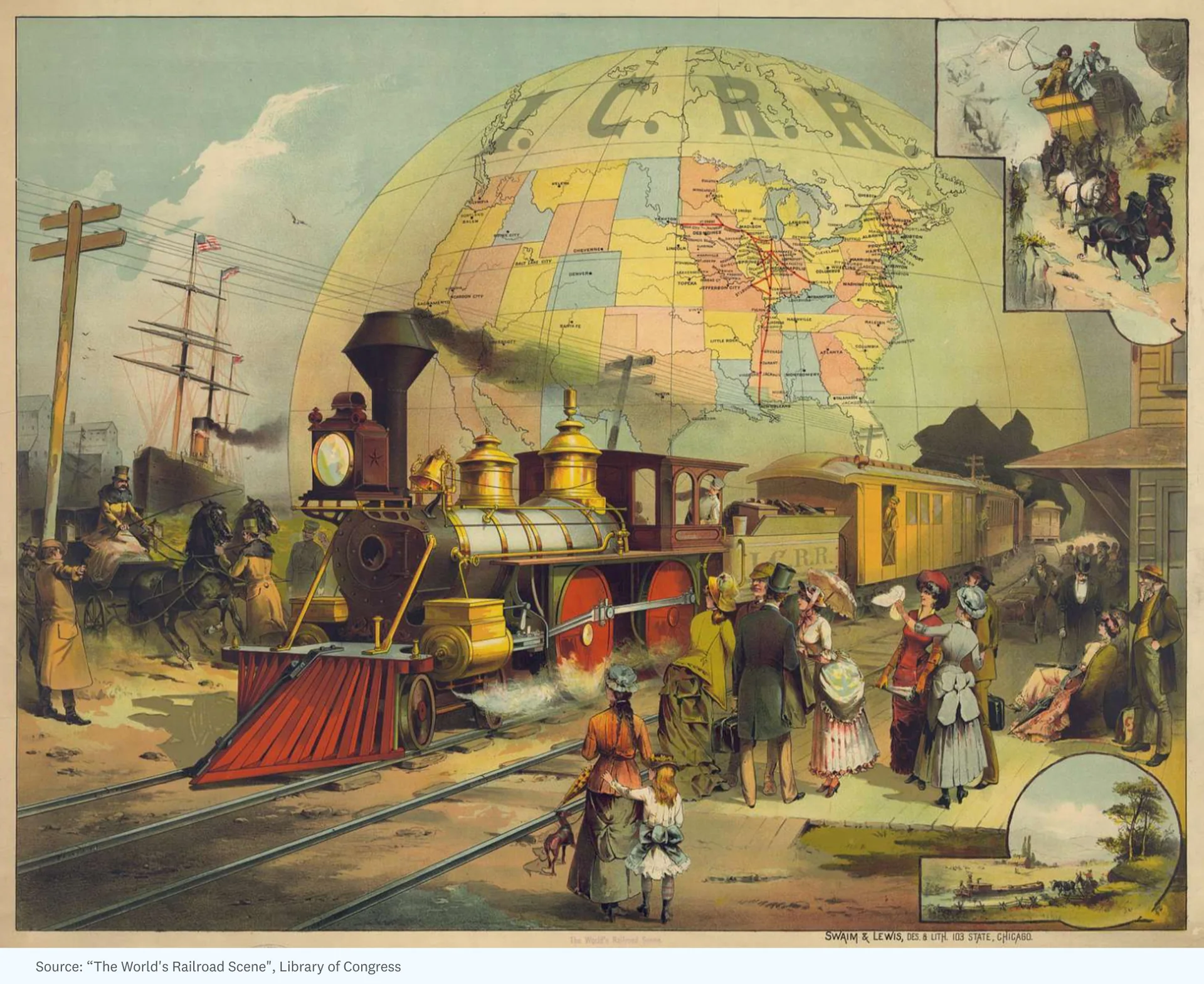
“The history of the ‘Pacific’ railroads of America is almost a romance. In the first instance, their construction was a political necessity … resources of the central portion of the States would be opened up, and a new route would be formed for commerce from Europe to Asia.” (The Elder Pacific Railroads of America, The Economist, May 17, 1884)
Charleston-Hamburg Railroad, the first American line providing regular service, opened its doors on Christmas Day in 1830. That winter morning, 140 lucky passengers experienced a new form of transportation that forever altered America’s economic trajectory. They may not have grasped the scale, but people at the time understood the social gains railroads could bring along with financial gains.
After completing the 136-mile line in 1833, Charleston-Hamburg’s directors stated:
“Our citizens wisely determined that railroads would be eminently beneficial to the State; that they would revive the diminished commerce of our city and tend to bring back the depreciated value of property … Real estate in and near Charleston had sunk to half its former value … industry and talent had lost encouragement and not met their merited awards…
Stockholders of the ‘South Carolina Canal and Railroad Company,’ especially those who entered the venture early, must have felt that delight in a very high degree when they considered the public benefit they had provided to this State and to a large part of their country by building a railroad from the vicinity of Charleston to Hamburg.”
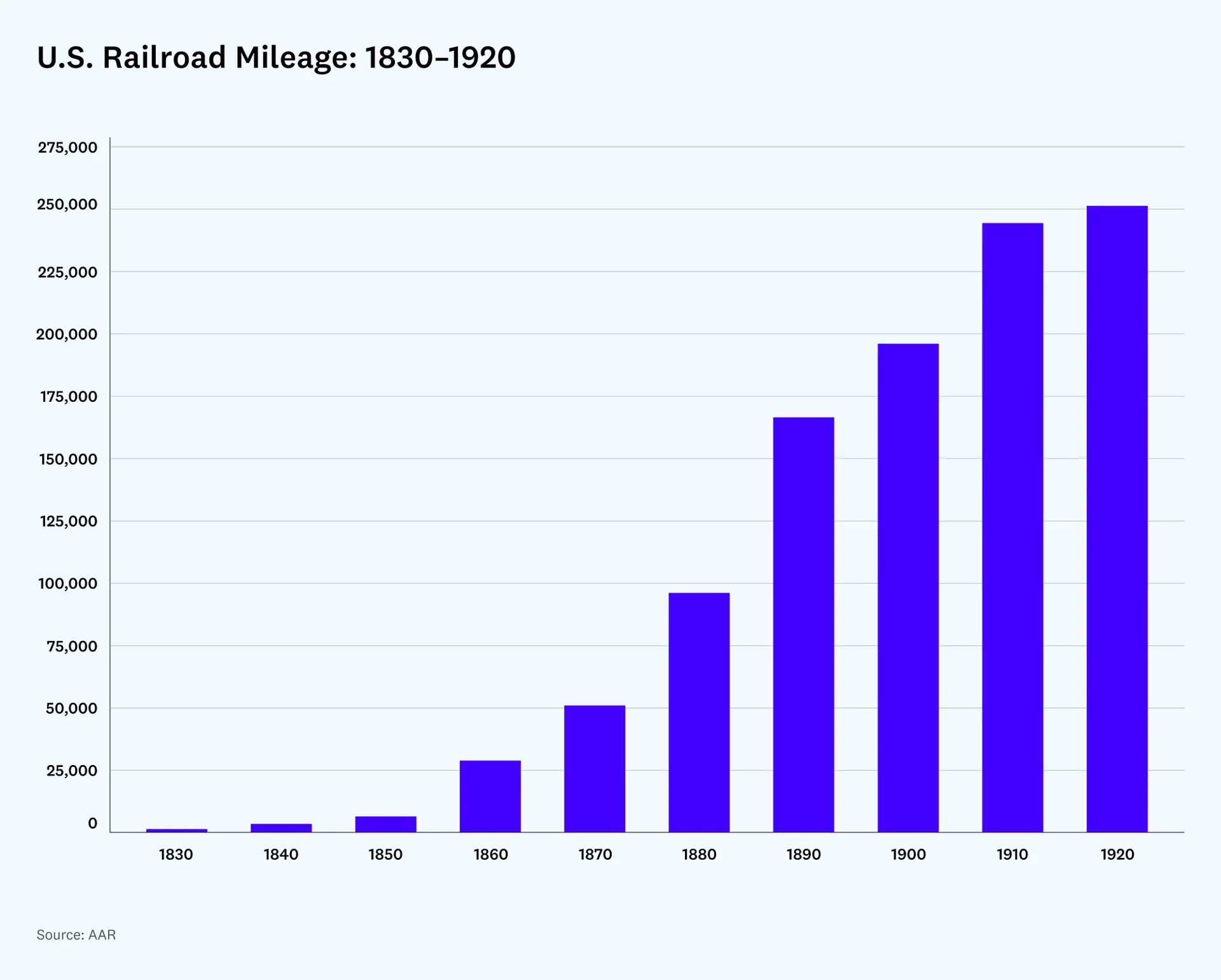
The point was unmistakable: railroads were both a public benefit and an appealing investment. That view spread nationwide, and by 1840 America had more miles of track than Europe.
Two decisive moments, in 1849 and 1851, then truly ignited America’s railway boom.
The ‘sparks’: Westward expansion and federal land grants
As with any new technology, the “hockey stick” rise in railroads did not escape investors’ notice. Up to 1850, $372 million ($50 billion) had been invested in American railroads. From 1850 to 1857, though, another $600 million ($80 billion) flowed into this fast-growing new industry.
This rapid growth was driven by a national fixation on westward expansion after a historic discovery at Sutter’s Mill set off the California Gold Rush in 1849. California’s population rose from 93,000 to 380,000 over the next decade as Americans and foreigners arrived in search of gold. When California gained statehood through the Compromise of 1850, it was obvious that America needed a railway connecting its coasts.
The method for building this transcontinental railroad was strongly shaped by the other decisive moment in America’s railway boom: federal land grants. In 1851, an ambitious young attorney from Springfield helped Illinois Central Railroad secure a grant of 2.6 million acres, which became the first federal land grant ever handed directly to a corporation.
These may appear to be minor points of government procedure, but this 1851 land transaction showed the government’s readiness to prompt private investment in railway building through federal subsidies.
Clearly shaped by the 1851 deal he helped arrange, that same Springfield attorney gave 5.5 million acres of federal land straight to railroads 11 years later in the Pacific Railroad Act. That young attorney had become the 16th president of the United States, Abraham Lincoln.
Money & credit (fuel)
The main aim of Lincoln’s Pacific Railroad Act was to build a transcontinental railroad linking America’s coasts.
“To persuade the railroad companies to construct the transcontinental railways, the government awarded them 6,400 acres of land (10 square miles) and $16,000 in government bonds for every mile of track laid. Some of the companies’ profit came from selling this land. So they began a huge sales campaign, promoting a settlement package, which included:
- a safe, inexpensive and fast trip west; temporary lodging in hotels until the families had constructed their own homes; additional attractions such as schools, churches, and no taxes for five years.” (Reasons for Westward Expansion, BBC)
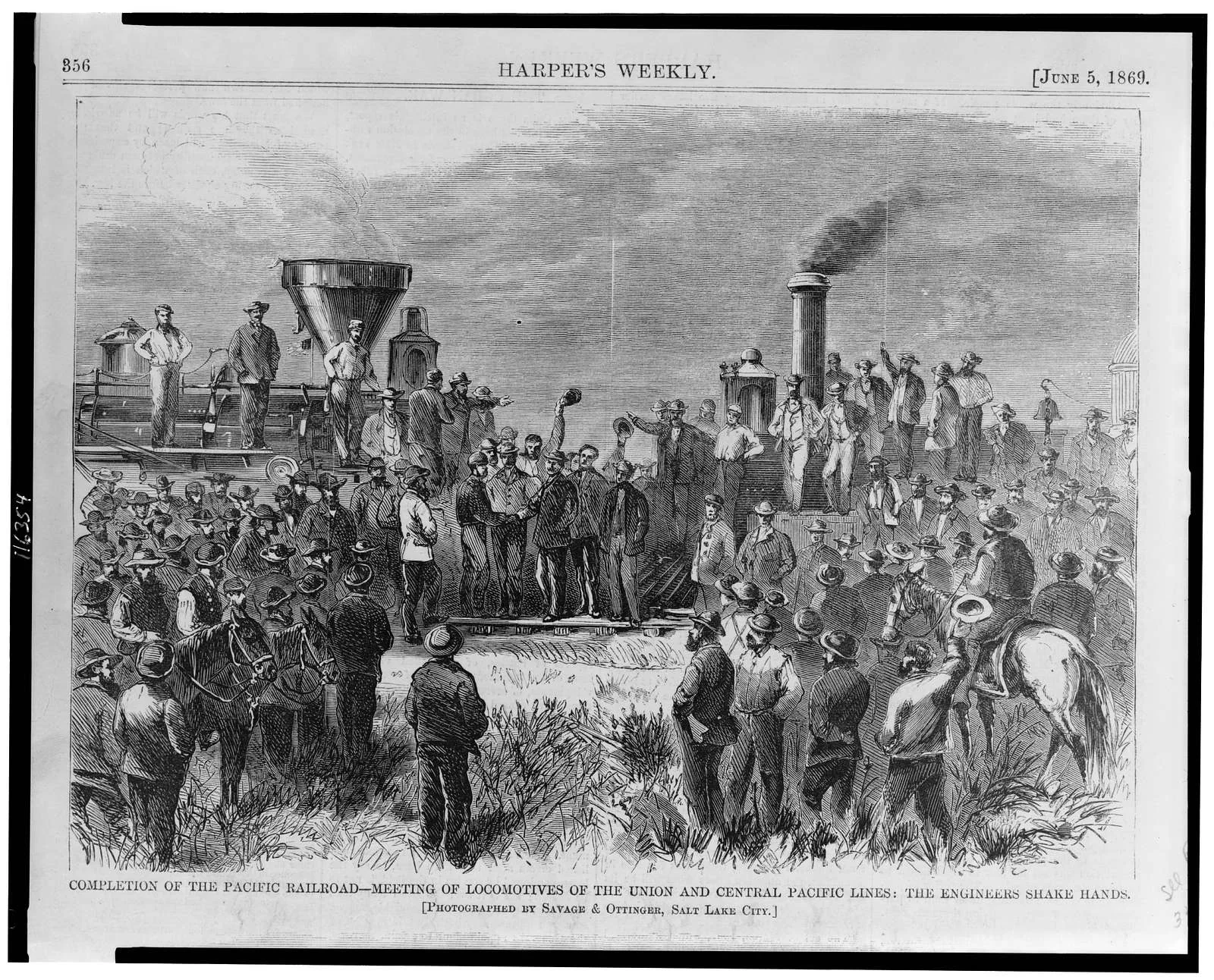
The Union Pacific and the Central Pacific railroads were the two companies assigned to build this extraordinary railway. Union Pacific’s line would begin in Nebraska and move west, while the Central Pacific started in California and built east. The two lines met at Promontory Point, Utah, on May 10, 1869.
The 6,400 acres of land and $48,000 for each mile of railroad track built was a major driver of America’s railway boom. The Pacific Railroad Act also broadly allowed the federal government to give land grants directly to corporations. This helped draw private investment by reducing the financing costs for expansion and offering financial incentives for starting construction. The scale of this effort was simply astonishing (Dan Allosso, American Environmental History, November 2015):
“In the eighteen years between the original Illinois Central grant of 1851 and the completion of the transcontinental line in 1869, privately-owned railroads received about 175 million acres of public land at no cost. This amounts to about 7% of the land area of the contiguous 48 states.”
In the 19th-century railway boom, the government supplied both the spark and fuel. Although the federal land grants and subsidies were not without problems — most notably the Credit Mobilier scandal — the approach still successfully drew enough private investment to make a large-scale project like building a national railway network possible.
Marketability (oxygen)
The staying power of this railway boom came from its appeal to smaller investors. This crucial element created widespread demand for railway shares as retail investors could join in the country’s exciting growth prospects in western territories.
Like all great manias, the railway boom was kept alive by speculators’ ability to buy shares through “installment” plans that required very little money at the start (sometimes only $1). Much like fractional shares today, lower denominations drew bigger crowds. If some investors could afford a $50 railway share up front, then many investors could purchase shares requiring just $1 up front.
As enthusiasm for railroads and western expansion grew stronger, newspapers were filled with investment offerings for new railway lines. One such offering in an 1861 edition of The Lancaster Ledger (“The Central Railroad Must Be Built!!!,” April 3, 1861) in South Carolina shows how railroads stressed the small up-front cost of buying shares:
Although shares were issued at $50, “no money (except one dollar per share) is needed now and will not be perhaps in a year or two.” Cheap!
Advances in communication technology (i.e., the telegraph) also meant that investors were increasingly aware of the money being made in railway stocks elsewhere, which further encouraged herd behavior. Every day newspapers carried reports of new railway lines and speculators’ profits, as news from across the country came by telegraph.
Today, social media likewise helps create excitement and rallies in popular stocks.
Speculation (heat)
Naturally, speculation is the final crucial element of the railway boom and the Bubble Triangle.
The government encouraged entrepreneurial effort and railroad creation by promising set rewards for each mile of track completed. That, in turn, drew in the investing public, captivated by western expansion and faith in America’s “manifest destiny.” Watching the profits earned in the first railroad stocks pulled crowds of speculators into the railroad bonds and shares issued in response to the government’s incentives.
The scale of speculative railroad activity is shown by the way railways sat at the center of the financial panics of 1857, 1873, 1893, and 1901. An excerpt from an 1869 newspaper captures the era well (“The Dangers of Railway Speculation,” The New York Herald, April 14, 1869):
“The history of our Western railways is just a repeated tale of abuse of public trust. A half dozen stock gamblers organize a company, publish their prospectus, persuade the public to put money into their bonds or stock, and with the funds thereby obtained build a hundred miles or so of the great line that is to serve as a link between the important cities …”
Another 1850s article shows how the government itself spurred speculation (“Highly Curious Financial Views,” The New York Herald, December 3, 1857):
“Under the stimulus of its supposed advance, its reputation abroad, and its swollen worth at home, the West truly believed in its own prosperity …
They urged capital to carry out plans for railways across the empty prairie and between cities not yet built. The market was inundated with railroad schemes; stock was issued, money was collected, and the West was drained at every point, for it was rich enough to give forth wealth in endless streams at every pore …
Congress handed out lavish grants of their only real assets, land, to stir speculation, and so the railway mania peaked …”
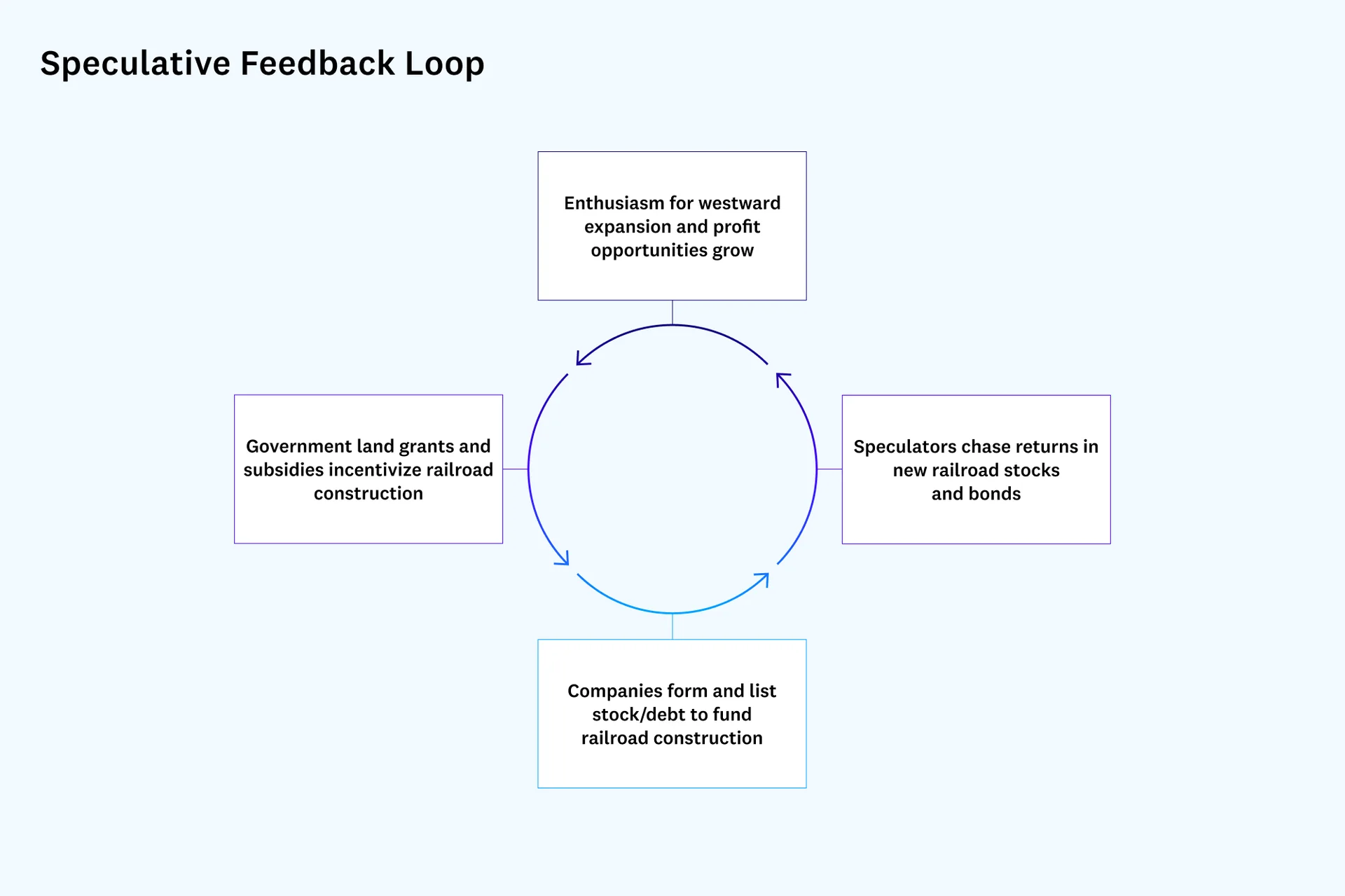
The government helped nurture speculation in railway shares by appealing to investors’ inborn behavior. Instead of blocking speculation or attempting to restrain it, the government made full use of it by granting land to induce more railroad companies to form. Investors’ speculative instincts handled the rest. Before long, speculation had become a feedback loop:
The Bubble Triangle today
How could this be repeated in markets today, and how well have recent efforts performed? Over the past 12 months, we have seen “mini-bubbles” in electric vehicle companies, SPACs, cryptocurrencies, NFTs, “meme stocks,” and more. Though no single trigger set off all of them, new trading platforms and the pandemic played major parts.
When the barriers to speculating are reduced or removed by technology, speculation abounds. The ability to trade on our smartphones with just a few clicks is the perfect example. Yet, until recently, there was a financial cost to these trades via brokers’ trading commissions. That changed in late 2019 as online-brokerage firms announced commission-free trading. The impact on levels of speculation was practically immediate:
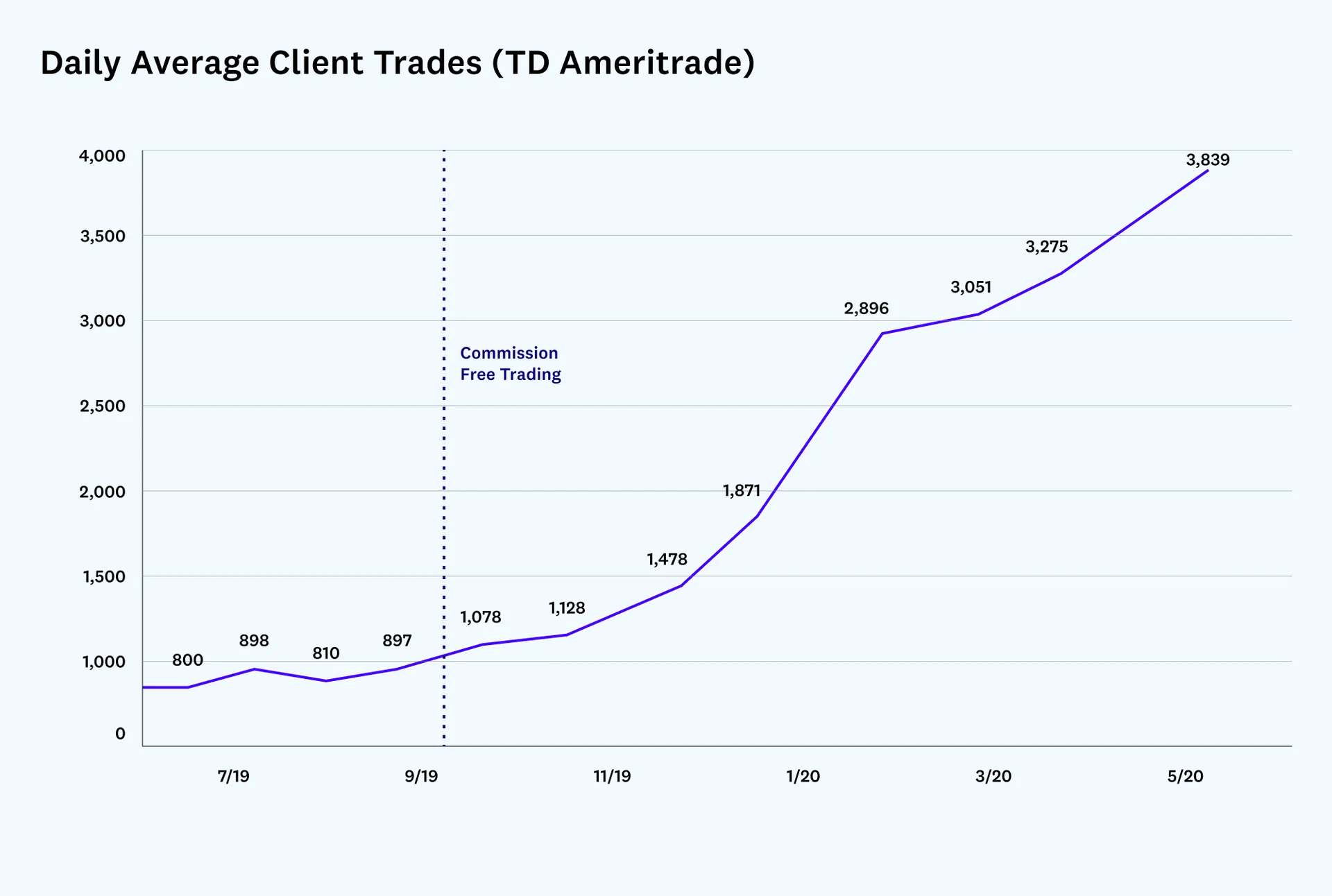
This rise in speculative conduct surged during COVID-19 lockdowns, when people were trapped at home with little to occupy them. In this setting, many turned to speculating on stocks, especially technology stocks with appealing brands.
Money & credit (fuel)
The fuel behind these mini-bubbles was a mix of low interest rates and stimulus checks. Low rates pushed investors toward riskier assets — such as equities — because bond yields are too low. This investor problem is now described with a new acronym, TINA: There Is No Alternative [to owning equities].
Government stimulus checks added more fuel, giving millions of Americans extra cash to spend. CNBC reported that half of 25- to 34-year olds “plan to spend 50% of their stimulus payments on stocks.” With monetary policy encouraging investors to buy riskier assets, and stimulus checks supplying capital for investors to put to work, this speculative boom has no shortage of fuel.
Speculation (heat)
Investors have always pursued returns after seeing others’ gains, and social media has only intensified that habit. One of the first stocks to draw speculators’ attention in 2020 was Tesla. From the stock’s March 18 low, shares surged an astonishing 590% through August 31 as retail investors piled in. The near-vertical gains in a household name like Tesla led speculators who had missed out to hunt for “the next Tesla.” Social media was full of posts from new day traders showing off gains from Tesla, and others wanted to join in.
Like the railroad companies formed to capitalize on enthusiasm for railways and western expansion, a wave of SPAC deals involving electric vehicle (EV) companies was announced to seize the moment. One such EV deal involved Nikola Motors, which was briefly hailed as the next Tesla. Even though it had no sales or product on the market, shares jumped 100% in the company’s first month of trading. Soon, however, it was clear that the only resemblance was their shared tribute to inventor Nikola Tesla, as Nikola’s CEO later resigned amid fraud allegations.
Although most speculators probably did not buy EV stocks for purely environmental reasons, the episode showed that speculative crowds could be drawn to industries that benefit society — in this case electric vehicles and lower fuel emissions. Channeling speculation may work just as well for all sorts of innovation, and for social causes too.
Marketability (oxygen)
As noted, commission-free trading is a major driver of this speculative boom. Eliminating the financial cost once tied to overtrading (that is, high commissions) encouraged speculators to keep wagering on stocks’ short-term direction and pile into popular trades.
An equally significant change was the arrival of fractional shares, which let smaller investors purchase stocks in fractional amounts. For small investors who wanted pricier stocks like Amazon, which can trade above $3,000 a share, fractionalization was a breakthrough. The ability to buy and sell shares (fractional or whole), commission-free, from a smartphone makes this the simplest time in history to speculate.
Channeling modern speculation
If we understand bubble formation through the Bubble Triangle framework, and we can see that speculation is now running hot, how might this speculative energy be directed into ventures that serve society more widely?
It helps to examine the results of a recent effort created to boost investment in neglected communities: opportunity zones. The Tax Cuts and Jobs Act of 2017 established Opportunity Zones to “spur economic development and job creation in distressed communities.” The program sought to draw private capital by providing appealing tax breaks for investing in such zones.
Yet a central problem with this approach, and others like it, is that smaller investors cannot easily—or at all—take part. Most opportunity zone funds demand accredited investor status and set six-figure minimum investments. As with other private “impact fund” investment vehicles, this accredited investor requirement makes it hard for a movement to tap the mood of a speculative public. In the Bubble Triangle, an asset’s marketability (the ease of buying and selling it) is the oxygen that keeps a bubble alive. Without that oxygen, speculation cannot exist.
Looking at the booming popularity of environmental-social-governance (ESG) investing in public markets, there is clear demand for investments that offer an element of positive societal impact (or more stakeholder vs. just stockholder involvement). Despite SEC amendments to modernize requirements for accredited investor status in 2020, more extensive changes may be needed to unlock this pent-up demand from non-accredited investors for more access to private markets.
A sensible first move toward drawing more private capital into these efforts is to let more people invest. Even so, the net worth threshold for accredited investor status should be reconsidered alongside the level of disclosures investors must receive in private offerings. Andrew Vollmer, a scholar at George Mason University, wrote in a recent paper (Securities Regulation Law journal, October 2020):
“Net worth or income does not provide a rational connection to an investor’s ability to fend for him- or herself by having knowledge of information in a registration statement or having an ability to ask for and obtain the information felt necessary to making an informed investment decision. Income and wealth are not effective ways of identifying the persons who understand the risks of buying securities. An individual may acquire high compensation or wealth in many ways other than actions that provide a basis for evaluating an investment opportunity.” [emphasis added]
Beyond regulatory reform, advances in technology, finance, and the overlap between the two fields open up exciting new ways to channel speculation. One initiative from Berkeley, California, gives a useful example of how private and public investment might be encouraged by offering municipal “microbonds” through blockchain technology, with investments starting at just $25. Although only time will show whether this idea takes hold, it is promising to see inventive efforts to combine public and private investment in ways that widen access (marketability) for smaller investors.
***
The 19th-century railway boom was a successful, though sometimes flawed, blending of private and public investment in a venture that transformed America’s society and the American economy. The transcontinental railway was the largest publicly funded work of the 19th century. With federal subsidies and land grants helping to draw in private investment, public enthusiasm for railroads — transcontinental or otherwise — showed itself in feverish speculation in railway stocks throughout the 19th century.
Economist Jack Kenneth Galbraith said that “Nothing in the 19th century is more remarkable than the way men forgot the last railroad debacle and proceeded to lose money in the next.” By not placing barriers between investors’ enthusiasm and their ability to speculate in this national undertaking, the government indirectly helped finance the expansion of America’s railways further. While there were also many examples of railway fraud and firms going bankrupt, the railway system built across this nation was a feat we still look back on for inspiration.
Across centuries, investors’ behavior and taste for speculation have not changed. As a society, we must choose the major projects we want to achieve, and then make sure the public’s speculative energy can be guided effectively into related ventures while attempting to curb fraud and chicanery wherever possible.
I leave the reader with this account of American prosperity and the need for speculation (“The Schuyler Frauds,” The New York Herald, August 4, 1854):
“The real capital of the country is in the energy and the enterprise of its people; and with these elements of success everywhere and always active, difficulties are only the stimulus of endeavor.
The Americans have been overtrading and overspeculating ever since they were a nation; their liabilities have always been, more or less, a mortgage on futurity; but they have never yet failed to find a way, wherever they had a will to force them forward in search of it …
They have heavier engagements on their hands at the present time than they can cover without a little embarrassment, but their present embarrassment arises from the investment of capital in enterprises [railroads] that, speculative as many of them may have been, will vastly enhance the available resources and accelerate the future progress and prosperity of the republic.”