

The world paid attention when the container ship Ever Given jammed the Suez Canal this March. Some people built websites, plenty made memes; I wrote a children’s book. It felt almost absurd: A spell of poor weather pushed the 1312-foot long, 200000 tonnes-heavy container ship Ever Given off course, lodging her at an angle in the narrow canal. She was trapped.
The internet may have loved it, but the episode also drained time and money around the globe — rerouting as many as 450 other vessels (roughly 30% of the world’s shipping container traffic) and shaving up to 0.4% off worldwide trade growth: about 10 billion U.S. dollars in only one week. In reply, the Suez Canal Authority is widening the waterway by 131 feet. But that will take two years, and even then it still won’t let a giant ship like Ever Given swing sideways in the canal.
This isn’t an isolated mishap or a singular example of obsolete infrastructure in some faraway country. It’s a warning sign — of a worldwide issue.
For all the talk about software taking over the world, it’s obvious (and became much more obvious during the PPE shortages in the early pandemic) that the physical world still counts. From a logistics perspective, the movement of goods and the back-and-forth among trade partners is what makes innovation possible. Tech commentators may speak of moving from atoms to bits or bits to atoms, but it’s the interaction between the two that keeps everything turning. And with global trade demand surging, the world’s shipping infrastructure is beginning to fail.
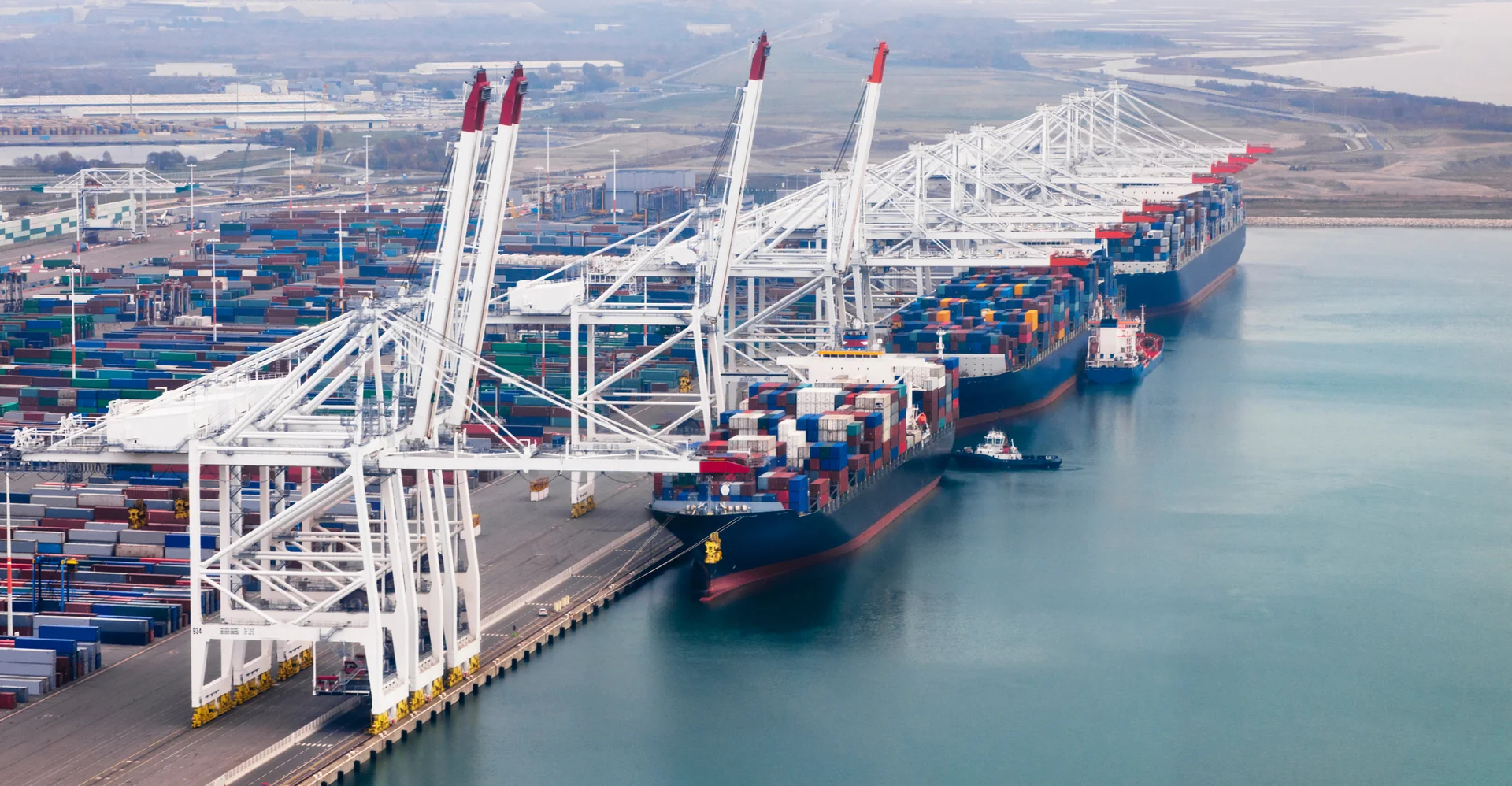
A standard for innovation
Before shipping was containerized, cargo was handled by longshoremen. By today’s measure the system was almost haphazard — oversized, non-standard cargo loads packed in whatever sequence seemed most practical to the workers on site at that moment.
In 1956, the year the first container ship sailed, loading a vessel by hand cost $5.86 per ton. With containers, that number fell sharply to 16 cents per ton — and the work moved much faster as well.
The concept of containerization came from a trucker, not a shipper. Malcolm McLean began by hauling empty tobacco barrels with his family in North Carolina in 1935. Back then, whole trucks would roll onto ships, squandering a huge amount of possible cargo space, along with a chassis that could otherwise have been on the road moving goods. McLean drew up plans to use the so-called trailerships for trips from North Carolina to New York, but U.S. rules would not let one person own a trucking company and a shipping company at the same time. So McLean did what any innovation-minded entrepreneur would do: He sold the trucking company, borrowed $22 million, and in January 1956, purchased two World War II T-2 tankers.
So on April 26 that year, the SS Ideal-X was loaded and departed from the Port of Newark, New Jersey, bound for the Port of Houston, with 58 containers aboard. Each one was 35 feet long, and they were known as trailer vans. (As expected, the International Longshoremen’s Association was unhappy. Asked for a reaction, a top official said, “I’d like to sink the son-of-a-bitch.”)
McLean later launched a new 101-acre port facility in Newark, and ten years after that landmark first container voyage, service began between New York and Rotterdam, Netherlands; Bremen, Germany; and Grangemouth, Scotland. In the late 1960s and early 1970s, these container networks expanded, reaching Hong Kong, the Philippines, Singapore, South Vietnam, Taiwan, and Thailand. By the close of the 1960s, McLean’s company owned 36 ships and more than 27,000 containers, with access to over 30 port cities. (Governments and regulatory agencies noticed and soon reinforced McLean’s efforts too.)
This swift expansion was driven by several forces, including post-World War II prosperity and a growing enthusiasm for globalization. Container shipping offered the ideal platform for global connectivity — not least because it was intermodal, moving across the very different modes of land, sea, and air, all in one format. It linked transportation, infrastructure, supply chains, and logistics, making the world smaller and the world economy larger.
According to a recent report cited by the St. Louis Fed, from 1970 — by which point this network had been established — to 2018, total world exports rose more than 65 times, from $384 billion to $25 trillion. Even after inflation is taken into account, total exports have still increased 10 times. Perhaps even more important — since GDP is usually the measure of productivity — global GDP moved from 14% to more than 30% through goods and services traded internationally (for the U.S. alone, this share rose from 5.6% to 12.2%). The Fed says the “key factor spurring this rapid globalization was the pervasive adoption of containers and corresponding infrastructure.”
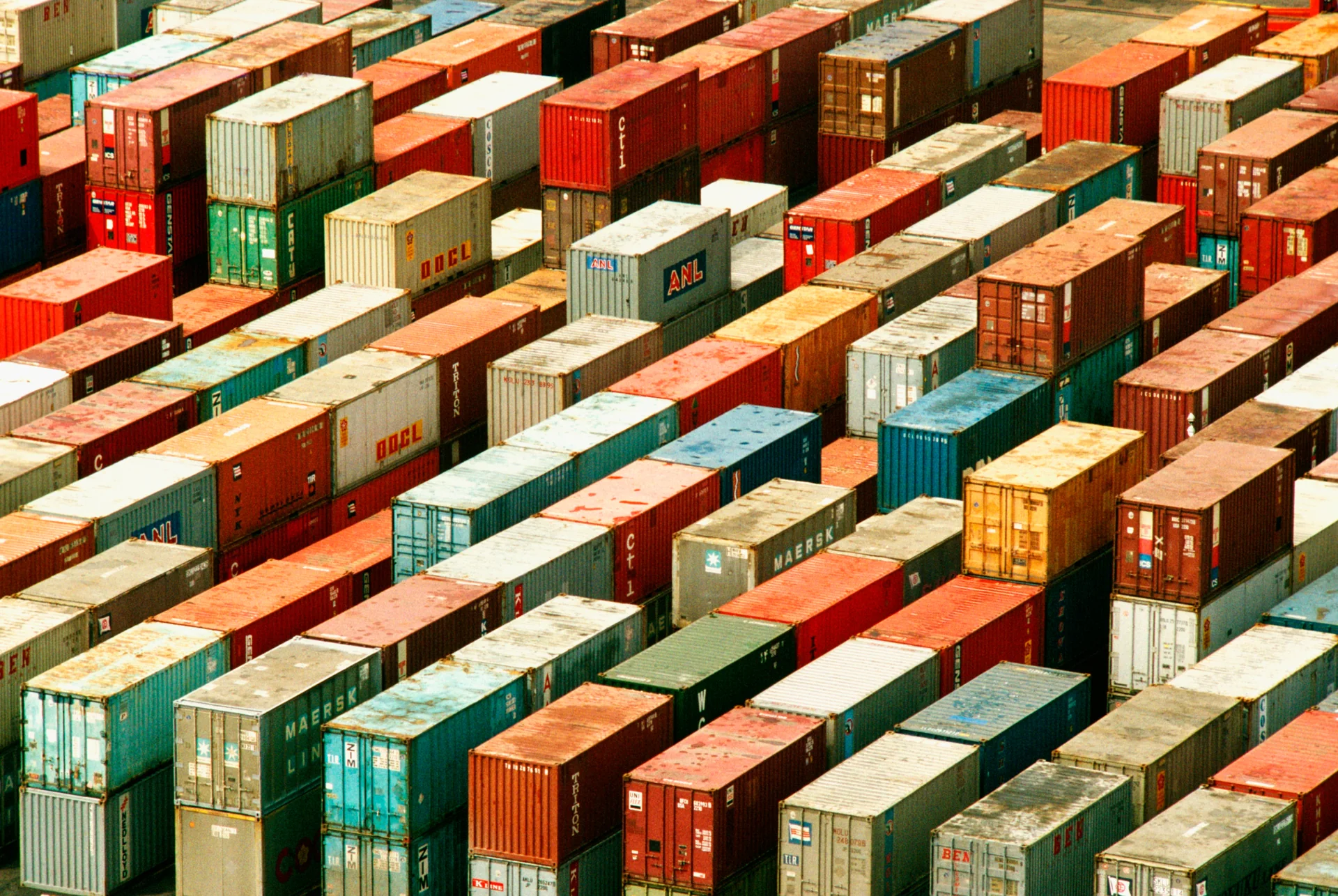
The shipping container is really the quiet hero of logistics. Containers keep cargo in standardized dimensions that work on ships, rail, and trucks. Whenever people discuss supply chains or port bottlenecks along key trade routes — the movement of goods — they are almost always talking about container movement.
The other main advantage of containers beyond (and built on) their intermodal character, however, was standardization.
The International Maritime Organization (IMO) issued a set of shipping container standards in the 1970s. Standard shipping containers are 8’ wide by 8’6” high, while high-cube units are 9’6” high; around 90% of the world’s containers are 20 feet or 40 feet long. These standards were developed by the International Organization for Standardization, the independent, non-governmental body that sets standards in information technology, graphics, photography, mechanical engineering, transport, non-metallic materials, health, medicine, and laboratory equipment.
Four years ago, they published a set of standards intended to cover ships over 18000 TEU, a direct descendant of the original framework. But in the late mid-century period, the usual container was 20’L x 8’W x 8’6”H, and this is called the “20-foot equivalent unit” or TEU, the standard unit used to measure global trade today.
How were such standards made to stick? At first, incentive did the work: Only ships built to carry standard sizes were eligible for federal subsidies. Later, the ISO also standardized container corner fittings, which made it possible to standardize the cranes and other gear needed to move containers.
A universal language for global trade
Standardization is a remarkable thing, spanning both atoms and bits. Consider the internet as a leading example: The HTTP standard propelled the internet to its present ubiquity by establishing a uniform way to exchange information.
Before HTTP, computers could exchange information only when they were on the same network. Different network types could not connect with one another. This separation restricted the size and reach of online communities. Today, the world depends on HTTP as a way for devices to exchange information to or from anywhere in the world. Information packets travel along these networks (and, as The Economist once put it, just like a packet of data, “a container is just a box with an address”).
Our computers, laptops, tablets, phones, and more can all reach the information we want quickly thanks to standardization. And while today’s global trade network is a bit like an internet for physical goods, it lacks a standard like HTTP. Just as data moves between devices over the internet, goods move between ocean ports, airports, warehouses, and other entities to get to their final destination. Without a logistics standard to serve as a request-response protocol, all the players — suppliers, drayage, ports, warehouses, buyers — must connect their networks manually.
Information is lost; layers of redundancy, built as backups because visibility is low, slow the exchange: connections become very fragile. Suppose a shipment is set to arrive in Long Beach on Tuesday. But which terminal exactly and which pier number? What time is pickup? How long until late fees start? Finding those answers takes a lot of labor and is not exact. Logistics managers end up checking different sources on websites, by email, or face to face.
The industry’s dirty secret is that nobody really knows where their stuff is.
But if global trade worked like the information network on the internet, we could simply type or speak into a search bar to ask and answer these questions, exactly.
This is not about which features such a system should have, but about the need for standardization, the need for a universal language for global trade. Once that exists, the physical world, like software, becomes searchable, programmable, accessible — linking together a patchwork of country-specific regulations and more.
The recent Ever Given spectacle exposed the hard limits of the current system and the chaos concealed beneath all our global trade systems. Standardization could help solve this chaos.
Strengthen infrastructure, strengthen the world
It is basically impossible to upgrade, all at once, the physical infrastructure that moves containers — and therefore trade and innovation. If it takes two years to make the Suez Canal 131 feet wider, imagine how long it would take to modernize the world’s entire logistics infrastructure.
There are thousands of ports, harbors, and wharfs, not to mention more than a thousand transoceanic mega-vessels. Containers move on ships and planes, pass through customs in the destination country, and are sent to warehouses through regional rail and truck networks. In some cases, it can take as many as 20 companies to move one shipment — each with its own systems, processes, and paperwork. It is also a highly fragmented industry: While thousands of independent freight forwarders make up a $2 trillion business, the #1 freight forwarder in the world has under 3% market share. That is not a bad thing, but the remaining thousands of mostly regional distributors — who know the details of their local geography better than any large company — do not have global visibility.
Information is accessibility, democratizing the playing field and reducing barriers to entry, not to mention reducing barriers to trade. A 1% increase in trade overall, according to economists, is associated with a 0.149%decline in poverty. Similarly, a 1% decline in the average tariff rate is associated with a 0.4% decline in poverty. To maintain or improve upon that progress, we need solutions that shore up physical infrastructure, so it can handle demand.
Because the various cascading supply chain problems are only the start. At the beginning of the pandemic, global trade slowed to almost a standstill, then surged back to life within weeks. And while the logistical effects continue, the economic effects have been nothing less than devastating. The world saw a demand shock, spending collapsed; then demand for essentials jumped, accompanied by panic over toilet paper, hand sanitizer, and face coverings. Since then, ocean shipping rates have broken records. It is not just China to the U.S. West Coast. Transatlantic rates are up 100% since 2019.
It is a global traffic jam. Before the pandemic, transit times from mainland China to the West Coast were about 33 days. Now, it is more like 60. There are shortages of vessel berths, cranes, truck chassis, truck drivers … and of course, containers, especially in Asia, where they are needed most.
So why not tackle all of this physically, with bigger ships? Can’t someone just build a larger ship to carry more containers? Well, yes, they can, and they have been: More than 400 container ships, totaling 3.63 million TEUs, have been ordered new since late 2020. (Bigger ships also cut emissions per container.)
Even the Ever Given, at 1312 feet and 20124 TEU, was one of the largest ships in the world when she first sailed in 2018. Now, only three years later, she is one of seven sharing 13th place for highest capacity. In 1869, when the Suez Canal opened, the HMS Newport was the first ship to sail the entire canal. She was 145 feet long, a good size in her day; a few decades later, under a new name, she explored the Arctic for Northern Sea routes. But she is tiny by today’s standards.
As they become larger, these ships hit their physical limits in terms of seaworthiness. During the two-month span between November 2020 and January 2021, nearly twice the annual average number of containers went overboard. Some of this was because of the winter season, when westerly winds across the Pacific Ocean blow strongest.
And as we scale ships to carry more containers, we also need to scale rail and trucking accordingly. That is not happening. It is just one more example of how demand for physical goods is dramatically outpacing infrastructure. Yet here we are, talking about expanding the Suez Canal by… 131 feet.
For consumers, for everyday people, the limits of infrastructure together with rising demand mean rising costs, creating a vicious cycle of scarcity. Standardization and more transparency will go a long way here, taking us from the pre-internet era to a post-internet era for shipping.
That’s the physical future we can build with software.
[also available as audio read-aloud in your a16z Podcast feed/ here]