
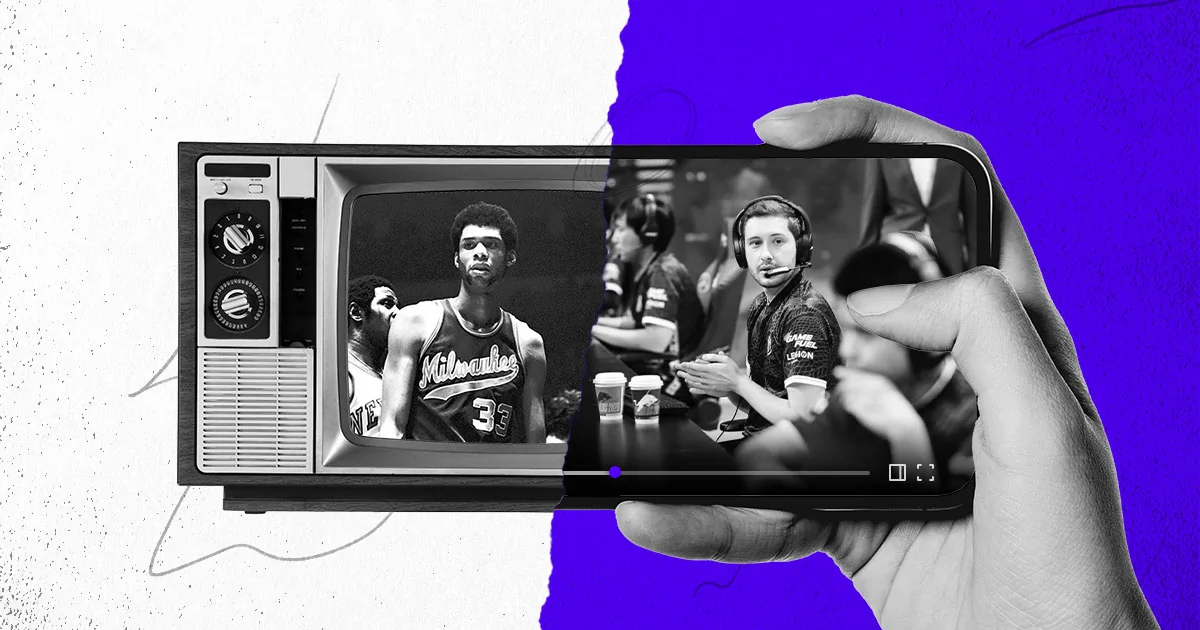
For years, pundits and commentators argued over whether esports even counted as “sports”; now, esports are pushing sports entertainment into the digital era. Over the last decade, esports monetization has largely been patterned on traditional leagues such as the NBA, NFL, and NHL. In the past few years, though, it has become clearer that esports are following a different path than traditional sports in important ways: the audience is younger, more transient, more online, and less tied to place. While fans of traditional sports tend to be as much as 30 years older on average, esports has been shaped by the viewing patterns of millennials and Gen Z.
Yet beyond the clear demographic gaps, viewer-engagement models are also shifting: esports teams are starting to resemble entertainment businesses more than conventional sports leagues. Across sports, the once-prized linear broadcast-rights model is struggling. We are seeing something like the sudden move from going to the movies to streaming on demand as more fans and more fans watch games digitally. This is most obvious in the esports audience, most of whom watch broadcasts almost entirely online.
And although many esports leagues will likely exceed traditional sports viewership figures in only a couple of years—some, such as the LCS and LEC (the League of Legends leagues in North America and Europe), already have—there is an elephant in the room that esports insiders have understood for a long time: even as esports viewership soars, financial growth is not matching it. Most esports broadcasts remain free and badly monetized; so far, no esports league has landed a nine-figure annual agreement. By contrast, the NHL takes in $625 million a year from broadcast rights alone—the smallest of the major four broadcast deals—despite drawing about the same total average audience as the LCS, one esports league in one region.
Although it is likely that many esports leagues will beat traditional sports viewership numbers in a couple of years—some, like the LCS and LEC, already have—there’s an elephant in the room that esports insiders have long recognized: though esports viewership is soaring, its financial growth is not keeping up.
If esports really are setting the course for the future of sports engagement, then esports teams have to keep moving from pure sports leagues built on old models toward durable entertainment companies with multiple revenue streams. With the right playbook—leaning into lifestyle “drop” culture, turning fandom into a gateway to other products, and franchising with a worldwide emphasis—esports titles are positioned to lead sports revenue charts in the years ahead.
When the “business of winning” isn’t enough
For esports teams, winning championships is not a business plan; it is only a bonus. To create true business success in today’s intensely competitive leagues, esports teams are seeing that they must move away from the traditional sports model.
I learned this directly when I cofounded my own professional esports team, Splyce, in 2015. Growing up in the ’80s and ’90s, I was a proud nerd, an avid gamer, and a dedicated sports fan. I looked up to the San Antonio Spurs’ general manager R.C. Buford and head coach Greg Popovich, underdogs who captured multiple championships without a famous brand, a flashy city, or a superstar centerpiece to attract other players. As CEO of Splyce, I turned to my childhood heroes as my guide to success.
In many respects, Splyce and the Spurs had a similar profile. While Splyce was a new startup with only a few standout names on our roster—we could barely afford to pay players the minimum salary—powerhouses like Cloud9, Fnatic and OpTic could lean on established brands and the ability to spend far more to pull in top talent. Each time a young prospect left Splyce for a bigger brand or a better paycheck, we ended up in the same position as Billy Beane’s celebrated Oakland A’s: we were not going to outspend the Yankees (in this case, Cloud9/OpTic/etc.) and we did not have the Yankees’ brand strength to rely on. To stay competitive, we had to become shrewd and assemble teams made up of rookies and underrated veterans.
Although we eventually won championships in games like Halo, Call of Duty, World of Warcraft, Marvel vs. Capcom, SMITE, and Starcraft 2, it gradually became clear that our competitive success—built on a traditional sports-franchise model—was not producing a sustainable business model.
Historically, a traditional sports league could build a strong business simply because of tribalism. If someone likes basketball and lives in Miami, there is a strong chance they become a Heat fan. If a Miami car dealership wants to reach basketball fans in the Miami market, there is one destination—Heat games. The regional monopoly of single sports made questions about business-model differentiation mostly irrelevant for traditional leagues. That is why teams like the Dallas Cowboys, the New York Yankees, and Real Madrid stood out from their peers in their ability to reach beyond normal regional limits. Fans of those teams are not restricted to their local area, and, as a result, the teams’ revenue has a global dimension that most others do not have. Walk into any sporting goods store in America and you will find Cowboys and Yankees gear, whether you are in Dallas or the Bronx or elsewhere. Ten years from now, the teams that have not learned to push their borders digitally will fall into irrelevance. It is now essential to grow beyond one’s region, not treat it as just a nice boost to the bottom line.
In addition, the current model in which broadcast-rights sales are the top revenue source is not sustainable for sports, or esports for that matter. Television audiences keep shrinking; video subscriptions are dropping by 7 percent each year. Advertising growth for online content is now ahead of linear TV, though online publishers still contend with more users blocking ads, currently 27 percent. Younger viewers are increasingly watching sports online; fewer than 35 percent say they watch on a traditional TV network.
That means the value of traditional broadcast rights is changing completely. How much is it worth to hold the rights to the Olympics if television as we know it no longer exists in fifteen years? (Recent viewership suggests not very much!) Will younger viewers pay for a subscription to a service only to get access to those rights? The subscriber losses that traditional cable and ESPN have posted in recent years (5 percent year-over-year for the last three years and 6 percent year-over-year for the last five years, respectively) suggest that subscription is not a wager sports leagues are likely to win. This change is a serious threat to the business—the NFL, for instance, gets more than half of its annual revenue from broadcast rights. And although it is true that the NFL recently struck a record-setting new rights deal with multiple television networks, I would argue that we have reached the high point for traditional sports rights deals.
The tipping point? Young fans today are more and more consuming entertainment digitally.
The need for a new model
When I play Fortnite, Call of Duty, or World of Warcraft, I can team up with friends I have met in different cities around the country. I join guilds and clans that share certain traits and become part of my online identity. In gaming and esports, my tribe has stretched far beyond the physical limits of my city.
This approach to engagement has been central to how gamers connect with brands for years, but it has been slow to move into esports. For years, esports leaders, commentators, and journalists have debated which esports model is superior. Some, like the publisher Activision-Blizzard and many team owners, have argued that esports franchises should be city-based, following traditional sports leagues. Other teams and publishers, including Riot Games, have said the industry should embrace esports’ global character, with teams extending their reach well past a local region. And companies like FaZe Clan and 100 Thieves have positioned themselves more as content creators than as conventional competitive teams, which broadens their business model. Some teams have even begun producing their own products—Fnatic went so far as to purchase a peripheral company and make its own line of gaming hardware to sell straight to fans.
Which model is best? The strongest route forward accepts a range of approaches, rather than the one-size-fits-all model of traditional sports.
From sports league to entertainment network
Today, some esports leagues already have viewership that is at least as valuable as the NHL, or MLS, MLB, or MMA broadcast. The LCS and LEC, the global Call of Duty League, and most CounterStrike tournaments attract millions of viewers with highly desirable demographics—young, educated, affluent, and tech-savvy. In addition, sports audiences are fully saturated, while these already large esports products are still in the middle of their growth curve.
The largest traditional sports leagues still depend heavily on playing many games across the year to fill a TV schedule, put people in seats at a stadium, and sell large amounts of food and beverages several times a week. But unlike Boomers or Gen-Xers, who reliably buy season tickets to watch the same team play 10 to 50 times a year, Gen Z puts a premium on unique experiences. The younger generation is looking for something different from the repetition of season play, that elusive “I was there when…”
The most successful esports viewership models today reflect that insight. Esports leagues that keep a traditional sports format—season play leading into playoffs—see much lower viewership and engagement on average than those that use a tournament model. For instance, CounterStrike tournaments draw average minute audiences (AMA)—the average number of people watching per minute over a set period—in the millions, while a season matchup between the same teams might only draw tens of thousands. Some leagues, such as the Call of Duty League and the Overwatch League, have adopted a hybrid structure that keeps league play but adds tournaments throughout the year to create peaks and variety.
Even this approach is not going to satisfy Gen Z fans and younger viewers, who expect a custom experience at every event they attend. This generation is far more likely than Gen X or Boomers to watch experiences digitally and skip the stadium altogether. Over time, I expect this preference to drive major drops in sports stadiums’ season ticket-holder base—traditional sports leagues’ longtime bread and butter.
But the most compelling and exciting part of the current shift in sports media consumption is the move from pure sports and competition companies into varied entertainment companies. Some traditional leagues have been more active in this transition than others—most notably the NBA and WWE. However, the leaders of this revolution are arguably the emerging esports organizations that are testing several new ideas for what a sports team can and should look like at this stage.
Lifestyle first
Informally dubbed “hoodie orgs” by fans, the lifestyle model can generate as much as 25 percent of a team’s overall revenue from merchandise sales. This is not conventional sports merchandising, the kind where a sports team licenses its rights to Nike or Reebok for a 5 percent margin on a $19 T-shirt. Instead, these independent brands are producing premium, small-batch “drops” that disappear in seconds, much like sneaker culture.
By tapping the latest digital trends on TikTok, YouTube, and Instagram and building buzz around merchandise launches, esports lifestyle brands cultivate a strong amount of cachet among insiders. In the same way that Supreme or Off White give their products a premium, lifestyle-driven esports teams such as FaZe Clan and 100 Thieves are creating an aura of status and exclusivity, while attracting collaborations with high-end labels like Gucci. These lifestyle organizations also often branch out beyond pure competitive esports, signing deals with popular YouTube and Twitch creators who generate content and bring sizable audiences of their own.
Franchise focus
GenG and OverActive Media (full disclosure: I’m an ex-employee and shareholder) have reworked the old formula of buying sports franchises, operating a venue in a major city, and expanding sports monetization.
Although this strategy may seem strikingly close to that of traditional sports teams, these franchises are different in that they compete in video games rather than on grassy fields, and pair a city-based approach with continental or global leagues. Even with digital and mobile-first fan bases, these organizations still see a chance to bring fans into physical venues for tailored live experiences, too. They are not only aiming to build an audience for city-based teams in a home market area, but instead to use the city as a hub and reach broader fan bases through marketing activations. Where an NFL team might stage a physical event to draw local fans, these organizations are more apt to host virtual tournaments, social gatherings, and digital meet and greets that span a wide geographic area (such as an entire country). Because they have major online audiences, these franchises can pull in fan bases worldwide.
Competition as a funnel
Team SoloMid (TSM) is arguably the most popular North American League of Legends team, with roughly 9.5 million followers across Instagram, Facebook, Twitter, and YouTube. The team could monetize through any number of paths, from the lifestyle approach to city-based franchising. However, they’ve had success using their platform to send users toward gaming apps.
The mobile app Blitz and web apps such as ProBuilds.net and FortniteMaster.com are all owned and run by TSM’s parent company, Swift Media Entertainment. TSM’s competitive fanbase serves as a top-of-funnel to generate traction across their different products. Thanks to a varied set of revenue streams through sponsorships, merchandise, and content creation on platforms like Twitch, the company is profitable—with no dependence on a league media deal.
Truly bespoke
Finally, esports organizations such as Fade2Karma (F2K) and Tempo Storm have taken highly specific strategies that make use of the particular makeup of their organizations.
F2K has a large combined following for both digital and physical card games, like Magic: The Gathering, Pokemon, and Hearthstone, across a range of Twitch and YouTube channels. Viewership reaches over one billion impressions per month, which accounts for roughly 1.5 percent of Twitch’s total viewership. On their own, these channels are not especially valuable, but together they are extremely powerful. Partner advertising is an obvious monetization route, of course, but F2K has pushed this a step further with its box-breaking business. Box breaking, in which creators open boxes of trading card packs that fans or viewers have bought, has been growing quickly on streaming and video platforms. The viewer gets the thrill of having their pack opened before an audience and still gets to keep the cards they purchase. With an existing, engaged audience of card enthusiasts, box breaking has become an increasing source of new revenue for the company. By handling the logistics of the physical cards, as well as payments and processing, F2K is building its own centralized marketplace for a new form of ecommerce.
Likewise, Tempo Storm founder Andrey “Reynad” Yanyuk is a well-known card game player in his own right. Over the past seven years, his team has assembled a strong foundation of card game viewership through its various esports teams and content creators on Twitch. Making use of a captive audience that already loves card games, the company has been building its own digital trading card game. Instead of continuing to build a company around games that the publishers fully monetize and control, Tempo Storm is using its existing fan engagement to become genuinely vertically integrated around the games they own and play.
* * *
It would be simple to look at the multibillion-dollar broadcast rights deals being negotiated in traditional sports today and decide to follow the money. (I’d be lying if I said that wasn’t something I thought would happen during my six years building Splyce.) However, the diverging viewing habits of younger generations, heavy cord cutting, and changing expectations for what fans want from live entertainment all show the need to modernize the way we monetize sports.
Over the next decade, a major business shift is coming for all sports, traditional and gaming. I believe esports will make that shift successfully first, opening up vast new digital-first fan bases in the process.