
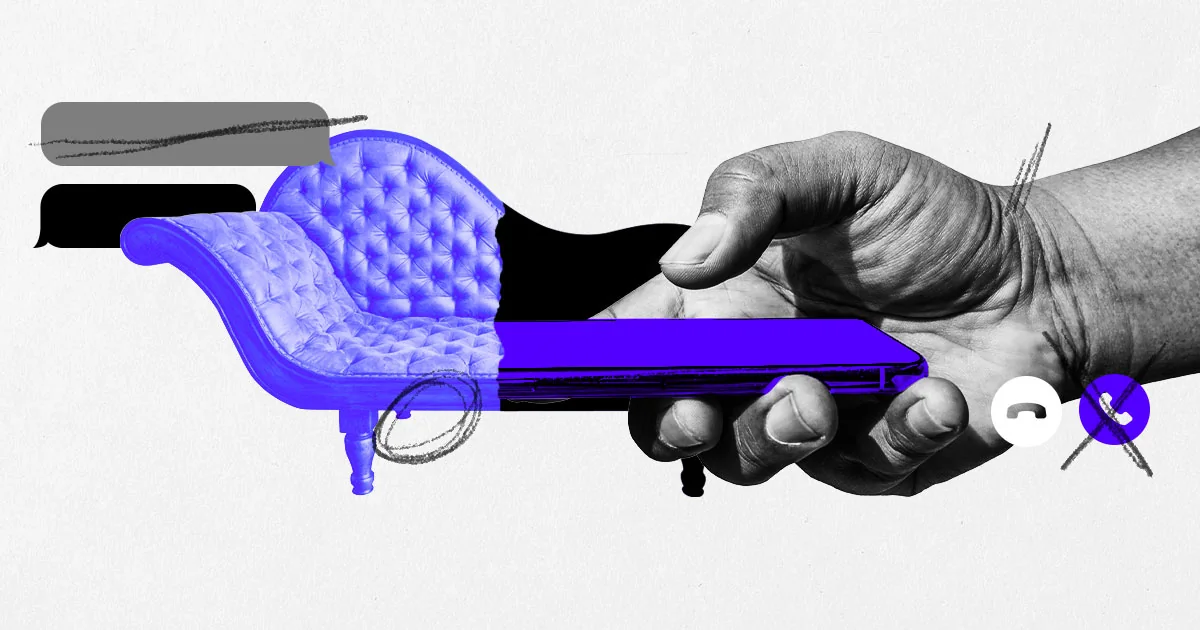
For a hundred years, when we have imagined therapy, many of us have imagined the settings in which it takes place: the clinic, the ward, the institution. Chief among these spatial associations is perhaps the so-called consulting room and what it contains: a box of tissues, a concealed clock, chairs and maybe a couch, the waiting room, buzzers, a white-noise machine droning, old magazines. More than the emblematic quality of the container itself, the office has also provided patient and therapist alike with a reflective space seemingly removed from their lives in the world. The office let patient and therapist meet in a confidential, secure place, one supposedly free of the noises or interruptions of work and family.
But over the past year or so, this de facto and idealized therapeutic place has been out of reach for most mental health providers and their patients because of required social distancing. As a result, FaceTime and Zoom, proprietary medical platforms, and apps have become therapy’s dominant spaces.
Before the pandemic, teletherapy—mental health services provided through technology—was seen as the shadow version of mental health care. It is now the default. But as vaccination rates climb in the United States, therapists and their patients are increasingly able to think again about where they might want to see one another. For some, vaccination has signaled the end of teletherapy and a return, quite literally, to the physical treatment room.
Given the long-standing attachment to, and significance of, the therapeutic office, it makes sense that for some therapists, a life of Zoom sessions was an exception rather than a new norm. These therapists call for a rapid and immediate return to the office—or have already returned there, masks on and windows open, sanitizing between sessions. These clinicians remain committed to the view that a certain kind of therapeutic co-presence can only happen when two (or more) bodies occupy the same room. I have even heard more than one therapist, on listservs and in hushed tones, compare video therapy unfavorably to sex with condoms. Remote therapy is cast as a hindrance, even though it has reduced other barriers to treatment.
Tech generates medium-specific forms of what I call “distanced intimacy” which, instead of weakening embodied togetherness and attachment, enables surprising kinds of human-to-human communication.
But for other practitioners, technology, along with the temporarily relaxed rules around it, broke the assumption that private practice had to mean a private office and revealed that arrangement as optional. Being relieved of commuting, high rents, and the dull repetition of sitting and listening was, well, freeing. Now, those practitioners say, there is no going back—at least not full-time. Perhaps more important, other clinicians who once assumed that the phone or Zoom would dilute the intimate bond with the patient have found instead that teletherapy not only works for them, but is preferable for many patients as a clinical tool.
For mental health clinicians who rely on interpretation as method, how to read a patient’s refusal to attend an in-person appointment is a fresh problem. Is it resistance or a search for safety? Yet this points to a new development in therapy, where the authority to define the frame of therapy is more evenly shared between patient and therapist. Where to practice is no longer the therapist’s decision alone; even if a clinician returns to the office, patients still have to be willing to come. And while for some patients pandemic teletherapy meant a lack of privacy necessary to pursue therapy (or, in other cases, a lack of the means to do so, such as a stable internet connection), many long-term patients found nearly the reverse: that therapy mediated by technology—whether phone, app, or Zoom—can do something extremely useful.
If the pandemic finally made teletherapy widespread, technologies have always been central to these caring exchanges. As has been true throughout teletherapy’s long history, some patients feel uniquely able to take part in therapy precisely because the therapist’s body is elsewhere, held at a distance. Tech generates medium-specific forms of what I call “distanced intimacy” which, instead of weakening embodied togetherness and attachment, enables surprising kinds of human-to-human communication. For patients who need the cover of anonymity to contact their emotions, for instance, or those who find it easier to express anger when they are physically alone, distance can make intimacy more possible.
Teletherapy can be more accessible and can introduce variation into the otherwise punishingly one-size-fits-all model of office-based care. This has been a revelation for many, especially those marginalized or pathologized within those forms of care. Teletherapy reduces some of the power imbalance built into expert care. Patients can choose not to be seen or to be seen only partly; they can show their actual living space or not, and can meet with a practitioner farther away than they could ever travel to or otherwise reach regularly. In addition, patients do not have to commute, which means fewer minutes away from work or other caregiving duties.
Other patients (and therapists) may feel anxious about what it means to try, perhaps impossibly, to resume life and work as it was before.
Many say they have valued the safety of displaced treatment—and of everyday life—especially amid a catastrophic pandemic. Finding a way back out is not simply a matter of vaccination. Although it is built around an exchange of money, therapy is a deeply intimate relationship and a test case for coming back together (or remaining apart) on the far side of this traumatic year. The way we do this is shaped both psychologically and materially, with immunocompromised people still unable to safely enter public life, many still unemployed, schools remote, and childcare hard to secure.
One risk, then, of yet another argument over whether teletherapy is “good” or “bad” (acceptable, better, worse, as intimate, more intimate, or less intimate) is that it can become a discussion that further classifies presence, embodiment, distance, and access to mental health care economically, and only for those already able to buy that care.
Contemporary teletherapy, like many digital interventions or disruptions, often promises democratized care. That is, by using various tech-enabled therapy models, we will finally be able to deliver therapy to everyone who needs it. Although corporate teletherapy apps are often promoted as expanding access, they are frequently available only through employee insurance or paid out of pocket and, in some cases, are therefore not much cheaper simply because they are tele-. It is also worth noting that with a sudden, mass move to teletherapy, we risk scaling up a whole range of deeply entrenched problems that affect patients and therapists alike—including labor, data privacy, and therapeutic confidentiality concerns.
And yet mental health care is so easily absorbed into a technology model in part because health insurance plans make so few accommodations for therapy in private practice, and because there are too few practitioners to meet demand. In short, mental health care is so broken that we are desperate for solutions. In a pandemic made far worse by inequality and unequal access, the sudden shift to teletherapy opened some, but certainly not all, barriers to psychological care. This is perhaps most true for historically underserved and overlooked communities, for whom purchasing care has been extremely difficult. In a nation where health insurance is tied to employment and where the reimbursement system for in-network and out-of-network mental health providers is exhausting to learn and manage (for providers and patients alike), suddenly 4 out of 5 of the major insurance companies waived the co-pay for teletherapy in March of last year. New patients were only willing to enter therapy (for psychological reasons) or able to access this kind of care (for material ones) because it had been made remote. At the same time, HIPAA enforcement was loosened to permit the use of Zoom and other consumer-friendly tools, precisely because medical-grade communications were failing. Now, those access points are slowly being rolled back as insurance decides we are no longer in an emergency state—just as Delta is surging in the United States.
When we shrink the clinical argument over teletherapy to the issue of whether it is good or flat, the debate, however falsely, becomes centered on a choice and on a resulting clash between those clinicians eagerly awaiting safe, close contact with patients in the quiet room of the past and those who have adjusted and are reluctant to give up this new digital way of assembling intimacy. And of course, for these practitioners, the stakes are about as large as they can be: what counts as good care in the 21st century.
Psychoanalysts joke about the impossibility of picturing Freud’s Zoom room. Therapists now have to figure out how to adapt to technology and protect the legacy of clinical practice (either by preserving it or by shifting it), and this serious question of care. Yet alongside these arguments there is also a wish for continuity, grounded in the idea that this is how therapy has “always been done.” Coming together in the office is a long-established custom. But this is only a partial view of therapy’s history. Teletherapy may feel “obtrusive” right now to some eager to return to the scene traumatically abandoned in March 2020, but telecare has been with us throughout the 20th century—long before therapy apps came to dominate the conversation.
Ever since early practitioners of the “talking cure” stopped placing hands on patients as part of hypnosis, some intervening distance between therapist and patient, however slight, has been deeply important in regulating therapeutic intimacy. Teletherapy is as old as psychoanalysis, and Freud himself practiced a version of it through letter-writing. Over the intervening century, as therapists have tried to batch-process patients, psychopharmacological and psychoactive drugs, short-term therapies (like CBT), and yes, technology, have each been used—sometimes together—to address the problem of therapeutic supply and patient demand that has been a pressing issue since at least World War I.
This also means that when we discuss the shortage of available care, we are always discussing access, affordability, and the supply of mental health workers. In a sense, we can revisit the terrain of Freud’s 1918 speech, “Lines of Advance in Psycho-Analytic Therapy,” in which Freud argued for psychoanalysis for all after World War I—even if that required giving up some of the cherished assumptions about what analytic practice might be like in its schedule, location, modality, and fee. Freud, significantly through a metaphor of precious metal, argued for a “psychotherapy of the people”: “We shall then be faced by the task of adapting our technique to the new conditions … It is very probable, too, that the large-scale application of our therapy will compel us to alloy the pure gold of analysis freely with the copper of direct suggestion.”
“Large-scale” is now a requirement for access, yet the ability to provide therapy at no cost is essential. Throughout its longer past, teletherapy has almost always been supplied for free or at low cost by activist clinicians, community members, and psychologists who were experimenting. As I argue in my book, The Distance Cure: A History of Teletherapy, they have “alloyed” the pure gold of psychotherapy with silicon. Technology has widened the therapeutic office’s reach by making it disappear, and not merely because it extends that scene’s material range across distance. When one assumption about what therapy has to resemble is thrown out the proverbial window, other assumptions about where and when and for whom therapy can be offered follow. If therapy is not limited by the office, then perhaps it follows that we can, both individually and at a systemic level, rethink a therapy that needs only emotional investment from its patients rather than economic investment. When we demand in-person treatment, we are perhaps demanding a kind of purity of genre, of payment, and finally—as Freud understood—of the sort of patient who can be admitted to the consulting room.