
When people discuss crypto’s recent past and imagine its far-off future, the talk keeps circling back to how wealth gets made and then spread around. Whether people realize it or not, there is a shared sense that growing the network means more than making existing members richer; it also requires increasing the number of people who can actually afford to join.
It has been talked about everywhere from Vitalik’s blogposts …
“This state of affairs in funding was possible at first because of extreme Bitcoin price rises from 2010-13, then the one-time ICO boom from 2014-17, and again from the simultaneous second crypto bubble of 2014-17, all of which made the ecosystem wealthy enough to temporarily paper over the large market inefficiencies.”
…to episodes of Bankless …
“I think what was perhaps one of the best things that came out of the 2017 ICO boom was the people were spending their eth and that led to reorganization and further distribution of eth across many many hands.” — Santiago Santos
…to observations from builders in the space …
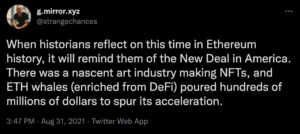
Looking at those Ethereum examples from the last few years, the network starts to look like a system that balances itself: when money gets stuck in the hands of a few, or activity is boxed into a limited set of protocols, redistribution — and fresh invention — eventually takes over, pushing value into new wallets and drawing in new people along the way.
Innovation over the past several weeks has been astonishingly fast: Layer 1 chains have pulled in billions of dollars in Total Value Locked, Layer 2 solutions are scaling at speed, and NFT sales keep setting new records. But we should also look past DeFi and NFTs. As more people come to web3, there will be even more varied ways to take part. And although it may seem to clash with the industry’s own name, there ought to be more ways to use crypto that put less emphasis on currency involvement.
New entrants, rising prices
There are many ways to read the size of the expanding participant base. We could start with centralized exchanges such as Coinbase (68 million verified users, up from 34 million verified users last year). If you add Robinhood and Square, that comes to something like 84 million crypto owners across those three companies. Or consider active Ethereum addresses, which reached around 10 million at their summer peak, according to wallet data sources like Metamask and providers such as Glassnode. Or total DeFi users over time (roughly 3.3 million people on Ethereum alone, up from 450,000 at this point last year). Or the number of Ethereum wallets holding at least one NFT (1.2 million, up from about 500,000 last year).
If you turn those figures into a story, it is obvious that the past year brought a remarkable jump in the number of crypto traders (that is, users who may mainly see holding crypto as an investment). There is also a smaller — though growing — share of the public that now uses crypto through peer-to-peer payments, DeFi, NFTs, and community creation. In other words, people who now treat crypto as a way of life.
Suppose the number of crypto users has at least doubled — and maybe quadrupled — over the past year. What that figure leaves out is that Ethereum’s price — and therefore the cost of taking part in what is now the most active crypto network — has also risen sharply. That is arguably a disadvantage for newcomers.
Early net, falling costs
People frequently liken this period to the internet’s early years. And there is plenty of truth in that: by the end of 1999, the three biggest internet providers in the U.S. reached about 26 million households (or roughly 100 million people), only a bit more than the current total of crypto owners at Coinbase, Robinhood, and Square together. Community networks such as TheGlobe had 4.7 million users. Online brokers like e*Trade had 3 million customers (about the same number of DeFi users today). And web3 keeps the early internet’s ambition alive: we are now trying to move value at the same speed as communication.
Yet many of the internet’s first users also benefited from prices falling each year: in 1996, AOL moved from usage-based pricing to flat-rate plans, which not only accelerated consumer adoption of the internet, but also increased the time people spent online.
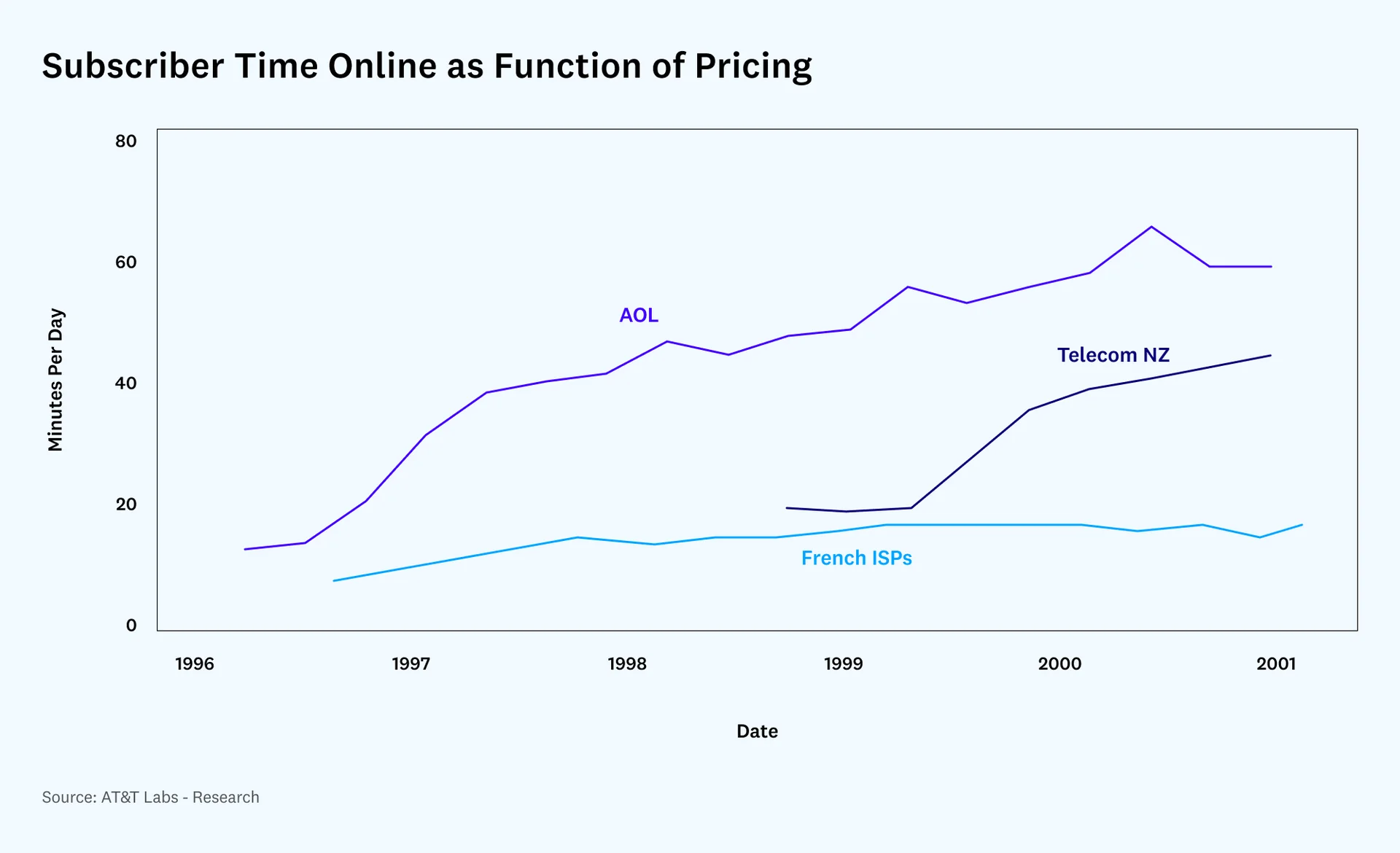
The chart above looks at time spent online in the United States, France, and New Zealand from 1996-2001. After AOL adopted flat-rate pricing in 1996, internet use tripled within a year, then doubled again by 2001. It is worth noting that internet speeds remained fairly unchanged at 56 kilobits/second for dial-up users (who made up most internet subscribers then). The same thing occurred in 1999 when Telecom New Zealand rolled out flat rates in its XTRA ISP Business. Meanwhile, French ISPs kept charging by the minute until 2002, when the French telecom regulator ART required ISPs to cut fees by 25-40% (as the chart shows, time spent online in France stayed roughly flat in the country from 1996-2001).
The lesson is that, even though internet speeds remained fairly stable in the early internet era (before cable, DSL, and satellite connections spread widely and began saturating the market through the mid-2000s), time spent online still rose in places where prices fell. That likely set off a virtuous cycle — the more time people spent online, the stronger and more valuable networks became, which in turn was followed by more innovation. Beyond a $19.95 monthly subscription fee, there were few obstacles to joining.
Wallets are keys
I have been thinking about how fortunate I was to find crypto about a year ago — back when Ethereum was cheap enough that I could treat whatever losses I took in the beginning as a kind of tuition I had to pay. When I lost money — because of fees, bots, or my own mistakes — it was unpleasant but not disqualifying; I could always top up my wallet and start over. It also helped that Ethereum’s price was rising almost every week: I could explain away every wallet refill as part roulette, part fate-driven dollar-cost averaging.
But the mood feels different now: gas costs are higher, the participants are more ambitious, and the bots appear more advanced. Opportunities increasingly seem to belong to insiders, bots with names like “mevsniper.eth,” and people who know which NFT mints to grab directly from Etherscan (and how to mint directly from Etherscan). Yes, I support the idea that you have to look out for yourself in the dark forest, DYOR, and get rugged (note: I mean rugged in the sense of resilient, and rugged in the sense of rekt). But if it becomes incrementally more difficult for new entrants to stay competitive and nimble in the current paradigm, we may slow the pace at which new crypto users grow.
The next generation of projects should focus not just on speed and low cost, but on function too. I do wish more projects made simply owning a wallet — not holding a specific currency or NFT — the only requirement to get in.
The loot that launched a thousand ships
The last few weeks have offered some encouraging examples. Dom Hoffman’s Loot project became a kind of crucible for many of the opportunities, tensions, and innovations that crypto contains. The NFT project inspired many derivatives (some of which brought in tens of thousands of dollars for their creators), an in-game currency (or governance token?) called $AGLD and world expansions such as Loot Characters. But my favorite offshoot in the rush came from Dom himself, who suggested making “Synthetic Loot,” a way to generate a virtual NFT from the keys of any user’s wallet (link to contract here). In Dom’s words, “creators building on top of Loot can choose to recognize Synthetic Loot as a way to allow a wider range of adventurers to participate in the ecosystem, while still being able to easily differentiate between ‘original’ Loot and Synthetic Loot.”
What I liked about Synthetic Loot was this: it could have acted as an entry point for people who are newer to crypto. And not only as an onboarding tool or an online course — if the Synthetic Loot ecosystem had grown at the same pace as the rest of the Lootverse, it could have brought newcomers and less eth-rich wallet holders right into the center of the most exciting thing happening in Ethereum: an experiment in gaming, governance, and coordination. The problem with Loot is that it really only gives Loot-holders an incentive to grow the economy. Synthetic Loot could have widened the circle of participants much more.
Synthetic Loot didn’t spark as much enthusiasm as other easy-to-access Loot variants, such as mLoot, the mintable Loot expansion pack. From what I could tell, only one project relied on the Synthetic contract to extend Loot Characters and produce sLoot renderings. There is certainly an upbeat way to interpret how this unfolded. Synthetic Loot’s inability to win over users could also reflect web3 priorities: ownership first and foremost. Synthetic Loot is neither transferable nor ownable in the way a standard NFT is, so it may not motivate builders and users to the same extent.
That doesn’t imply that the concept of accessible NFTs is any less appealing. Dapper Labs was an early trailblazer — first with CryptoKitties and now with NBA Topshot — in building user-friendly ways for people to engage with crypto, and in pushing inclusive price points that feel open to everyone. As Brian Flynn of Rabbithole noted a few days ago, Dapper Labs also gave developers a way to build on CryptoKitties, much like people are now building on top of early NFT-focused games. And on other chains as well, there is evidence of major progress.
On September 5th, Andre Cronje, the founder of yearn (which has also been likened to Loot), posted a blog entry titled Loot & Rarity. In it, he outlined the plan for a D&D-like game centered on sending an NFT “Summoner” on quests, gaining levels, and collecting skills and attributes. Importantly, the only costs tied to keeping a Summoner are gas (fees that are low because Rarity runs on the Fantom blockchain). It triggered a buzz of activity: There is now a functioning frontend for Rarity, a summoner search tool, a dungeon, rare gems, Rarity Gold, and more visualization tools in development. There are also at least 100,000 unique summoner owners (though this does not rule out the chance that one player holds multiple wallets or summoners). On Friday, another developer called “storming0x” released Deevy Project, a trading card game on Arbitrum where the first set is free for the user to mint. In the last few days, other projects have also remixed the atomic units of web3 games: Miguel Piedrafita’s “wagmigotchi”-inspired game on Polygon and Nour Haridy’s Lair of Wisdom on Fantom.
Mainstreaming crypto
This is not intended to set any chain or game against another one (full disclosure: I’m a Loot-holder). What interests me more is this emerging phase of where we are in the mainstreaming of crypto. The first consumer-facing dApps beyond DeFi are starting to scale, L1s and L2s are beginning to draw activity away from the Ethereum mainnet — but the very thing that demonstrates Ethereum’s strength (its current price) may also turn into a bottleneck for engagement going forward.
Ethereum, and crypto more broadly, cannot simply reduce prices whenever it wants — the expense of bootstrapping a network and rewarding miners and stakers makes lower prices at the infrastructure layer hard to achieve (that is the reality of being a decentralized network rather than a multi-billion dollar telco company with an operating budget and the ability to use debt to finance capex). There are, however, choices further up the funnel, and developers can decide how to build in features that make crypto easier for the average user to interact with. I am not saying developers should make things free (deploying a smart contract is costly and time cannot be replaced). But where are the chances for more people to participate in crypto in a way that is not buying or flipping NFTs, using DeFi, or working for a DAO? And how will people discover the pleasure of collaboration and shared ownership on a network that has already priced them out?
It may help to view this as a spectrum — where we are now, and what we may hope to see more of later. At one end of the spectrum is participation through capital: This is what we saw in the early days of crypto networks, DeFi participation, and NFT trading. In the middle are emerging ways of earning your spot at the table — everything from earning DAO tokens by taking part in a working group, to sending proposals to a DAO for a particular job, to adding to conversations on Discord, to finishing quests on Rabbithole, to play-to-earn games like Axie Infinity. And at the other end are formats that are only now starting to appear: taking part in crypto first through the simple act of having a wallet.
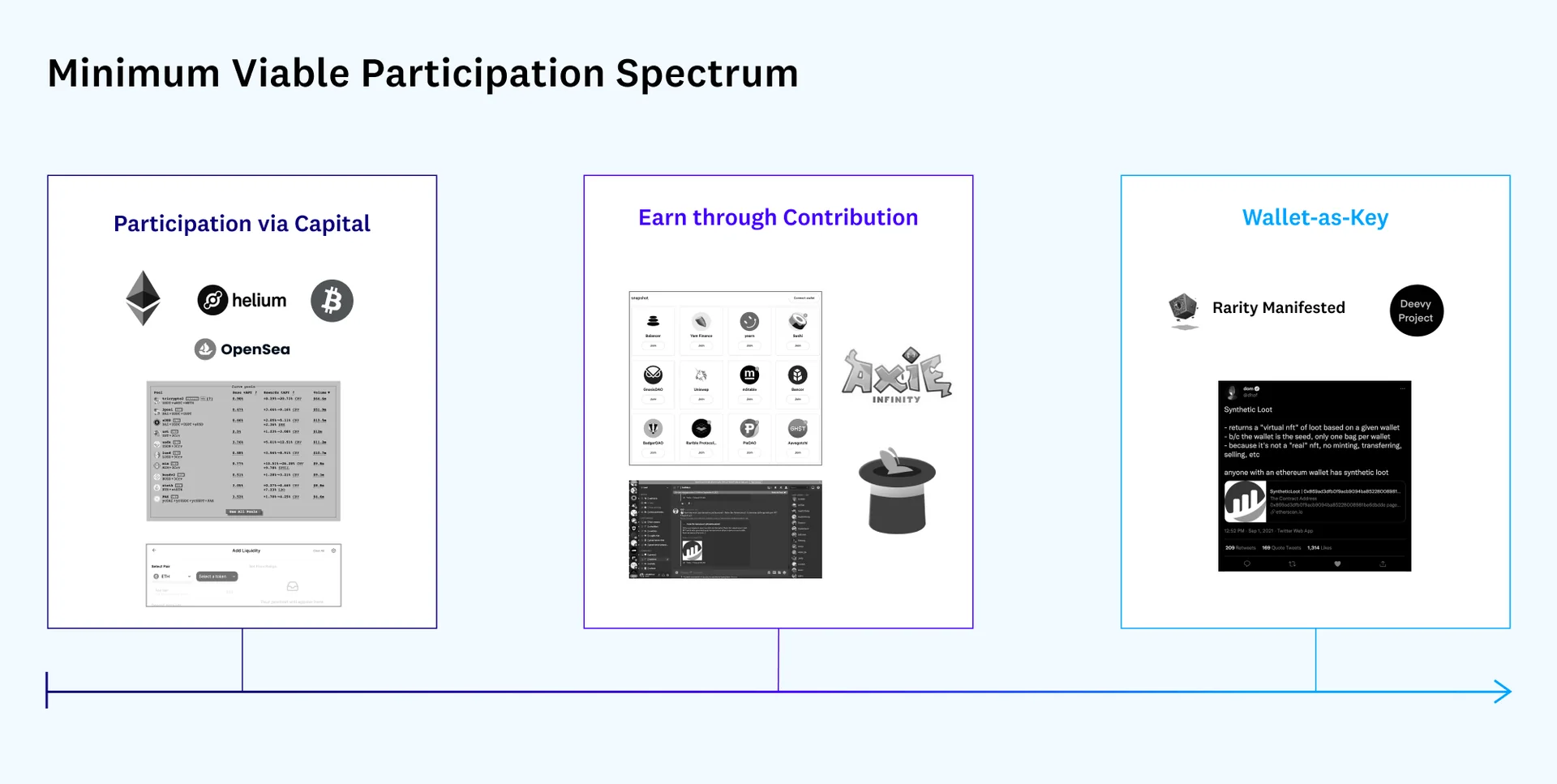
A few days after writing about Synthetic Loot, Dom also wrote about a method for making Loot expansion packs instantly available to every Loot-holder, without making users pay gas. This was another intriguing proposal: It would force developers to point to a sort of standardized registry of all Loot expansions, possibly requiring more coordination, but also bringing the ecosystem together in a more network-friendly way. Although it does not appear that developers have embraced this standard, it is an encouraging sign of where the energy is moving. Between attempts to make on-chain, non-financial dApps more affordable, and exciting accessible game projects on other chains, it is clear there is a wish to make crypto more concrete for the everyday user, along with the grassroots coordination that can help bring it about.