

Reputation systems give platforms a way to identify—and therefore reward—participants’ high-quality contributions, including content creation, moderation, community building, and gameplay. This matters greatly for the growth and long-term viability of any web3 project. But building reputation systems means making difficult choices about reputation supply, distribution, credibility, and more. So although many are investigating this area—from DAOs such as FWB to play-to-earn games like Axie Infinity and new social platforms such as BitClout—builders still have not settled on the best design for these reputation systems.
Using our understanding of economic theory and game design, we contend that reputation systems should be built around a pair of tokens—one for reputation signaling and the other for liquidity—which could act as concrete markers of meaningful contributions.
The evolution of reputation systems
The core idea behind reputation systems is not new. Since civilization began, people have used signs of reputation, such as giving badges for merit or service. In the corporate world, workers are given titles or “levels” to show where they sit in the hierarchy—such “tokens” usually set salary and other perks.
Gaming has also been a long-time leader in digital reputation systems. Players earn “points” while playing, which they can exchange for in-game “coins” to buy new skins, weapons, characters, and the like.
In the crypto world, reputation tokens have generally appeared as social tokens. These tokens—which may be issued by many kinds of entities, including individuals and communities, as well as games and apps—can be used to gain social capital, access services, and/or turn into rewards, financial or otherwise. Just as important, in crypto settings, social tokens can often stand for ownership and uniqueness (in the case of NFTs) and, because blockchains make them decentralized and portable, they can be used across the global internet economy rather than only inside a single platform or by one decision maker.
The paradox of reputation tokens: Was it earned or bought?
Reputation tokens on digital platforms usually have two functions:
- To find and reward the users who have added value to the platform—a signaling function that those users can convert into public reputation. To act as a kind of payment that lets contributors turn some of the value they created into a currency they can exchange.
But these two functions clash with one another. A token must be exchangeable to be liquid. Yet the more liquid a token becomes, the less well it can function as a pure reputation signal.
To see this, imagine reputation tokens can be transferred without restriction. If the tokens were a reliable sign of reputation quality, their market value would be high, and holders would be inclined to sell them. But once trading begins, ownership no longer signals anything, wiping out the reputational capital the tokens are supposed to represent.
For instance, a charity might begin minting NFTs that it gives to people who have completed more than 500 hours of community service. But if those recipients may sell their NFTs to anyone they choose, then whenever you see a holder, you have to ask: “Did that person earn their NFT or buy it?” Even if no one publicly trades their community service NFTs, the chance of private sale weakens the signaling value. And in a fully liquid market for such tokens, the signaling value disappears entirely.
This creates a paradox: if a token is easy to transfer, people without reputation can simply buy it, which weakens the token’s ability to function as a reputation signal.
Remember when it was simple for people to buy Instagram followers? That made follower count a much weaker indicator of reputation, to the point that brands began seeking engagement metrics that were far harder to “buy.”
That said, very high prices can also make transfer harder. For instance, CryptoPunks are now so costly to buy that almost all holders must have purchased early. This may seem to resolve the paradox—restoring the tokens’ reputational value—but because some people are willing to pay extreme prices for CryptoPunks to create the impression of reputation, the signaling value may still erode. There is also currently a natural limit on how many people can enter the space; imagine this problem at scale as more people adopt crypto.
Furthermore, a drop in the reputational capital tied to a token can feed back into that token’s market value. If the token can no longer signal reputation, people become less interested in trading it. In fact, as people began buying Instagram followings in bulk, those followings lost signaling power, which made influencers less interested in buying them. That opened markets for other reputation purchases, including likes. An “I’m Rich” NFT that nobody believes truly signals wealth is not really worth buying.
Making reputation tokens transferable not only weakens their ability to act as a reputation signal, it can also undermine their usefulness as compensation. So building reputational capital calls for tokens that are fully, or at least mostly, non-transferable. The remaining question is how to turn reputation into liquidity.
Social capital shouldn’t be bought—but that doesn’t mean it can’t generate liquidity
A token has signaling value when a trusted source, such as a brand, university, or government, grants it. But in crypto and blockchain settings, there may not be centralized third-party sources that provide that authority.
So a second route to signaling value is to make the token much easier to earn if someone has certain underlying traits. For example, high scores in video games are far easier to achieve if you are truly skilled or have worked extremely hard; therefore, high scores signal some blend of skill and effort. High view counts on platforms like YouTube are similarly informative.
The paradox above—more transferable, less signaling power—exists because making reputation tokens transferable separates them from the underlying institutions and/or effort that act as sources of signaling value.
So what if instead we separate transferability from the token itself? That is why many games already split scores or points from coins or currency; it is easy to see how spending your “score” could really backfire.
We propose a two-token reputation system, in which one token, which we call “points,” functions as a non-transferable reputation signal. A second token, “coin,” is a transferable asset distributed to holders of points on a regular cycle. In effect, points generate dividends in coins that can be used as tradable currency. And because coins accrue to holders of points, coins also remain linked to the underlying reputation.
At a high level, this design creates a feedback loop in which users earn points from high-quality contributions on the platform such as contributing content, moderating, or winning gameplay. Then, when users with points receive coins, they can trade them as currency. Demand for coins pushes users to obtain points, which in turn encourages high-quality contributions.
Note that although we describe points as non-fungible and coins as fungible, the exact implementation may differ from one application to another. The essential idea is that contributors get a non-tradable token that generates tradable tokens.
Points should reward contributions
For points to preserve their signaling power and encourage high-quality participation, they need to be tied in some way to users’ contributions. In a game, points may just be assigned algorithmically based on performance. On creator platforms such as YouTube or TikTok, points could directly track people’s engagement with a particular creator’s content. In other settings, like publishing platforms such as Mirror, there may be a group of users who can grant points, or a governance/voting process that decides how points are allocated.
The crucial thing is that points must plausibly connect their holders to the source, or engine, of reputation. In addition, the rate at which points are awarded as a result of contributions needs to be clearly understood, so users can estimate how much work they must do to reach a given point level. In other words: participants need to know the rules of the game before they begin playing.
In many situations, points do not have to be scarce. For instance, Discord can award moderators as many badges as it wants. Still, scarcity can increase or strengthen the reputational value of the system. For example, the “moderator” role on a Discord server is reserved for only a handful of people, so a person with a moderator badge is viewed as having greater reputation on that server. And if the server began naming too many moderators at the same time, the perceived meaning and value of the role would weaken.
Size matters: The importance of dividends, supply, and distribution
To make reputation carry a liquid form of value, coins should flow to point holders through a sequence of dividends, with each point holder receiving coins according to how many points they possess.
There are three central questions in designing this kind of system:
Size: How big should dividends be?
The overall size of each dividend—that is, how much coin is handed out every time a dividend is issued—depends on the system’s macroeconomic objectives.
Unlike points, coins should be relatively scarce if they are to have value as a currency. Many currencies, such as Bitcoin, are helped by a long-term cap on coin supply — there’s only so many of them that can ever be minted. In these situations, the average total dividend has to shrink over time, unless some mechanism exists for coin to be absorbed back into the system, such as through payments made within the platform.
Even so—and contrary to some common assumptions—coin supply does not necessarily need to be capped. If, for example, coins can be redeemed for a portion of a platform’s treasury, then total coin supply can grow as the treasury expands. In those cases, dividends could stay the same in total size, or even increase over time, as long as the dividends are spaced far enough apart that they do not surpass the treasury’s growth.
Supply: How frequently should dividends be issued?
For platforms where participation works like employment, as with gig or creator platforms, the best approach would be to pay coins to point holders on a fixed schedule: for example monthly, or even daily. That way, users who contribute valuable work and therefore preserve a certain point level receive a steady income.
Dividends that are infrequent or issued irregularly are better suited to platforms where contributions are less routine, as in some DAOs. For example, Forefront issues its $FF token when a member writes an article or contributes to a coding project. Another option is to issue coins only when platform engagement, productivity, or funding rises above a threshold. This resembles dividends at public companies, and we also saw it in the case of Mirror’s $WRITE token airdrop.
Distribution: How should the size of the dividends relate to point holdings?
The simplest way to connect coins to points is probably through linear dividends, where each point gives a user an equal portion of every dividend. But that is not the only choice.
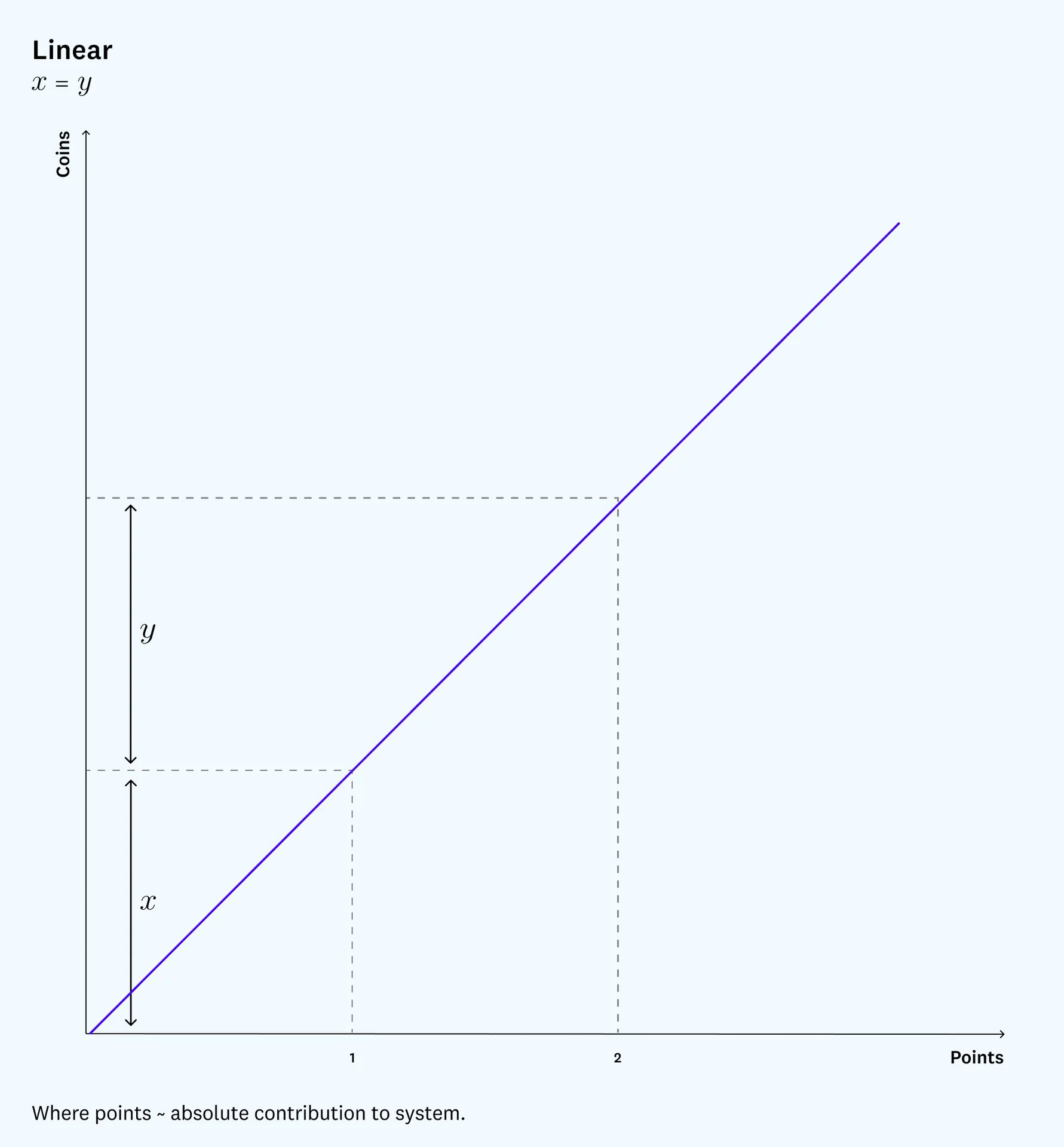
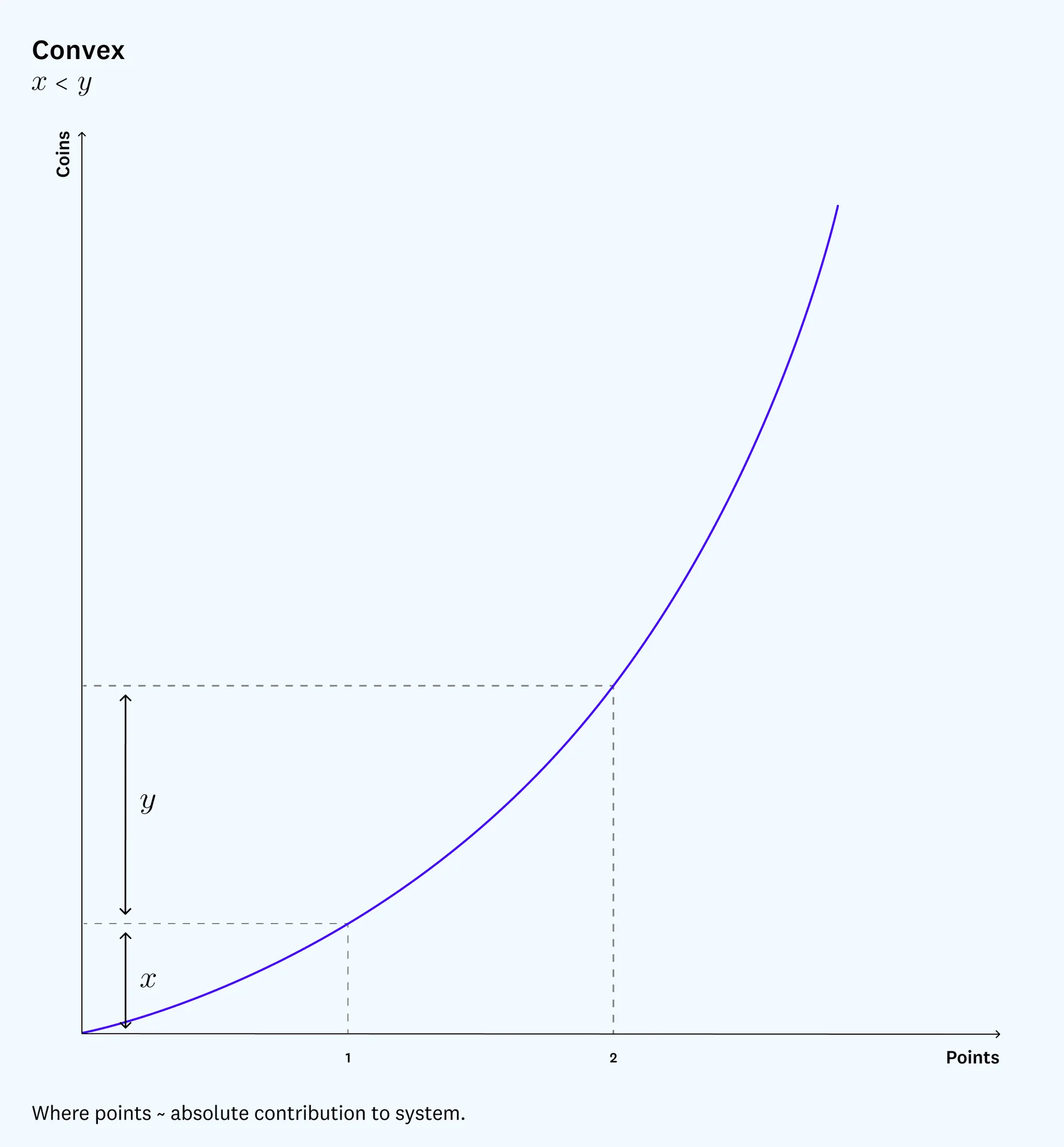
With a convex dividend rate, a disproportionately larger portion of each dividend goes to users holding more points. In other words, the jump in dividend from 1 point to 2 points is greater than the jump from 0 to 1. A convex rate rewards users who have stayed active in the system for a long time, creating more incentive to keep their status.
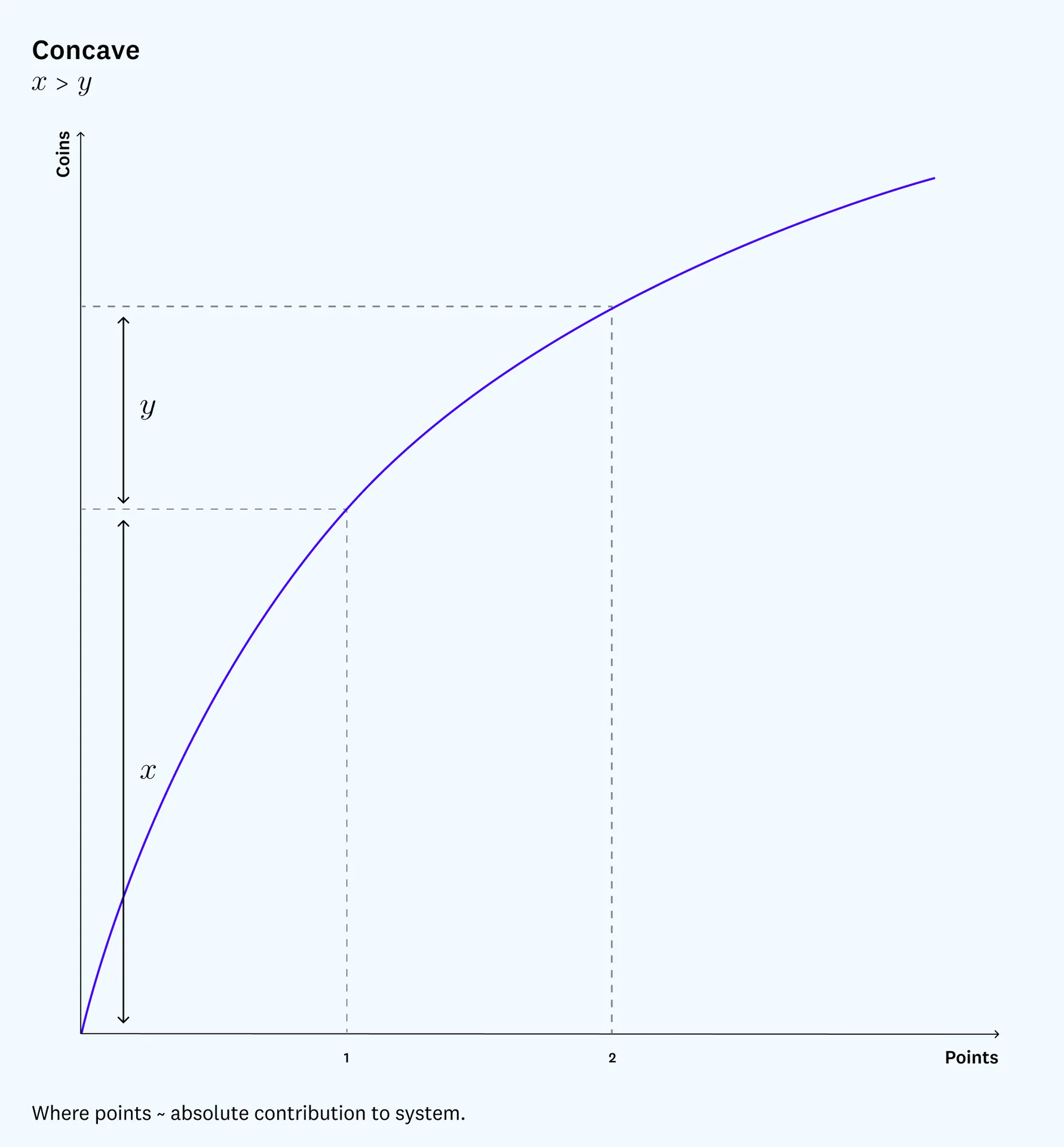
The reverse option is a concave dividend rate, where moving from 0 points to 1 is worth more than moving from 1 to 2. This approach is well suited to attracting new users, because it rewards first contributions more than later ones, whether the next contribution is your second, third, or 27th. That said, a concave rate system like this is harder to sustain if users are anonymous, since in that situation users can open many accounts and collect “early” points through each one.
Financial rewards should align with contributions
The three dividend design features—size, supply, and distribution—set how many coins a point holder gets in each period. This relationship has a direct effect on the incentive to earn points.
Ideally, coin distribution should be tuned so that a user’s marginal return from acquiring points matches the marginal benefit of the point-generating activity to the platform. How you define this marginal benefit depends on how contributions create platform value. Put differently, you should earn points according to how much value you are creating for the platform.
On platforms like YouTube, for example, points would correspond to video views—and the platform can estimate quite precisely how much any given view adds to platform engagement and the bottom line. The platform should then distribute coins to each creator in proportion to the marginal value of their views. In this case, convex dividends may be appropriate, since “top” YouTubers generate more long-term engagement than less popular ones. YouTube has gone through several versions of this—first linking payout to views, then to watch time and, most recently, to an engagement metric it has called “YouTube time” that accounts for more than just time spent watching content on the platform.
YouTube is always adjusting how much it pays out. This creates income uncertainty for YouTube creators who rely on ad revenue payouts to cover their bills. Ideally, a platform would make the amount participants earn from their contributions more transparent, so contributors can judge the value of acquiring points, as well as prevent frustration and burnout.
Additionally, the principle that marginal return equals marginal benefit suggests that the rules for point allocation may need to be revised. That lets the platform assign a disproportionate portion to early contributors, in line with how important their contributions were to the system when it was less established. That said, the platform may not have a definite grasp of the value of those contributions, especially at the beginning, so a mechanism for experimentation and recalibration around token distribution is needed.
Reputation incentives must be ongoing
The connection between points and coins creates a natural way to reward users who have made high-quality contributions. But because points are non-transferable, there is a kind of hysteresis: those who collect points early could end up holding a disproportionate share of the dividends, especially if the asymptotic coin supply is fixed.
In many crypto projects, the biggest holders are simply the people who learned about the project first. But those early adopters are not necessarily the ones most valuable to the ecosystem’s future. So it is crucial to preserve incentives for continuing contributions and engagement. One natural way to do this in a two-token framework is to let points fade or depreciate over time. This can be done by reducing dividends as a function of the age of user points. But an even simpler implementation is to have a user’s point totals fall, either automatically over time or as a function of the user’s engagement level relative to others.
This is again similar to what happens in gaming: With absolute leaderboards, points are zero-sum—if a player does not keep contributing, then they eventually lose their ranking as other players pass them. The same is often true on creator platforms, where competition for consumer attention encourages ongoing participation.
But even when the point pool itself is expanding, rather than zero-sum, there may be value in having points decay mechanically simply to create participation incentives. There also may be value in clearly defining the rate and causes of point degradation, as it could help users optimize their contribution levels.
Point degradation means that coin dividends are like a stock dividend with automatic dilution over time, in the same way that traditional public firms dilute their equity by issuing new shares precisely when they need fresh investment to increase their value. In this sense, point degradation reflects the need for ongoing user investment in the platform.
And of course, as with any currency system, the actual value of coins depends on the community’s perception of that value. This implies that the value of points depends largely on the perceived value of coins. Thus, the community’s perception of a coin’s value needs to be at least high enough to support the total coin in distribution.
This means the platform may need to carry out monetary policy—adjusting the total money supply, perhaps through buybacks or temporary trading restrictions. For example, in the first few weeks after launch, BitClout didn’t allow the exchange of BitClout to other currencies. The two-token system we have described offers a simple alternative approach: adjust either the point accrual rate or the dividend flow rate. For example, the council that governs a game could make the game slightly harder, as a way of slowing point accumulation, or could reduce total dividend size, as a way of decreasing the long-run coin supply.
But builders have to be careful with these kinds of interventions, as every change in the overall incentive structure for contributors affects contributor behavior. In particular, anything that unexpectedly degrades point value could damage user trust.
Don’t overfinancialize it
We’ve set out some core principles of social token design, but it is equally important to pair such designs with product-market fit that intrinsically motivates users. For example, a play-to-earn game that focuses on enabling users to profit but that does not get the “play” element right misses the point: games are, first and foremost, supposed to be played for fun.
A product that is built around a reputation system but lacks true product-market fit risks creating a community of speculators, rather than actual users.
But once product-market fit is achieved, incentive dynamics take over. It would be very hard for a platform to scale and reach mass adoption if it does not reward users properly. To make the incentives work, a reputation system should separate social capital from financial capital, especially if the former offers a clear route to the latter.
* * *
There’s much more to consider here, such as the relationship between governance and reputation; making the reputation system responsive to the evolution of the contributor community; and making reputation building accessible for all types of contributors. But we believe that if builders embrace the two-token system design at a high level, they’ll be able to reward contributors with an authentic reputation signal that holds its value even while generating liquidity. That’s precisely what these projects need to drive growth.
Acknowledgments: This essay is a response to a community request via GhostKnowledge. Thanks to Sari Azout, Christian Catalini, Far, Jihad from Forefront DAO, and David Phelps for their input.
Disclosures: Jad Esber is an investor in a number of NFT and DAO projects. Scott Kominers provides market design advice to a number of marketplace businesses and crypto projects, including Novi Financial, Inc., the Diem Association, and Quora.