Web1 (roughly 1990-2005) centered on open, decentralized, community-run protocols. Most of the value flowed to the network’s edges — users and builders.
Web2 (roughly 2005-2020) centered on centralized, siloed services operated by corporations. Most of the value flowed to a small set of companies like Google, Apple, Amazon, and Facebook.
We’re now at the start of the web3 era, which blends the decentralized, community-governed spirit of web1 with the advanced, modern capabilities of web2.
Web3 is the internet owned by builders and users, coordinated with tokens.
(Thanks to @packyM for this definition.)
Why does web3 matter?
First, let’s examine the issues with centralized platforms. (I wrote more about this back in 2018.)
Centralized platforms tend to follow a familiar life cycle. At the start, they do everything they can to attract users and third-party complements like creators, developers, and businesses.
They do this to reinforce their network effect. As platforms climb the adoption S-curve, their influence over users and third parties keeps increasing.
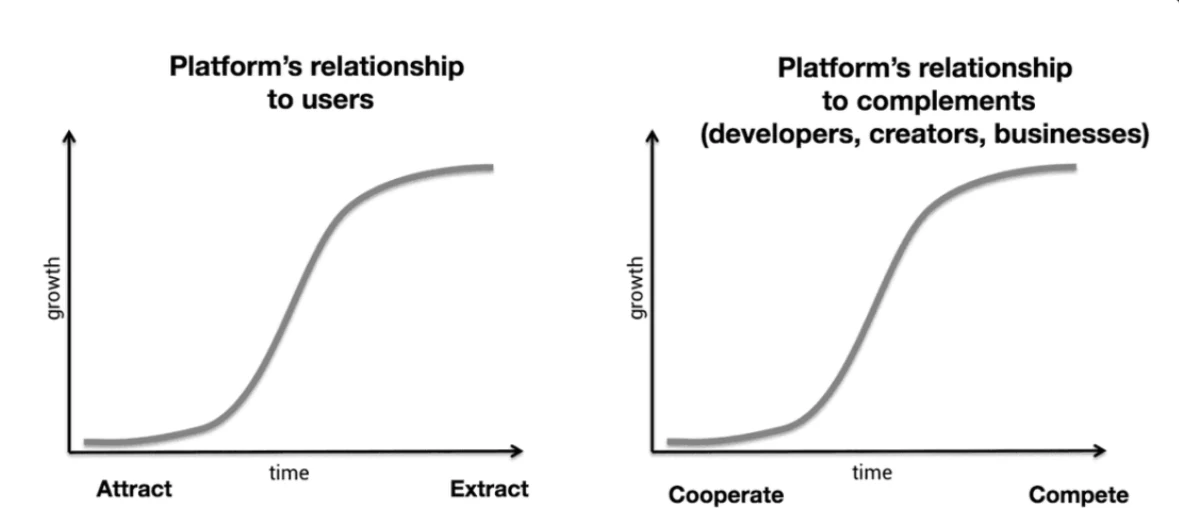
Once they reach the top of the S-curve, their ties with network participants shift from positive-sum to zero-sum. Keeping growth going means extracting data from users and competing with (former) partners.
Well-known examples include Microsoft vs. Netscape, Google vs. Yelp, Facebook vs. Zynga, Twitter vs. its third-party clients, and Epic vs. Apple.
For third parties, the move from collaboration to competition feels like a bait-and-switch. Over time, the best entrepreneurs, developers, and investors have learned not to build on top of centralized platforms. This has slowed innovation.
Now let’s discuss web3. In web3, ownership and control are decentralized. Users and builders can own portions of internet services by holding tokens, both non-fungible (NFTs) and fungible.
Tokens give users property rights: the ability to own a share of the internet.
NFTs let users own objects, which can be art, photos, code, music, text, game objects, credentials, governance rights, access passes, and whatever else people imagine next.
NFTs live on top of blockchains like Ethereum. Ethereum is a decentralized global computer owned and operated by its users.
Blockchains are unusual computers that anyone can use but no one owns.
Ethereum is powered by a fungible token, ETH, which incentivizes the physical computers that support the system. ETH is also the system’s native currency for transactions, like NFT purchases.
There are many ways for users to obtain fungible and non-fungible tokens. You can buy them, but there are also ways to earn them.
Uniswap famously retroactively airdropped 15% of its governance tokens to early users of the protocol. Community grants like this have become common in web3 as a way to build goodwill and encourage adoption.
You can also earn tokens through creative and entrepreneurial work. For example, people are earning roughly $100 million worth of ETH per day selling NFTs.
Tokens align network participants to work together toward a shared objective — the growth of the network and the appreciation of the token.
This solves the core problem of centralized networks, where value gets captured by one company, and the company ends up battling its own users and partners.
Before web3, users and builders had to decide between the limited functionality of web1 or the corporate, centralized model of web2.
Web3 introduces a model that brings together the best parts of earlier eras. This movement is still young, and it’s a great time to get involved.
This first appeared here.