
As DeFi and NFT communities swell dramatically, how decentralized protocols are governed matters more than ever. Right now, and for the next few years, one of the most pressing problems these communities face is working out governance — the practice of directing collective decision-making to optimize funds and operations.
Governance does, however, demand substantial coordination costs, since network participants must be involved in voting on every decision that is made. These coordination costs can be cut sharply in new kinds of decentralized networks, where smart contracts allow participants to govern together.
These new networks are known as DAOs (decentralized autonomous organizations) — groups of people united by aligned incentives and shared interests, with no single leader or point of failure, and run almost completely by code. Many new protocols are being developed with this structure, much of the activity so far in open-finance-based systems, but also, more and more, in cultural networks buying and trading art and other collectibles. In many respects, DAOs may be seen as a blend of parts of investment banks, companies, and social clubs, held together through cryptographic commitments.
Despite the name, DAOs are usually not entirely autonomous — someone must design decision frameworks to make sure a DAO is governed well and financially motivate network participants to take part so the DAO can expand.
Many questions then face DAO creators and participants: What decisions must be made? What kinds of financial incentives can be applied? Under what conditions should DAOs be created? What are the main governance tasks needed today? And what tools can be used to help govern?
Before answering those, let’s ask another question — how did we arrive here? — and briefly look at how DAOs developed. This will let us see how decentralized structures have formed and shifted over the last half-decade, helping explain why financial incentives are a central factor in the coming age of DAO governance.
Experiments paved way for modern DAOs
The world first heard about these internet-native organizations in 2016. “The DAO,” the best-known early DAO, was a collective investment vehicle meant to be a rationalist version of crowdfunding — a kind of decentralized venture fund — and it gave the first look at how such a decentralized organization, run through code, could govern itself. Participants sent ETH to The DAO and received DAO tokens. These tokens gave holders an economic stake in The DAO along with voting rights.
The DAO’s dream was to let any participant — no matter how small or large their contribution to the treasury — earn substantial rewards in the Ethereum ecosystem. A serious smart contract bug caused the funds in the DAO contract to be drained by an attacker, and the term DAO fell out of favor, giving rise to the “DAO winter” that matched the post-2017 bear market.
With expectations lower and less attention on them, a number of significant governance experiments during this period helped prepare the ground for modern DAOs. The first of these tackled security — no network can work, much less expand, if users fear their funds will vanish. First, Ethereum rivals such as Tezos proposed safer smart-contract programming languages that would make it simple for developers to avoid The DAO’s problems. On Ethereum, several experiments such as Aragon, dxDAO, Kleros, and Moloch appeared. These DAO implementations introduced stronger programming standards and experiments with new token distribution mechanisms to the space.
With security worries reduced, the biggest problem common to early DAOs was that they still could not find an incentive model that drove high voter participation in DAO matters. Without participation from voters with specialized knowledge needed to make informed decisions, DAO governance stalled.
The rise of financial incentives
The rise of DeFi (decentralized finance) in recent years has opened the door to more advanced open-finance systems and tools that don’t depend on banks and other legacy systems. New DAOs started to appear that used financial incentives to promote participation in these systems.
These incentives, and the ways they have built on one another, have become essential to DAO governance — without financial incentives, network members have no reason to invest their time, money, and energy in networks, vote on proposals to improve them, or care at all about their ongoing growth and success.
Here are several kinds of incentives, and some of the key events in their formation, to help builders understand how we got here, when DAOs are needed, how incentives are vital for governance, and the tactics for governing DAOs effectively.
Growth incentives
An important development came in June 2020, when Compound, an on-chain lending protocol, decentralized itself — its core developers handed over the operation and ownership of the network to the community. Unlike earlier DAOs, the Compound Governance DAO gave community members control of the protocol’s reserve assets that are produced through fees from borrowers. These cash flows were (at the time) the highest revenues ever produced by an on-chain protocol.
Compound devised a new token distribution model that aimed both to encourage capital growth within the protocol and to give users better loan pricing. This model included continuous distribution of Compound’s native tokens (COMP) to users who supplied liquidity to the protocol and borrowed from the protocol. Every user of Compound immediately became a stakeholder, with some of them becoming active contributors and voters.
These financial incentives were essential for controlling key parameters such as margin requirements and interest rates. Compound’s distribution offered a glimpse of the decentralized dream — control of the protocol (and its cash flows), by users of the protocol. And as the Compound protocol had billions of dollars of assets and liens that needed governance, the basic conditions for a new kind of DAO were established — participants had clear reasons to act in the best interests of a network, with their time, assets, and votes, because the growth and success of the network could personally benefit them.
Yield farming
The development of governance token distribution, given to users of a protocol rather than only investors and the development team, created room for many new models to emerge. First came the creation of various incentivized actions on a protocol — “yield farming.” Yield farming happens when users are rewarded for carrying out actions like lending, borrowing, staking, or providing other forms of asset liquidity — and the reward is a token that represents a share of ownership of the protocol itself. Recipients can either hold that ownership, betting on a rise in the protocol’s value, or they can sell it on the open market, compounding their action and raising their yield. Imagine if major banks gave you a small share of their stock each time you made a deposit — you’d be more likely to make deposits, which would be good for you and the bank.
Compound users, for example, could realize a form of yield by locking their capital in the protocol (i.e., using it as collateral to transact in the protocol through borrowing and lending) and earning denominated DAO governance tokens. In this way, Compound was able to use COMP to incentivize growth and build a user base motivated to vote on and contribute to the protocol, as the promise of yield brought in more users.
Once developers recognized that they could draw capital to new DeFi primitives through yield farming, there was a race across the summer of 2020 to expand DeFi protocols via DAO governance token distributions. The summer’s growth catalyst was the launch of DeFi yield aggregator Yearn Finance (YFI), whose “fair launch” (in which all tokens are distributed to capital providers and none to developers), shifted the narrative away from VC-funded projects to community-funded projects. Once YFI launched and grew rapidly, many competitors released clones and knock-offs promising slight improvements but, more importantly, new DAO governance tokens.
YFI showed that the promise of governance alone could bootstrap network adoption. The fair-launch model, and its use of initial token distribution to target the ideal future users, has since become common.
Retroactive airdrops
New protocols have extended these models to give users even more incentive. A well-known case is the airdrop, meaning tokens sent to current or past users’ wallets to raise awareness, create ownership, or reward early users after the fact. Decentralized trading protocol Uniswap, for instance, introduced the UNI token, which was retroactively distributed to anyone who had ever used the Uniswap protocol. That airdrop meant some early users received UNI worth tens of millions of dollars.
More importantly, the airdrop and token launch proved to be a powerful capital-preservation tool that quickly became essential for new DeFi protocols seeking market share.
Rising token issuance also changed governance power — early users, who had no notion that their activity would later bring governance rights, started to hold meaningful shares of networks, helping push greater decentralization.
The retroactive airdrop became a way to expand both token spread and governance involvement among active users.
Cultural DAOs and Gaming Guilds
The financial incentives described above helped drive the exponential expansion of DeFi protocols over the past year. At the same time, other kinds of DAOs are appearing, with distinct cultures, incentive systems, and governance designs. Lately we’ve seen DAOs emerge whose token distribution models, unlike those of DeFi DAOs, are not based on usage or participation.
These are collector DAOs, formed by people who decide together to buy art or other digital objects. One example is PleasrDAO, which came together after the creation of a commemorative video made by pplpleasr, née Emily Yang, for the launch of Uniswap V3 (I’m a genesis member of PleasrDAO). That video was seen as the defining artwork that embodied the DeFi spirit in 2020. An NFT was created for the video and auctioned, with the proceeds donated to charity. That auction, and the shared spirit around the work, led several longtime DeFi developers and entrepreneurs to form a DAO to buy the art.
PleasrDAO’s emergence offered a distinctive way to fractionalize NFTs, making shared ownership of one artwork far more practical. This idea presents the DAO as an art museum, like MoMA, except that every piece in the museum could be jointly owned by its patrons.
Another culturally important collector DAO, formed in Fall 2020, was FingerprintsDAO (of which I’m a member). Unlike PleasrDAO, FingerprintsDAO is centered on building a collection of generative and on-chain art. NFT-based generative art is unusual because it lets the artwork change whenever ownership changes — for example, works such as $HASH (Proof of Beauty), where the underlying metadata shifts randomly based on blockchain state every time the artwork is transferred. FingerprintsDAO collects such works and holds some of the largest collections of Autoglyphs, Bitchcoins, and 0xDEAFBEEF.
FingerprintsDAO and PleasrDAO use their DAO governance token to oversee their treasury, carry out asset sales, including the proceeds from fractionalization, and curate assets. DAO tokenholders may vote on these matters, and in many cases the results of those votes are carried out directly on-chain algorithmically with DeFi protocols such as Fractional or Uniswap.
Because collector DAO token distribution is not tied to usage or participation — and because financial incentives are not as well aligned as they usually are in DeFi DAOs — it can cause early DAO organizers to accept bigger and bigger obligations to keep the DAO running well, along with complex dynamics among DAO members. This alignment problem is unique to cultural DAOs, and builders in this area should apply different governance methods to keep DAOs operating efficiently.
One approach is for collector DAOs to hire full-time engineers and product managers who are directly incentivized with the DAO governance token, while ensuring that this organizational setup preserves the DAO’s decentralized governance and operations. By making sure that the people working for the DAO can earn a growing share of the DAO’s assets, it is possible to establish a stable balance between early tokenholders and those handling the day-to-day management of a DAO.
A final type of DAO, with its own culture, incentive structure, and governance design, is the gaming guild — a DAO version of gaming clans (basically, groups of players who team up). These decentralized guilds jointly own game items and/or collectibles, and share in their use and in the proceeds when they are sold.
Unlike traditional gamer guilds, play-to-earn mechanics in games such as Axie Infinity can promote cooperative strategies and revenue sharing among participants. These mechanics make them more similar to DeFi DAOs — participation in the network earns rewards while also improving the network’s outlook — but so far the governance of the networks is less closely tied to pure financial metrics and more closely tied to game performance and social metrics. These DAOs are worth watching, because as they develop, they may discover new ways to increase decentralization that have not been used in other DAOs.
When DAOs are needed
The growth of DAOs in general and the huge success of some of the most innovative ones inevitably creates the impression that a DAO structure is the path to growth and strong network participation. In periods of excitement, market forces make it easy to assume that every organization, community, or project needs a DAO, much as we saw in 2017 with crypto tokens during the ICO boom.
But that is not always the case. DAOs are most effective when the governance burden tied to curation, security, and risk can be lowered faster than the natural rise in coordination costs that comes with needing members to vote on every decision made. That is why protocol builders should evaluate the true goals of the organization when choosing whether to create a DAO.
The governance areas that are shared by all DAOs are:
- Collective asset ownership and management. DAO treasuries and balance sheets should operate like decentralized corporations, with attention to assets and liabilities, liquidity, income, and where financial resources should be allocated. Risk management for assets. Volatility, price, and other market conditions require constant monitoring. Asset curation. From collected artwork to collateral for lending, all DAO assets benefit from goals and processes around curation.
A DAO should be formed only when it is clear that a community requires all of these governance areas.
It is important to note that although a DAO may focus on only some of these activities, it still needs to deliver all three functions. For example, imagine that a cultural DAO owns an asset that it suddenly has the chance to earn proceeds or yield from. Even if the DAO had entirely overlooked risk management up to that point (for example, by focusing only on asset curation), it must confront that challenge when such a sale appears.
One of the clearest examples of this kind of event was PleasrDAO’s $225m sale of the $DOG token, which represented fractionalized ownership in the original Dogecoin meme NFT. Up to that point, PleasrDAO had focused only on asset curation and had ignored risk management issues. Releasing the token through Sushi’s Miso platform pushed the group to learn about different token distribution mechanics and economics, especially because the fractionalized NFT market structure is still nascent. The group also had to make sure community members felt genuine ownership in the NFT by setting up a community development fund.
The main lesson is that DAOs will need to develop new collective skills and governance processes as their activities evolve, and that successful DAOs will spot shortcomings quickly.
The three key governance areas
As DAOs grow, they will probably reach a stage where their communities require governance systems for all three of the key needs. In what follows, I give a more granular outline of each one to help builders/protocol developers pinpoint where their attention must go if they want to create a successful DAO.
Collective asset management
Every DAO begins with some starting capital, in the form of governance tokens held by the DAO smart contract and assets used to buy governance tokens. For example, if a DAO begins by minting 1,000 governance tokens and sells 500 of them to genesis members for 100 ETH, then the DAO’s original treasury is made up of 500 governance tokens and 100 ETH. But as a DAO expands in users or accumulated cash flows (e.g. Compound), it becomes necessary for communities to handle their capital much like a company, because corporate governance best practices fit DAOs well, with the extra challenge of reduced privacy.
Risk management
Since a DAO’s balance sheet is usually composed of risky assets, handling a DAO’s currency exposure so that future operations can be financed becomes more and more important. Many DeFi and NFT DAOs have treasuries worth hundreds of millions or even billions of dollars in assets. Those assets are intended to fund development and audits, supply insurance if an underlying protocol breaks, and support user growth and acquisition. To achieve these aims, DAOs must manage treasuries against specific metrics or key performance indicators (KPIs), such as, “Can we survive a 95% drawdown in asset prices?” or “Can we still purchase NFTs of high value if we earn X% interest on our holdings?”
Here’s a recent example of this in action: Network participants in Aave, a decentralized money market protocol, last week spotted possible weaknesses in using xSushi as collateral inside the protocol, because of an oracle mispricing problem (which was exploited in CREAM Finance for $130 million). Gauntlet ran simulations to evaluate the danger, and determined that under present market conditions potential attackers would not be able to succeed in manipulating the currency. As an extra safeguard, Gauntlet introduced a proposal in Aave governance, which participants approved overwhelmingly, to turn off certain forms of borrowing to reduce the risk. (Aave’s DAO is a Gauntlet client.)
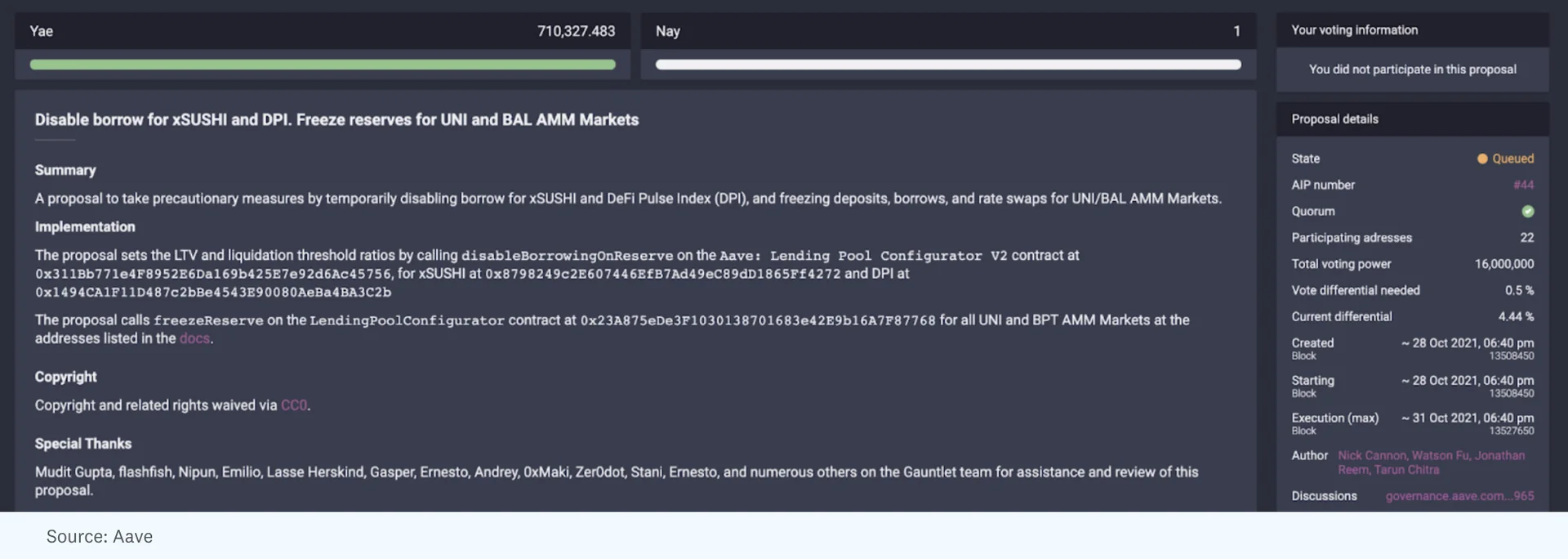
Here, we can see three important governance dynamics at work — a financially aligned community that is alert to possible threats, modeling that tests the real shape of the threat, and a governance process already in place to implement needed changes (with a bias toward security).
Asset curation
The most obvious setting for asset curation is NFT collection DAOs, such as PleasrDAO. These DAOs naturally function as curators of art and culture, with the DAO governance token used to vote on whether assets are added or removed. But DeFi DAOs often encounter this issue too. While some mechanisms, such as Uniswap, permit permissionless asset addition — anyone can open a trading pool with a new asset — others that involve leverage cannot do that. In particular, lending protocols like Aave and Compound use governance to decide which assets may be added or removed. That is because several parameters have to be set for each asset — margin requirement, interest rate curves, insurance costs — and those choices are vital for protocol safety.
Let’s use a straightforward example of what can go wrong. Imagine we mint a new asset — TarunCoin — and I own 100% of the TarunCoin supply. Now imagine that I set up a lending pool that lets me borrow against 100% of TarunCoin’s value. If I can control the USD price of TarunCoin (e.g. via a Uniswap pool where I am the sole liquidity provider), then I can push TarunCoin’s market capitalization very high (say $100M) and then borrow $100M in USD against TarunCoin. However, when my loan inevitably defaults because there is little to no TarunCoin liquidity, the lenders who pooled assets together to lend me $100M bear the loss.
This example shows that asset quality — measured by token distribution, liquidity/ease of price manipulation, and historical volumes — is essential for DeFi DAOs that use leverage. Because many such DAOs rely on their governance token as an implicit or explicit insurance fund to repay lenders if an adverse event happens, it is important for such DAOs to be careful about which assets they admit and how the parameters for those assets are set. As the ecosystem develops, it is likely that insurance products will help make governance intervention for asset curation in DeFi less frequent and more effective.
Ways to run a DAO
A natural follow-up question is: “How can our community actually do these three tasks? Our community only cares about X.” As DAOs mature, there is a steadily expanding ecosystem of companies and protocols that try to reduce the burden on DAO members by automating analysis and monitoring and helping with careful asset and parameter selection. And there are tactics that can lower complexity inside DAOs and allocate resources more efficiently. Here are some of the steps DAOs can take:
Use governance tools
First, quantitative tools have appeared that let your community see the risk in the DAO (and potentially, the related protocol) as a function of market conditions and let DAO members grasp what it means to vote on lowering collateral/margin requirements or raising an interest rate, for example. This gives greater transparency into the level of risk held by a DAO treasury and allows the community to adjust treasury composition to meet specific KPIs.
The billions of dollars of assets held by lending protocols Aave and Compound, for example, effectively serve as an insurance backstop for the underlying lending protocols. For instance, if there is a major price shock that leads many loans to default, causing losses to lenders in the protocol, these DAOs can use their treasuries to make lenders whole (see, for example, the Compound DAI liquidation event).
Changing protocol parameters, such as collateral requirements, helps lower the chance that the DAO will need to spend its treasury on such backstop events. Below is an example of a live dashboard for tracking risk in different Aave markets. (Disclosure: I am the founder and CEO of Gauntlet, which provides these services). The tools used to measure risk include simulation tools that merge tools used in algorithmic trading and AI (e.g. AlphaGo).
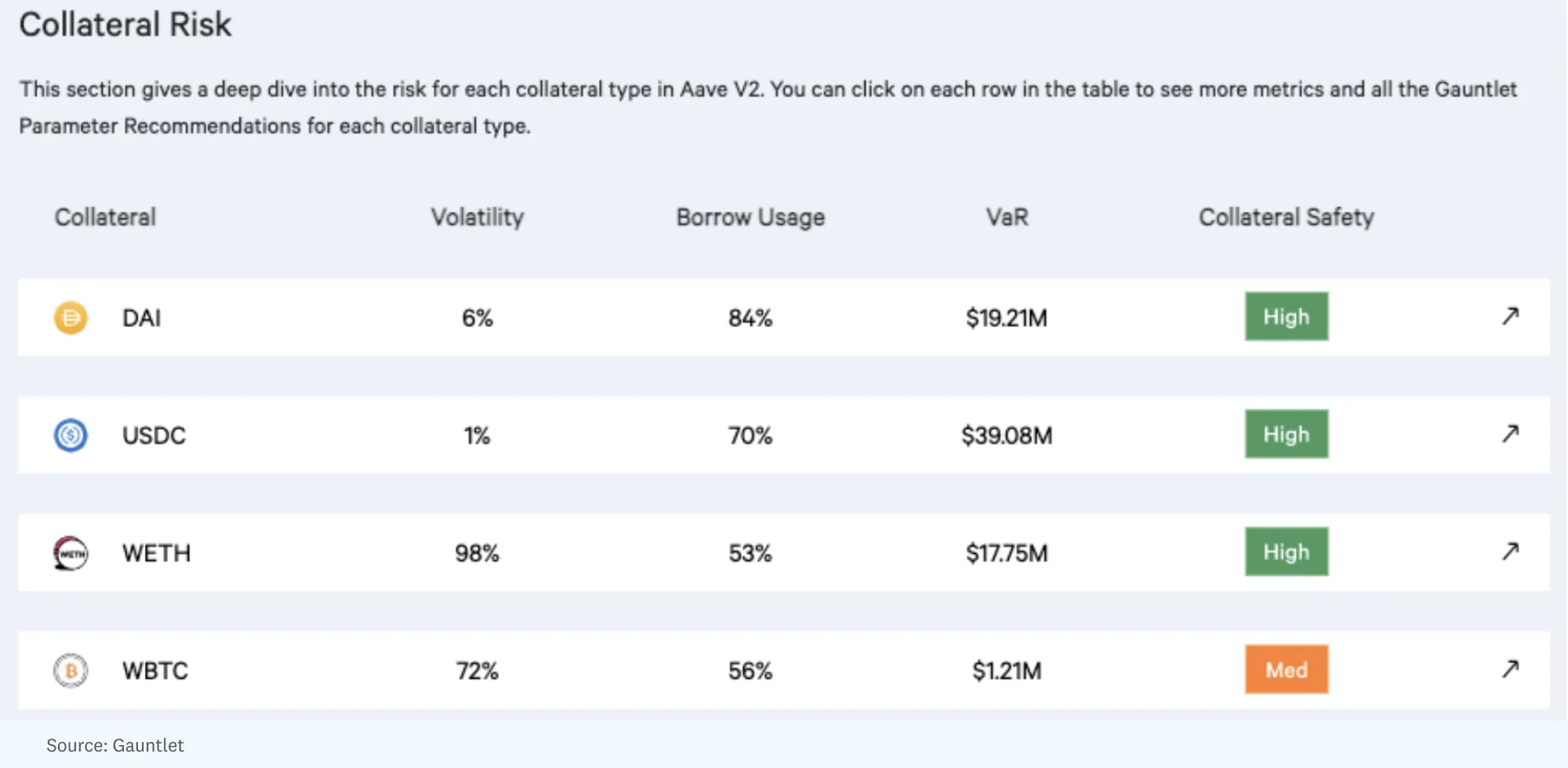
The purpose of such tools and services is to let communities grow to larger and more diverse populations. As protocols become more and more complex and interconnected because of smart-contract composability, governance becomes gradually harder for every new member. This, in turn, makes it more difficult for new members to join a DAO and take part in a meaningful way.
By helping users simply interpret the complex behavior hidden inside a DAO, visualizations can assist with onboarding new members. For instance, tools can let all members understand what they are voting on without needing to understand the underlying technical intricacies. Each DAO tool or service can then focus on providing clear, easy-to-understand dashboards of a DAO’s health from technical, financial, and community angles.
Within DeFi, the main problems that DAOs usually handle involve financial and technical risk, so their tokenholders use tools to evaluate such risks. They can also help proxy voters (e.g. voters who delegate their voting rights to another voter) judge how well their proxies are performing in improving protocol performance.
Partition into “subgroups”
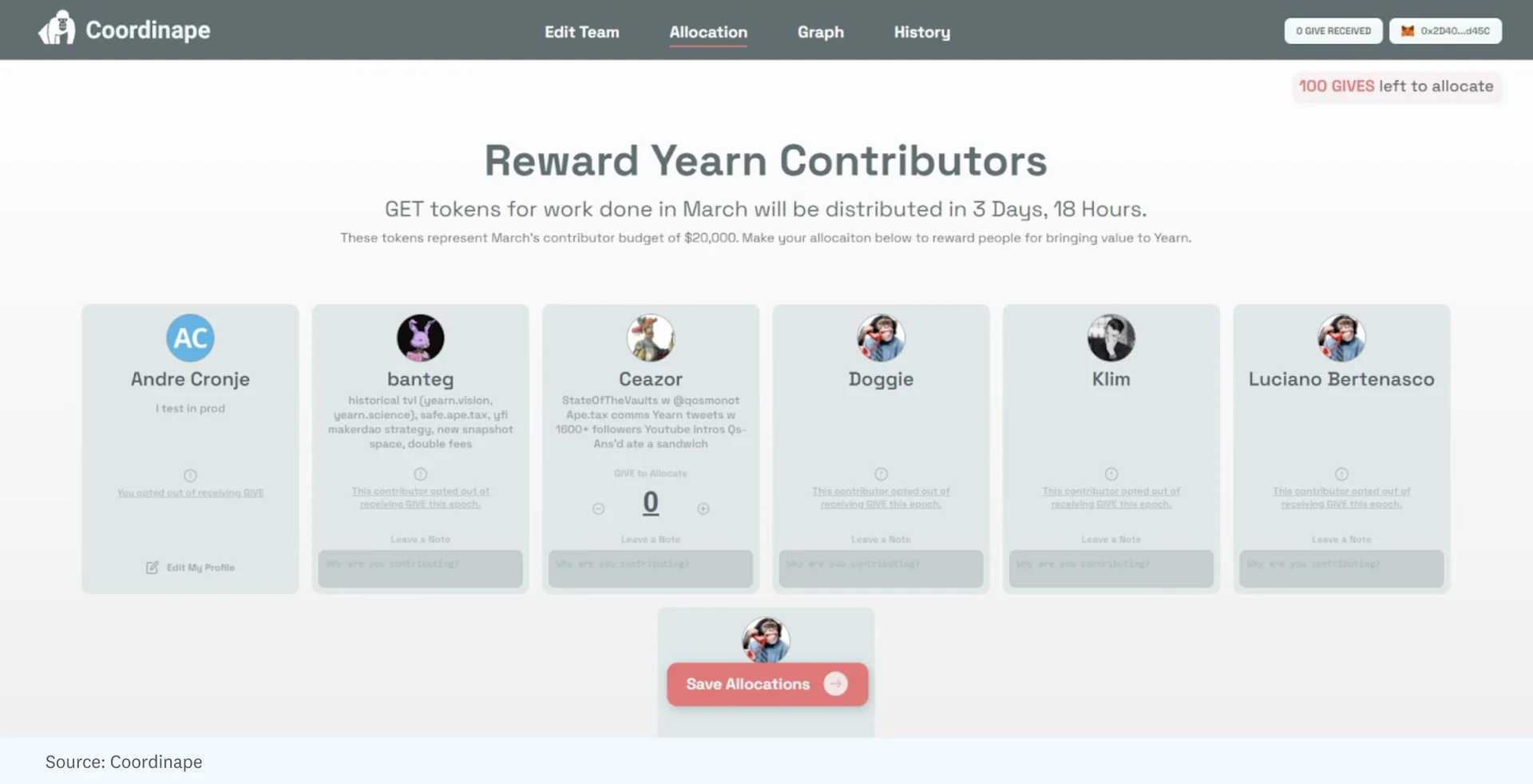
Another possible tactic that can help broaden a DAO’s membership and scope is splitting a DAO into subgroups that each work independently and concentrate on specific tasks (development, marketing, etc.). One of the first DAOs to split itself successfully was Yearn Finance. Yearn’s fast growth and constant product evolution created a need to divide the team into multiple teams that independently managed tasks like front-end UX, core protocol development, and marketing. Early Yearn contributors tracheopteryx, zemm, and zakku created Coordinape, an “Asana for DAOs,” to help contributors coordinate. This product let DAOs manage tasks and payroll across teams, time zones, and pseudonymous identities.
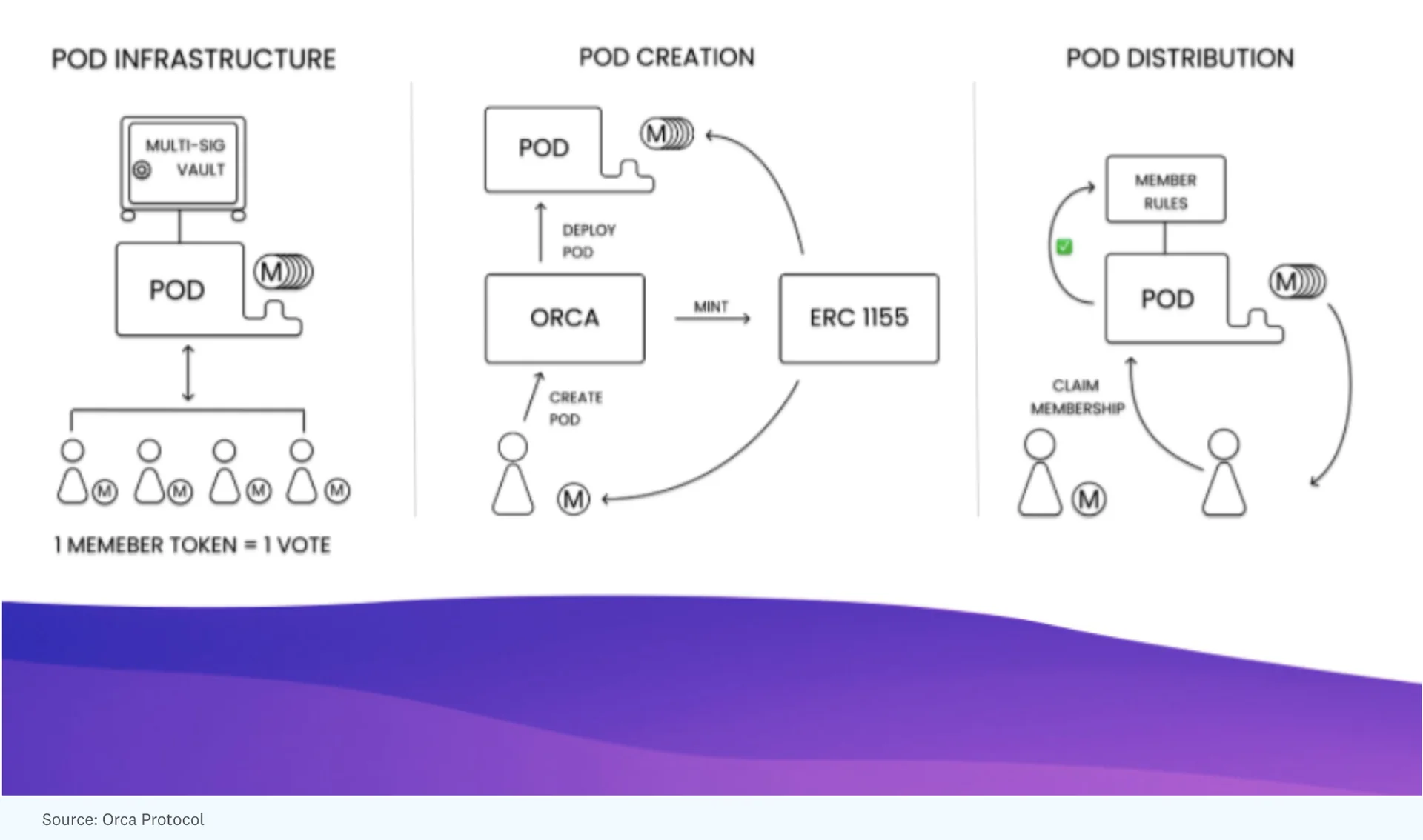
For a more decentralized method, one can use DAO smart contracts to explicitly divide a DAO into teams. One can do this by letting certain subgroups (known as sub-DAOs or pods), call certain functions within the DAO’s smart contract. Orca Protocol has built tools around automating this process so that people without development experience can easily create pods. This protocol lets you create authorized groups that can manage certain functions within a DAO, allowing different subgroups of your community to carry out each of these tasks independently.
Hire staff
A final point on DAO governance: once a DAO reaches a sufficiently large community and asset base, it becomes important to bring on people who can devote their time full-time to maintenance, communication, and administrative work. Still, DAOs need to avoid creating any “Active Participants” that token holders may come to depend on for driving the underlying token’s value. So any new service providers have to be added with decentralization in mind.
DAOs that do not succeed in hiring full-time developers, community managers, and other staff often end up at a crossroads when their assets run low or require servicing. Once-hot DeFi protocols lost momentum as their DAO treasuries emptied, and no DAO member felt they had enough agency to keep operations going (e.g. through protocol improvements or asset reallocation).
Although PleasrDAO has a council (similar to a company board) that helps steer the DAO’s long-term path, key contributors make sure the launches, financing, and curation carried out by the DAO are handled flawlessly. In this way, DAOs can often draw on best practices from regular organizations as well.
***
Coordinated attempts to build decentralized internet institutions that hold assets are sometimes seen as a “wild west” of unexplored territory. But many of the problems and solutions in traditional systems — where people also coordinate — can inform and guide DAOs; they’ve been tested under pressure for centuries, and can be adjusted for this new world. In many ways, studying both the past and the recent history of DAOs may help new builders discover and adapt ideas for the future of online institutions.
Acknowledgements:
Thanks to John Morrow (Gauntlet), Nick Cannon (Gauntlet), Julia Rosenberg (Orca), John Sterlacci (Orca), Luiz Ramalho (FingerprintDAO), Jamis Johnson (PleasrDAO), and Robert Leshner (Compound) for useful feedback and comments.