
It can feel as though everyone now is a creator — artist, developer, or anyone else pursuing a craft — yet the creator economy still has plenty of room to expand. Even with over 50 million people powering a multibillion-dollar market, this movement is far broader than the platforms that monetize it, and far larger than the small share of people who can actually earn a living from creative work.
There are unspoken, frequently ignored layers within this new economy; the field for creators is still uneven, and repeatable success stories remain rare. So what is absent? Those who lump all “creators” together may miss the next wave of opportunity: specific tools that help breakout stars scale their businesses, raise the quality of their content, and provide tailored resources that address particular pain points. To help creators move up, tool builders will need to think about creator levels in a more detailed way. At present, those levels are too often left underserved by technology.
The case for more tailored creator tools
When the Web 2.0 social media wave began in the 2000s, more people than ever before turned hobbies into careers. Amateur photographers used Instagram to become professionals. YouTube turned workout gurus into fitspo influencers. SoundCloud turned amateur artists into chart-toppers.
But for every success story, there are dozens of creators who simply picked up a new hobby, and hundreds who tried to make a living from their work and ended up burned out. It’s a textbook example of the 1 percent rule, where a chosen few collect all the rewards.
This pattern holds across most competitive industries. But this split should also push businesses and platforms in the creator economy to be explicit about whom they intend to serve: Are they helping the 99 percent pursue their childhood dreams? Are they helping the 1 percent build stronger businesses? Or are they working with the 0.1 percent (and the 0.01 percent) of creators to grow their wealth? Each group has different pain points. Some of those pain points are missed because the total addressable market does not amount to billions of users.
But much like the creator economy itself, addressing those distinct pain points can be profitable if creator platforms focus on a niche audience.
Each creator level is its own economy
A startup founder raising a pre-seed investment round would probably not approach a private equity firm for funding. Founders and investors alike understand the expectations tied to fundraising stages. In the same way, the creator economy has its own levels, and creators and companies need to align with each other’s needs for the best results.
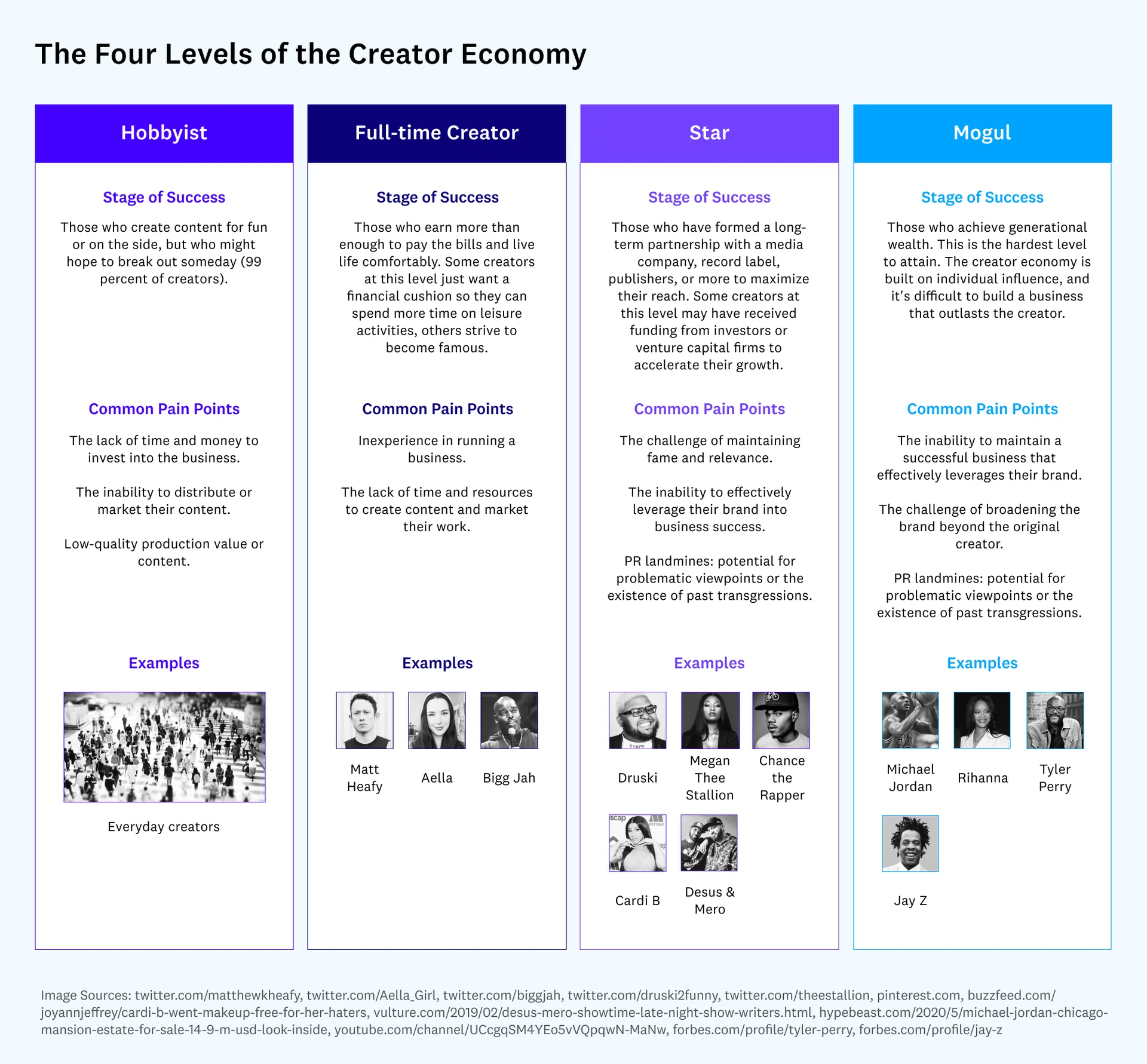
Level 1: Hobbyists are typically those who create content for fun or on the side.
As technology keeps reducing the barriers for creators — in audio, for instance, with tools like Anchor, which makes it easy to start a podcast; Descript, which makes it easy for anyone to edit a podcast; Splice, which lets anyone make music with royalty-free samples; and more — even more such hobbyists will appear.
The major pain points at this level are that these people either do not have the time or money to put into their business or they lack distribution and marketing. Often, they also struggle to reach a certain level of production value or quality content. The reality is that most hobbyists will stay hobbyists, and only a small number will earn enough to begin making a living from their work.
Level 2: Full-time creators are those who can support themselves with their creative work.
The platforms that host these creators often highlight the success stories of people who began as hobbyists, used their platforms, and left their day jobs to go all in. (I would know!) They are ahead of hobbyists in terms of steady cash flow, but not so far removed from Level 1 that they are not relatable.
Creators’ pain points at this level usually include inexperience running a business, which takes time away from creative work, along with a lack of time and resources to market their work.
Level 3: Stars are those who can typically form partnerships with external brands, such as media companies, record labels, publishers, and others, to maximize their reach.
The biggest challenge here is staying famous and relevant; there can also be brand crises that may cost those creators their partnerships and even their livelihoods. In terms of moving up, the real pain point is understanding how to turn one’s brand into business and financial success.
Level 4: Moguls are those who build businesses that not only evolve, but also have staying power, lasting longer than the creator themself.
Take Rihanna’s Fenty, Gwyneth Paltrow’s Goop, and so on. When Beyonce Knowles said “my great-grandchildren are already rich,” this is what she meant! For obvious reasons, this is the hardest level to reach.
As with any hierarchy like this, it is natural to assume that someone at Level 3, for example, is more successful than someone at Level 2. But that is not always true, because success can mean different things, and creators make tradeoffs at each level. Some independent hip-hop artists, for instance, earn more than artists signed to major record labels. There are comedians who make great money independently without outside capital or HBO deals.
The distinction between Level 2 and Level 3 therefore lines up with different forms of success, but it also depends on the creator’s values. Those who want fame and ubiquity, for instance, often push to become stars even before they earn enough as full-time creators. Those who value profitability and control may wait on that. It’s a classic case of, “Do you want to be rich or be king?”
For those who become stars, their success becomes tied to fame, which feeds an ongoing (sometimes virtuous, sometimes vicious) cycle of maintaining relevance and maximizing any opportunity.
The mogul mindset
Much of the above comes from my own lived experience, and from experience I have observed closely. As the founder of Trapital, I’ve studied how hip-hop artists build their businesses, the common challenges they encounter, and what it takes to level up at each stage.
Historically, I’ve noticed that Black entertainers are more inclined to strike out on their own and are more likely to wind up on charts like the one above — in part because, at various points in their careers, many Black creators have had to fight for the same support and recognition their non-Black peers received. If those creators don’t feel the system serves their interests, they’re more likely to handle things themselves.
For instance, one reason Jay Z founded Roc-a-Fella Records was that no major label would sign him. Even after he later became president of Def Jam, his authority was still constrained. When he requested a credit line to move Def Jam into both the headphones and clothing businesses, label executives rejected his ask for additional money.
He later created Roc Nation, and then became a billionaire largely through deals he struck on his own terms. That path is far less typical in rock or pop music: Historically, those artists usually get more support from both record labels and radio stations. Rock, pop, and country stars who are structurally looked after have less reason to branch out on their own.
Jay Z’s path helped shape a generation of hip-hop business leaders who have also been underestimated. Still, they face a steep climb. And this systemic shortage of resources is not only a problem for hip-hop artists, or for Black artists specifically. One of the biggest attractions of the creator economy is the appeal of controlling one’s own livelihood and building a business independently, without the support of mainstream labels or publishers.
But that appeal is often little more than a pipe dream. Still, more of those dreams can become reality if the tools and platforms serving these creators have a clear sense of who they’re built for, which creator level they reach, and what value they offer.
Open opportunities in the creator economy
Creators of the creator economy need to understand which groups in their target audience are overrepresented and which are underserved. The most effective creator platforms know their user base deeply and focus tightly on solving those pain points and needs. The strongest opportunities help creators improve at creating and at building their business.
So far, much of the creator economy’s money has come from mature, established platforms such as Facebook, Snapchat, and YouTube. These platforms are aimed at hobbyists who may hope to become full-time creators. That emphasis makes sense; tech scales, and hobbyists are the biggest addressable market. It fits with what social networks already do well.
But there is still a major business opportunity at other levels of the creator economy, especially in areas that go beyond the usual “creator tools.”
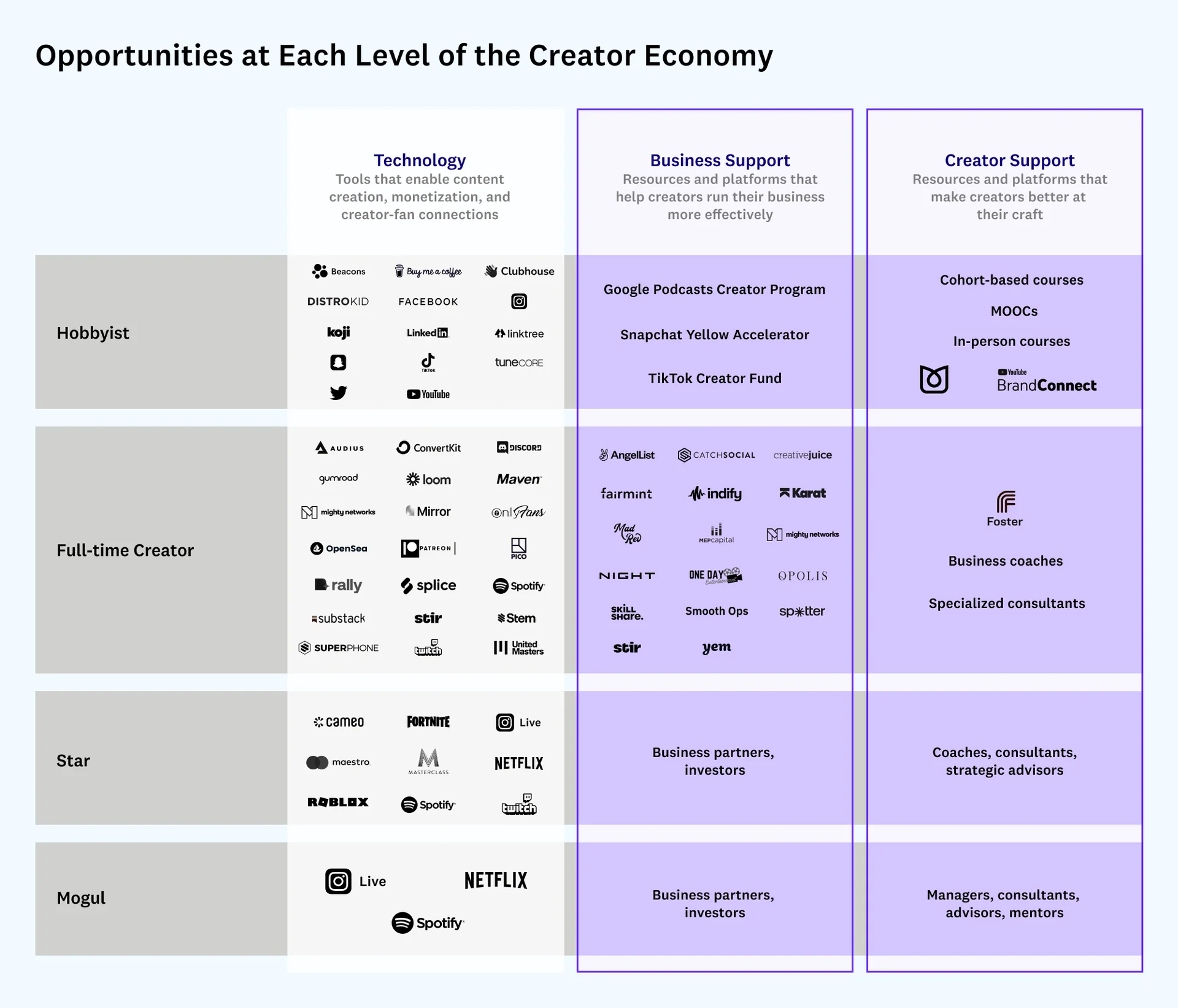
Technology can solve many of the hard-to-scale parts of the creator economy. As a creator’s business grows into new stages, they often need to bring on more people. A 10-person company is very different from a 25-person company, a 40-person company, and so on. Tech tools and platforms can smooth these transitions and the common pain points as creators move up.
Right now, the leap from full-time creator to star or mogul often depends on custom, frequently costly solutions. Creators may work with agencies, business managers, consultants, and contractors to handle specific needs. But tech can address those pain points. Businesses like Smooth Ops and Mad Rev have appeared to help creators manage operations, partnerships, endorsements, and more. These companies learn from each client, which helps reinforce their position over time.
Indify, for example, is a startup that helps artists obtain funding from investors and links artists with seasoned business partners. Those are two overlooked areas in music. Outside investors offer an alternative to the capital that comes from a record label contract. In addition, those investors can be creators themselves, which makes for a two-sided marketplace. A comedian could invest in an artist, for instance, and then use that artist’s music in their next standup special. Both creators win.
These kinds of tech tools deal with the business side of the creator economy, which is often overlooked. Creators still have to know how to build a sustainable business (or work with those who do), and those skills are often very different from the ones they use to make their content.
* * *
Clearly, we need more customized solutions for creators. The billions of dollars flowing into the creator economy might imply the space is saturated, but that is far from true. There are many emerging hobbyists who need help with marketing. For rising multi-hyphenates — inspired by, say, the way Issa Rae launched her own record label to include music in her media properties — the opportunities exist. But the tools are not keeping pace.
If these tech platforms succeed, there will be more creators than ever. They will need solutions tailored to their different business needs, whether in marketing, copyright expertise, investing, operations, community-building, or product launches. The companies that see this shift — and build tools for a specific slice of creators — will have a huge advantage. I believe it will open up new levels of creativity for creators.