

A decade ago, equity compensation — paying employees with company stock — was a perk reserved solely for executives. The practice was largely deployed by companies as a way to optimize retention while keeping their balance sheets clean. Since then, equity compensation has expanded quickly. Within the next 10 years, it’s estimated that public companies will compensate employees with nearly $800 billion in Restricted Stock Units (RSUs), stock promised to employees upon meeting certain conditions. Given the 400+ IPOs last year, the growth of equity compensation in tech shows no sign of slowing. Tech companies alone are projected to pay employees over $40 billion in RSUs this year, according to Candor’s salary database.
This huge spread of stock pay has clearly changed job incentives, especially in tech. It is not too much to say that in 2021, the biggest driver of a person’s wealth is the company they decide to join. Yet wealth managers still are not prepared to help workers choose between, for example, Snapchat and Stripe. As equity compensation has moved from a C-suite benefit to a routine pay element in tech, many employees are left to figure it out on their own.
Glossary of key terms:
Derivative: A securitized contract whose value depends on an underlying asset.
Hedging: A method for limiting loss risk by trying to anticipate market moves and placing offsetting purchases.
Forward contract: A contract to sell a security at a forecast price in the future.
Grantor Retained Annuity Trust (GRAT): A financial tool used to shift asset growth from the grantor to beneficiaries, lowering one’s tax burden.
Options: A pay contract in which companies award a set number of fixed-price shares that employees may purchase at a discount with their own money.
Restricted Stock Unit (RSU): A type of employee pay where receipt of shares depends on a vesting schedule.
Trust: A legal arrangement created to keep assets separate from you, and managed by another party.
Today, the financial setup for workers paid in equity is almost nonexistent. For people with little background in the acronym-heavy world of equity, the details of stock as pay and the tax consequences can be intimidatingly intricate.
For tech companies, there is a chance to close the knowledge gap by widening access to equity data and providing tax-management resources. For builders, there are too few tools that help equity-paid workers manage risk and wealth in a responsible way.
Below, I cover the main hurdles for employees paid in stock, along with strategies for dealing with them; how forward-looking companies can reshape the equity landscape; and where I believe there is promise for tools that serve both better.
But first, a brief history of how we arrived here.
The equity shift: From executive perk to salary expectation
The tools now used to understand and manage equity compensation were mostly created in the ’70s. In 1972, the Financial Accounting Standards Board released Accounting Principles Board Opinion Number 25 (APB 25), which let companies avoid listing stock options as a compensation expense on their income statements.
After that, stock options became broadly popular as compensation. By the mid-1990s, Standard and Poor’s Execucomp database showed that 85 percent of executives were getting stock incentives in one form or another. That did not last — amid growing accusations of tax evasion, fraud, and scandals at Enron and Worldcom, many companies gave up stock options in favor of the easier accounting model of restricted stock units, or RSUs. With stock options, employees are allowed to lock in a price to buy stock later; RSUs are stock units granted to an employee that the employee does not need to purchase.
The broad move to RSUs meant that, for the first time ever, employees could access a perk that had once been reserved for senior leaders. By spreading the gains of company building more widely, this shift also helped draw more smart, capable people into tech, where innovation and early faith are rewarded accordingly. By 2007, even one of Google’s in-house massage therapists had become a millionaire from stock she received as an employee. The pace was fast.
Still, the set of tools and frameworks that help newcomers understand their equity did not grow at the same speed. The rapid adoption of stock options, and later RSUs, as compensation helped create some of the complexity we see today around equity.
For employees: Constraints around equity compensation and strategies for making the most of it
Employees commonly run into four major challenges when trying to understand and manage equity: trading restrictions, concentrated risk, data asymmetry, and tax complexity. I will break down each one below, along with strategies for reducing downside and risk when dealing with them.
1. Trading restrictions
Although the basic form of insider trading laws goes back to 1909, the regulation as we know it today was largely established in the mid-’80s, driven by more political lobbying and by the SEC and Congress taking a tougher stance on insider trading. Today, many of the laws that govern stock compensation today still reflect their original aim: stopping executives from insider trading.
In practice, it is difficult to say who has access to information that could provide a trading edge. So companies made a deliberate call: every employee, no matter how junior, is legally treated as an “insider.” That means employees can sell stock only when permitted, even if they own it outright. At many companies, this period comes quarterly after earnings calls, when the stock is often at its most volatile.
That condition can leave stock-compensated workers in the dark; many tech employees do not fully understand the choices they have for accessing liquidity. According to a 2021 Candor research report, among the 30 largest public tech companies, only 11 have put policies in place to help employees create a stock sale timetable. That makes it hard for people paid in stock to tap equity for urgent life expenses, for example, without major exposure to market and concentration risk.
In reality, employees have a number of tools that can help release liquidity.
- Staged sales: The process for staged sales is straightforward: You decide in advance how and when you want to sell stock, and a third party carries out those instructions. That means employees can sell stock freely — even during blackout periods, mergers, and litigation — and put staged sale proceeds toward immediate cash needs, such as buying a home, or move them into more diversified portfolios. In a Stanford study, staged stock selling plans delivered 6 percent stronger returns over time, along with cohort advantages such as tax optimization and lower market risk and concentrated positions. Lines of credit: Employees can use their RSUs as collateral to secure a loan. This is generally a temporary-liquidity tool, for cases when the person does not want to sell stock. It can be a useful way to “have your cake and eat it too” if the stock appreciates faster than the loan interest. (On the other hand, if the stock drops, you may end up needing to sell stock in order to satisfy the loan.) Block or large-chunk trades: These trades are the sale of a large quantity of securities, arranged in advance with the company, at a discount to the stock’s most recent market price. In general, block trades are used when selling stock could move the market price or shape outside perception. They are most commonly used by employees with a large RSU concentration who need to sell a sizable amount of stock to rebalance their portfolio. This approach may be a workable option for very early senior employees after IPO.
2. Concentrated risk
A second issue many employees face with equity compensation is concentrated risk. A tech employee may have as much as 90 percent of their wealth in company stock through compensation, according to a Candor market survey of over 1,000 tech workers. Because workers are restricted in when and how they can sell, liquidity, company, and market risk can build up against them over time.
Because of stories about huge payouts that made early FAANG employees overnight millionaires, many millennials and Gen Zers have been trained to see their stock as a lottery ticket. They are told that keeping it will make them wealthy. At times, that is true.
But often it is not. In the early days of Covid in March 2020, for instance, Uber employees saw more than 50 percent of their stock value disappear over a span of a few days (the stock has since recovered). Other companies suffered comparable drops; no company is protected from a market shock. A March 2021 JP Morgan Chase study of 13,000 large-cap, mid-cap, and small-cap stocks from 1980 to 2014 found a fall of 70 percent or more from a stock’s peak price, after which there was little recovery. The study indicates that declines are not tied to isolated events, like the tech boom-bust — or a pandemic, for that matter.
For a stockholder with a concentrated position, even a modest loss is significant. In general, most investment advisors do not suggest putting more than 10 percent into one stock. While employees may be tempted to keep a concentrated stock position in the hope of a large windfall, past returns do not ensure future gains.
Here as well, employees have diversification choices, including automated hedging strategies — methods for automating risk management — and derivatives, financial contracts whose value depends on the underlying RSU/stock value.
Derivatives carry risk and are harder to use independently, but they can provide more flexibility for selling or holding positions, generating income, managing volatility, and reducing risk.
Primer: How derivatives work when you have RSUs
- Protective puts: Think of this as insurance against a stock decline. You can still benefit from stock appreciation while establishing a floor price. On the other hand, this can reduce upside, particularly when inflation is high. Covered calls: Getting paid to sell your stock. You choose the sale terms — when and at what price — at a price above the current market. A buyer purchases the option to buy at that price and pays you an upfront premium. If the exit terms you set are met, the buyer can decide to exercise and buy your shares. If they are not met, you still keep the premium. It is worth noting that here, again, you accept some risk: If the stock climbs more than you predicted, you may miss gains. You can also lose money if the stock price falls below the break-even point — the stock purchase price minus the option premium you received. Zero-premium collars: This is a way to manage volatility and is often used around IPOs. In this situation, you spend nothing. A bank or broker takes on all the downside risk by buying an option for a premium and selling a call option at the same time on your behalf. These options “zero out” because you buy and sell derivatives of equal value. If the stock drops below a certain level, the bank pays you the difference, but if it rises above a set mark, the bank keeps the upside.
Not every tech company permits employees to buy derivatives. Also, few systems exist today to supervise and manage compliance around derivatives. As the Securities and Exchange Commission and the Department of Labor keep scrutinizing equity pay and insider trading, I expect compliance tooling to emerge as a heavily contested area.
3. Data asymmetry
A third obstacle employees face around equity compensation is that many companies use data asymmetry to keep talent. Unfortunately, compensation design can often become a cat-and-mouse game in which companies add layers of complexity to stay under overall payout caps, while employees join forces in forums to reverse-engineer total compensation figures. It can be nearly impossible for a job seeker to easily compare equity-based offers from several companies without outside assistance.
All this complexity around equity means many tech employees turn to outside sources to collect useful information. That includes professional networking forums like Blind, Elpha, and 1Point3Acres to assess companies, investor databases like Morningstar and Crunchbase to judge company performance and metrics, and online forums such as Candor, Triplebyte, Angelist, and Option Impact to run salary numbers. A busy secondary market has emerged around people selling their carefully built equity spreadsheets and methods to other tech employees. This knowledge gap is well suited for new software tools and innovation.
4. Tax complexity
Finally, tax planning is often overlooked when it comes to equity compensation. Most companies treat RSUs as supplemental income, which means far less tax is withheld. The flat IRS rate for supplemental wage income up to $1 million was 22 percent in 2021; by comparison, the federal income tax rate for a tech employee filing single earning $209,426 to $523,600 was 35 percent. This gap can leave tech employees owing large sums to the IRS after a vest.
Although there are many tax tools that can help tech employees, finding an accountant who can build a tax plan around equity compensation can be hard. In a 2021 Candor survey of 1,500 employees at public tech companies, for example, only 47 percent said they had a tax plan.
Companies today provide little help in getting employees to understand and plan for taxes. That creates room for the democratization of a broad set of mechanisms and resources, including:
- Deduction planning products: Deduction bunching is the practice of timing tax write-offs on items like mortgage interest and health savings accounts to offset RSU taxes. In the near future, I believe deduction-planning products that help employees optimize paycheck deductions, plan capital gains through stage sales, and calculate 83(b) election and deduction bunching will become table stakes for companies. Structuring as a service: I call this the “other” SaaS. While some tax maneuvering can be done on your own, strategies like variable prepaid forward contracts require institutional support. Think of these as a tax optimization strategy with simple mechanics: you sell a block of stock directly to a brokerage without finalizing the transaction. The brokerage gives you around 75 percent of the cash you are owed now and the remaining 25 percent later. Because the transaction is not “done” until you receive all your cash proceeds, you can technically defer capital gains tax until the full contract is completed. As wealth managers and companies alike search for ways to provide employees liquidity that does not trigger a tax avalanche, this is an area where I believe we will see a lot of near-term growth. Qualified small business stock exclusions: Another opportunity exists around QSBS exclusions for founders. Today, anyone who starts or invests in a startup can exclude up to $10 million from tax after sale “per taxpayer.” However, planning around this, such as sequencing the liquidation of low- vs. high-basis stock, is unnecessarily complex. With an accelerating number of exits on the market, I believe this strategy will move from obscurity to a staple of equity management, furthered by companies. (As of Nov. 19, 2021, the House of Representatives has passed new limits on QSBS exclusions, which reinforces the need for planning ahead of a qualifying event.)
For companies: Optimizing a new financial stack around equity pay
It is time to rethink what it means to be paid in equity. Every employee, not only executives, deserves tools and resources to make informed decisions and trades, manage risk, and handle taxes around equity. This shift means more companies are beginning to treat equity management as an employee benefit.
We have already seen firms like Fidelity, Morgan Stanley, and First Republic promote “financial wellness” as a perk for tech companies. However, the offerings so far — better lending rates, staple investment tools, ATMs on campus, student loan help — have often been shallow.
As a subgroup, tech workers have some distinctive traits: they are accredited investors with concentrated holdings, and they often tolerate more risk than earlier generations. Going forward, companies will increasingly use access to management tools as a way to keep employees. I also expect banks to update their offerings so they resemble health insurers more closely, changing billing systems to create tailored deals and products for each tech company. Over the next five years, for instance, we will probably see consolidation in the alternative investment market as firms compete to create value for this new generation of consumers and wealth across the broader investing ecosystem.
To date, we have seen the most momentum in taxes and trusts through startups that build tools to simplify tax planning, and platforms that help people plan charitable giving better.
A trust is a legal structure created to hold assets apart from you and have someone else manage them. For tech employees, trusts can often be used more effectively than retirement accounts, and they are easier to establish than hedges and derivatives. In most cases, trusts do not have contribution limits, carry many of the same benefits as retirement accounts such as IRAs, including tax deferral, and can provide liquidity before retirement. There are several types of trusts tech employees should know about today in practice.
- Donor Advised Funds (DAFs): Think of this as a way to front-load deductions while managing capital gains and giving to charity. The employee moves a lump sum of RSUs into a DAF and can deduct the full amount, up to 30 percent of adjusted gross income, in the same year. Charitable Remainder Trusts (CRTs): A split-interest setup: you get some, you donate some. In a CRT, the stock grows inside the trust free of capital gains. The trust then pays you or your beneficiaries income until you die. The remainder of the trust value goes to charity. Zeroed-out Grantor Retained Annuity Trusts (GRATS): A way to transfer the appreciation of your assets to a beneficiary. Intentionally Defective Grantor Trust: Turns your stock into a bond through structuring for many tech employees in practice today now.
Offering a full investment management suite will soon become a competitive edge for companies. For large public companies, this may include everything from simple upgrades, like the tax tools and staged-sale strategies above, to more dramatic changes, like letting employees direct pay into trusts to improve tax outcomes across the compensation stack overall.
Today, many of the techniques above may feel obscure to anyone without a crowd of lawyers, accountants, and wealth managers, but these strategies can be immediately valuable to anyone earning RSUs. Over the next few years, I believe we will see the development of sophisticated tools that layer these products holistically, taking into account employees’ full financial picture, risk appetite, and goals.
For builders: New career platforms will disrupt compensation
As a continuation of this innovation, I believe a new category of job-search tools will emerge that combines wealth management, career growth, and taxes. Glassdoor 2.0 will feel more like a PitchBook and less like a job board. Employees will be able to run projections and simulations that connect considerations across their entire financial stack as they go.
As it becomes easier for employees to price and compare equity across offers, companies’ ability to hide the value of total compensation will fade. That will create a class of enterprise products focused on helping employees make the most of their equity.
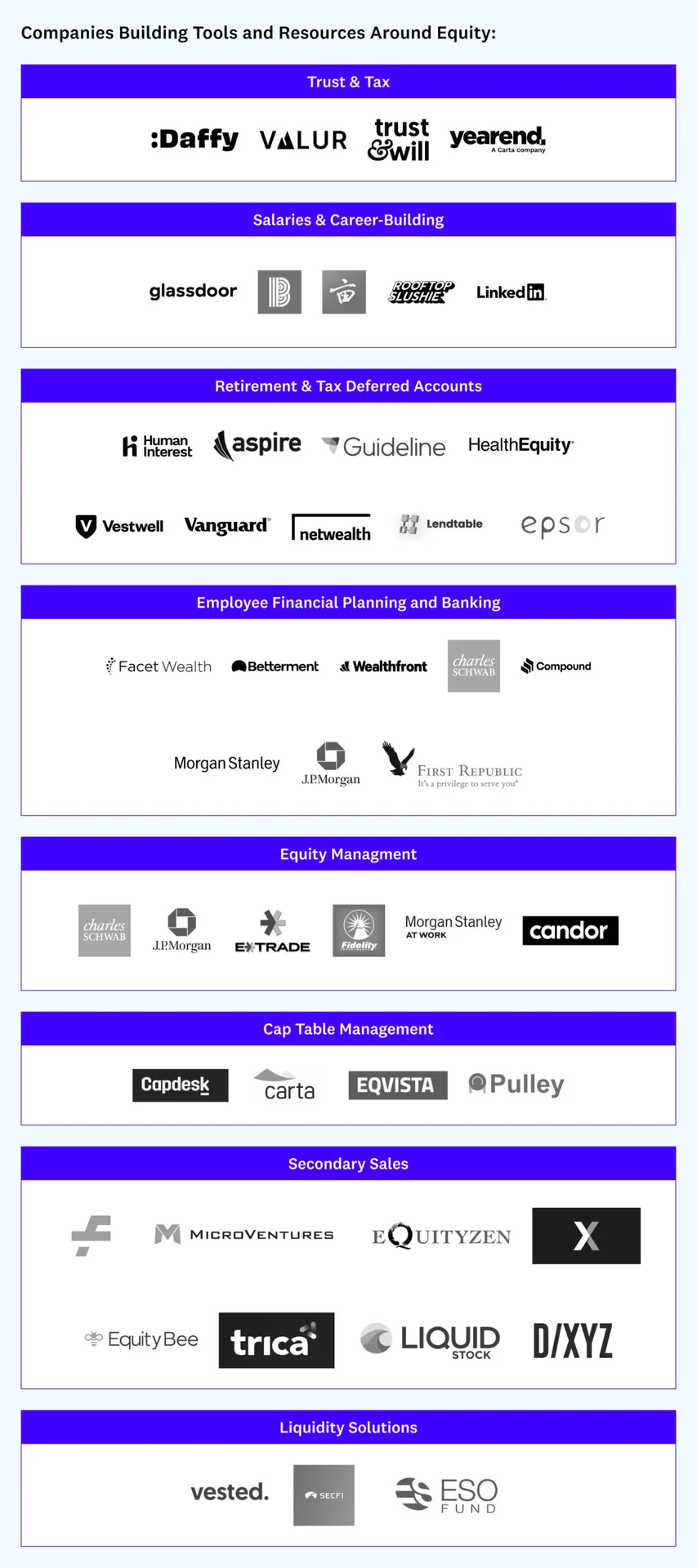
For startups, I hope to see equity tokenization, such as Restricted Token Units, or RTUs, stock buyback programs from investors, the repackaging of equity into lower-risk instruments that let employees diversify earlier than existing secondary-market options, and pre-negotiated access to lending tools with banks for both public and private companies alike.
We are seeing regulatory discussions around RTUs; the main hurdles today are compliance-related. In particular, there is a lack of clarity about whether crypto pay should be treated as a security or as property for accounting purposes, and how that would affect employers. There is a significant market opportunity for a third-party provider to handle back-office accounting, compliance, and escrow for companies that want to offer RTUs at scale.
The future of equity compensation
In the tech industry, equity compensation has completely changed the incentives for choosing a job. For some job seekers, knowledge work has become a way to build a portfolio of equities over the years.
Within the next decade, equity compensation is likely to become even more mainstream, moving beyond the tech sector. Even in old-line industries like durable-goods manufacturing and finance, the use of RSU pay is rising. In 2019, 92 percent of all industries surveyed by the National Association of Stock Plan Professionals had an equity-based incentive plan in place at that time.
Equity compensation gives employees the chance to build wealth. Still, tech workers should treat it as an investment, not a lottery ticket. For employees, that means thinking about risk, diversification, and taxes in advance. In turn, companies need to understand that the story of treating equity as a promise of loyalty can ultimately hurt the same employees they hope to reward. Instead, there is an opportunity to act as a catalyst for employee wealth by building a vetted ecosystem of services and tools, similar to how we handle health benefits today. The future is an infrastructure that encourages financial inclusion and responsibility over speculation.