Every company confronts some form of the “cold start problem”: How do you begin with nothing? How do you win customers? How do you build network effects — where your product or service grows more valuable to users as adoption rises — that give even more people a reason to sign up?
Put simply, how do you “go to market” and persuade prospective customers to invest their money, time, and attention in your product or service?
The answer most web2 organizations — the Internet era shaped by large centralized products and services like Amazon, eBay, Facebook, and Twitter, where most of the value goes to the platform rather than the users — is to spend heavily on sales and marketing teams as part of a conventional go-to-market (GTM) strategy centered on lead generation and customer acquisition and retention. But in recent years, an entirely new model for building organizations has taken hold. Instead of being governed by corporations — with centralized leadership deciding everything about the product or service, even when it uses consumers’ data and free, user-generated content — this new model relies on decentralized technologies and gives users an ownership role through the digital primitive called tokens.
This new model, called web3, reshapes the whole notion of GTM for these new kinds of companies. Although some classic customer acquisition frameworks still matter, the arrival of tokens and new organizational forms such as decentralized autonomous organizations (DAOs) calls for multiple go-to-market approaches. Since web3 is still unfamiliar to many people, even as there is major building in the space, in this article I share some new ways to think about GTM in this setting, along with where different kinds of organizations might sit in the ecosystem. I’ll also provide some tips and tactics for builders who want to design their own web3 GTM strategies as the space keeps changing.
The catalyst behind new go-to-market motions: tokens
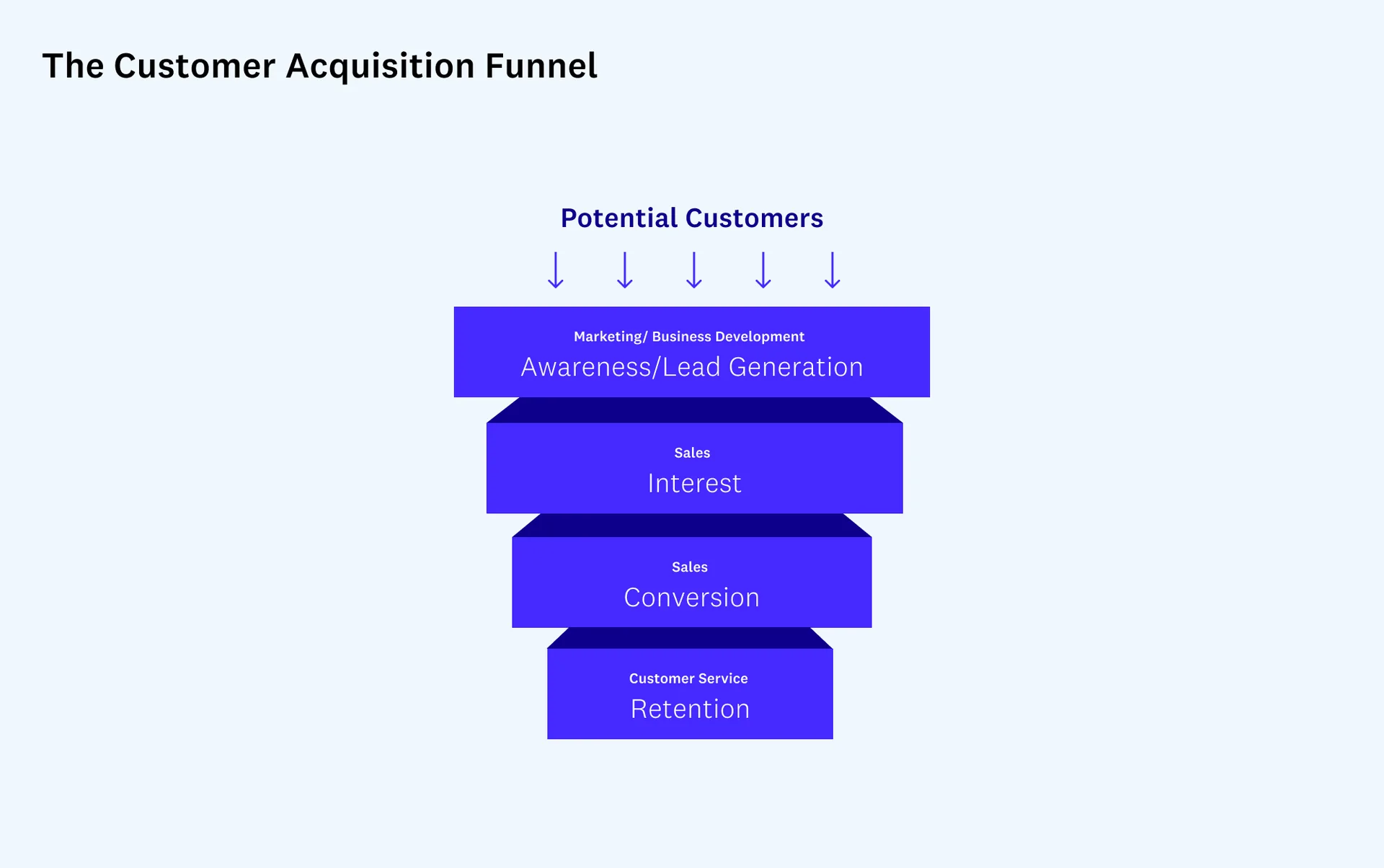
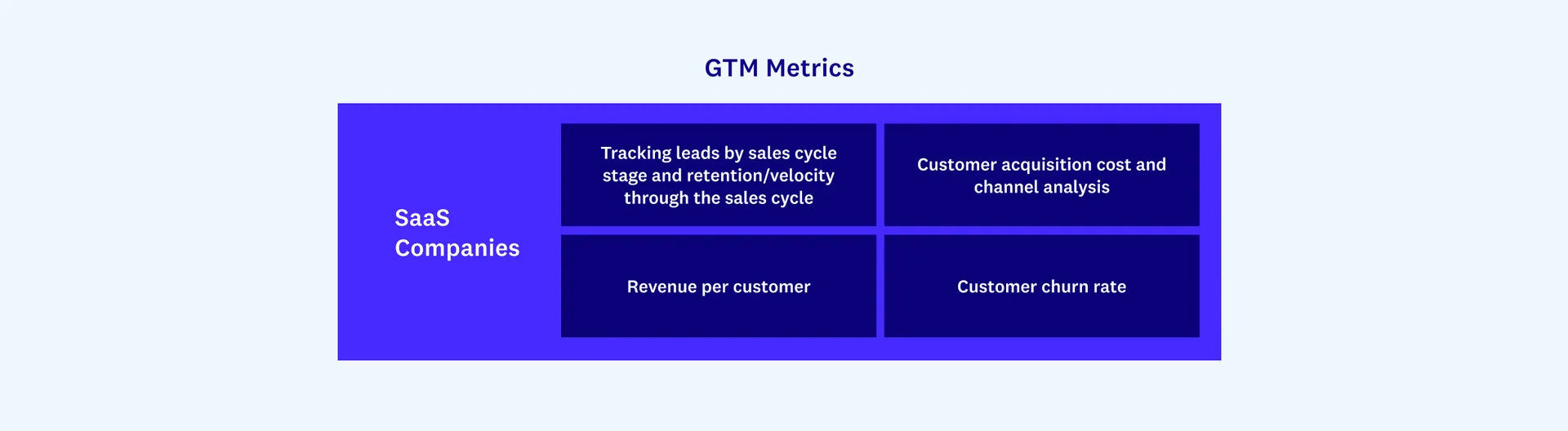
The customer acquisition funnel is central to go-to-market, and it is familiar to most businesses: moving from awareness and lead generation at the top of the funnel to conversion and retention at the bottom. Traditional web2 go-to-market therefore tackles the cold-start problem through this highly linear customer acquisition lens, covering areas like pricing, marketing, partnerships, sales channel mapping, and sales force optimization. Success metrics include lead close time, site click-through rate, and revenue per customer, among others.
Web3 changes the entire way new networks are bootstrapped, because tokens provide an alternative to the usual method for solving the cold-start problem. Instead of spending money on traditional marketing to attract and acquire possible customers, core developer teams can use tokens to draw in early users, who can then be rewarded for their early contributions before network effects were obvious or even underway. Those early users are not only evangelists who bring more people into the network (and who would similarly want to be rewarded for their contributions), but this effectively makes early users in web3 more influential than the traditional business development or salespeople in web2.
For instance, the lending protocol Compound [full disclosure: we’re investors in this and some of the other organizations discussed in this piece] used tokens to encourage early lenders and borrowers by giving additional rewards in the form of COMP tokens for participating, or “bootstrapping liquidity,” through a liquidity mining program. Any users of the protocol, whether borrowers or lenders, received COMP tokens. After the program went live in 2020, total value locked (TVL) in Compound rose from ~$100M to ~$600M. It is important to note that while token incentives can attract users, that on its own is not enough to make them “sticky”; more on this later. While traditional companies do incentivize employees with equity, they rarely financially incentivize customers in a long-term way (other than through acquisition discounts or referral bonuses).
In summary: In web2, the main GTM stakeholder is the customer, usually reached through sales and marketing efforts. In web3, an organization’s GTM stakeholders include not only their customers and users, but also their developers, investors, and partners. As a result, many web3 companies see community roles as more important than sales and marketing roles.
The web3 go-to-market matrix
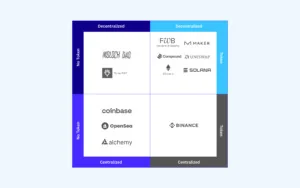
For web3 organizations, GTM strategies vary based on where an organization falls in the matrix below, according to its organizational structure (centralized vs. decentralized) and economic incentives (no token vs. token):
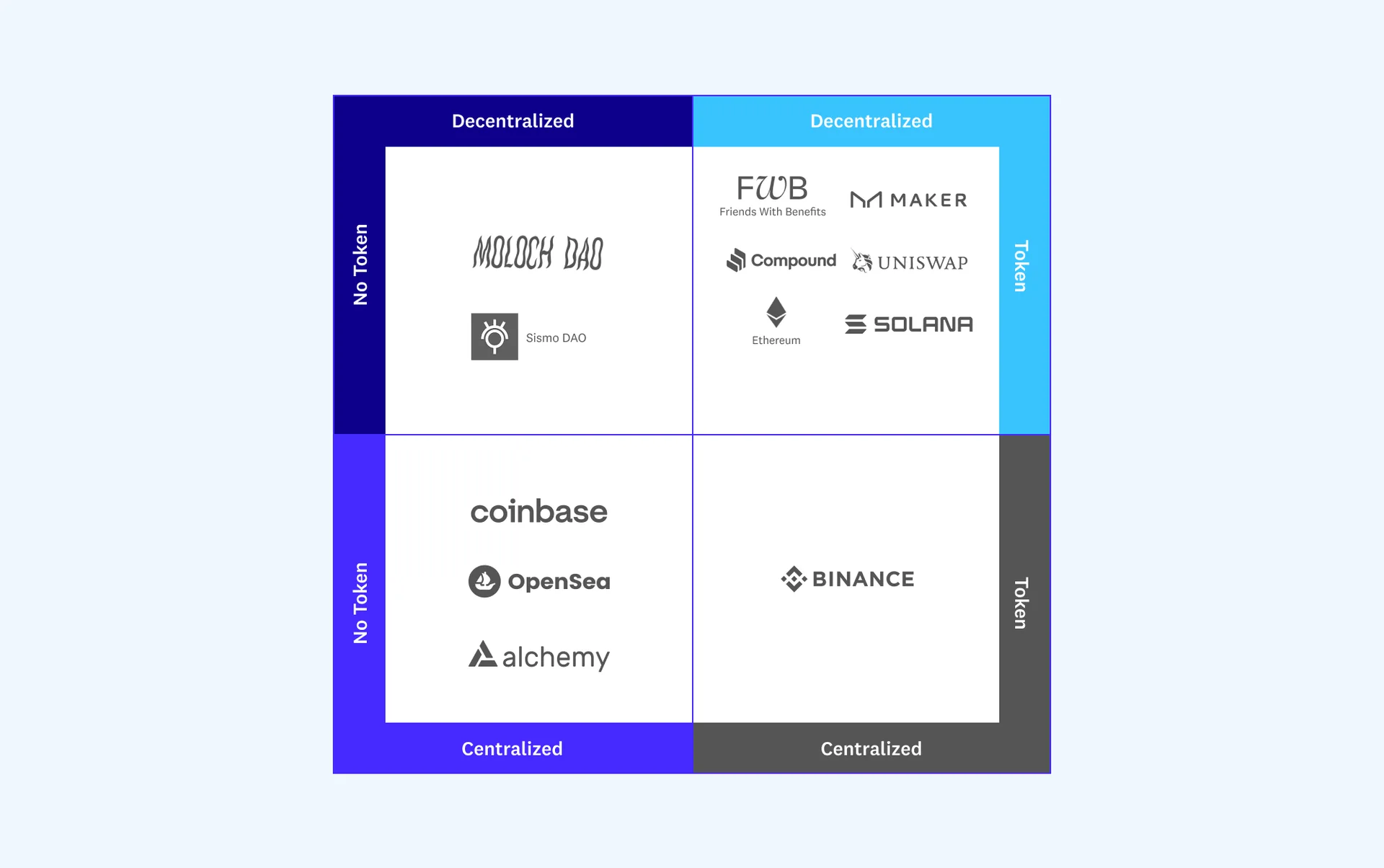
Go-to-market varies across each quadrant, and can range from classic web2-style tactics to emerging and experimental ones. Here, I’ll concentrate on the upper right quadrant (decentralized team with token) and compare it with the lower left quadrant (centralized team with no token) to show the difference between web3 and web2 GTM approaches.
Decentralized with token
First, let’s examine the upper right quadrant. This includes organizations, networks, and protocols with distinct web3 operating models, which in turn call for new go-to-market strategies.
Organizations in this quadrant use a decentralized model (though they generally begin with a core development team or operational staff) and rely on token economics to bring in new members, reward contributors, and align incentives across participants. (For a deeper discussion of web3 business models and the apparent paradox of value capture, see this talk from a16z Crypto Startup School.)
The key difference between the web3 organizations in this quadrant and those that use a more traditional GTM model comes down to the central question: What is the product? Whereas web2 companies and those in the lower-left quadrant generally have to begin with a product that will pull in customers (“come for the tools, stay for the network”), web3 companies approach go-to-market through the combined lenses of purpose and community.
Having a product and a strong technical base is still important, but it does not need to come first.
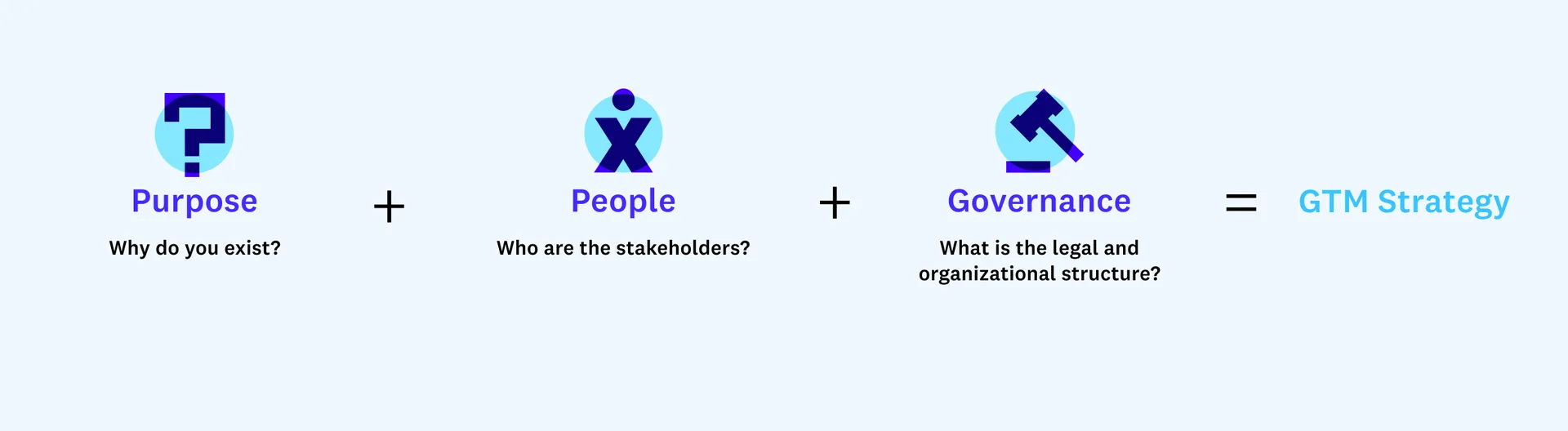
What these organizations do require is a clear purpose that explains why they exist. What problem are they uniquely trying to solve? This also means more than simply raising money on the basis of a white paper and founding team. It means having a strong community — not just being “community-led” or “community-first,” but also being community-owned — blurring the line between owner, shareholder, and user. What supports long-term success in web3 is clear purpose, an engaged and high-quality community, and the right organizational governance matched to that purpose and community.
Now let’s go further into the go-to-market motions in the two main categories of web3 organizations in the upper right quadrant: (1) decentralized applications; and (2) Layer 1 blockchains, Layer 2 scaling solutions, and other protocols.
GTM motions for decentralized applications
“Decentralized applications” includes use cases such as decentralized finance (DeFi), non-fungible tokens (NFTs), social networks, and gaming.
Decentralized Finance (DeFi) DAOs
One major category of decentralized applications is decentralized finance (DeFi) applications, such as decentralized exchanges (e.g., Uniswap or dYdX) or stablecoins (e.g., MakerDAO’s Dai). Although their go-to-market motions may resemble those of a standard, non-decentralized application, value accumulates differently because of the organizational structures and token economics.
Many DeFi projects follow a path in which the protocol is initially built by a centralized development team. After the protocol launches, the team often works to decentralize it in order to improve security and spread management of its operation to a decentralized set of token holders. This decentralization is usually achieved through the concurrent issuance of a governance token; the launch of a decentralized governance protocol (typically a decentralized autonomous organization, or DAO); and the transfer of control over the protocol to the DAO.
This decentralization process can take a variety of organizational and entity forms. For example, many DAOs have no associated legal entity and exist only online, while others rely on multi-signature (“multisig”) wallets that follow the DAO’s instructions. In some instances, nonprofit foundations are created to guide future protocol development under the DAO’s direction. In almost every case, the original development team remains active, both as one of many contributors to the ecosystem formed by the protocol and to build additional or related products and services. (This white paper provides further detail on legal frameworks for DAOs, ranging from taxation and entity formation to operational issues and considerations.)
Here are two popular DeFi examples:
- MakerDAO began as a DAO in March 2015, formed a foundation in June 2018, and dissolved its foundation in July 2021. MakerDAO offers a stablecoin, Dai, designed to let users transact in a fast, low-cost, borderless, and transparent manner using a stable unit of value. This may include buying goods and services or interacting with other DeFi applications. It also has a governance token, MKR. The DAO votes on a range of governance updates as well as certain protocol operating parameters, including the collateralization ratios used by the protocol to mint DAI. The Uniswap protocol was originally launched by a centralized company, but is now owned and governed by the Uniswap DAO, which UNI token holders control. Uniswap Labs, the protocol’s creator, runs one interface to the Uniswap protocol and is one of many developers contributing to the protocol’s ecosystem.
So what does go-to-market look like in this context? Consider Dai, the algorithmic stablecoin issued and governed by MakerDAO. A major aim for most algorithmic stablecoin issuers such as MakerDAO is to drive greater use of their stablecoin across the financial ecosystem. The go-to-market approach is therefore to have it: 1) listed on cryptocurrency exchanges for retail and institutional trading; 2) integrated into wallets and applications; and 3) accepted as payment for goods or services. Today, there are over 400 Dai markets, it is integrated into hundreds of projects, and it is accepted as a payment method through major commerce solutions like Coinbase commerce.
How did they accomplish this? MakerDAO first did so through a more conventional business development team that drove many early partnerships and integrations. But as decentralization increased, the business development role shifted to the growth core unit, a sub-community of Maker token holders often called a SubDAO. In addition, because MakerDAO is decentralized and its protocol operates in a trustless and permissionless way, anyone can create or purchase Dai through the protocol. And since Dai’s code is open source, developers can integrate it into their apps in a self-service way. Over time, as the protocol became more self-service — with stronger developer documentation and more integration playbooks — other projects were able to build on it at scale.
Go-to-market metrics for DeFi DAOs: New go-to-market approaches for web3 bring new ways to assess success. For DeFi apps, the standard success metric is the previously mentioned total value locked (TVL). It reflects all assets using a protocol or network for activities like trading, staking, and lending.
Still, TVL is not a good measure of long-term organizational health and success. Even though new DeFi protocols can replicate open-source code, promise high yields, and draw sizable capital inflows and TVL, that is not always durable — traders frequently move on as soon as the next project appears.
The more important metrics to monitor, then, include things like the number of unique token holders; how often and how positively the community engages; and developer activity. Also, because protocols are composable — meaning they can be programmed to work with and extend one another — another key metric is integrations. The number and type of integrations show how and where the protocol is used in other applications, such as wallets, exchanges, and products.
Social, culture, and art DAOs
For social, culture, and art DAOs, go-to-market means forming a community around a distinct purpose — sometimes even beginning as a text chat among friends — and expanding it organically by finding others who share that same purpose. But isn’t this “just a group chat” or simply like traditional crowdfunding on Kickstarter, for example?
No, because while leaders of traditional web2 crowdfunding projects may also have a clear purpose, they must be far more explicit about how they will achieve that purpose from the top down. The project founders usually provide a detailed explanation of how the money raised will be spent, a clear product roadmap, and a thorough timeline. In the web3 model, the purpose comes first, but the methods are often worked out later — including how funds will be used, the product roadmap, and the timeline.
For example, with ConstitutionDAO, the purpose was to buy a copy of the U.S. Constitution; for Krause House, the purpose is to buy an NBA team and lead fan governance of a team; for LinksDAO, it is to create a virtual country club with a community of golf enthusiasts; and for PleasrDAO, it is to collect, display, and creatively add or share back to the community NFTs that represent culturally significant ideas and movements.
In the case of ConstitutionDAO, which raised $47M from a community of strangers who gathered around this purpose, the whole effort came together in just a matter of weeks, and began with a clear purpose and raising money only for that specific purpose. ConstitutionDAO did not have much else — no clear roadmap, execution plan, or even a token at that stage (it was created after the bid failed). The individuals who contributed financially were so aligned with the purpose, and motivated by the community, that they simply wanted to help and spread the word, filling Twitter with emoji scrolls that turned into a meme.
Friends with Benefits is a token-gated social DAO that began as a token-gated Discord server for web3 creatives. Along with a minimum buy-in of $FWB tokens, which signify membership in the DAO, prospective members must apply to FWB through a written application. The community expanded, connected in different Discord channels, held IRL events, and eventually recognized that one of the products they could build was a token-gated events app. FWB gives creatives a real stake in the community, while the DAO structure allows large-scale coordination of this decentralized social group to do things like allocate budget and complete projects ranging from publishing content to producing events.
Go-to-market metrics for social DAOs: One key measure of a DAO’s health is the quality of community engagement, which can be tracked through the main communication and governance platforms it uses. For example, a DAO can measure channel activity on Discord; member activation and retention; attendance on community calls, governance participation (who is voting on what, and how often); and actual work being done (number of paid contributors).
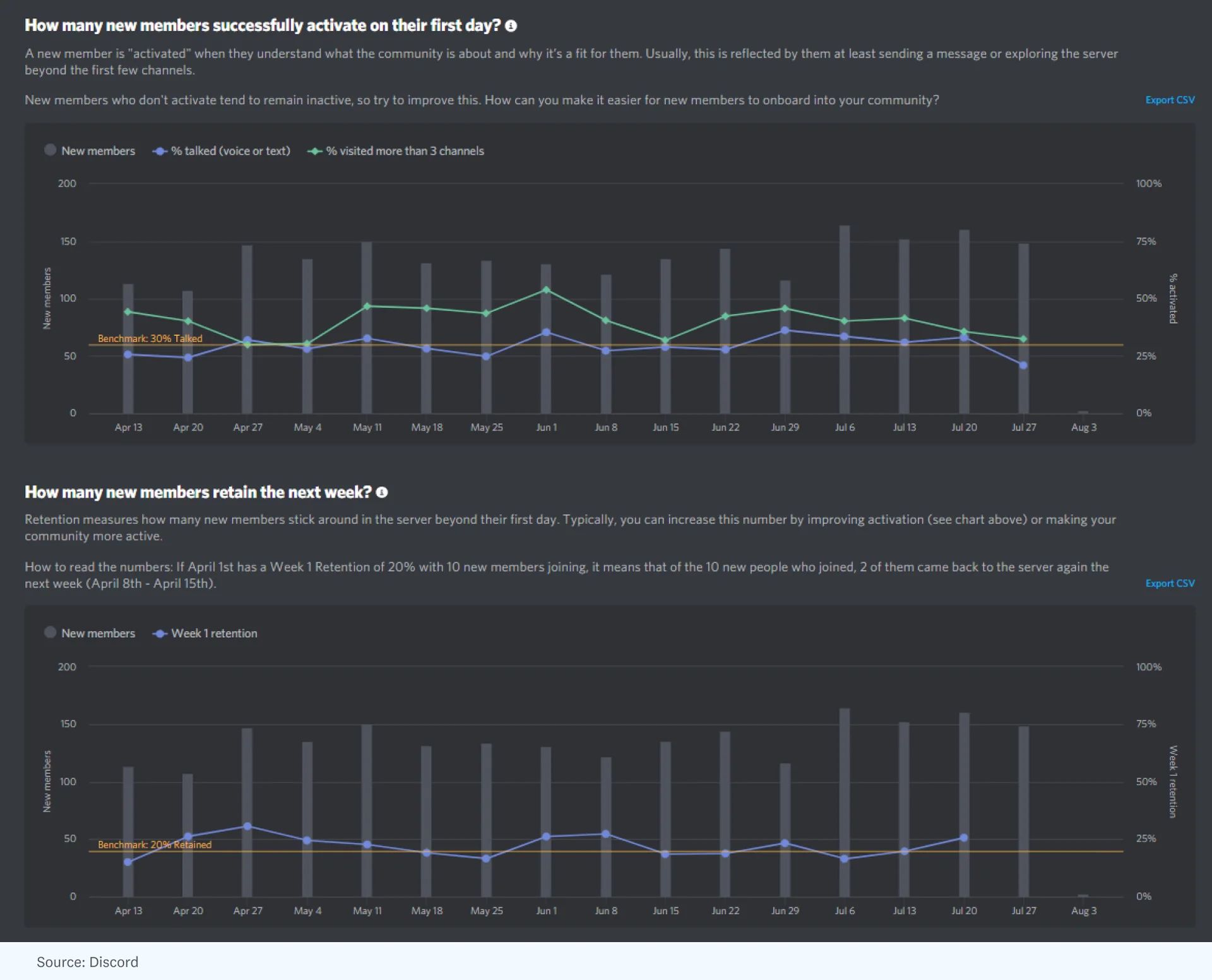
Other metrics could include net-new relationships formed, or gauging trust developed among DAO community members. Although some tools and frameworks are available here, social DAO metrics are still an emerging area, so we’ll see more tools appear and develop as the space matures.
Game DAOs
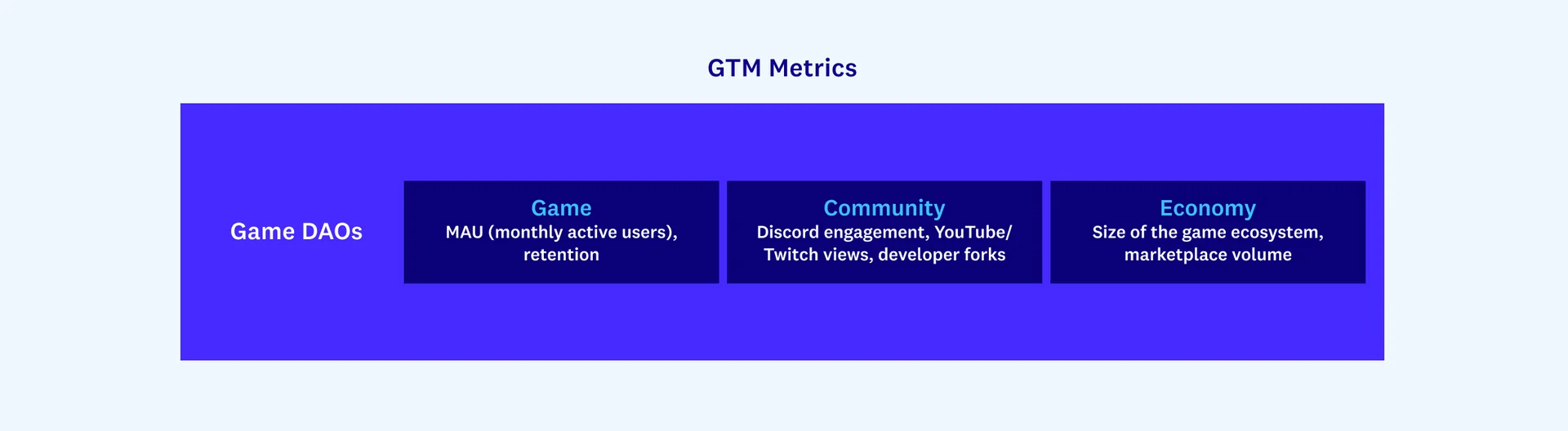
Today, most web3 games, whether play-to-earn, play-to-mint, move-to-earn, or another model, closely resemble familiar web2 counterparts — but with two key differences:
- The use of in-game assets native to open, global blockchain platforms rather than the closed, controlled economies found in traditional pay-to-own and free-to-play titles; and The ability for game players to become true stakeholders and have a voice in the governance of the game itself.
In web3 gaming, go-to-market strategy is built through platform distribution, player referrals, and partnerships with guilds. Guilds such as Yield Guild Games (YGG) let new players begin playing a game by lending them game assets they might otherwise be unable to afford. Guilds decide which games to back by considering three factors: the quality of the game; the strength of the community; and the robustness and fairness of the game economy. Game, community, and economic health all need to be maintained together.
Although developers of blockchain-based games may have a lower ownership share and/or take rate, by rewarding players as owners the developers are helping expand the overall economy for everyone.
But unlike in web2, purpose and community come first. For example, Loot, a game that began with content before shifting to gameplay, is an example of purpose and community, rather than product, driving GTM. Loot is a collection of NFTs, each called a Loot bag, which contain a unique mix of adventure gear items (examples include a dragonskin belt, silk gloves of fury, and an amulet of enlightenment). Loot effectively offers a prompt — or building block primitive — from which games, projects, and other worlds can be created. The Loot community has produced everything from analytics tools to derivative art, music collections, realms, quests, and more games, all inspired by their Loot bags.
The core point is that Loot grew not because there was an existing product users rushed toward, but because of the idea and lore it embodied — an open, composable network that encouraged creativity and rewarded users with tokens. The community creates the product — it is not the network creating the product in hopes of attracting a community. As a result, a key metric here would be the number of derivatives, for instance, which could be viewed as even more valuable here than traditional metrics would be.
GTM motions for Layer 1 blockchains and other protocols
In web3, Layer 1 means the base blockchain itself. Avalanche, Celo, Ethereum, and Solana are all Layer 1 blockchain examples. These blockchains are open source, which means anyone can build on them, copy or change them, and connect with them. Their growth comes from more applications being built on top of them.
Layer 2 refers to any technology that sits on top of an existing Layer 1 in order to address scalability issues with Layer 1 networks. A rollup is one kind of Layer 2 solution. Layer 2 rollups do exactly that — they “roll up” transactions off chain and then send the data back to the Layer 1 network through a bridge. There are two main types of Layer 2 rollups. The first, optimistic rollups, “optimistically” treat the transaction as honest and not fraudulent through a fraud proof. The second, zk rollups, rely on “zero knowledge” proofs to establish the same. Most of these Layer 2 solutions are being built for Ethereum right now and do not yet have their own token, but we will cover them here because their go-to-market success metrics are similar to those of the other networks in this category.
In addition, protocols can be built on top of other L1s or L2s, with the Uniswap protocol, for example, supporting Ethereum (L1), Optimism (L2), and Polygon (L2).
Growth of Layer 1 blockchains, Layer 2 scaling solutions, and these other protocols can come from forks, which happen when a network is copied and then modified. For example, Ethereum, a Layer 1 blockchain, was forked by Celo. Optimism, a Layer 2 scaling solution, was forked by Nahmii and Metis. And Uniswap was forked to create SushiSwap. Although this may at first appear negative, the number of forks a network has can actually be a sign of success — it indicates that others want to imitate it.
These examples and ways of thinking all concentrate on the upper right quadrant, decentralized networks with tokens — broadly speaking, the most advanced current examples of web3. However, depending on the organization type, there is still a fair amount of mixing between web2 GTM strategies and new web3 models. Builders should understand the full set of approaches as they start to shape their go-to-market strategy, so let’s now look at a hybrid model that combines web2 GTM with web3 GTM strategies.
Centralized and no token: The web2-web3 hybrid
Many companies in this lower left quadrant (centralized team with no token) provide entry points and interfaces that let users access web3 infrastructure and protocols.
Within this quadrant, there is substantial overlap in go-to-market strategies between web2 and web3 — especially in SaaS and marketplaces.
Software-as-a-service
Some companies in this quadrant use the conventional software-as-a-service (SaaS) business model, for example Alchemy, which offers nodes-as-a-service. These companies provide infrastructure on demand through multiple subscription tiers, based on factors such as how much storage is required, whether nodes are dedicated or shared, and monthly request volume.
The SaaS business model usually calls for a standard web2 go-to-market motion and incentives. Customer acquisition comes from a mix of product-led and channel-led strategies:
Product-led user acquisition is about encouraging users to try the product directly. For example, one of Alchemy’s products is Supernode, an Ethereum API intended for any organization building on Ethereum but that does not want to handle its own infrastructure. In this situation, customers would test Supernode through a free tier or freemium model, and those customers would then recommend the product to other possible customers.
By contrast, channel-led user acquisition focuses on dividing different customer types (for example, public-sector vs. private-sector customers) and aligning sales teams with those customers. In this case, a company might have a sales team dedicated only to public-sector customers such as government and education, and would understand that type of customer’s needs very deeply.
I’m giving an overview in this article to clarify the distinction between web2 and web3 go-to-market strategies, but it’s important to note that developer-focused outreach and developer relations — including developer documentation, events, and education — is also very important here.
Marketplaces and exchanges
Other companies in this quadrant rely on the comparatively familiar consumer models of marketplaces and exchanges, such as peer-to-peer horizontal NFT marketplace OpenSea and cryptocurrency exchange Coinbase. These businesses earn revenue — the “take” — from a transaction fee (typically a percentage of the transaction), which is similar to the business models of classic web2 marketplaces such as eBay and Amazon.
For companies like these, revenue growth comes from increasing the number of listings, the average dollar value of each listing, and the number of users on the platform — all of which drive more transaction volume, while also benefiting users through variety, marketplace liquidity, and more.
A major go-to-market motion here is expanding channel distribution by partnering with other platforms to surface a selection of items. This resembles the Amazon affiliate program, in which bloggers can link to the items they like best, and any purchases made through those links earn the blogger a commission. But a key difference from web2 is that web3 structures make royalty distributions back to the creator possible in addition to the affiliate fee. For example, OpenSea provides the traditional affiliate sales channel through its White Label program, in which purchases made through a referral link give a percentage of the sale to the affiliate, but it also enables royalties, in which creators can keep earning a percentage of any secondary sales. (This web3 feature is uniquely possible because crypto lets smart contracts encode the percentage arrangement in advance, blockchain records provenance, and more.)
Because creators now have a chance to keep monetizing their work through secondary markets — value they could not previously see, much less capture, in web2 systems — they are motivated to keep promoting the marketplace. Creators become evangelists too.
GTM tactics
Now that I’ve covered an overview of key mindsets and sample use cases, let’s look at specific go-to-market tactics often used in web3 organizations. These are the core ingredients, not a full playbook, but they can still help builders entering and exploring the space understand the tactics and options.
Airdrops
An airdrop is when a project gives tokens to users to reward certain behavior that the project wants to encourage, including testing the network or protocol. These can be sent to all existing addresses on a given blockchain network, or targeted (such as to specific key influencers); often, they are used to solve the cold start problem — to bootstrap early adoption, reward or incent early users, and more.
In 2020, Uniswap airdropped 400 UNI to anyone who had used the platform. In September 2021, dYdX airdropped DYDX to users. More recently, ENS carried out an airdrop to anyone with an ENS domain (a decentralized .eth domain); the airdrop took place in November 2021, but anyone who owned an ENS domain before October 31, 2021, was/is eligible (until May 2022) to claim $ENS tokens, which give holders governance rights with respect to the ENS protocol.
In the non-fungible token space, airdrops for NFT projects are also growing in popularity to help with giving more people access and other reasons. One recent notable airdrop was from the Bored Ape Yacht Club, a collection of 10,000 unique NFTs; on August 28, 2021, BAYC created the corresponding Mutant Ape Yacht Club. Each of the BAYC token holders received a mutant serum, allowing them to mint 10,000 “mutant” apes, and additionally a new 10,000 mutant apes became available for new entrants. Because there were different types of serums, serums could only be used once, and since a Bored Ape could not use multiple serums of the same tier, serums added a new scarcity model.
The reason for creating MAYC was to "reward our ape holders with an entirely new NFT" — a "mutant" version of their ape — while also opening the BAYC ecosystem to newcomers at a lower membership tier. This keeps the broader community accessible without weakening the exclusivity of the original set or making original owners feel their contributions were diminished. (Another approach to accessibility is NFT fractionalization, in which an NFT has multiple owners.) The MAYC floor price, meaning the lowest listed price for a MAYC, is consistently below the BAYC floor price, yet owners essentially receive the same benefits.
These airdrops were carried out retroactively to reward NFT holders or network and protocol users (as with the ENS airdrop), but airdrops can also be used proactively as a GTM move to raise awareness for a specific project and prompt people to explore it. Because blockchain data is public, a new project can airdrop to, for instance, every wallet using a particular marketplace, or every wallet holding a particular token.
In any event, projects should clearly explain their overall token distribution, allocation, and plans before carrying out the airdrop. There are many cases of airdrops being used for malicious purposes and of airdrops that have gone badly. Also, token airdrops can be treated as securities offerings in the United States, so projects should seek legal counsel before engaging in any such activity.
Developer grants
Developer grants are funds distributed from a protocol’s treasury to people or teams that are contributing in some manner to improving the protocol. This can be an effective GTM tool for DAOs, since developer activity is such an essential part of a protocol’s success. Examples of projects and protocols that offer developer grants include Celo, Chainlink, Compound, Ethereum, and Uniswap.
But grants can cover everything from protocol building to bug bounties, code audits, and other work beyond coding. Compound even offers a grant type tied to business development and integrations, financing any integrations that increase Compound’s usage. One example is its funding of a grant that connected Compound with Polkadot.
Memes
Viral images with text overlays are another GTM tactic for web3 organizations. Because the cryptocurrency ecosystem is so complex and broad, and social media users have short attention spans, memes help information spread quickly. Memes can also communicate belonging, community, goodwill, and more in a very information-dense format.
The NFT project Pudgy Penguins, a collection of 8,888 penguins, began because of its meme appeal. The collection’s primary drop sold out in 20 minutes, and it was covered by major media outlets, which in turn helps projects like this reach the mainstream. The social-display and community aspect of "PFP" (profile picture) collections — in web3 this is emerging as NFTs shown as an owner’s profile picture on social media — also support this virality. Twitter recently introduced a feature letting users prove ownership of an NFT through hexagonal profile pictures linked to OpenSea’s API.
Owners with large social media followings create awareness of a project when they switch their profile picture to one from that project, and project owners often follow all other owners of the same project. These actions can also spark additional memes, as with Crypto Covens and the "web2 me vs. web3 me" meme, where users began showing their witches next to their actual faces, signaling identity, belonging, and more.
***
So what does all this mean for web3 founders? The biggest mindset change is shifting from planning toward something more like gardening.
In web2 companies, founders not only define a top-down vision but are also responsible for building a team and planning and executing against that vision. In web3, founders take on more of the role of a gardener, helping cultivate and nurture potentially successful products while also preparing the space for everything to occur. While web3 founders still set the organization’s purpose and its initial governance structure, that governance structure itself may quickly create new roles for them. Rather than optimizing for headcount growth or revenue and profitability, founders may optimize for protocol usage and the quality of community. In addition, after any decentralization, founders have to adapt to settings where no hierarchical power structures exist and where they are one of many actors supporting the success of a given project. As a result, before decentralizing, founders should make sure they are preparing their project for success in such an environment.
I witnessed some of this firsthand when I was chief of staff to Tony Hsieh, former CEO of Zappos.com, an e-commerce company now owned by Amazon. The company experimented with more decentralized (compared to only top-down) governance structures beginning in 2014, including the self-organized management system known as “holacracy.” Holacracy involved a hierarchy of work rather than of people, and had mixed results. But Hsieh offered a useful metaphor when comparing his role as being the cultivator of a greenhouse of plants (in the holacracy model), rather than being the best plant. He had said he needed to be the “architect of the greenhouse” — setting the right conditions to enable all the other plants to flourish and thrive.
Today, Alex Zhang, Mayor of Friends with Benefits (FWB), the social DAO with a fungible token, echoes that sentiment, saying his job "is not to set a top-down vision" but to enable the creation of "frameworks, permits, and regulations for community members" to approve and build on top of. Where a web2 leader would focus on updating the product roadmap and pushing toward new product launches, Zhang sees himself more as a gardener than a top-down builder. His role includes monitoring the FWB "neighborhood" (in this case, Discord channels) and curating it by retiring channels with little traction and helping support and expand channels that have momentum. By building a framework for these channels — and playbooks for channel success (such as a mix of activity, clear leadership, and governance structures) — Zhang becomes more of an educator and communicator.
In the case of founders of NFT projects, their role is primarily as originators and temporary stewards of intellectual property (IP). Yuga Labs, the creators of Bored Ape Yacht Club, wrote, “We see ourselves as temporary stewards of IP that is in the process of becoming more and more decentralized. Our ambition is for this to be a community-owned brand, with tentacles in world-class gaming, events, and streetwear.” Owning an NFT — whether it’s an image, a video or sound clip, or another form — conveys to the owner all the rights associated with the NFT. As the NFT is bought and sold, that ownership is transferred — and as ecosystems grow around the NFT, those benefits go to the NFT owner, not just the founding team of the NFT project.
NFT ownership can also center on community-driven licensing and community-driven content, unlike traditional IP franchises. One example is Jenkins The Valet, an NFT avatar from the BAYC collection (specifically, Ape #1798) that signed with Creative Artists Agency (CAA) for representation across different forms of media. Jenkins was created by Tally Labs, the group that owns Ape #1798. Tally Labs chose to give the ape its own brand and backstory, and flipped the idea that an NFT’s statistical rarity is the main factor in its price and success. They then created a way for others to help create content around Jenkins through a "writer’s room" NFT, where, for example, community members were able to vote on the genre of the first book.
There is much more that is possible here; we have not yet seen what else is possible as more people adopt crypto and decentralized technologies and web3 models. Traditional web2 GTM frameworks are a useful point of reference and provide some helpful playbooks — but they are only a few of the many frameworks available to web3 organizations. The main difference to keep in mind is that the goals, growth, and success metrics of web2 and web3 are often different. Builders should begin with a clear purpose, grow a community around that purpose, and align their growth strategies and community incentives — and with them, the go-to-market motions — accordingly. We will see many models emerge, and look forward to observing and sharing more here.
Thanks to Justin Paine, Porter Smith, and Miles Jennings for their contributions to this article.