
related must-readsThe Web3 Playbook: Using Token Incentives to Bootstrap New NetworksChris DixonDesigning Internet-Native Economies: A Guide to Crypto TokensPatrick RiveraGo-to-Market in Web3: New Mindsets, Tactics, MetricsMaggie Hsu
Decentralization’s promise has been widely explored and argued over, from why it matters to the larger issue of who will govern the software that runs the internet. These are vital questions, because as we have learned, when control sits in the hands of very few, intrusions on personal freedom, choice, and privacy are built in. “Don’t be evil” is very different from “can’t be evil” when a CEO chooses one path or another.
Yet making the internet decentralized has proven difficult. Compared with the long-tested efficiency and reliability of centralized systems, decentralized ones have had trouble keeping up. Now, though, the developing crypto and web3 stack — especially programmable blockchains, composable smart contracts, and digital assets — makes it feasible for decentralized systems to reach extraordinary levels of coordination and operational capability. This shift makes possible new kinds of governance and organizations, community-owned-and-operated networks and services, strong economies, and many other innovations.
We’ve already seen categories like decentralized finance (“DeFi”) and core infrastructure projects gain traction, and we will soon see decentralized versions of existing web2 categories such as social media, video games, music, and marketplaces. The success of these systems will hinge on their capacity to provide the real benefits of decentralization, including more even ownership among stakeholders, less censorship, and broader diversity. But the more familiar decentralization models used for DeFi will not necessarily fit these more complex systems (that is, those with more UI features, richer client experiences, centralized products or services, or licensed IP).
So, I thought it would be helpful to outline specific models and principles of decentralization drawn from the last several years of working closely with crypto founders, to help web3 builders working through what decentralization means in practice across a range of use cases. Depending on where you are in your web3 journey, I invite you to read the full piece below; read the more detailed paper on which this piece is based (which includes added background and specifics); or skip ahead straight to:
- a framework for understanding the design challenge of web3 decentralization; a summary of how builders can use the novel components of web3 systems to achieve decentralization; an analysis of several models of decentralization and how they apply in practice.
(1) design challenge of decentralization
(1) The design challenge of web3 decentralization
Decentralization can be seen as one design challenge that covers three different, yet connected, elements: technical, economic, and legal. Grasping how these elements differ is essential to designing web3 systems because design choices in regard to one affect the others.
Technical decentralization
Technical decentralization is mainly about the security and structural mechanics of web3 systems. The central innovation of programmable blockchains is that they can enable technical decentralization by offering a permissionless, trustless, and verifiable environment in which value can move — and, more importantly, on top of which web3 products and services can be created.
This means that products and services can be launched and operated without depending on trusted, centralized intermediaries to run (or pull the rug out from under) them, which opens up a huge range of possibilities. For these reasons, technical decentralization serves as the base on which the other two forms of decentralization can take place: economic and legal.
Economic decentralization
Economic decentralization concerns the economies of web3 systems. The rise of programmable blockchains (such as Ethereum, Solana, and Avalanche) and digital assets (such as ETH, SOL, and AVAX) made it possible for open source and decentralized systems to finally develop their own decentralized economies (i.e., autonomous free-market economies).
This is a major breakthrough. The open source and decentralized protocols of earlier generations of technology like web1 (such as http, smtp, ftp, etc.) stalled because they did not have the means to motivate continuing development and/ or additional investment of critical resources back into their systems. This created fertile ground for the centralized companies of web2 to arise and thrive as they could use their efficiency and resources to create products and services that exceeded those of web1. But this centralization also produced countless instances of user rights abuses, de-platforming, and aggressive take-rates.
Today, the technology that supports web3 makes it possible for much more advanced open source and decentralized systems to be built — and allows decentralized economies to emerge around them — which will let the products and services of web3 compete with and eventually overtake those of web2.
Builders of web3 systems can help create decentralized economies through thoughtful design choices that cause their systems to accumulate “value” — whether information, economic value, voting power, or other form — from many different sources, and to allocate that value fairly among system stakeholders based on their contributions. To do this, web3 systems must give meaningful power, control, and ownership to system stakeholders (via airdrops, other token distributions, decentralized governance, etc.). This, in turn, motivates stakeholders to supply meaningful value, because they have agency over how their contributions are handled and rewarded.
The continuing balancing of incentives among the stakeholders — developers, contributors, and consumers — can then spur further contributions of value to the system as a whole, for everyone’s benefit. In other words: all the advantages of modern network effects, but without the drawbacks of centralized control and captive economies.
Legal decentralization
Legal decentralization concerns the legality of web3 systems. In this piece, I focus mainly on U.S. securities laws, which govern how and whether web3 systems may use their own native digital assets. Although there is no codified standard of “legal decentralization,” a first-principles reading of U.S. securities laws, case law, and SEC guidance (including the SEC’s definitive guidance from April 2019) can help us develop a practical standard.
To begin, U.S. securities laws are generally meant to establish a “level playing field” for securities transactions by restricting the ability of those with more information to take advantage of those with less information. This is the principle of information asymmetry, and U.S. securities laws usually try to remove asymmetry in certain securities transactions by imposing disclosure requirements. The principle is relevant to the Howey test, the subjective test that decides whether U.S. securities laws should apply to a digital assets transaction where there is (1) an investment of money (2) in a common enterprise (3) with a reasonable expectation of profit (4) primarily based upon the managerial efforts of others. The fourth prong aims to deal with information asymmetry on the theory that where there is dependence on “managerial efforts”, the risk of information asymmetry (of the managers versus outsiders) is likely high, and so the application of securities laws may be required.
From the above and SEC guidance, we can infer that if a web3 system can (a) remove the potential for significant information asymmetries to emerge and (b) remove reliance on essential managerial efforts of others to determine the success or failure of that enterprise, then the system may be “sufficiently decentralized” such that the application of U.S. securities laws to its digital assets shouldn’t be required. For the purposes of this piece, I call these systems legally decentralized. Admittedly, the legal decentralization threshold will not be attainable by most businesses, but as I explain below, the novel components of web3 systems uniquely place them to reach such a threshold.
Taken together, these three distinct aspects of decentralization — technical, economic, legal — must be considered holistically, as one design challenge, because design decisions regarding one will influence another. In general, the relationship between technical, economic, and legal is mainly additive, not subtractive — developments in one open up more possibilities in the others. For example: Decentralized economies help push systems toward legal decentralization by emphasizing decentralized ownership among stakeholders, value accretion from decentralized sources, and value distribution to decentralized stakeholders. All of these reduce the risk of information asymmetries and the need to depend on managerial efforts of individuals.
For more background on legal and economic decentralization and how these aspects fit together, see the full paper.
(2) components for decentralization
(2) How web3 system components can be used to achieve decentralization
When web3 systems are built well, decentralization turns into a virtuous, not vicious, cycle. Now that we have a framework for the design challenge of decentralization, let’s briefly review how builders can use the novel components below of web3 systems to advance decentralization in practice:
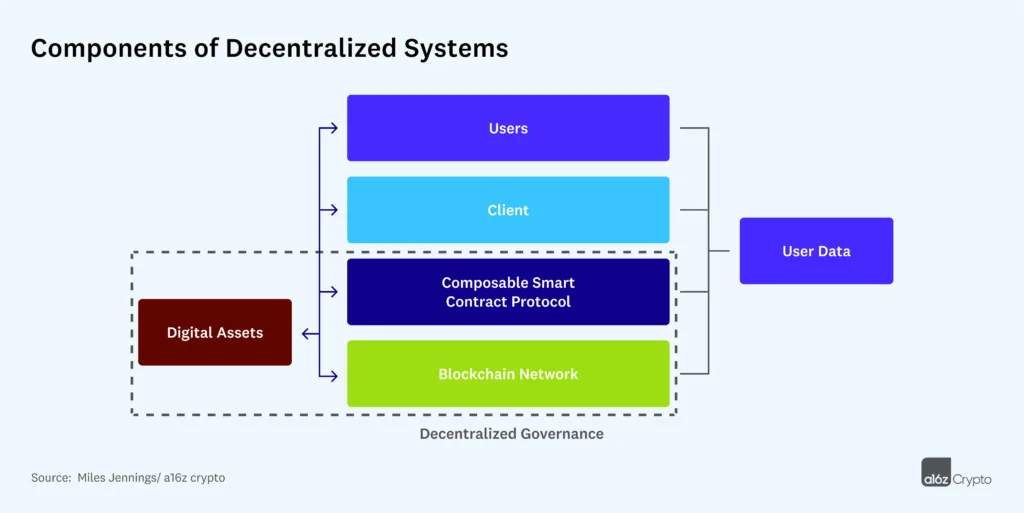
Blockchain networks and smart contract protocols
At a basic level, blockchain networks and smart contract protocols make technical decentralization possible. But they can also be structured in ways that encourage both economic and legal decentralization too, including:
- by increasing transparency — for example, anyone can presently see where the most digital assets have been placed, and where the most fees are being generated in Ethereum’s DeFi ecosystem; by serving as open-source public goods — anyone can freely use and test functionality to verify safety, support decentralized economies, more; by supporting data portability, mobility, and interoperability — users keep control of their data, purchases, and content across web3 products and services; by emphasizing composability — elements can be coded to work with one another, making these programs like building blocks that anyone can use.
Together, these features lower the risk of information asymmetry, reduce the significance of any web3 system’s proprietary technology, and raise the importance of the system’s network of contributors and consumers relative to its developers.
Put another way: These features move the system’s value away from its tech stack and toward its network. Because networks are more open and diffuse than proprietary systems, this shift shows why web3 systems are better positioned than web2 systems to achieve decentralization.
Digital assets
The decentralized economies of web3 systems are powered by a combination of two kinds of incentives:
- Intrinsic incentives, which activate a third party’s innate wish to participate in such systems based on the system’s underlying traits, such as user base, network effects, technology, etc. Extrinsic incentives, such as digital asset distributions, revenue sharing, etc.
Of these, digital assets are the most essential tool web3 builders have to support the formation and continuing operation of their decentralized economies because they make it possible to balance incentives among developers, contributors, and consumers.
When well designed, digital asset distributions can create a “flywheel” of network effects, where the whole system becomes more valuable to more users as participation grows. Yet unlike the locked-in network effects of web2, web3 digital assets let users shape their own experience and benefit from what they add.
Strong user acquisition and retention can greatly strengthen the built-in incentives of web3 systems for developers and contributors, creating more value for those parties and, in turn, drawing in additional users, and so forth. Ethereum’s expansion over the past two years is a clear example: From the beginning of 2020 to the beginning of 2022, the amount of digital assets locked in Ethereum’s DeFi protocols rose from just over $600 million to just over $150 billion. But this is not a story about the amount or its monetary worth — instead, it illustrates how developer activity produced products and services that brought in users, which then brought in more developers and further products and services, which then drove still more user growth.
Beyond possibly producing that flywheel, the network effects of web3 systems can also give builders a moat against rivals copying and redeploying their infrastructure, even though it is all open source. Why? Because in systems with strong network effects, duplication by itself is unlikely to give users a reason to move to the new system.
Once again, this shows that the real value of a web3 system lies in its network of stakeholders — not in its tech stack, a closed or proprietary system, or other familiar moats.
Decentralized governance
The vast majority of blockchain networks and smart contract-based protocols have decentralized governance administered by a decentralized autonomous organization (“DAO”). Decentralized governance and DAOs provide many benefits along each of the three decentralization criteria already discussed, including that they:
- Make web3 systems more secure by spreading technical control across decentralized groups — which limits the chance that any single party can seize control of the system’s governance. Give stakeholders meaningful representation in decisions and keep long-term incentives aligned among stakeholders. This, together with the added security, helps decentralized governance work better — enabling it to support the overall health and sustainability of the decentralized economies of web3 systems. Support legal decentralization by lowering stakeholder dependence on the managerial efforts of any one person or group — thereby reducing the risk of possible information asymmetries.
When building decentralized governance for any web3 system, we can draw on insights from several different models that have already been developed and put into practice across the DeFi sector. For instance:
SubDAOs. To make decision making more efficient, several DAOs give subDAOs specific authority over certain types of actions, such as legal, finance, development, etc.
Governance minimization. To improve the reliability of DeFi protocols and address low DAO participation, some have argued for reducing the total number of decisions DAOs must make, or alternatively for using a hierarchical structure in which more important decisions require higher voting quorums.
Incentivize participation. To ensure effective DAO governance, some DAOs incentivize active participation, including the compensation of delegates. Note that while grant programs have not worked as well here, retroactive awards programs can be very effective because they defer the assessment and awarding of contributions until after the value has been delivered. They can also help spur competition and an open marketplace if designed well.
Progressive decentralization. To protect against malicious attacks, many DAOs use “progressive decentralization”, where greater control is handed from the developer company to the community as the safety of the protocol/ network increases.
Ultimately, web3 builders should avoid concentrating too much power in insiders’ hands. Instead, meaningful control should be placed with the community. When power is unevenly distributed, web3 builders should consider delegate programs to help spread it out.
To strike this balance, web3 builders should also put in place safeguards against hostile attacks, including possible manipulation of decentralized governance for gain. Although off-chain governance tools and multisigs (where control requires several multi-signature holders, each using their own keys, to approve an action) have commonly been used as protections for this reason, they have recently faced substantial criticism, including concerns that they may weaken decentralization.
For additional examples of how all of the above pieces can be structured to improve decentralization, along with a discussion of more best practices, see the full paper.
(3) models of decentralization
(3) Models of decentralization in practice
Let’s now examine how the technical-economic-legal framework I introduced earlier applies to several distinct models of decentralization in practice. These models range from “full” decentralization (where every part of a system is decentralized) to “open” decentralization (where independent third parties all take part in a shared decentralized system). I have also included models for particular uses of open decentralization, such as NFTs projects and tokenization protocols.
how to decentralize DeFi & simple apps
Full decentralization: How to decentralize DeFi and other simple applications
Full decentralization is currently the most common model of decentralization within the DeFi sector. As reflected in the images below, the shift from a centralized model (as in web2) to a decentralized model (as in web3) involves:
- deploying an open-source smart contract protocol onto a decentralized and programmable blockchain network to serve as the core infrastructure layer of the web3 system — the smart contract protocol supplies an execution layer for all backend components that can be deployed on-chain (i.e., payments, messaging, etc.); running a “client” layer in decentralized form — the client includes all system software that runs off-chain and serves as a gateway to the smart contract protocol (clients can range from simple frontend websites to complex applications); adding digital assets distributions — this may be an airdrop to contributors and consumers; issuances to insiders (employees, advisors, and stockholders of the developer company); allocation of digital assets to an explicit incentivization scheme (such as liquidity mining in DeFi); and creation of a treasury controlled by the DAO, to be used in connection with any future incentivization; launching DAO governance of the smart contract protocol and DAO treasury; and making sure users own and keep their own data (currently a major point of contention in web2 systems).
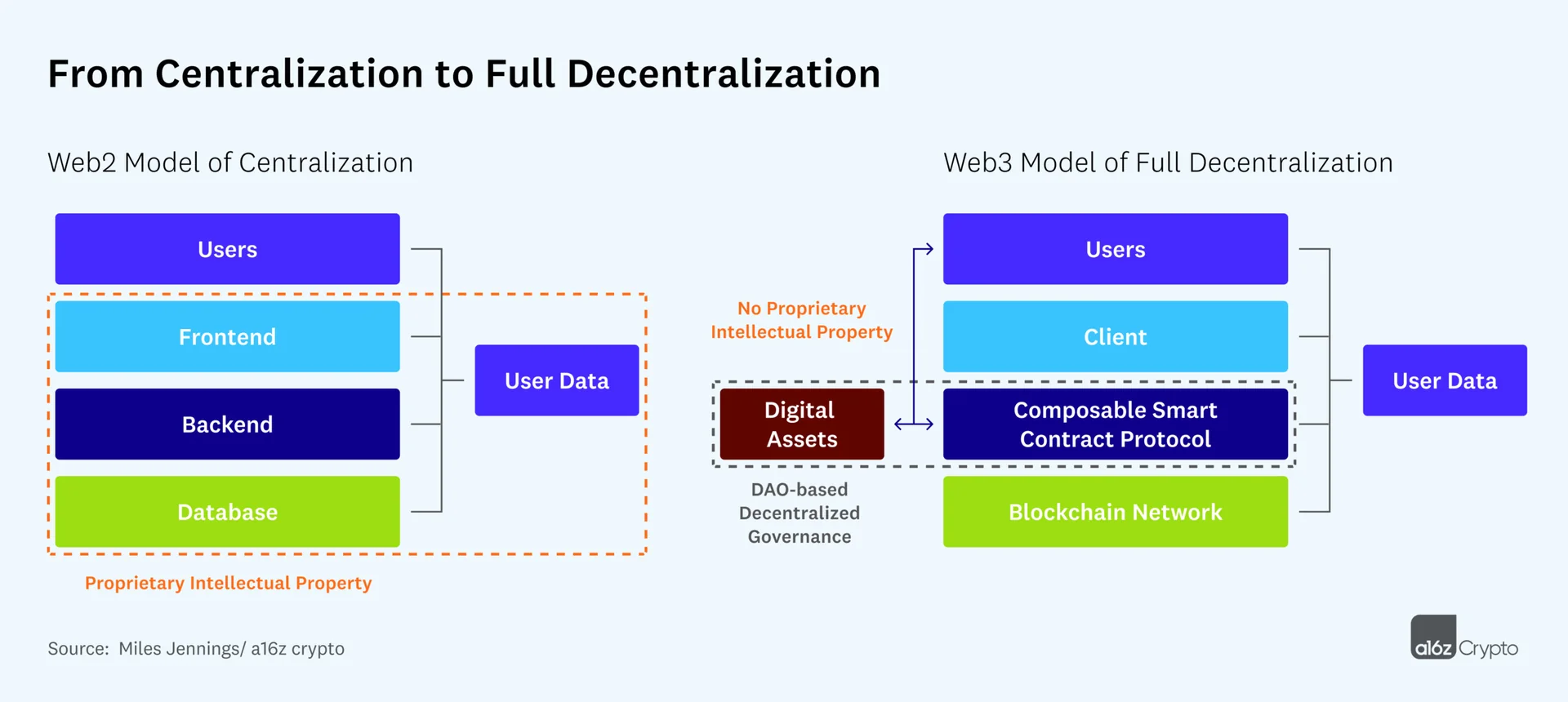
For web3 systems using this model, decentralization of the blockchain network and smart contract protocol is achieved mainly because those layers are technically decentralized, and because decentralized governance is launched in the form of a DAO that takes control of the smart-contract protocol from the developer company that created the system. Deploying the smart contract protocol to a public blockchain and launching its DAO brings transparency, as well as greater safety and security for the system, and it means that no individual or group controls the system.
The decentralization of the client layer then happens in a few different ways. Within DeFi, where most clients are just simple frontend websites that provide a gateway to the underlying smart contract protocol (that is, they allow users to interact with the protocol), most developer companies make their client/ website open source, and host it on a decentralized file system (such as IPFS). With the client/ website open source, third parties that are independent from the developer company often end up hosting their own clients/ websites providing access to the same underlying protocol. In addition, independent third parties often build gateways to the protocol into their own aggregators and dashboards. This means that gateways to the protocol are always available, regardless of whether the developer company’s client/ website is maintained.
The foregoing steps largely remove the risk of information asymmetries — the force behind much of the U.S. securities laws — because (1) information about the protocol and its operations is openly accessible on a public blockchain ledger, and (2) the managerial work of the developer company that launched the protocol is no longer essential to the success or failure of that protocol.
And since the blockchain and smart contract layers are operational and not controlled by any group or entity, the system has full redundancy and is no longer reliant on the developer company. DeFi primitives are a great example of this because they require little to no ongoing development to continue providing users with utility. As a result, protocols implementing this decentralization model could be considered legally decentralized, even without a fully functioning decentralized economy.
Limitations of full decentralization
Although the full decentralization model has worked well in DeFi, its straightforward nature may make it a poor fit for more intricate web3 systems. Builders should recognize and prepare for these issues, which can add complexity:
Complex clients. The decentralization of clients within DeFi is somewhat straightforward given their relative simplicity — very little incentivization is necessary to get third parties to build independent and simple gateways (mostly in the form of websites) to such protocols. However, as web3 products and services become increasingly complex, with computationally expensive/ resource-intensive client layers built on top of underlying smart contract protocols, the decentralization of the client becomes more complicated. For example, consider the difference in complexity of the clients/ websites that provide access to the Uniswap and Compound protocols, as compared to hypothetical web3 social media clients, which would need the full-featured functionality of web2 applications like Twitter and Instagram. Such complexity could reduce the pool of third parties that are willing to build and/ or host alternative clients, or that are willing to integrate access to the protocol layer within their own systems without explicit incentivization.
Significant improvements required. Likewise, systems that need major improvements after digital asset launch may have trouble making those improvements in a decentralized way. For example, in DeFi, many protocols have found it difficult to successfully use explicit token incentives to encourage ongoing meaningful development of their smart contract protocols.
Ongoing operations. Developer companies may plan to carry out significant operations to increase the value of their web3 system after launch of their digital asset. This could weaken the system’s decentralization if extra contributions of value do not also come from independent third parties. Moreover, because governance tokens usually do not grant any rights to future products and services that a developer company may create, developer companies should be careful not to suggest to token holders that any such relationship exists.
Retention of exclusive rights. If the original developer company (or others) keep exclusive rights to any intellectual property used in the system, it may weaken the system’s full decentralization. For example, if developers of complex clients for web3 social media wanted to keep those clients proprietary, full decentralization could be impossible.
Each of these limitations can be addressed by web3 systems that can encourage substantial economic decentralization, creating functioning decentralized economies. If a decentralized group of developers, contributors, and consumers creates and receives substantial value — thereby reducing the significance of the original developer to the system as a whole — it shifts the system from a full decentralization model to an open decentralization model.
how to decentralize complex apps
Open decentralization: How to decentralize complex web3 applications
As with the full decentralization model, the open decentralization model includes a decentralized blockchain and smart contract protocol layer, digital assets, and a DAO.
But unlike the fully decentralized model, an open decentralization model would also include independent developers who build and run several clients, which may be centralized, on top of a shared smart contract protocol layer. For example, consider potentially rich and complex clients for web3 social media with capabilities similar to web2 applications such as Twitter and Instagram, yet all relying on a shared smart contract protocol instead of separate proprietary backend systems.
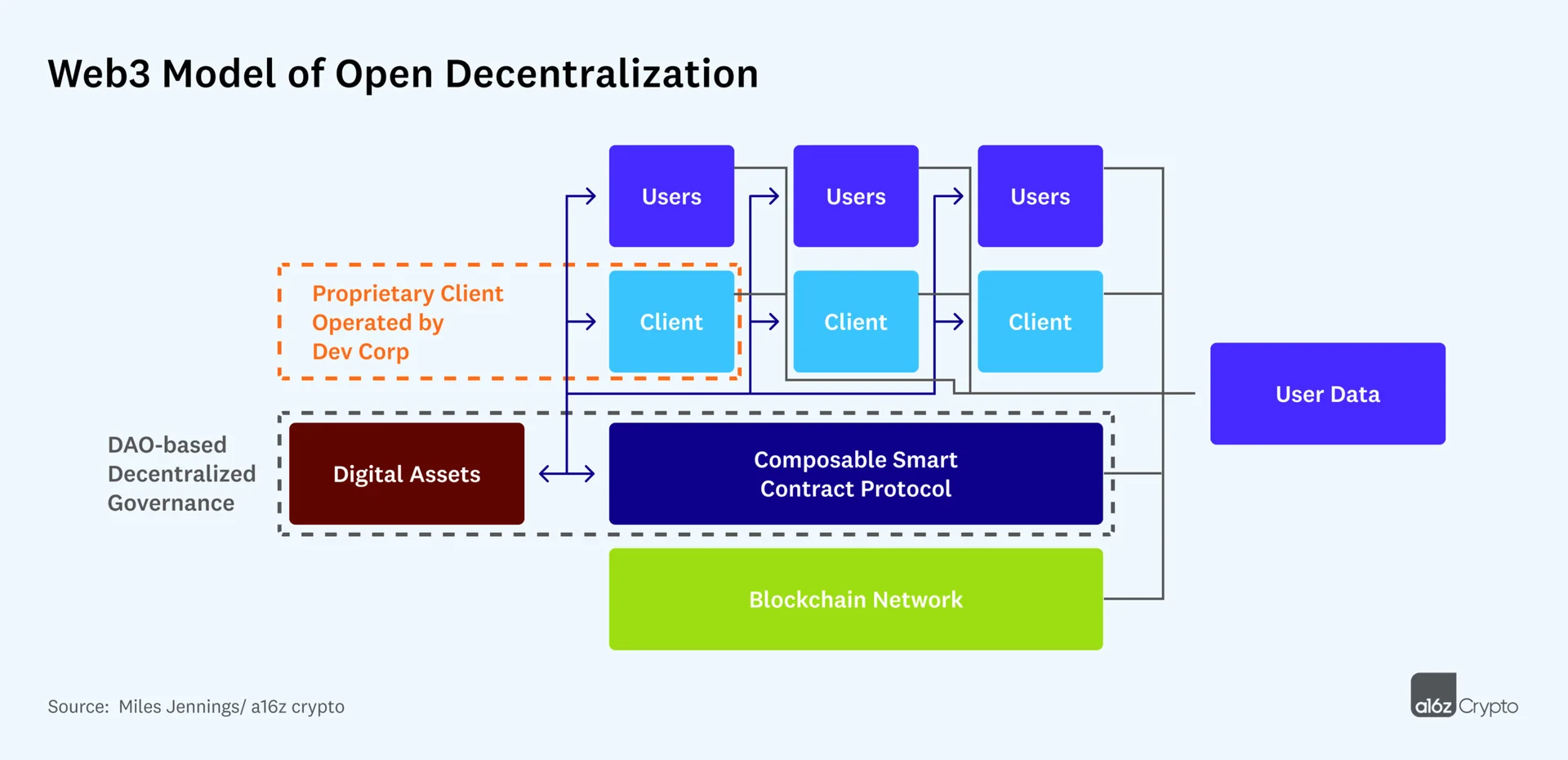
Under this open decentralization model, all clients would use the digital assets of the underlying smart contract protocol, and their development and operation would be incentivized as follows:
- Initial Incentives. Early development could be encouraged through explicit and implicit incentives, including grants of digital assets from the DAO-controlled treasury of the smart contract protocol; the protocol’s network effects; and the fact that these developers could keep intellectual property rights in their respective clients. Ongoing Incentives. Continued maintenance and further development could be encouraged in the same way, with digital asset-based rewards being paid automatically according to performance metrics set by the DAO. One example in DeFi is Liquity Protocol, which compensates the operators of independent frontend websites that give access to the protocol with awards linked to the economic activity such frontend websites generate for the protocol. In more complex web3 systems, we would expect such awards to become much more common. For instance, in a decentralized social media ecosystem, a client’s user engagement could be tracked and rewarded through tokens. Finally, beyond incentives from the protocol, the operators of clients would also be motivated by any financial returns they can produce through their own proprietary clients.
Builders trying to decentralize their web3 systems through the open decentralization model will need to shape their incentive structures and their decentralized governance models so they are “client agnostic” and can attract participation from many actors. They will also need to make sure that no major power imbalances accumulate in a single client in a way that would allow it to control the whole ecosystem. If such imbalances could arise too easily, then the builders of these clients could regard the web3 system negatively and be less willing to devote their time and resources to it. In some respects, such a system would face centralization and control issues similar to those in web2 systems.
Builders using the open decentralization model should also emphasize transparency, open-source technology, data portability, and composability to further lower the risk that power over their systems becomes concentrated in the hands of developers. These qualities reduce information asymmetry, cut the entry barrier for competing developers, and allow users to move between clients — all of which supports a more open and decentralized ecosystem, where users are not bound by the constraints or burdens imposed by any single client. (This is a major obstacle in current web2 systems, where user data is siloed within each captive web2 system.)
Finally, for the system’s decentralized economy to be truly resilient, the success or failure of the whole web3 system should not hinge on any one person or group, including any individual client. If this requirement, together with the economic decentralization requirements described above, is satisfied for a web3 system, then the chance of significant information asymmetries emerging in that system would be greatly reduced, making it legally decentralized.
At first, it may seem counterintuitive to argue that builders should favor the above design choices because they essentially incentivize competition against themselves. But doing so will help bring about a functioning decentralized economy built on shared infrastructure, which will in turn create a much broader and richer ecosystem than any single company could build on its own.
Put another way: these steps enlarge the whole pie instead of favoring a single slice of it.
Web3 versions of web2
To understand how these principles work in practice, let’s use the open decentralization model to build simplified web3 versions of familiar web2 applications. The promise of web3 extends beyond merely removing intermediaries from known features and applications, as it enables entirely new possibilities; but for illustration, I’ll focus on a few simple examples.
Web3 gaming could involve a system with multiple games that implement a shared smart contract protocol and governance token; that have separate in-game currencies and NFTs; and that allow both players and contributors to earn digital assets. These assets would also be portable throughout the ecosystem. The games generating the most usage could then receive the largest share of the governance tokens distributed by the system’s DAO, prompting game creators to fund additional development of their games in return.
Web3 social media could involve a system with multiple versions of social media services and messaging services, each created as a separate client on the same open-source smart contract protocol. Because the protocol would have a native governance token: consumers would earn tokens based on use, contributors would earn tokens based on the content they produce, and clients would earn tokens based on various metrics established by the DAO.
Web3 marketplaces might involve a structure in which a set of smart contracts and clients coordinate service providers and help manage their interactions and scheduling with customers. Developers could then create white-label editions of those clients, allowing providers to deliver many layers of tailored services or products. Clients and service providers would all receive the same governance token according to their contributions to the system. There are an increasing number of examples showing how web3 businesses are already using tokenomics to generate and realize long-term value.
In the end, the open infrastructure — consisting of the blockchain network and smart contract protocol in this model — creates a strong setting for many specialized products and services to be developed on top of its layers. By using this shared infrastructure, builders can create web3 products and services at a small part of the cost of building centralized web2 applications from the ground up.
Progressive open decentralization
One difficulty created by the interaction between economic decentralization and legal decentralization in the open decentralization model is that it frequently creates a chicken-or-the-egg paradox: genuine economic decentralization may require the use of digital assets (i.e., legal decentralization), but the use of digital assets requires economic and, as a result, legal decentralization. This issue is especially sharp in open decentralization models, which depend on fully working decentralized economies (as compared with DeFi protocols using full decentralization models, which do not always need economic decentralization).
Although there are many ways to tackle this issue from technical and practical angles, web3 systems can follow a process of progressive decentralization and take safeguards regarding digital asset distributions before full decentralization is reached. These safeguards include, among other things, restricting transferability and limiting issuances and listings in the United States until the system becomes fully decentralized.
how to decentralize with IP & third-party resources
Open decentralization: How to decentralize projects with IP (and third-party resources)
One version of the open decentralized model that deserves additional examination is one in which a third party supplies a resource to the web3 system, intending that the system clients will use it for their products and services.
This may take the shape of licensing intellectual property (a video game engine, a data asset, a marketplace, etc.), along with a range of services (including regulatory compliance, marketing and business development) that anyone in the ecosystem could use for or build into their own client. The model below shows intellectual property being contributed to the web3 system:
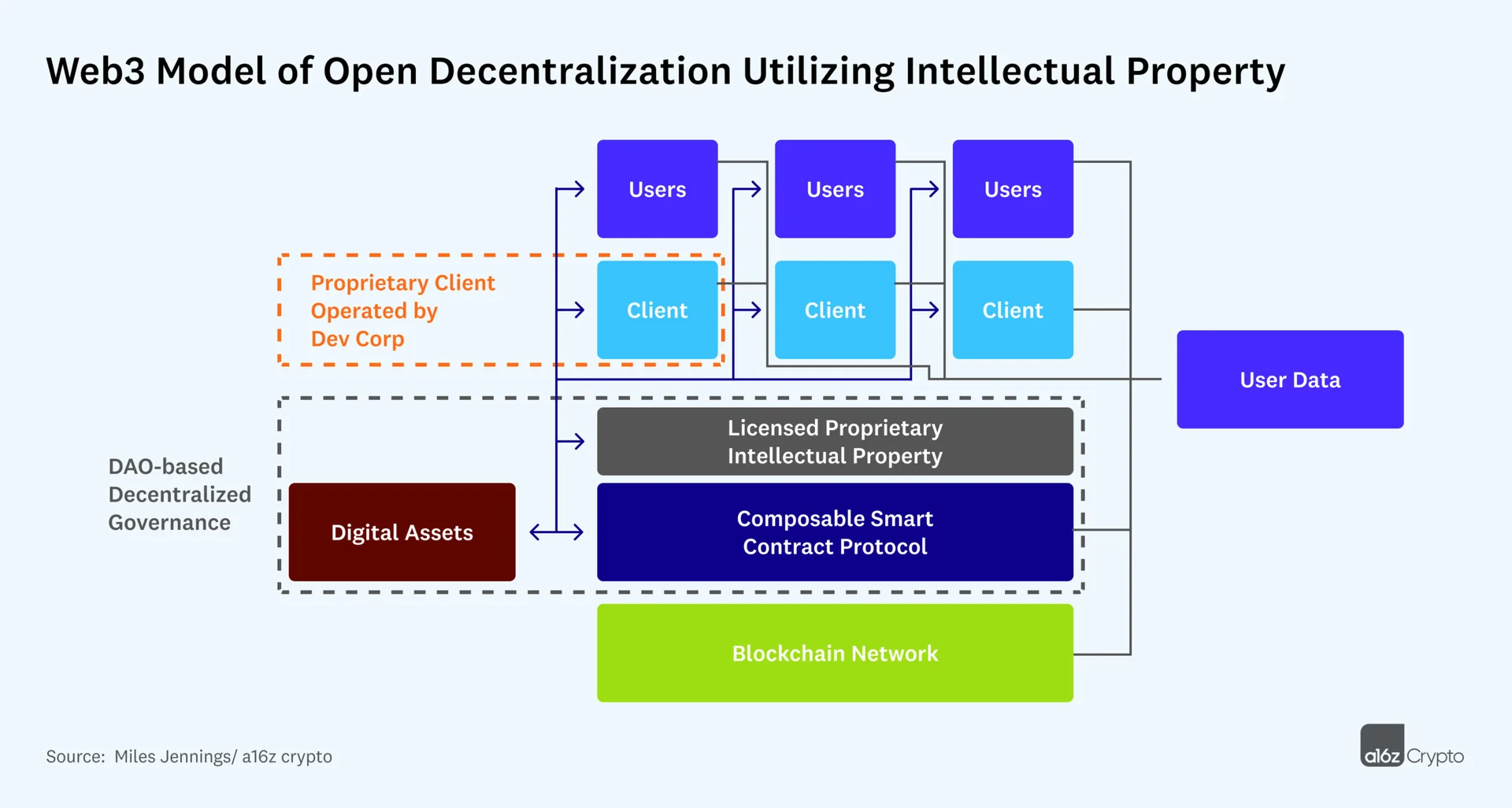
The addition of proprietary intellectual property may seem to push part of the system’s decentralized economy back toward an owner-managed web2 economy, particularly if developers/operators of the clients are unwilling to expose their products and services to the preferences and control of the intellectual property owner.
Still, that risk could be reduced through the license’s contractual terms (through irrevocable/perpetual duration, rights to modify/improve, and so forth). A key point in this context would be what services and continuing maintenance of the intellectual property are needed, and whether those services and that maintenance (if any) could come from independent third parties — because heavier dependence on a single third-party owner of the intellectual property could weaken the system’s overall economic decentralization.
Ultimately, if the web3 system’s terms were arranged properly, its decentralized economy would stay intact. For example, a web3 system that uses a broadly available API (application programming interface) in its clients would not weaken the overall decentralization of the web3 system, but would probably strengthen it.
From a legal decentralization standpoint, the main issues to weigh are: Are the provider’s essential managerial efforts for the intellectual property needed to determine whether the web3 system succeeds or fails? Could major information asymmetries emerge? Even where the intellectual property is vital to the system’s success, if the intellectual property owner cannot revoke it at any time, then the answer to both questions may be no — which would support the system’s legal decentralization. The same would be true if the intellectual property owners were required to obtain DAO approval before making any material changes to the intellectual property.
This concept can be extended beyond intellectual property to other resources that might be contributed or licensed to a web3 system as well. For instance, if a third-party regulatory compliance service enabled DeFi protocols to confirm their users were verified U.S. persons, such a service should not undermine the decentralization of the web3 system. Similarly, one could imagine third parties providing marketing and business development-related services to the protocol — independent of the activities of the individual client businesses.
While there are many ways in which the introduction of third-party resources could harm the decentralization of the system, such risks (as with the above) can generally be mitigated through structural and contractual mechanisms.
how to decentralize NFTs
Open decentralization: How to decentralize NFT projects
Non-fungible token (NFT) projects and their communities are a new and increasingly popular kind of web3 system that provide a useful chance to examine several additional ideas of open decentralization.
First, it’s important to understand the legal basis for why most artistic NFTs can be excluded from U.S. securities law, which is that they fail the fourth prong of the Howey test: The value of an NFT is largely intrinsic and not derived from the managerial efforts of others. But as NFT projects have grown in complexity, the Howey analysis has become less straightforward. NFT projects now often involve additional content creation/ additional NFT drops, implementation of NFTs in video games, community-driven product development, and other activities — all of which potentially increase the reliance of NFT holders on the managerial efforts of others.
NFT projects should therefore consider incorporating the principles of decentralization into their web3 systems, particularly if they intend to couple the project with a fungible token. What would that model of NFT project decentralization look like? The image below is one example. It reflects: (1) an NFT collection minted on a blockchain and held by various users; (2) intellectual property contributed to the NFT community, most likely relating to the NFTs themselves (which could be “staked” to the community by the holders) and any lore created by the community; (3) digital assets distributions and incentivization mechanisms; (4) the launching of DAO governance with respect to the community intellectual property and DAO treasury; (5) the initiation of derivative projects; and (6) the hosting of social gatherings and events.
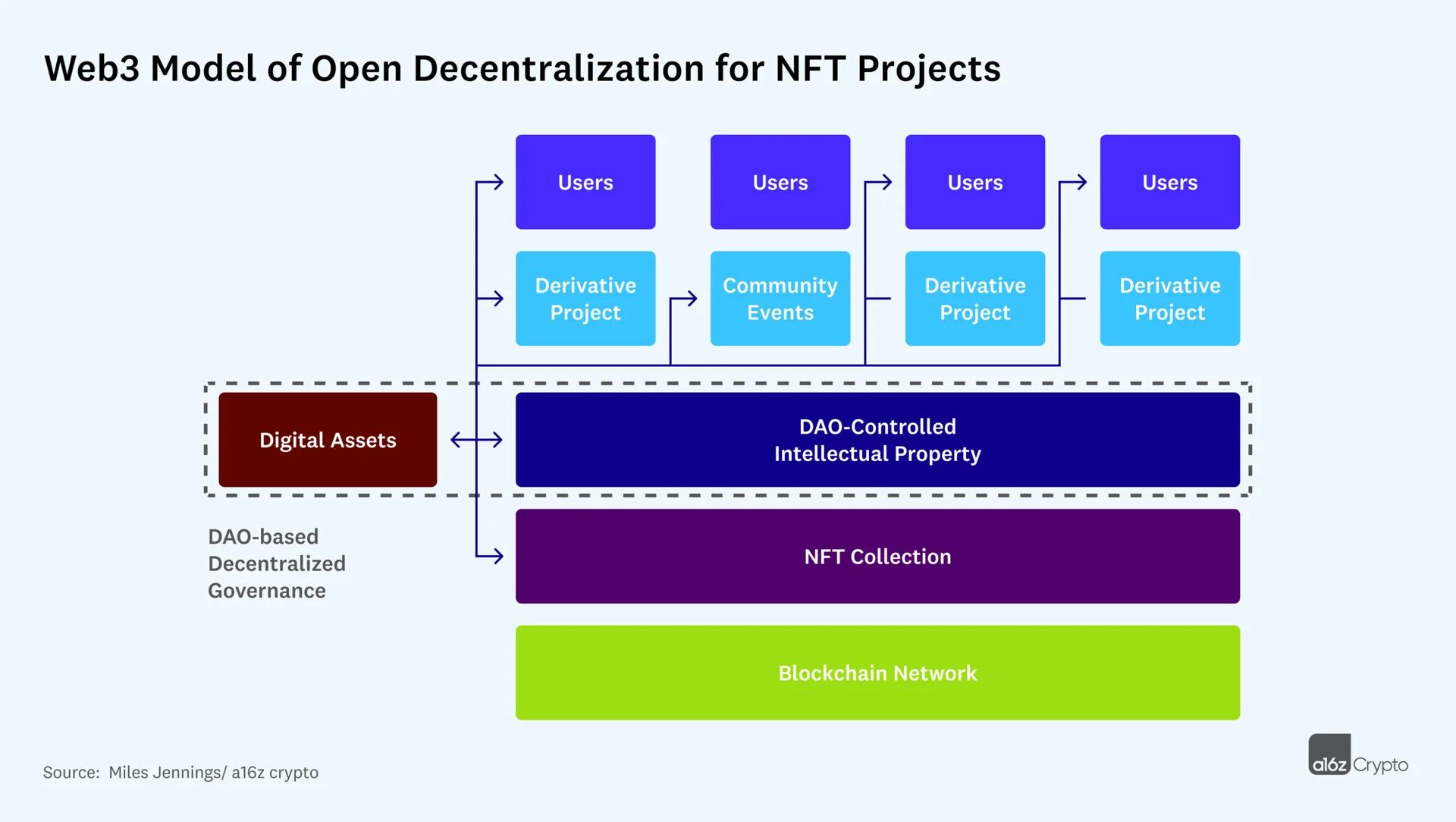
In this model, economic decentralization for NFT projects can be accomplished through several steps:
- First, the DAO could use its initial resources on community engagement (e.g., Twitter,Discord, etc.) and to fund social gatherings and other events — thereby boosting the implicit incentives of the community (i.e., its popularity). Second, those implicit incentives — along with explicit incentives (such as fungible token awards, access to NFT sales, etc.) — could then be used to incentivize the creation of derivative projects utilizing the community’s intellectual property. Developers would receive rewards for developing such projects, and consumers would receive awards for using them. For example, the DAO could employ a third-party developer to create a play-to-earn game using the community’s characters, with in-game tokenomics featuring the native digital asset of the community. In this regard, derivative projects act similarly to the clients described in the earlier open decentralization models, making the overall system less dependent on any single source to drive value to NFT holders, which helps limit the risk of significant information asymmetries arising. Finally, another significant tool that NFT projects have at their disposal are royalties on secondary sales of NFTs accruing to the DAO, which can fuel their decentralized economies. These royalties would provide the DAO with a decentralized revenue stream during periods in which derivative projects may not be producing sufficient returns for the system.
Over time, the combination of value flowing to the ecosystem from derivative projects and secondary sales could lead to the formation of a healthy decentralized economy for the NFT project.
From a legal decentralization perspective, the key questions would again be: Are the essential managerial efforts of any third party necessary to drive the success or failure of the web3 system? And is there potential for significant information asymmetries to arise? The answer to both questions would depend on many of the same considerations discussed above.
But in this instance, the intellectual property in the NFT setting likely helps, rather than obstructs, the community’s broader decentralization. Why? Because the intellectual property comes into the DAO from a decentralized source (the NFT holders). In addition, if the DAO were to govern token distributions, further NFT minting, and decentralized intellectual property — together with decentralized revenue flows (either from royalties or derivative projects) — the system would be unlikely to create major information asymmetries.
Most NFT projects are still at an early stage, so we have not yet seen many NFT projects using decentralized tokenomics, but we expect to see many different mechanisms. For now, many lessons can also be brought into NFT projects from other web3 systems.
how to decentralize tokenization protocols
Open decentralization: How to decentralize tokenization protocols
Tokenization protocols are another kind of developing web3 system. In these systems, assets are introduced onto a blockchain, tokenized through a smart contract protocol, and then sold or put to other uses. Tokenization protocol types include serial NFT-minting projects, digital asset marketplaces, and protocols that tokenize real-world assets.
The open decentralization model below includes:
- assets brought on-chain from multiple providers through a shared smart contract protocol; the smart contract protocol tokenizing such assets; the sale or use of such tokenized assets through multiple clients; native digital asset distributions and incentivization mechanisms; and the launching of DAO governance with respect to the community intellectual property and DAO treasury.
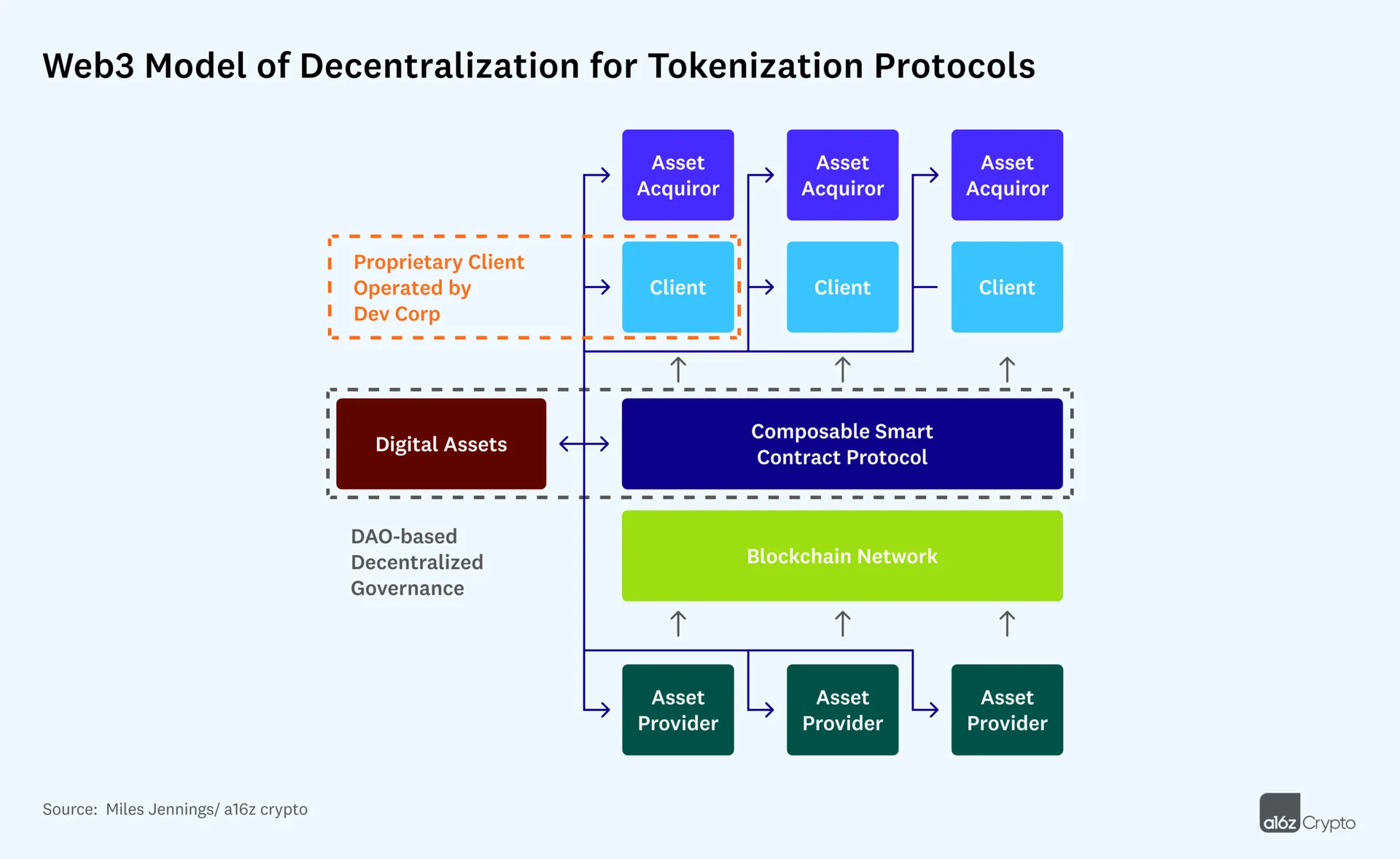
Under this model, economic decentralization comes from enough variety of inputs (asset providers) and outputs (asset acquirors), as well as from decentralizing the layers through which the tokenized assets move (the blockchain, the smart contracts, and the clients).
The protocol’s DAO could also rely on direct incentives (fungible token awards, no commissions/ fees, etc.) to:
- incentivize asset providers to provide assets to the system; incentivize clients to make a market in the tokenized assets; and incentivize acquirors to acquire such assets or to consume them.
Although the original developer company may at first have an important role in any of these capacities (asset provider, client operator, asset acquiror), once the system is decentralized, the developer company would ultimately be only one of many participants in any particular role. This would reduce the chance of any significant information asymmetries accumulating to it and lessen dependence on its managerial efforts. In addition, many roles could be carried out by the DAO and/ or subDAOs.
As time passes, the direct incentives could also be revised to reflect possible shortages on either the supply side or the demand side. In a decentralized marketplace for instance, token incentives to sellers (the supply side) could be raised to attract more goods for sale onto the platform; and token incentives to buyers (the demand side) could be raised to encourage more purchases.
From a legal decentralization perspective, the key questions, yet again, would be: Are the essential managerial efforts of any third party necessary to drive the success or failure of the web3 system? And would there be the potential for significant information asymmetries to arise? The answer to both questions depends on whether the DAO could effectively manage its incentives to balance supply and demand as in the example above — but more broadly, it’s really about preventing any single asset provider, asset acquiror, or client from becoming so important that the success of the entire system relies on any one entity’s efforts.
For additional models and use cases, as well as more details relating to the above models, please see the full paper.
conclusion
* * *
Builders of web3 systems still face many challenges in starting, governing, and scaling decentralization. Yet treating decentralization as one design problem with three dimensions — technical, economic, and legal — can serve as a solid guide as builders use the new pieces of web3 systems to meet these challenges, even as regulatory requirements change.
Failure to account for all three of these elements will lead us to a web3 that falls short of the future that blockchain technology and cryptocurrencies make possible. No one wants a “web3“ that’s built on new tech, but that is otherwise indistinguishable from web2. Instead, by building systems that carefully and deliberately design for decentralization, builders can create digital infrastructure, and give life to decentralized economies, which will form the foundation of the internet for decades to come. It’s time to build that internet, and that future.
Special thanks to Chris Dixon, Sriram Krishnan, Sonal Chokshi, Eddy Lazzarin, David Kerr, and Adam Zuckerman for their contributions and insights, as well as to all of the authors of the works I reference in the more comprehensive version of this piece.