
There has been plenty of chatter about “the metaverse” since the term was coined in the ‘90s, especially throughout the pandemic (as online activity surged), and even more after Facebook rebranded itself as Meta.
Is this simply a form of murky marketing language? What exactly is a metaverse? How should the term be defined, and where is the boundary between a metaverse and, say, merely another virtual world? These are frequent questions people raise about the metaverse, so we thought we’d set out how we view it and how the metaverse connects with web3.
In many respects, the metaverse is just another way of describing the internet’s next stage: one that is more social, immersive, and much more economically advanced than what exists now. Broadly, there are two rival visions for making that happen: one is decentralized, generous in property rights and new opportunities, interoperable, open, and governed by the communities that create and sustain it. The other vision — all too familiar to many people today — is centralized, sealed off, subject to corporate whims; and it often pulls painful economic rents from its creators, contributors, and inhabitants.
The main dimension for comparing these two visions is open versus closed, and the distinctions between them can be framed as follows:
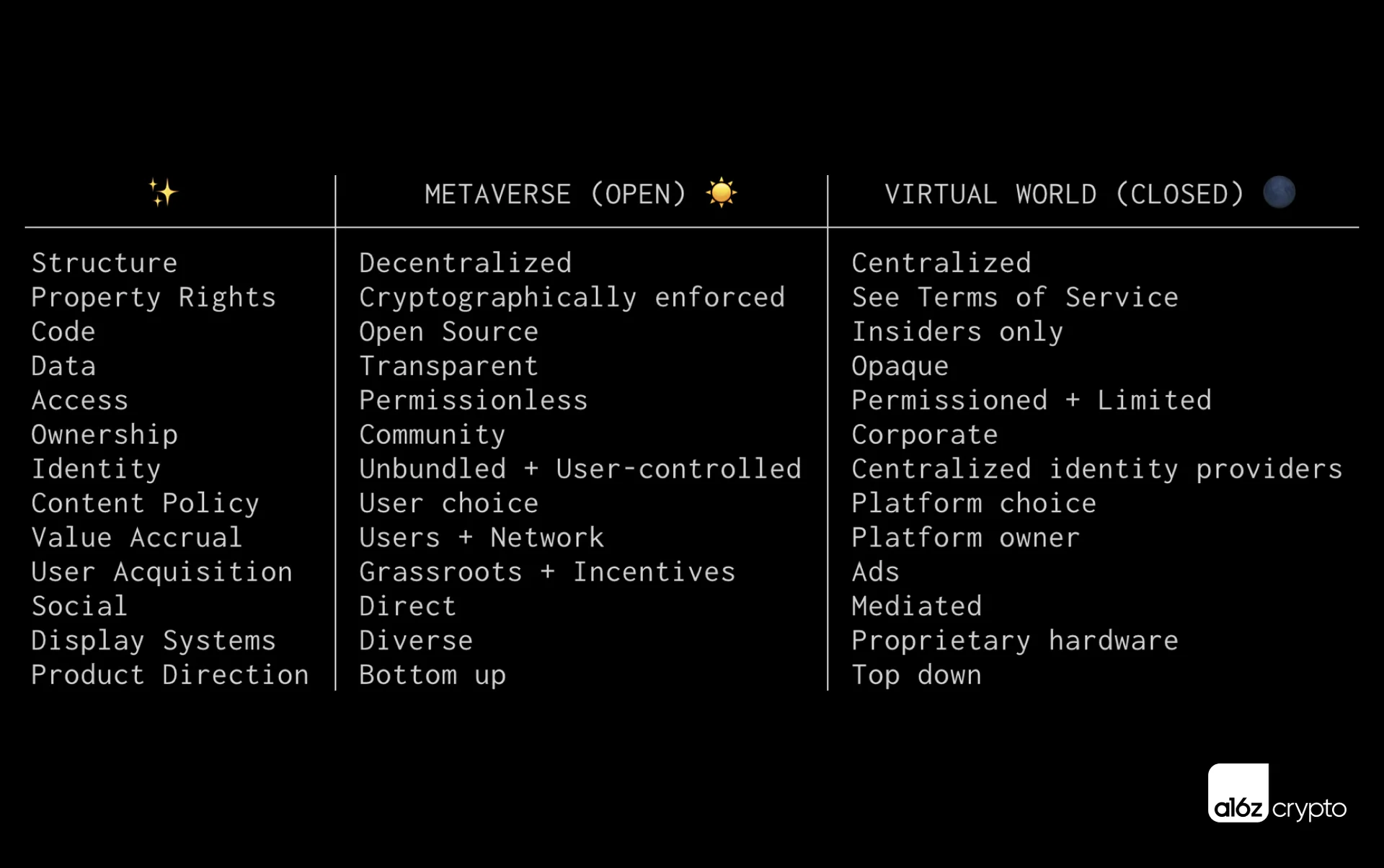
An open metaverse is decentralized, lets users govern identity, upholds property rights, aligns incentives, and makes sure value flows to users rather than platforms. An open metaverse is also transparent, permissionless, interoperable, and composable (others can freely build inside and across metaverses), among other criteria.
Building a “true” metaverse — one that is open rather than closed — calls for seven essential ingredients that are intrinsic to this desired state. We contend that these are required to satisfy the minimum standard for something to be called a metaverse. Our aim is to remove the haze of misinformation around what is and is not a true metaverse for builders and would-be participants, and to offer a framework for judging early metaverse efforts.
1. Decentralization
Decentralization is the broad, guiding principle of a proper metaverse, and many of the traits that follow rely on or emerge from this central idea.
By decentralization, we mean not being owned or run by a single entity or left at the mercy of a few powerbrokers. Centralized platforms usually begin in a friendly, cooperative way to attract users and developers, but once growth slows they turn competitive, extractive, and zero-sum in their dealings. Often these influential intermediaries commit abuses of user rights and de-platforming, and they support captive economies with steep take-rates. Decentralized systems, by contrast, show more balanced ownership among stakeholders, less censorship, and greater variety.
Decentralization matters. Without it, anyone can be “rugged” at any time — a precarious condition that discourages people from building on top and slows innovation. Because centralized platforms cannot make the same sorts of strong commitments — enforced by code — that blockchains can, their promises can be withdrawn or changed whenever an arrangement no longer suits the whims of leaders or organizations. The best way to guard against such abuses and make a metaverse secure is to ensure that control is decentralized.
2. Property rights
Most successful video games today earn money by selling in-game items, such as “skins”, “emotes”, and other digital goods. But people who buy in-game items today are not really buying them — they are renting them. The moment anyone leaves for another game — or the game itself unilaterally chooses to shut down or change the rules — players lose access.
People have become so used to renting through the centralized services of web2 that the idea of truly owning things — digital objects you can sell, trade, or move elsewhere — often seems strange. But the digital realm should follow the same logic as the physical one: when you buy something, you own it. It belongs to you. Just as courts of law protect these rights in the physical world, code should do the same online. True digital property rights only became possible with the arrival of cryptography, blockchain technology, and related innovations such as NFTs. In short, metaverses turn digital serfs into homesteaders.
3. Self-sovereign identity
Identity is closely tied to property rights. You cannot own anything if you do not own yourself. As in the real world, people’s identities must be able to endure across the metaverse without total dependence on a small group of centralized identity providers.
Authentication is about identity: showing who a person is, what they can access, and what information they disclose. On the web today, this means asking an intermediary to do so on one’s behalf through popular one-click login methods such as social login or single sign-on (SSO). Today’s biggest tech platforms, like Meta and Google, use this method to gather data and build their businesses: tracking people’s behavior to create models that deliver more relevant ads. In addition, because these platforms have full control, attempting to innovate on authentication depends on the honesty and willingness of the corporation behind the platform.
The cryptography at the heart of web3 allows people to authenticate without depending on these intermediaries, so people can manage their identity directly or with help from services they select. Wallets (like Metamask and Phantom) give people ways to verify themselves. Standards like EIP-4361 (Sign-in with Ethereum) and ENS (Ethereum Name Service) let projects align around open source protocols and contribute independently to a richer, more secure, and continually changing idea of digital identity.
4. Composability
Composability is a systems design principle, and here it specifically means the ability to mix and match software components like lego bricks. Each software component only has to be written once, and can then simply be reused. It is comparable to compounding interest in finance or Moore’s law in computing — some of the most powerful known economic forces — because of the exponential power it can release.
To include composability — a concept closely linked with interoperability — a metaverse would need to provide high-quality, open technical standards as its base. In games like Minecraft and Roblox, you can create digital goods and new experiences from the basic components the system supplies, but it is harder to move them outside that setting or alter their inner mechanics. Companies that provide embeddable services, like Stripe for payments or Twilio for communications, operate across websites and apps — but they do not let outside developers modify or remix their black boxes of code.
In their most robust form, composability and interoperability can work permissionessly across broad portions of the software stack. Decentralized finance, or DeFi, is an example of this stronger form. Anyone can adapt, reuse, alter, or import existing code. Beyond that, developers can build on live programs — such as Compound’s lending protocols or Uniswap’s automated market-making exchanges — whenever they like, side by side in the memory of a shared virtual computer (Ethereum). By combining powerful new ingredients like property rights, identity, and ownership, builders can produce entirely new experiences.
5. Openness/open source
True composability is impossible without open source, which is the practice of making code freely available so it can be redistributed and modified at will. Whatever the degree or form, open source as a principle is so vital to the development of a metaverse that we’ve separated it out as its own ingredient, despite the overlap with composability above.
So what does open source mean in a metaverse development context? The best programmers and creators — not the platforms — need complete control in order to be truly innovative. Open source, and openness, helps make that possible. When codebases, algorithms, marketplaces, and protocols are transparent public goods, builders can pursue the full scope of their visions and ambitions to create more sophisticated, trustworthy experiences.
Greater openness results in safer software, makes the economic terms clearer to everyone involved, and removes information gaps. Those qualities can produce systems that are fairer and more equitable and that genuinely bring network participants into alignment. They might even make obsolete the old U.S. securities laws, which were written decades ago to address the enduring principal-agent problem and information gaps in business.
Much of web3’s composability comes from the open source spirit that underpins it.
6. Community ownership
In a metaverse, every stakeholder should have a voice, in proportion to their participation, in how the system is governed. People should not simply be forced to follow the directives handed down by a team of product managers at a tech company. If a single entity owns or controls this virtual world, then, like Disney World, it may provide a limited kind of escapist experience but will never reach its full promise.
Community ownership is the missing element that brings network participants — builders, creators, investors, and users — together to cooperate and work toward the common good. This feat of coordination — once cumbersome or impossible without the arrival of crypto and blockchains — is managed through token ownership, the native assets of networks.
In addition to the technological gains produced by decentralization, the philosophical meaning of a community-owned space is essential to the metaverse’s success. Throughout web3, people involved in decentralized autonomous organizations, or DAOs, have embraced this idea. They are rejecting the strict formality of corporate hierarchies in favor of more adaptable, more diverse democratic, and informal governance experiments. This makes possible communities that are governed, created, and propelled by their users, rather than by one central entity.
7. Social immersion
Big tech firms would like you to think that high-powered virtual reality or augmented reality (VR/AR) hardware is a necessary — perhaps the most necessary — component of a metaverse. That is because these devices are a trojan horse. Companies view them as a route to becoming the leading suppliers of computing interfaces for 3D virtual worlds, and thus also becoming the bottlenecks that mediate people’s metaverse experiences.
A metaverse does not need to take place in VR/AR. The only requirement for a metaverse to exist is social immersion in the broad sense. More important than hardware is the kind of activities metaverses make possible. They will allow people to socialize remotely, collaborate, spend time with friends, and have fun, much as they already do with Discord, Twitter Spaces, or Clubhouse today.
The pandemic highlighted the demand for more immersive experiences — beyond conventional text based communication platforms, such as email — as the use of other remote conferencing and telepresence tools, like Zoom and others, surged. In addition, because of the economic features described earlier — property rights, self-sovereignty, community ownership — metaverses can allow people to earn a living, do business, and achieve status. In a standard knowledge worker’s office, people work together with tools like Slack, while outside the traditional corporate sphere in the bottom-up organizational movement of DAOs, Discord and Telegram dominate.
The metaverse has nothing to do with “view” modalities — the tools you use to see the metaverse. That’s a convenient meme for those who control hardware production.
***
Although several companies have started assembling different parts of the whole, if a virtual world is missing any of the above elements, it does not qualify as a fully formed metaverse, in our view. We believe — as this framework shows — that a metaverse cannot exist without the essential foundations of web3 tech.
Openness and decentralization are the pillars supporting the entire structure. Property rights depend on decentralization — they have to survive even under the pressure of powerful adversaries. Community ownership stops unilateral control of the system. The approach also strengthens open standards, which help with decentralizing and composability, a closely related property that follows from interoperability.
The building of an ideal multi-dimensional virtual world will happen gradually. Many problems still need solutions, or we may end up with some dystopian equivalent of the IOI-mediated Oasis in Ready Player One. If builders remain faithful to these axioms, though, that result will be less likely. (If you’re such a problem-solver or builder, get in touch with us!)
When the metaverse arrives, it should represent a complete expression of these principles — with decentralization at the center.
Thanks to Robert Hackett for editing this piece.