

Afghanistan. North Korea. Russia. The South China Sea. Open a newspaper these days and you’ll see the many challenges confronting America’s military. Global dangers and a shrinking technological edge have pushed the Pentagon to draw closer to Silicon Valley, a relationship that has produced successes like Palantir and Anduril. Even so, most dual-use startups developing emerging technology still have trouble working with the Defense Department. These companies would be wise to spend the summer reading comic books — especially Iron Man — and taking in a few of the lessons.
Dual-use startups
Dual-use means technologies with both military and commercial uses.
Popularized by the Iron Man films and comic books, the Marvel hero Tony Stark, also known as Iron Man, is a brilliant inventor and heir to Stark Industries, where he designs and builds advanced weapons and defense systems. The highly inventive products Stark creates, including the Iron Man suit and sophisticated aircraft, have been used by the U.S. government in the Marvel Universe to defeat enemies since 1963. A defining feature of Stark’s inventions is that they are built to give the Pentagon what it needs, not what it wants.
For many reasons, the U.S. needs Tony Stark-style innovation more than ever. But to build Iron Man-like technology, companies have to learn how to work with the Pentagon in the best way rather than treating it like any other customer. Taking advantage of government opportunities can reduce the risk facing technology startups in both the commercial and defense markets.
The Iron Man model: giving the Pentagon what it needs
The Iron Man model: giving the Pentagon what it needs
The notion of creating defense innovations with little Pentagon direction to address national security problems is not far-fetched. Stark and his company are fictional, but the Iron Man character drew inspiration from real-world industrial tycoon Howard Hughes, who created advances in military aircraft and air-to-air guided missiles, and also built the world’s first geosynchronous communications satellites for the U.S. government. It was defense advances like these, along with progress in nuclear research, rocketry, and silicon chips, that powered the dominant technological edge the Pentagon held over rivals from World War II into the early 21st century.
Successful modern defense firms, including Palantir Technologies and Anduril Industries, were also started with something like the Iron Man model. Peter Thiel, the co-founder of PayPal, co-founded Palantir in 2004 with the idea that an algorithm could be used to hunt terrorists. Palmer Luckey, founder of Facebook-acquired virtual reality company Oculus, co-founded Anduril in 2017. Anduril uses AI, automation, and edge computing to shape and speed up defense mission decisions.
Both companies gave the government capabilities it needed. Palantir’s platform was not what the Pentagon wanted to build, but it beat the government-backed rival while saving it a great deal of money. Anduril’s counter-drone technology, also built on the company’s own dime rather than the government’s, recently secured a $1 billion contract from Special Operations Command (SOCOM) to transform how the command carries out operations.
However, although the ingredients for the Iron Man recipe are straightforward — (1) civilian entrepreneurs (2) using their own money to develop high-risk capabilities in unproven technology sectors (3) outside government organizations and requirements (4) to meet a government use-case — the model is neither scalable nor repeatable for one simple reason: very few companies have billionaire founders.
Still, the lessons from these exceptional wins can be used by non-billionaire-founded dual-use companies if they treat the Defense Department as a way to extend development runways. Using government dollars in this way means tapping a wide range of government opportunities — from R&D to prototype to production contracts — to increase funding and scale. Dual-use companies can do this by following three tried-and-true strategies:
- Securing government funding through different channels, to grow and scale on the defense marketplace Selling unaltered commercial products to the defense industry before adapting them for defense requirements Fully evaluating the market opportunity across a broad set of agencies and organizations
Increasing the opportunity to produce novel solutions
Increasing the opportunity to produce novel solutions
Before WWII, the Defense Department developed and built all mission-essential materiel in U.S. shipyards and arsenals. It knew exactly what it needed and how to develop it. Setting the development path was therefore necessary to make sure commercial companies delivered what was required at a reasonable price. That prescriptive process is how the defense acquisitions system began. It is also where prime contractors like Boeing and Lockheed Martin, for example, came from.
Today, though, technology is advancing quickly and the Pentagon does not always stay current on recent developments. Sometimes, it may know about technologies but not understand their battlefield impact (e.g. terrorist use of commercial off-the-shelf drones). So, prescribing narrow technical requirements for unknown solutions to serve unknown use-cases is counterproductive. The Defense Department recognizes these limits and has created many organizations, programs, and opportunities to improve how it works with companies. That is good news.
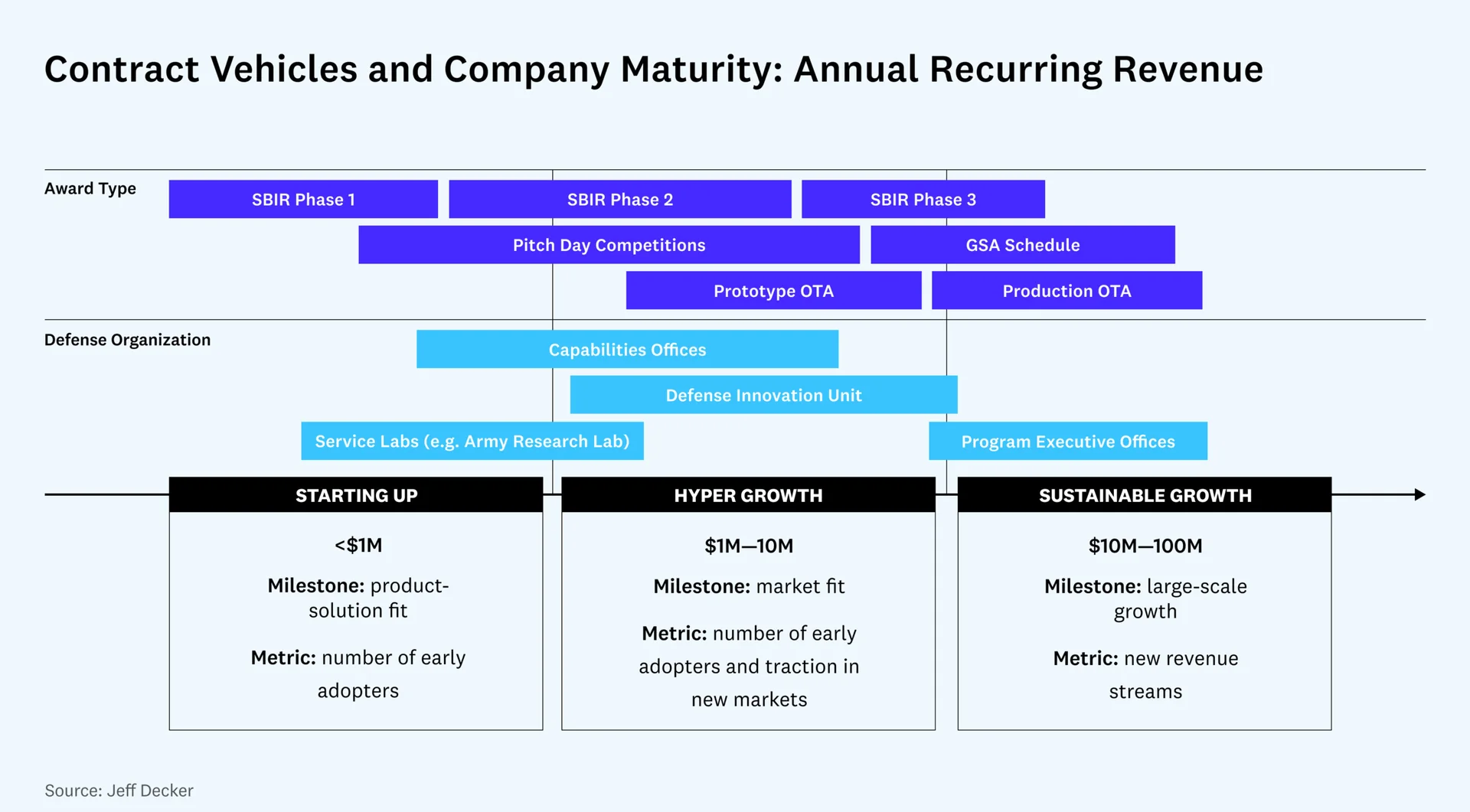
Since 2016, the Pentagon has renewed the use of older tools such as Small Business Innovation Research (SBIR), Small Business Technology Transfer (STTR) awards, and Other Transaction Agreements (OTAs) to buy commercial technologies. In 2021, federal agencies obligated$3.8 billion to nearly 7,000 companies under the SBIR/STTR programs to test whether technologies were feasible in government use-cases. $1.6 billion was awarded through Defense Department SBIR/STTR. SBIR/STTR awards are non-dilutive and range from $50,000 to $1.7 million depending on the phase of the award and the awarding service. Moreover, SBIR/STTR funding gives companies a foothold in the defense marketplace by letting the government award them contracts without needing to compete in the open market.
The Pentagon has also broadened the use of OTAs, which were first created in the 1950’s under NASA. OTAs act as the bridge between R&D work and procurement. They are the contracting foundation for prototyping programs like the Defense Innovation Unit (DIU) and Joint Interagency Field Experimentation Program (JFIX), as well as prize competitions like xTechSearch and TechStars. OTA prototype awards can range from $250,000 to $50 million. These programs help the Defense Department learn about potentially game-changing technologies while giving companies user feedback useful for guiding development in both the commercial and defense markets.
One of the most attractive things about these programs is that the OTA prototype contracting mechanisms behind them are meant to lead into full-scale production contracts worth anywhere between $1 million and $1 billion if the company can prove its value for a defense need. Anduril, for example, was able to turn an OTA prototype valued at $5.1 million through DIU into a OTA production contract with Special Operations Command (SOCOM) worth $99.95 million.
The problem for dual-use companies, though, is that although a range of defense opportunities exists, very few of those companies can move through them successfully; they lack the manpower and defense sector know-how. But it can be done.
Anthro Energy, a startup in the lithium-ion battery space not founded by a billionaire, is an example of what can go right when defense opportunities are aligned properly. Emerging from Stanford University’s Hacking for Defense (H4D) course, Anthro Energy found product-defense market fit with its flexible, safe, and high-performance batteries. H4D taught Anthro Energy how to move through the defense ecosystem and work with defense customers. That engagement led to developing special operators as their customer, which then shaped the development of Anthro Energy’s wearable battery design.
After the class, the company took part in and was funded through the Army’s xTechSearch competition before receiving $600,000 from the newly formed National Security Innovation Capital (NSIC). Anthro Energy used NSIC funding to commercialize the technology it designed for SOCOM customers. The company is now positioning itself to use DIU OTAs, and is continually using Defense Department funding to move forward its commercial and federal products.
University classes are only one example. NSIN, for instance, is a defense organization that offers a variety of programs connecting companies with military personnel, along with funding to help entrepreneurs build prototypes. Other organizations, such as Parallax Research, are funded by the government to help companies address the defense marketplace.
Selling commercial products before crafting custom defense capabilities
Selling commercial products before crafting custom defense capabilities
Two rules govern how solutions are deployed in the defense market: (1) anything short of a fully finished, 100%-complete solution is not acceptable for non-R&D contracts, and (2) acquiring defense customers takes more time and more resources than selling in commercial markets.
Even so, some dual-use firms that are not trying to piece together awards still enter the defense market with the same playbook they used to succeed commercially, either by releasing an unfinished product and refining it, or by collecting user feedback to build a 100%-complete solution. As noted above, the first approach is a dead end because the Defense Department avoids risk (and for good reason).
But building a 100%-complete solution to match a solicitation exactly, or to align perfectly with end-user feedback, and then expecting multiple contracts to follow is also a case of the wrong commercial logic. In defense, this logic has two problems:
- End-users seldom buy products. In defense, customer acquisition actually needs approval from at least three groups: end-users, buyers, and decision-makers — who are almost always in different places and usually do not know each other. End-users, buyers, and decision-makers also tend to see both the problem and the solution differently. Because of this, more feature requests get stacked onto the product requirements, adding more time and more cost. That makes engineering a 100%-complete solution and assuming it will sell a risky bet.
The fictional Iron Man approach handles these problems by using billionaire wealth to reduce the risk of technology before the concept is ever pitched. Dual-use firms without billionaire founders cannot absorb that risk, but they can mirror the model by selling their commercial product to the Pentagon with no changes, or at least no major ones. Selling commercial products to the Defense Department brings in revenue and lets users try the product before any money is spent on adaptations.
For instance, Learn to Win first brought its unchanged pro-sports training platform to Air Force pilots. After selling the commercial product to the Defense Department, the company started adapting the platform for specific defense uses like helping service members spot corrosion, monitor weather, and train pilots. Learn to Win is now in use by 7,000 uniformed personnel.
The way to pursue these deals should start with looking for Commercial Service Offerings (CSOs), which lay out defense problems without saying exactly what the answer must be. The Defense Innovation Unit (DIU) created and uses CSOs to carry out its mission of “accelerat[ing] the adoption of leading commercial technology throughout the military and growing the national security innovation base.” DIU director Mike Brown supports the Pentagon buying unchanged commercial products because they keep the government current on the latest technology while also allowing users to identify modifications that better meet their needs. Another route to selling commercial products is through prototyping programs that do not specify what the solution should be.
Just as important, these contract types happen before the government commits to a major strategic procurement, and they can stop government stakeholders from adding “nice-to-have” features that have long wrecked programs by driving up costs and making them technically impossible (e.g. the F-35 and DCGS-A).
Assessing market opportunity
Assessing market opportunity
Some dual-use firms, however, will find it hard to enter the defense market with their commercial product. For example, it may seem that a machine learning algorithm needs only slight changes and just has to be uploaded to government servers, or that a commercial drone only needs camouflage paint. That almost never happens and is more likely to belong in a comic book.
Billionaire-backed companies win because they have the financial backing to build an advanced defense solution and the manpower to create a market for it. Building a defense market matters for dual-use companies as well, but they cannot create one from nothing. Instead, dual-use firms must work backward from likely success and build the market by finding and grouping customer segments inside the Defense Department.
Companies therefore need to reduce defense-market risk by confirming that total available market (TAM), serviceable available market (SAM), and serviceable obtainable market (SOM) justify the cost of upfront defense modification and licensing. But finding those data points requires companies to figure out whether and how their product’s value proposition(s) line up with the needs of end-users, buyers, and decision-makers. This is extremely difficult and time-intensive because dual-use companies must find these stakeholders inside the 2.2-million-person Defense Department. There is no central database of problems, or of the people who face them.
What does exist is SAM.gov, which lists all open government solicitations and is very poor at estimating the total possible value of the defense market. In plain terms: solicitations point to the needs of a single organization, but they are weak signals because they mention only one government organization that needs the solution, even when the problem may be broader and systemic. Sadly, there are no shortcuts, and market reports on the defense market do not exist. Companies must assemble scattered customers themselves to estimate the value of the defense market.
So, dual-use companies that do not want to seek awards and cannot make an unmodified commercial sale have to do the difficult work of speaking with potential defense end-users to understand their needs and confirm that the company’s solution can satisfy them. To have outsized, Iron-Man-scale impact, these companies will also need to read strategic doctrine (e.g. National Security Strategy (Interim), National Defense Strategy, National Military Strategy, Air Force, Army, Navy, Marine Corps) to identify the measures of success, and then speak with buyers and decision-makers to make sure that helping end-users complete their task (product-task fit) becomes mission success (product-market fit).
Before entering the defense market, for example, Snorkel AI believed its machine learning software could save defense and intelligence analysts hundreds of person-months of time on every application. That belief came from years of Defense Department-funded research and testing. But the company also worked with intelligence analysts and leadership to confirm that its product would actually fit analyst workflows and that the time savings would truly benefit the broader organization. This enabled Snorkel AI to gauge defense-market TAM by counting the defense and intelligence organizations doing analyses, and then estimating how much each of those organizations spent on software for analysts.
These efforts, along with defense customers, helped make Snorkel AI a unicorn. Its federal team is now expanding the platform across the government and Defense Department.
Scaling defense innovation
America’s national security problems are tied to unlocking defense capabilities from the commercial market. Lessons from the Iron Man model successfully used by Palantir and Anduril can be applied to dual-use startups. However, the lessons for dual-use companies depend on using Defense Department opportunities to maximize efficiency and minimize risk by treating the Pentagon as a partner. Evaluating the defense market, identifying and building a roadmap of defense opportunities, and selling unchanged commercial products will extend a company’s commercial and defense runway.
Companies that want to deliver value to the Defense Department and tap its substantial budget would do well to heed Iron Man’s words: “Heroes are made by the paths they choose.” Defense go-to-market strategies are unique to each company and its products. Applying the three Iron Man lessons will shape the defense paths a company takes, producing more revenue, greater defense capabilities, and a stronger economy — all of which are needed to prepare for and respond to a constantly changing world and shifting geopolitics.