

Many of the world’s top consumer marketplaces began life as very different businesses. Amazon was, memorably, an online bookseller, Uber began as a black car service, DoorDash launched under the name “Palo Alto Delivery” (a nod to its limited geographic scope), and Booking.com only helped travelers locate hotels in the Netherlands.
This kind of narrow launch makes sense — it helps a marketplace build network density and discover product-market fit. Yet once things begin working, most marketplace companies feel the pull to scale. Marketplace operators then have to decide how to allocate scarce resources: deepen their current market, or move into something new?
We spoke with more than a dozen marketplace operators from companies like Uber, Instacart, and Airbnb and distilled their lessons on when, where, and how to expand into new geographies and verticals.
When to expand
The kind of product or service a marketplace offers, and the way it is delivered, has a significant effect on the resources needed for expansion — and therefore on the right timing.
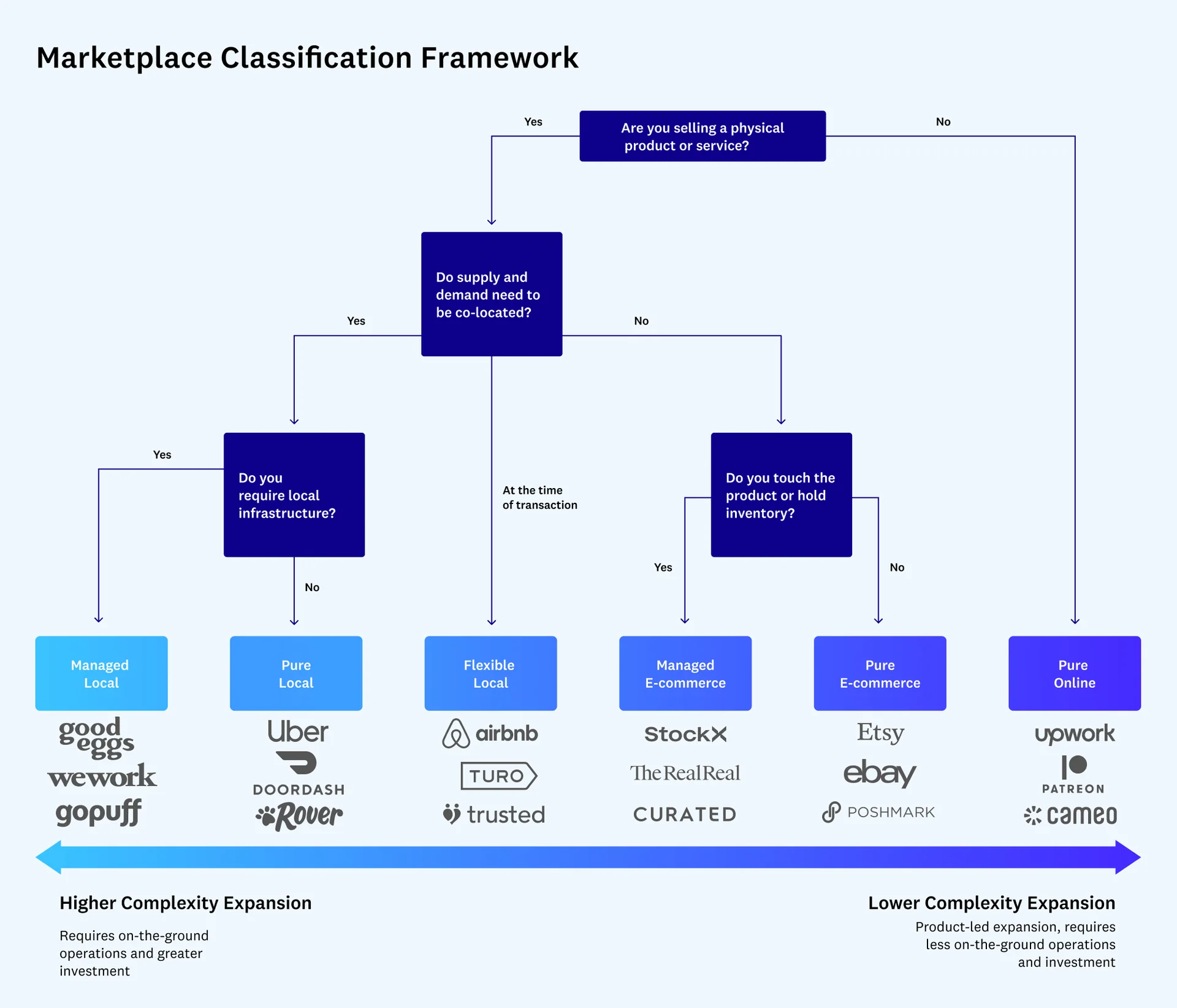
Some marketplaces, such as Good Eggs or GoPuff, store physical goods in warehouses and ship them to consumers — they need infrastructure in every new market, and that takes time and resources to put in place. Other marketplaces, like Etsy and Poshmark, are asset-light, so launching a new market or product category may require little more than marketing spend to stimulate supply and demand.
A few additional factors marketplace operators should weigh when considering expansion timing:
1. Competitive pressures — are rivals entering markets or categories you intend to compete in? Is there a meaningful first-mover advantage? That may push you to expand sooner so you do not fall behind.
A former executive told us that Airbnb was compelled to expand into Europe when a clone called Wimdu (backed soon after Airbnb’s breakout in the U.S.) began taking market share in the region. Notably, Airbnb had a chance to buy Wimdu, but instead decided to launch its own local operations.
2. Funding: Do you have the capital required to finance expansion? Growing often means hiring new staff, adding features to your existing product, and spending on marketing, particularly if you are entering a space with strong incumbent competitors or need to strengthen your brand.
3. Product-market fit: Have you achieved product-market fit in your first market? You want a genuinely “sticky” product before moving into a new category or geography — otherwise, your time and resources should stay focused on perfecting your initial market.
TaskRabbit co-founder Leah Busque has discussed the risks of expanding before finding product-market fit. TaskRabbit was repeatedly losing users and had to redesign and relaunch its product when it was already live in 20 markets. This was not just wasteful of resources, but ultimately forced the retraining of the entire supply base, which Busque called “a massive undertaking.”
4. Impact on existing supply and demand: How will current suppliers and consumers be affected by the expansion? Does it create opportunities for suppliers to grow their business on the platform? Will it meet more of consumers’ needs?
Rover began as an app for dog owners to book sitters while they traveled. The company quickly broadened into other pet care categories — dog walking, daycare, cat sitting, and drop-in visits — because customers were already trying to use the app to book those extra services, according to CEO Aaron Easterly. The expansion made Rover more useful to these customers.
5. Scalability: Are you worried that something about your original market or vertical is unusual, and that your current model will not scale elsewhere? It may be useful to know this sooner rather than later, especially if TAM concerns are likely to push you to expand.
Where to expand
You can identify expansion opportunities either proactively or reactively:
Proactive growth means you actively look for expansion opportunities, often in service of a mission to drive growth. This usually means brainstorming possible new markets, verticals, or product lines, and then assessing them with the following matrix.

Most companies are looking for opportunities in the upper left quadrant: high-impact and low-effort, also known as low-hanging fruit.
When thinking about what “low effort” means, consider whether the new vertical or market can use your marketplace’s existing traffic or transaction volume.
Whatnot’s expansion from Funko Pops into Pokemon cards is one example. The company’s current buyers already wanted these cards, and many existing sellers already had supply — no new customer demographic had to be onboarded.
Still, high-impact and high-effort opportunities can be worthwhile investments for expanding a marketplace’s TAM.
Reactive growth means responding to expansion opportunities raised by competitors, partners, or even customers. Watching what your competitors do may be obvious, but it is also essential to look for signals from your customers. Are they “hacking” the platform to transact in categories you do not currently support?
Early eBay team members told us they regularly watched for signals from the community to decide which verticals to add next. eBay Motors was created when then-VP of U.S. Operations Simon Rothman was looking for collectible cars and discovered that people were using eBay to trade real ones.
Prioritizing opportunities
Many marketplaces have more ideas than they can pursue about where to expand, and must choose how to rank them. A few factors should shape that decision:
1. Customer leverage (cross-selling potential): Will your existing customers gain from your expansion? This mainly applies to new categories and product lines. Ideally, the expansion will make your marketplace more useful to current customers, improving retention, transaction frequency, and LTV.
2. Supply-side leverage: Will your existing supply benefit from your expansion? Ideally, a new vertical or product line will open ways for suppliers to make more money through your platform, which should boost retention and stop multi-tenanting.
One example is Uber launching Eats. Several former execs told us that drivers benefited from more trip volume — they could take food delivery trips when ride-hailing requests were slow. They didn’t even have to download a separate app, because Uber made it simple to switch between Eats and Rides.
3. Competitive dynamics: What does the competitive landscape look like in the new category, geography, or product offering? If local density matters, are there existing local competitors with a meaningful advantage?
4. Unit economics: Is there anything about the new market or vertical that could materially affect your unit economics, for better or worse? You may at first see weaker economics after expansion, but you want to map out a path to profitability.
For example, does your business model depend on high-AOV items to recover your customer acquisition cost? Do you need extreme density (e.g. a college campus) to make your deliveries profitable?
5. Comparable market characteristics: Is the new market or vertical similar to the one where you currently have product/market fit? Are there enough of your target customers who live in the new geography or transact in the new category?
Many marketplace operators build an “archetype” of their core customer (e.g. age, gender, household income) and evaluate whether enough consumers who match this profile exist in a potential new market. Instacart, for example, looked for cities with high household income, fewer households with cars, and frequent inclement weather, according to co-founder Max Mullen.
How to expand
In conversations with founders about carrying out successful expansions, we found several common patterns in their strategies, even across different kinds of marketplaces.
1. Build a playbook, but tailor your approach in each market. Playbooks usually cover guidance on areas like launch timing, staffing needs, growth tactics, and legal issues. However, a “one size fits all” approach almost never succeeds — the playbook will need to be adjusted for local or category limits.
For example, Uber launched in India with the same digital payments model that worked in the U.S. and in other international markets. However, a substantial share of India’s population is unbanked and needed to pay in cash. To win meaningful market share, Uber had to revise its playbook to permit cash payments.
2. Prioritize recruiting high-quality supply. The best marketplaces tend to be supply-constrained. As a result, it’s vital to recruit quality supply before launching in a new geography or category. If your marketplace is known for having abundant quality supply, the demand side will come — and if they find what they need, your buyers will retain.
When P2P fashion resale app Depop launched in the U.K., the company visited independent shops and vintage stores in this market and persuaded them to upload their inventory to the app. This let the company bring on quality supply at scale. While an individual seller might upload a few items, stores uploaded hundreds of items at once — often with more professional photos and product descriptions.
3. Make sure your whole team has bought in. Successful expansion requires coordination and buy-in from every function within the company — not just the “launchers” or verticalized teams. Team members who aren’t directly accountable for the expansion need incentives to put meaningful effort into initiatives (e.g. new features, localization) that will help the expansion succeed. This is especially true if the expansion may not help the existing business.
4. Be ready to jump-start growth with artificial levers. Otherwise known as “Do things that don’t scale!” You may need to use unconventional tactics to kickstart the flywheel in a new market or category, since your channels for acquiring supply and demand in an existing market may not function in an environment where you have no current users or brand.
Tinder is a classic example of this — it held parties on college campuses and required attendees to download the app in order to attend. Meanwhile, Lyft went door-to-door at startups, giving away free cupcakes and donuts alongside coupons for free rides.
5. Stick to one kind of expansion. Focus is essential. One kind of expansion — geographical, categorical, product — takes a significant amount of effort. Trying to manage two kinds of expansion at once is much harder, and may blur your data. For example: imagine you launch a new category in a new geography. If the expansion isn’t successful, was it because of the category or the market? It might be difficult to disentangle the effect of each.
* * *
For most early-stage marketplaces with limited time and resources, expansion feels like an existential risk. But when done well, expansion has immense rewards: it can supercharge your business and put you on a new growth trajectory. Deciding when, where, and how to expand your marketplace is both a challenge and an opportunity.