
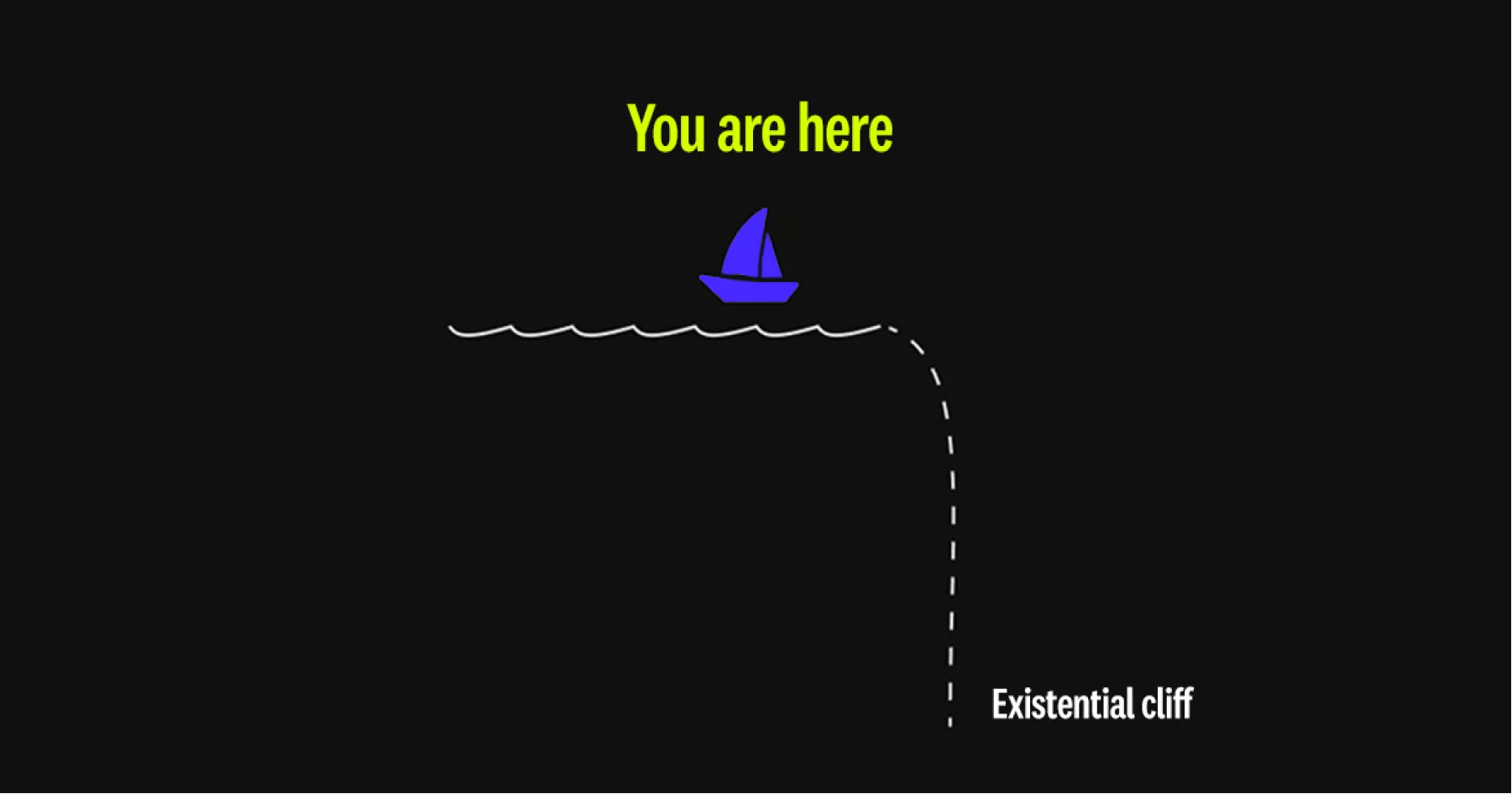
This piece first appeared here.
Most strong teams would agree that, when it comes to carrying out ambitious plans, nothing beats a goal that is clearly defined and well communicated. But at times the stakes are far greater than normal. In those situations, a goal demands even more concentration, execution, and precision. All of that can be accomplished with a framework I’ve come to call SuperGoals, which I’ve depended on throughout my career.
Below, I’ll outline my SuperGoals framework, plus real-world examples of how I’ve applied it. But before I get into that, I want to give a bit of background to establish the context.
SuperGoals helped us transform podcasting.
In 2015, while I was at Adobe, my friend Nir Zicherman and I realized we had a lot in common, and we connected over music, writing (you can read his work here), and above all… podcasts. After a decade of relative obscurity, podcasts were finally starting to catch on with mainstream audiences, drawing in millions of listeners, ourselves included. Nir and I both felt the medium would keep building momentum, and we were so excited that we decided to try making our own podcasts. Still, we were soon discouraged by the steep barriers to entry: complicated software, costly hardware, and clunky file hosting and distribution systems.
Motivated by the personal difficulties we ran into with podcasting, we chose to launch a company called Anchor to tackle these issues, with a mission to democratize audio. Over the following years, we would build a category-defining product, assemble a world-class team, and eventually sell Anchor to Spotify. After the acquisition, I worked at Spotify for several years, most recently leading the podcast, video, and live audio businesses, while helping turn Anchor into the world’s largest podcasting platform. Although the Anchor story had many highs and a very happy ending, it also included plenty of lows and near-death moments. I think one of the reasons we were able to solve many of Anchor’s hardest challenges was SuperGoals.
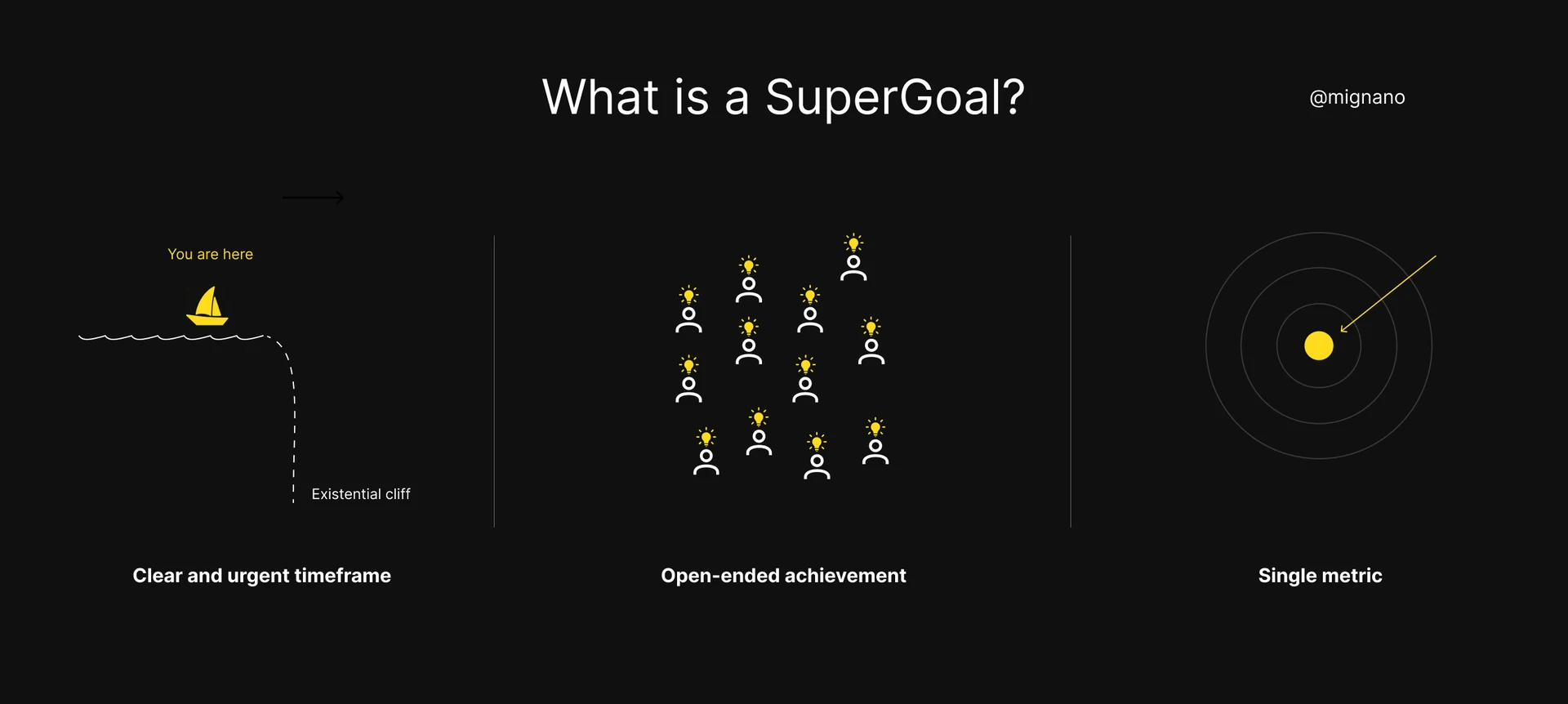
What is a SuperGoal?What exactly is a SuperGoal?
A SuperGoal is a high-stakes goal that sharpens focus for a team. It comes with a clear and urgent deadline, an open-ended path to completion, and one success metric that everyone can grasp. Although I’ve worked with many different goal-setting systems, including OKRs, BHAGs, and stacked priorities, I’ve found SuperGoals to be my default framework in the most critical moments.
Very few goal-setting systems provide the singular focus of SuperGoals — you get only one, it is not aspirational, and it has to be met.
When SuperGoals are in use, nothing else counts: they temporarily outweigh every other goal by creating urgency that strengthens clarity and sparks creativity.
When I use SuperGoals, they have to satisfy three distinct criteria:
- Clear and urgent timeframe: Many single-goal systems emphasize “audaciousness” (for example, “BHAGs”) in a way that accepts a goal will likely never be reached. My approach is the reverse — SuperGoals have to be achieved, and they need a specific date by which they must be done. In that sense, SuperGoals can create urgency within a team. I strongly suggest using SuperGoals in situations where existential risk is present (meaning if we don’t hit X percent growth by Y date, then we’ll run out of money and our startup is dead.) Open-ended method of achievement: Even though SuperGoals should be as exact as possible about the goal and the date, they should be the opposite when it comes to the delivery approach. They are meant to promote an “all hands on deck” mindset, pulling ideas from every part of an organization. In this way, SuperGoals can encourage creativity across a team — letting surprising ideas surface from anywhere. Single measure of success that everyone can understand: “There can be only one.” If you follow the SuperGoal framework, you simply cannot have more than one goal at once. And everyone on your team has to be able to understand it — it is meant to create clarity for the team.
Looking back on my work at Anchor and Spotify, three SuperGoal stories stand out, each tied to a particular stage of my broader journey. Each one produced both great results for our team and a clear lesson about the power of SuperGoals: creating urgency, unlocking creativity, and bringing clarity.
Lesson 1: SuperGoals drive urgency
In the spring of 2017, around a year after Anchor launched to a wave of enthusiasm (but before we had found product-market fit), we found ourselves in a risky position: unless we managed to raise our Series A round of funding during the upcoming fall months, we would likely run out of money and the company would be finished. At that time, fundraising followed a strict seasonal rhythm; summer was basically a dead period, as were December and much of January. That left us September, October, and November to close a deal.
Sharp, aggressive goals are motivating.
There was only one major issue: because we still hadn’t found product-market fit, our growth numbers were totally flat and underwhelming. We had just three months to turn the business around or it would be over. Grow or die.
Nir and I shut ourselves in a conference room for several days and hurried to come up with a plan. The central idea was to establish an aggressive monthly active user target, about 4x our current level, that we needed to reach by August. On paper, this seemed promising, but there were a few problems.
- First, setting an MAU target for a three month stretch meant we were essentially giving ourselves only three data points to show dramatic growth. If even one month was weak, the growth would look bad to investors. Second, choosing an absolute number as the goal meant it would be difficult to follow our progress regularly and judge how we were doing.
To solve the first issue, we switched to weekly active users (WAU), which gave us roughly 9 data points to demonstrate growth instead of 3. And for the second, we took inspiration from one of my favorite Paul Graham essays, Startup = Growth. In that essay, Graham points out that the best YC companies increase revenue by 10 percent per week. Although that pace felt extreme, especially since we still had not found product market fit, we realized that once we put it into our model it would bring us almost exactly to 4x our current scale. So we established a company-wide SuperGoal of 10 percent week over week growth in WAU to make sure we didn’t run out of cash.
SuperGoal 1: Achieve 10 percent week-over-week growth of WAU for the next three months to ensure we don’t run out of cash.
High stakes spark ambition.
As a company, we met every day to review progress and think up new tactics. No idea was dismissed, and everyone was expected to both offer ideas and help carry them out, no matter their role or seniority. We also made one rule for ourselves: if we missed a week, we had to make up the lost growth the following week instead of resetting the baseline. That raised the stakes even more, because missing a week meant we would have to pay for it later. During this stretch, some of our earliest growth came from pure marketing tactics. For instance, we got very good at promoting platform content and making Twitter Moments that spread widely, which helped build our brand and drive user acquisition. But we discovered that nothing had more effect on the WAU growth needle than shipping and marketing new features.
Because SuperGoals use an open-ended delivery mechanism, the ideas for reaching them can come from anywhere. As a result, more than ever before, we were willing to ask our users for requests, including some that had previously broken a few of our earlier product principles. For example, one of our core beliefs was that our audio format was unique to Anchor and therefore could not appear on other platforms, such as Apple Podcasts and Spotify. Yet we saw a rise in requests to allow Anchor-made content to be distributed off-platform. This started a debate: should we pursue it and change the way Anchor worked?
In the beginning, it still wasn’t a podcasting platform; it was a social audio app that made it simple to create and share audio content. This piece of our plan meant that both making and listening could happen only inside the Anchor app. If we decided to go through with this request, we would be violating our strategy. With so much at stake, we set aside our pride, took the request out of the idea stack, and got to work.
In just a few weeks, the team built, launched, and promoted an RSS delivery engine that let us distribute audio to every major podcasting platform with one tap. Almost at once, the feature altered Anchor’s path. With this release — which was possible only because of rapid iteration and a feeling of existential urgency that compelled us to challenge our original assumptions — we discovered product-market fit and achieved our SuperGoal of 10 percent week-over-week WAU growth for three months in a row. And we were able to raise a $10M Series A that September on the strength of our growth over that three month span. Looking back on this story in the years since, it has become unmistakably clear to me how SuperGoals generate urgency.
Lesson 2: SuperGoals unleash creativity and deliver unexpected results
From that point forward, Anchor started growing like mad and soon became one of the largest hosting platforms. Even better, as more people came to Anchor to make podcasts, we were helping broaden the ecosystem, staying true to our mission. But a year later, a new challenge arrived.
From our research, we found that only 1 percent of podcasters around the world were able to monetize their podcast. That meant the other 99 percent had no practical route to earning any money, and their podcasts would always stay a side hustle. As a company committed to empowering creators of every size, we believed it was our duty to fix this. We didn’t just want podcasting to be accessible; we wanted it to be fair, too. To reach the next stage of Anchor’s growth, we had to break this pattern — we needed to make it possible for creators to earn a real living from their podcasts.
Because of Anchor’s scale, we believed we could do something no one had done before in podcasting: launch the world’s first scaled podcast ad marketplace. We imagined brands could advertise across thousands of shows with a single click, just as they did with websites and search results through Google AdSense. Over many months, we worked at full speed to build and release the product, with a firm deadline to launch what we would call “Anchor Sponsorships” by the end of calendar year 2018 so we could start seeking a Series B round of funding in early 2019.
Imagination is unlocked by constraints.
There was only one issue: while we rushed to build the actual product, we were severely demand-constrained, struggling to find brands willing to spend money on the platform before it launched. Since so few podcasters had ever been able to earn money in podcasting before, we wanted to give creators something new and bold — the chance to sign up for Anchor and begin making money right away. As a creator-first company focused on democratizing podcasting, it would go against the whole value proposition if we didn’t have enough brand dollars available for creators the moment they joined. After all, how could we provide an ad marketplace without both supply and demand? It was the classic chicken-and-egg problem, but with the product’s launch deadline right in front of us. It was time for a SuperGoal.
Once again, we set an ambitious target. After a lot of discussion, we decided creators wouldn’t be satisfied — and neither would we — unless every single creator who signed up was matched with at least one brand campaign at launch. So we made that our SuperGoal. By the product’s launch date, we had to have enough demand on the platform to make sure every single podcaster could be sponsored.
SuperGoal 2: Ensure every single podcaster has a sponsor for their podcast by Anchor Sponsorships launch day.
The best ideas can come from anywhere.
We met every day to brainstorm and rank the work tied to our goal. Our first thought was to hire salespeople, which we started doing right away. The few we brought on — along with other team members (such as my co-founder and me) — got to work phoning brands and pitching them on the idea. While we had some success bringing in a few, we soon saw that this slow, manual approach would never get us to our SuperGoal.
Next we turned to agencies. Instead of creating new brand relationships, we tried to work with people who already had a roster of brands ready to spend. Although this sounded sensible in theory, in practice we discovered that the buying cycles were slow and seasonal. In addition, brands that worked with agencies insisted on buying proven formats only. With the launch just a few weeks away and the SuperGoal deadline rapidly approaching, we knew we had to attempt something wild.
Then one of Anchor’s engineers came up with a brilliantly inventive idea: what if Anchor, the brand, became creators’ first sponsor? At first, the idea sounded impossible. We were a small startup and didn’t have much of the $10M left in the bank. But as we let ourselves think it through and estimated the possible cost, we realized it might actually work. Since podcast ads typically paid on a CPM basis (cost per thousand impressions) and the world’s podcast catalog was mostly made up of smaller shows, supporting most creators would be inexpensive. And for the shows that eventually did break out and attract huge audiences, we felt sure we could help those creators sell their inventory to one of the agencies or brands we had partnered with and charge a market-standard fee to cover the cost of the Anchor ads.
It worked. Sponsorships launched in November of 2018, with Anchor acting as the first sponsor for every creator who signed up for the service, and then other sponsors like Squarespace, SeatGeek, Cash App, and others as creators’ shows grew. Within weeks, we had doubled the number of podcasters who had ever earned money from their work. Not only that, but we quickly learned that by having Anchor sponsor all creators’ shows, we actually expanded our user base in a highly efficient way through word of mouth impact. Making sure every creator had a sponsor sparked deep creativity from every part of our team and gave us an unexpected new marketing channel. In this case, I found that SuperGoals unleash creativity and deliver unexpected results.
Lesson 3: SuperGoals provide clarity.
Soon after this launch, based on the rising strength of our product and creator base, Spotify announced that it was acquiring Anchor in the winter of 2019. It was a dream come true for us to keep doing our work at Spotify, and the beginning of a new chapter for our team.
If you were tracking the podcast industry at the time, you may remember that on the same day Spotify bought Anchor, they also acquired another podcasting company, Gimlet Media. This was a significant moment for both the previously small podcast industry and Spotify, the world’s leading music streaming service at the time. With these two acquisitions, Spotify was signaling, to itself and to the world, that it was no longer only about music: it was about audio in its entirety.
While Gimlet and Anchor were both podcasting companies, the similarities stopped there:
- Gimlet, along with companies like Parcast and The Ringer (both of which Spotify would later acquire), was a bet that podcasting would be a hits-led business, one where the world’s most popular shows generated most of the value. It was easy to understand why; companies like Netflix had built huge businesses worth hundreds of billions of dollars on a similar idea, but for video rather than audio. By buying Gimlet, Spotify was making one bet that audio would track the same path as subscription video platforms like Netflix. Anchor, by contrast, followed a completely different strategic path. We believed podcasting would eventually grow into a massive, creator-driven ecosystem, similar to open content platforms like YouTube or Instagram. We thought that by democratizing audio, we could both give everyone in the world a voice and build an enormously valuable audio business. By acquiring Anchor, Spotify was making a simultaneous, yet complimentary bet that podcasting would be more like YouTube… but for audio. While each acquisition took a different approach to podcasts, Spotify had to find a way to measure all podcasts (and thus each acquisition) equally.
But how would they do it?
Almost every mature internet business measures user value with a metric called Lifetime Value (LTV). This helps companies decide which users are more valuable than others so they can identify the most efficient marketing channels, the stickiest product features, and so on. But Spotify had an idea to push LTV even further. By using traditional LTV, as well as concepts like marginal churn contribution, Spotify was able to transform its LTV metric and apply it not just to users, but also to podcasts. That meant the value of every podcast on the platform — no matter its size — could be measured the same way, apples to apples (you can see how Spotify talks about it here).
Using this powerful LTV metric, it was easy to see how huge, hit podcasts with millions of listeners (like ones Gimlet was producing) could be very valuable to Spotify. However, the idea that smaller podcasts could also create meaningful LTV was still very much unproven.
Deep insights can drive breakthrough discoveries.
As we got settled at Spotify, tried to define our new identity, and asked how we could add real value to LTV, Anchor continued to expand. More and more people were starting podcasts. Still, we believed we had to demonstrate to the rest of the company, and to the podcasting ecosystem more generally, that smaller creators mattered. It felt existential; after speaking with many founders of other acquired companies and having lived through another acquisition myself (before Anchor, I was VP of Product at Aviary, which was acquired by Adobe), we understood that inside large companies, acquired teams had to prove their strategy was valuable or face the risk of being cut off from funding.
Our Insights Lead had become deeply fixated on Spotify’s LTV metric. After spending months digging through Anchor data, he brought me a finding: smaller podcasts were indeed producing meaningful LTV. He concluded that this was because smaller podcasts, by definition, served niche audiences that were unlikely to overlap with other shows, which created more value per listener than larger shows. When we examined bigger shows, they often reached far larger audiences. But those audiences tended to overlap a lot, so the marginal LTV of some of those shows was lower than we had expected. For the smaller shows, though, the reverse was true. It felt like a breakthrough. Smaller shows were punching far above their weight.
On its own, the value of one smaller show was not enough to warrant major attention inside the company. But given this insight and how quickly this part of the catalog was growing, we believed the combined value of these shows could become extremely significant, perhaps even equaling—or surpassing—the value of the catalog’s head shows. With the new discovery and the pressure we were already under, it was time for a SuperGoal.
Simplicity is powerful.
Once we recognized this insight, we debated at length what the right SuperGoal should be. Driving LTV can be somewhat abstract for particular parts of a business, and as noted above, a SuperGoal has to create an “all hands on deck” mindset. LTV as the SuperGoal was not going to work.
We next looked at total catalog size, which we eventually decided could send us in the wrong direction and encourage us to focus on features that merely attracted new users. Instead, we needed a goal that pushed us to deliver genuine value to creators – value that brought them back again and again – rather than simply letting them record one episode and stop.
In the end, we chose to keep the goal simpler and more relatable for everyone on the team by centering it on Monthly Active Creators (MAC). This included both new and existing creators to create long-term value for all creators — not only the new ones. I’ve decided not to share the exact SuperGoal metric and date (since the team’s strategy is still evolving); however, I can say it was highly ambitious and time-boxed.
SuperGoal 3: Prove Spotify LTV and the value of millions of podcasts by reaching X MAC by Y date.
What came next was one of the most collaborative, productive, and unifying stretches of my Anchor/Spotify journey. We were able to launch cross-functional, breakthrough features such as Music+Talk, Podcast Subscriptions, and Video Podcasts. This SuperGoal not only tied directly to Spotify’s mission of enabling a million creators to live off their art, it also pushed our team to step beyond our Anchor bubble and collaborate with other teams at Spotify. During that time, we proved that the millions of creators making podcasts on Anchor were driving LTV in a major way.
It also taught me something else: SuperGoals bring clarity. The wide impact we could have on the future of audio became obvious. And for Spotify, it clarified the role of all podcasts within the company’s broader strategy: Podcasting was no longer just about the world’s most popular shows, it was about the many millions of creators, regardless of size, who decided to share their stories with the world.
A template for creating your ownCreate your own SuperGoals to unlock new levels of success for your team.
SuperGoals unlock exceptional outcomes for teams when the stakes are highest. They rise above everything else by bringing colleagues together around a shared urgency while releasing creativity and strengthening the clarity required to move closer to the intended goal.
If you and your team are ready to make your own, here are three templates to get you started:
- Choose your SuperGoal: Brainstorm possible SuperGoals as a team, pick just one, and measure everyone’s commitment to the SuperGoal. Ideas for your SuperGoal: Collect and cultivate ideas from across the organization. Achieve your SuperGoal: Meet daily to review progress and talk through new ideas.
As you dig in, ask yourself: What is the single most important thing your team can accomplish right now? To get started, use the button here to copy a template for setting your own SuperGoal.
Thanks to the following for their help and feedback: Nir Zicherman, Maya Prohovnik, Daniel Ek, Gustav Soderstrom, Matt Hartman, M.G. Siegler, Lenny Rachitsky, Lane Shackleton, Alex Taussig, Hunter Walk, Shishir Mehrotra, Erin Dame, Justin Hales, Harry Stebbings, Taylor Pipes.