
Too many products still collapse because there is no real demand for them. How does that happen? Or how do so many startups launch full businesses without realizing users never needed their products?
By ignoring user research.
Every tech company must build and release new products to keep growing. And whether there are 10 users or 10 million users, the key to creating successful products is understanding who the users are and what they want. User research is the unsung hero of assessing a product’s viability and the hidden ingredient in its success.
And while an Amplitude or Mixpanel account is often the first software license a startup buys, these same startups often fail to adopt user research software or processes. This is despite the fact that product managers at these companies spend about 30% of their time on user research-related activities. If knowing what users are doing inside the product is so important, knowing the why is even more crucial: It shapes the follow-on decisions that make or break product experiences.
Before founding Sprig, I was a product manager at five different successful startups, and I saw firsthand how user research can steer the right product decisions. What became clear to me, however, is that although most founders and product teams already know research is important and impactful, not all product teams understand how to prioritize user research in the early stages of company building (especially given the breakneck pace of a startup) or how to evolve a research function as a company grows. This article offers a blueprint for investing in research at every stage, so teams can focus work on the right products and features, and build them with their users in mind.
What is user research?
User research is the practice of examining users’ needs, customer journeys, pain points, and processes through questions, surveys, observation, and other methods. Strong user research goes beyond basic feedback, bringing structure and process to collecting insights from the right users. Anyone can ask questions. The challenge is knowing how to ask the right questions to guide the product roadmap and having the right tools to get answers efficiently and effectively.
There are several kinds of research that fit different situations. Knowing when to use each method is an essential first step in building a research program. Here are a few of the different research methods and categories:
Strategic vs. tactical
Tactical research answers the questions that help move the business ahead today. For example, “What should we name this new feature?” or “Which product concept is more effective at driving the desired action?” Strategic research examines long-term initiatives, such as “Should we expand into a new market?” or “Is there enough demand to layer on a new persona?”
Most startups start with tactical research and then shift into strategic research over time. Tools like in-product surveys can make it possible to get quick answers to tactical questions about an existing product, such as why users are dropping out of onboarding or not engaging with a new feature.
Moderated vs. unmoderated
Moderated research takes time and energy to oversee the user, while unmoderated research lets users share feedback on their own. Moderated research provides rich detail and the chance to ask follow-up questions, so it’s useful when weighing bigger, strategic decisions and there are still a range of unknowns. Moderated studies are ideal for strategic questions, like “Should we build this new product area?”, or to gather insights into a new persona.
Alternatively, unmoderated studies are best for tactical questions, when an unbiased perspective is valuable. Use unmoderated research to understand if a product concept makes sense to users or to gauge overall satisfaction with a new feature.
While most moderated sessions are fine to run via Zoom, unmoderated research tools can help teams get more insights with less effort, and answer critical questions much faster.
Quantitative vs. qualitative
Quantitative research answers questions about customers’ attitudes and behaviors — at scale and across measurable metrics — while qualitative research goes deep with a smaller group of people to understand the why behind those attitudes and behaviors.
However, techniques such as in-product surveys can also allow teams to produce qualitative insights at the scale of quantitative surveys. This is especially useful when, for example, teams uncover a new insight from a user interview but aren’t sure whether a statistically significant share of users feels the same way. Rather than spending weeks of valuable development time investigating the issue, an in-product survey can measure the demand and offer direction in a few days.
While all research is not available — or even practical — at all times, it’s useful to create a plan early to determine research investment at future growth stages. This helps allocate resources and reduce risk in decisions from Day 1, and sets the stage for user-driven growth.
How research can fuel the right decisions at every stage of growth
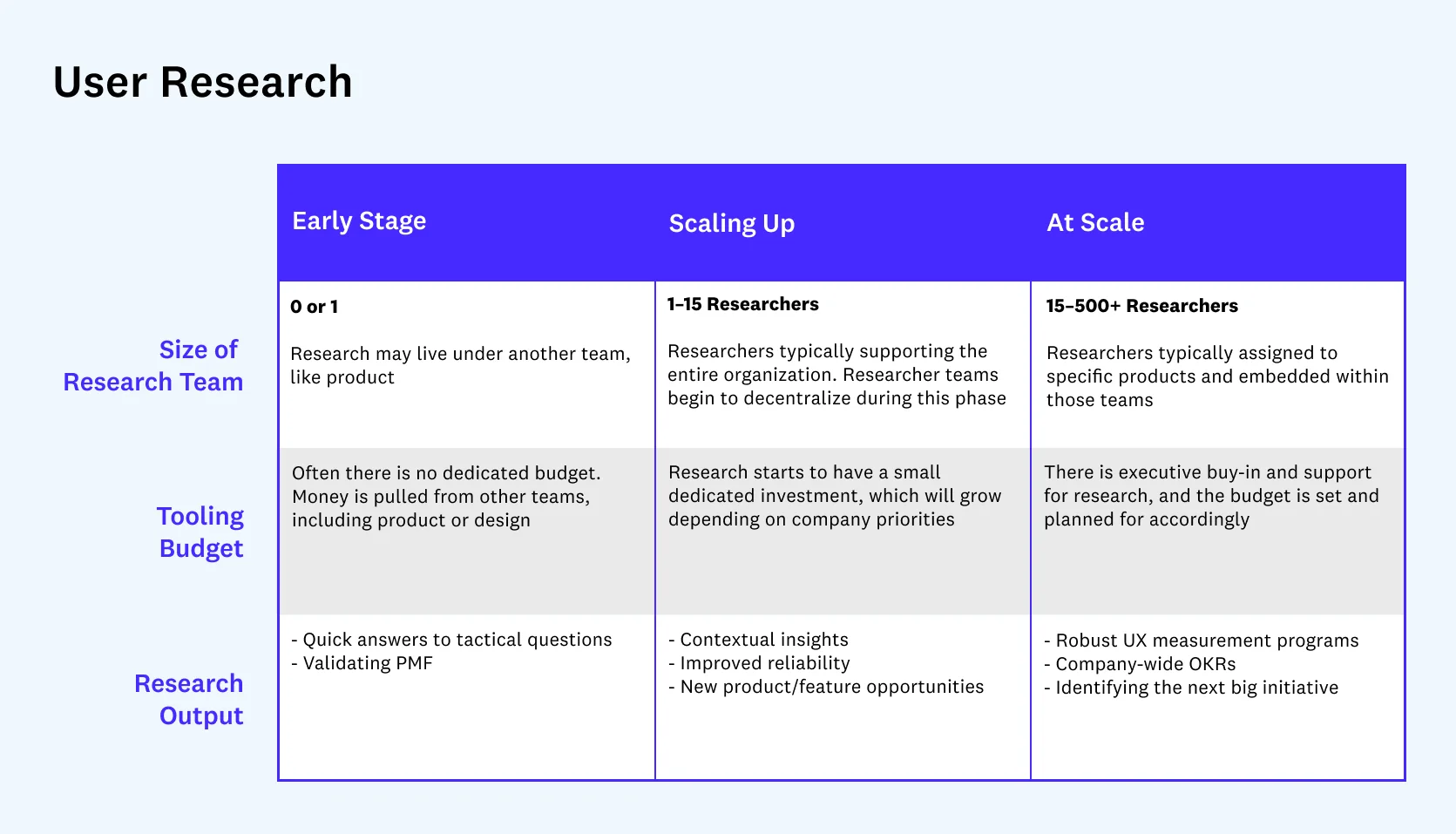
Early stage teams may know about user research, but might not know where to begin. Companies already beginning to scale may start to wonder about best practices for incorporating research into a growing organization, or how to retrofit a research function into a product and design team that’s already been carrying out some form of research on their own.
Here’s how to meet those challenges and get started on the path to becoming user-driven.
Early stage
At this stage, companies don’t usually have bandwidth for a user research-specific hire, so they need to embrace tools and technology that let small teams conduct meaningful research on their own. The goal is to make decisions that use capital wisely, and only prioritize those decisions that users actually want — both pre- and post-launch.
Teams may be surprised by how much clarity a short survey can bring to the ever-elusive product-market fit question. A simple 4-question survey can help signal product-market fit, even with only 100 beta users. As a rule of thumb, if 40% of users or more say they would be very disappointed if your product did not exist, then there is some level of product market fit. And if the survey shows that there is no fit, the open-ended responses to questions like “How could we improve the product?” and “What are the primary benefits you recieve from the product?” will help shape your next iterations and make sure the product does not drift away from what users like best.
Research at this point does not have to be flawless, but it does need to offer a broad signal about which way to move. And at this scale, most companies are still small enough to hold one-on-one conversations with users that produce focused, useful, and practical insights. Tooling at this stage should support quick, unmoderated testing, and offer templates informed by best practices.
Scaling up
As an organization expands, its research needs expand with it. Founders will feel pressure to build a dedicated user research team to handle an increasing number of questions about product decisions, the customer journey, and more. As a company grows, the research team may evolve into its own unit and, eventually, bring on a dozen or so researchers to the organization. At this stage, a small research team can start addressing more strategic questions and helping product owners and decision-makers handle some tactical research themselves.
This is the stage where a company needs to establish more disciplined research practices, allowing teams to ask the right questions of the right users at the right time. That is because during periods of rapid growth, small changes in flows like acquisition and onboarding can have a huge effect. And making the wrong call can lead to massive drops in new user growth and add up to millions in lost revenue.
By learning directly from users in-product, teams can get a clear and dependable signal about what is working, what is not, and why. A well-timed survey after users abandon the onboarding flow or fail to convert from a trial to paid subscription can give clear direction on how to improve those flows within hours, without waiting for the results of multiple A/B tests. In my experience, these are some of the most common and widely used surveys because they produce real results, fast.
At scale
Once a company attains significant scale, usually post-IPO, user research can become a major competitive advantage. Whereas in earlier stages of company growth, speed to market and product-market fit will likely be the biggest drivers of success, companies operating at scale must optimize around the edges, and small changes matter far more.
At this point in a company’s journey, research is carried out systematically across the full product lifecycle, and large teams of researchers work in close coordination with product teams to drive sound decision-making. At scale, it is vital to continuously measure the user experience by collecting a range of metrics and insights. These can span from simple surveys like Customer Satisfaction Score (CSAT) to customized measures that assess the product’s impact on business-specific KPIs or OKRs.
In companies like Meta and Google, this kind of research allows teams to compare user experience data alongside product analytics and financial data to make sure the company is making decisions that are in the best interests of both the company and customer. While this is not at all the case for all at-scale companies, it is the ideal state for organizations or companies aiming to be customer-centric.
The bigger a company becomes, the more it has to invest in tools that help it scale and spread research across the organization, so that all teams stay aware of and aligned around the customer experience. The best organizations use tools that support continuous user-experience measurement and benchmarking as they work to understand the impact of new product development and prioritize across projects.
How to incorporate user research across the product development lifecycle
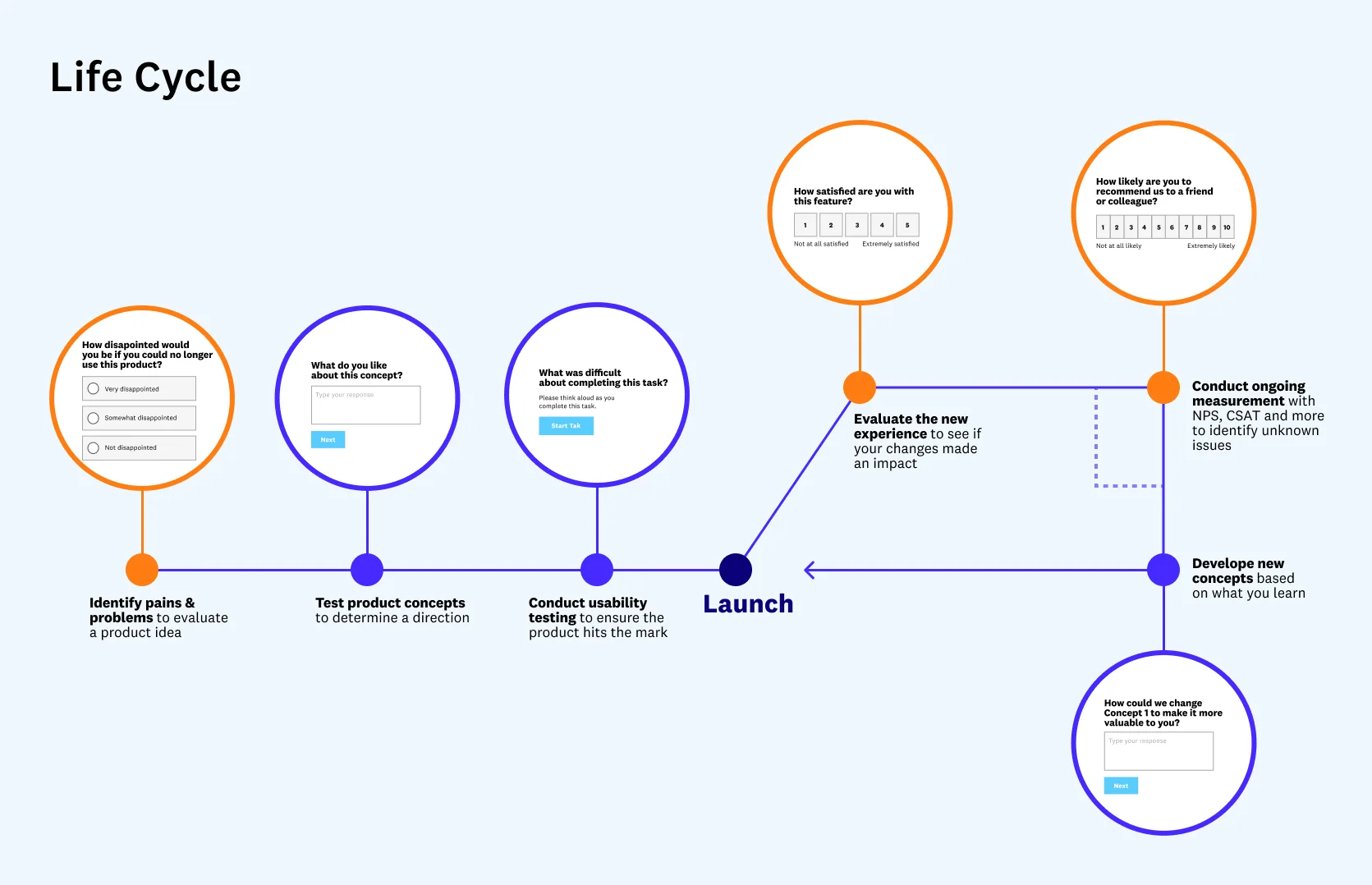
Of course, even the best-laid plans and well-developed strategies can be undone by poor execution. So, how does user research actually work in practice? No matter the stage or the size of the research team, the framework for incorporating user research across the product development lifecycle stays generally the same.
It begins with customer discovery. After identifying issues and settling on a direction, the next steps are concept testing and usability testing. Finally, after launching new features and functionality, it is important to assess the effectiveness of those changes after launch. The cycle continues and aims to optimize growth initiatives, launch new features, improve product adoption, and more.
Here is a breakdown of the kind of research companies might carry out at each stage of the product development lifecycle.
Phase 1: Discovery research
Discovery research, also known as exploratory research, finds pain points before they turn into a problem in the live product. Or, if the product or feature has already launched, it can uncover issues that are keeping users from taking a desired action. Discovery research can help shorten the product lifecycle by preventing unnecessary work later and reaching the most effective solution in earlier iterations.
For example, I worked with a popular real-estate technology company that saw onboarding drop-off was much higher than expected on its “Get a Quote” page. The team had a few options to figure out why that was the case:
- Run a range of A/B and multivariate tests to change content on the page and eliminate fields. Make an informed guess based on past learnings and assumptions. Conduct user research.
The first two options would take a few weeks to several months, and would likely lead to significant waste because only about 1 in 7 A/B tests produces a clear winner. By running user research with a few simple in-app surveys, the product team could go straight to the source — and learn from users completing the “Get a Quote” page in real time. In this case, the team learned that users were reluctant to share their phone number so early in the quote process, and that many visitors to that page were not actually intending to get a quote at all. They were simply shopping around and in a completely different part of their customer journey.
When the phone number field was taken off the page, the conversion rate rose 10% almost immediately.
Phase 2: Concept testing
Improving conversion and repairing critical growth funnels is only one way to apply discovery research. More often, there will be several different concepts that solve product issues, especially those tied to engagement and adoption. The objective is to narrow it down to one — quickly — and get it right before investing substantial time and resources into building.
Let us say, for example, that while researching the “Get a Quote” experience in the example above, the team discovers that obtaining a mortgage is confusing for users and stops them from advancing in the home-buying process. The team develops some ideas to solve the issue, and settles on an interactive mortgage calculator as the answer. That may be the best option, but it will require significant engineering and marketing resources to build and launch the feature.
This is why it matters to de-risk the project by making several product mockups and testing them with users before you begin building. Unmoderated concept testing makes it simpler to try a handful of options and learn how viable potential solutions may be. When evaluating multiple prototypes, keeping the choices to two or three will reduce the cognitive load for test-takers.
Phase 3: Usability testing
Once the strongest mortgage calculator concept has been chosen, it’s time to confirm that the design truly works. In usability testing, participants carry out a series of tasks, using either a prototype (sometimes referred to as “prototype testing”) or a live website/app, to pinpoint friction and uncover chances to improve the user experience. Participants are asked to “think aloud” while they work through tasks, describing any questions, hesitations, or difficulties they encounter. For the mortgage calculator, test questions might include, “Can you easily adjust your down payment?” or “Select your rate to be 30-year fixed.”
Best practices for usability testing recommend including at least 5, and as many as 50, participants. There’s no reason to make usability testing overly complex (it’s the simplest of the research techniques covered in this article); the goal is just to ensure your design functions and users can carry out the intended actions.
Phase 4: Post-launch evaluation
User research is ongoing — the work doesn’t stop at product launch. Once new features and flows go live, the task becomes measuring satisfaction and comparing those results with earlier data to confirm the product changes worked as intended.
Returning to the mortgage calculator example, we’d want to compare the metrics from the prior onboarding experience with the newest iteration. A team can run the same in-product survey before and after the new calculator is implemented to see whether the improvements are creating a better experience and encouraging the right behaviors. The team might ask, “How confident are you in the results you recieved?” to help assess whether the calculator is delivering on its promise of boosting buyer confidence. If not, open-ended responses will plainly explain why and what the next steps should be.
It’s not unusual for this process to be iterative, with several rounds of research and solutioning.
Bonus: Continuous UX measurement
Not every research effort is tied to a specific, clearly defined business problem, such as weak onboarding conversion or a decline in engagement. As companies establish and expand research, it’s useful to keep a continuous watch on the user experience to uncover unknown issues that are not yet on the product team’s radar. This kind of research doesn’t have to take a long time or be complicated. Adding simple in-product surveys on common pages that measure net promoter score (NPS) and customer satisfaction score (CSAT) can produce some of the most meaningful “aha moments” in a business.
Back to phase 1: Redesign discovery research
And the cycle goes on. With continuous measurement and post-launch evaluation insights, an organization will keep discovering new pain points. In business, and especially in tech, there are always new problems to solve — and they need to be solved fast. This is especially true in the era of agile development, when — unlike the quarterly release schedules of a decade ago — teams are working on continuous release cycles and, in some cases, shipping products every few days. Companies that understand user research are far better positioned to keep pace with all this change and keep their customers happy.