
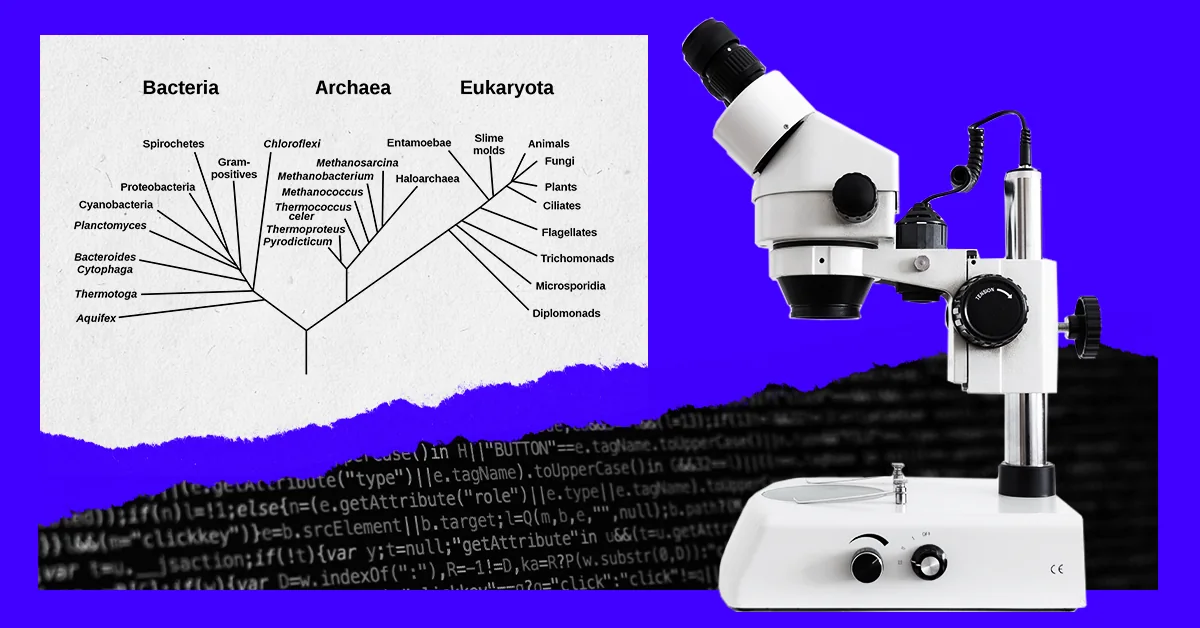
Biology has delivered immeasurable riches to humans: We breed animals and plants selectively, we prevent catastrophic pandemics and ecosystem breakdowns, we predict severe illnesses, we extend our lifespans, and sometimes we understand and regulate our bodies all the way down to individual bits of DNA. All of this depends on knowing how we are connected to the organisms that surround us, and live within us.
In the context of this bounty of biological knowledge, where does the past — the study of our earliest ancestors — fit in? I’m not talking about our hominid cousins or even our cute distant kin, the social media-friendly warm-blooded mammals. I’m referring to the microorganisms that lived billions of years ago on the early Earth. These organisms are difficult to distinguish by the human eye, they barely resemble us, and, as Douglas Adams (The Hitchhiker’s Guide to the Galaxy) once wrote, “Humans are not proud of their ancestors, and rarely invite them round to dinner.” So why concern ourselves with the anatomy, physiology, and molecular biology of organisms that lived billions of years ago — presumably including many lineages that have long since perished — pruned away by the ferocity of fate and circumstance?
Evolution’s deepest deception is the teleological feeling it plants in our minds. The familiar “March of Progress” image showing a gradual transformation from ancestral primate to Homo sapiens is fixed deep in the human psyche. But evolution is far more complex, unexpected, and beautiful: Most species that have ever existed have died out, and many of those extinctions happened through no fault of their own. They were fully fit to reproduce, but natural swings or disasters arrived and removed them from the board. Among all populations of organisms alive at any given time, almost none belong to a lineage that actually becomes measurably more complex within a visible number of generations. Why? Because short-term complexification brings many costs and few benefits — every added feature is also something that can fail, and there are always far more ways to fail than to improve.
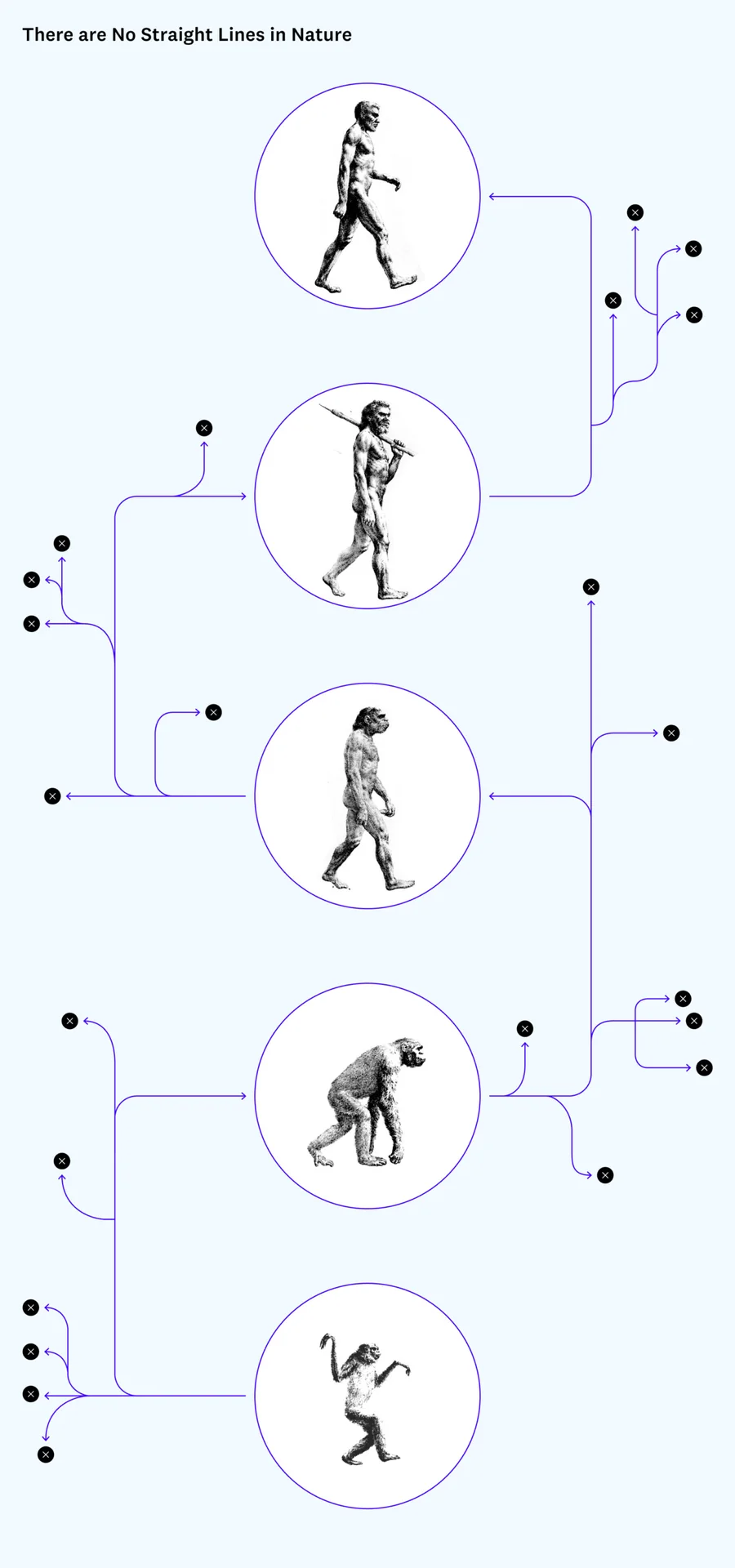
And yet, our attention appears to be pulled toward the oddities in the set — the animals, the trees, the fungi; those organisms that defy the likeliest outcome and seem to become more intricate over time. There are many species around (both in the past and today) that are hugely successful at changing, persisting, and adapting while staying more or less as they are, and still we give them little attention. Even the simplest definition of evolution (succession with modification over time; descent of change from a common ancestor across generations) seems to bias modification as an additive process. What remains when we ignore all this beautiful nuance in the arc of paleobiology is the idea that the fittest were (naturally) destined to survive, and the weakest were not.
This view is too simple, and misses a greater truth. Not everything is inherited, and elegant modifications can be simplifying as well as complexifying. When we choose to embrace all of the beautiful nuances of evolution, we can begin to appreciate paleobiology for what it is: a study of organisms that were fit … for their unique time and circumstances.
Paleobiology is therefore not the study of what failed, but of what worked best under a particular set of conditions. In fact, a broader range of conditions than exists on our planet today. What is innovation except something built under high uncertainty, and judged fit for its time and place? Durability and usefulness can be products of timing.
Applying this mindset to biology today
Bioengineering and biology-based solutions can therefore be much more effective if they draw on the full set of solutions biology has produced to address problems, and not merely the narrow slice that survives today. Evolution may indeed show some signs of temporal directionality — because biological histories can be, and often are, contingent — but environmental conditions are what they are, and nothing else. There is no useful, absolute standard of comparative fitness or built-in value to be derived from differences in, say, high or low sulfur content, greater or lesser solar insolation, or freezing versus boiling temperatures.
The origin of life may be seen as part of a continuum linking complex biology with complex geochemistry. Although the emergence of the first self-reproducing cell marked a singularity — a milestone of biological possibility that fixed the architecture of all later cells — there is little reason to think the chemical-evolution stage before biological evolution was meaningfully different or less complex. Recreating the origins of life may help us uncover self-organizing chemical solutions to problems that are no longer preserved in (or able to be found through) living descendants.
Four billion years of struggle for survival means four billion years of living experience, of biomolecular tinkering, of probing novelty and possibility that defy present conventional logic. It would be impossible to gather this much information through laboratory experimentation, and it should therefore be regarded as a bioinformatic repository without comparison — a Library of Alexandria, not fully lost in the sands of time.
Treating this rich repository as such — combined with modern bioinformatics and molecular biology — not only affords us the opportunity to explore the successful “solutions” employed by both ancient and modern forms, but to leverage those solutions for modern-day problems. This goes far beyond notions of biomimicry, where engineering materials and solutions are modeled on biological ones and something visible today is copied in another form. It is about realizing that ancient biological solutions that have long since been forgotten can be entirely new, and useful, to us in the present.
The CRISPR gene editing system, for instance — arguably the future of genetic engineering (and which moved from discovery to practice to Nobel Prize recognition in a relatively short timespan) — is based on a bacteriophage that isn’t even really alive at all. It is difficult to imagine a more distant biological entity from us, and yet this tool (and others like it) may shape the contours of human societal evolution for the next century. In this way, reaching into the past can become a way of connecting with an unfathomable range of functional molecular possibilities. It doesn’t especially matter whether the solutions involve our direct ancestors or our far-flung distant kin.
And the range of solutions can extend from the ordinary to the extraordinary. We may discover more efficient carbon-harvesting methods for mitigating climate change, create artificial life forms that readily synthesize more ecologically compatible fertilizers, or uncover how molecular language processing in translation can be altered to synthesize entirely new classes of reactive artificial enzymes. Careful observers can begin to see that the next evolutionary phase of scientific exploration of ancient life on Earth may be far more interactive and beneficial than has been imagined: an exploration of new techniques that can bring past states to life to solve our current, and future, most pressing problems.