

In reaction to the pandemic, technology companies have rolled out many different remote-work policies. Apple, Facebook, Google, and Salesforce have adopted hybrid setups, permitting some work from home while still requiring every employee to come into the office on specific days (or requiring certain employees to be in the office every day). Meanwhile, Coinbase, Shopify, and Twitter have said they are now “remote first” or “digital by default,” even letting employees work from home “forever.”
At the other extreme are companies such as Netflix, which has said that not being able to gather face to face is a “pure negative”, and Amazon, which has said that an “office-centric culture” is their starting point. Either way, remote work is here to stay. I’d say it was always present for companies operating at scale (those with several offices, employees on the road, work-from-home days, and regular offsites), but the pandemic has made it obvious that, going forward, every company will be remote at least part of the time.
As we begin returning “back to the office,” it has become ever more obvious that the offices being discussed have changed for good. In surveys, or directly, companies have said that the main model for the near term is hybrid work. Some worry it will be “the worst of both worlds”, yet the phrase “hybrid work” still lacks a clear definition. Hybrid work is not a simple, straight-line mix of remote and in-person work — it is a major shift in the modern enterprise that raises (as former Microsoft executive Steven Sinofsky has noted): What is the structure of getting things done?
We will inevitably mix distributed work with in-person work, but the specifics are far tougher than they seem. From unequal access to the difficulty of creating digital “presence” in the workplace — there are many issues, questions, and yes, anxiety about hybrid work, for both employees and company leaders. Rather than arguing over whether one hybrid model is better than another, it is more useful to start by following the development of remote work itself, with special attention to how work has been changing — especially around presence and collaboration. These shifts are harder to manage in hybrid arrangements than in fully remote ones; solving them will create a future of work that links us smoothly, wherever we happen to be.
The evolution of remote work
A year back, remote work was for many people an unfamiliar and questionable idea, but during the pandemic we’ve shifted from managers asking how to prove employees are actually working to more constructive questions (“how do we avoid burnout?”). Behind all of this is a continuing change in technology. A quick look at the recent past helps show where we are headed.
Remote 1.0. The earliest wave of modern “remote-first” companies (including Automattic, Gitlab, and Zapier) depended heavily on asynchronous communication through tools such as Google Docs and Slack. That required a deep cultural change that most businesses could not — and did not want to — make. It didn’t help that video conferencing was awkward and unreliable, which made smooth real-time communication impossible. When collaboration did occur, it mostly took the form of screen sharing: low-resolution, non-interactive, and ineffective. Rather than enabling progress, technology got in the way.
Remote 2.0, the stage we are in now, comes closer to in-person work by using video conferencing that supports real-time collaboration, though still with friction; video calls are much improved now, thanks to more consumer-friendly tools such as Zoom and Google Meet. Millennials and Gen-Z-ers, who are more at ease with multimedia (video and audio as well as multiplayer gaming), are increasingly entering the workforce. But although this phase has been more workable technically, it has not been enjoyable: “not being able to unplug” has become the leading complaint among remote workers. (Especially since many teams have tried to recreate the feeling of in-person presence by adding more video calls, which has led to “Zoom fatigue”). As context fades, trust has become harder to build — especially for new hires.
Remote 3.0 is the stage ahead of us: hybrid work. The same problems seen in Remote 2.0 are intensified here by asymmetry. The pandemic first leveled things by forcing everyone into remote work; now that it is possible to work in person again, hybrid work will produce a “second-class citizen” issue. Remote employees may find it far more difficult to take part in core company activities, to join informal conversations, and to build relationships with their coworkers.
I’ll concentrate mainly on technology here, and to better see how it is connected to these problems and changes, let’s map two broad tech trends: the rise of “multiplayer” mode in workplace tools and the creation of a more visceral sense of presence in hybrid work, and examine their effects on connection, collaboration, and trust.
The future is multiplayer
“Multiplayer” enterprise software allows real-time collaboration. Unlike “single-player” tools such as Microsoft Word and Excel, Google Docs and Google Sheets showed workers the value of multiplayer editing. And being able to work on the same artifact at the same time was transformative. In “The Arc of Collaboration,” Kevin Kwok uses Figma to demonstrate that this kind of collaboration is not just a feature; it creates entirely new possibilities: “Unlike Sketch or Photoshop, Figma …shows what collaboration means when you understand that collaboration is intimately part of productivity. …The feedback loops of collaboration get so short that they become part of the productivity loop.”
A result of this, Kwok notes, is that both work and collaboration can happen quickly and without loss inside apps, and “going to Slack is increasingly a channel of last resort.” That is the strength of multiplayer: it fuses collaboration and productivity by letting us work together inside the same tools we use for individual work. These tools, however, are technically hard to build, and because of that, the move toward multiplayer has taken place slowly.
The idea of multiplayer collaboration, though, has existed for a long time. Take, for example, this video from Xerox PARC in 1991 of two people drawing on the same surface from different places. While those prototypes were striking, practical multiplayer tools were too expensive and too hard to construct at scale. Jump ahead to 2006, when Google Docs advanced operational transform algorithms (which made simultaneous editing possible); it took Microsoft almost a decade to catch up. Later, Figma spent years in stealth building multiplayer design in the browser with specialized data structures used in distributed systems.
Even when real-time collaboration itself has been solved, multiplayer apps still need to reach parity with their single-player predecessors before users will switch (not an easy task). Despite the difficulty and the expense, though, multiplayer has arrived. Screen sharing is rapidly becoming outdated, replaced by multiplayer applications for documents (Google Docs, Notion), design (Figma, FigJam), and code (starting with Replit and VS Live Share). Note that there are different levels of abstraction for multiplayer mode, which can exist:
- at the computer desktop layer (e.g. Zoom’s remote control function), which tends to consume bandwidth and feels awkward; at the native application layer (e.g. Google Docs, Figma), where the application itself handles collaborative editing; at a virtualized layer, which is still mostly hypothetical, but if users are willing to move to a virtual computer such as Parsec (or newer virtual browsers like Mighty), these could make smooth multi-user control possible.
For the moment, it is hard to get the necessary speed and fluidity without building multiplayer into the application layer. To do multiplayer well, some tasks need to be fast (e.g. drawing curves together), while others can be slower (e.g., commenting); those tradeoffs are best handled by the application itself today. The lesson here is that multiplayer is not simple or effortless, but it is worth the work, and a great deal of impressive innovation is happening right now. It will only improve.
So if every app becomes multiplayer, what does that imply for the future of work? The spread of multiplayer apps has two very important consequences:
First, multiplayer apps greatly strengthen a team’s sense of presence and personal connection: you are less likely to feel alone when you can see everyone else’s cursor, for example. (I also think of cursors as digital index fingers, not only pointing at things but also giving a sense of where my gaze is; my collaborators are made person-like to me through their own cursors, and the effect feels strikingly alive. These interfaces help you “think” with your hands). Through modern interfaces like these, the feeling of working together in real time can come close to that of an online game; in fact, consumer gaming mechanics now appear throughout many enterprise multiplayer apps.
Second, multiplayer apps can make hybrid collaboration almost frictionless. Teams use tools like Figma and Google Docs to work together digitally, even when they are in the same physical space. So when remote team members are added, the boundary between them and their in-office coworkers becomes less distinct. In a hybrid world, this is extremely valuable.
Making presence work
Multiplayer apps can create a sense of presence, which is an intuitive awareness of your teammates’ activity and availability in real time. Presence, however, is not confined to multiplayer mode. Social Presence Theory, which emerged as a research field in the 1970s, examines the depth of awareness people have of one another during communication across different media; in this setting, “presence” has mostly centered on the differences between face-to-face and telephone communication. In virtual reality, presence has long been discussed as a technical term — the holy grail, where the user’s awareness of the technology disappears and produces a seemingly real, complete immersion in a virtual world.
In the workplace context, presence is not about matching reality; it is what gives you that familiar sense of your team’s natural choreography, rhythm, and pulse. This is not only about explicit alerts or signals; it is about tacit stories: when I see two colleagues talking in front of a whiteboard, I know they are brainstorming (and that I can join them). When I see that Vivy and Ram are still talking in a meeting room, I understand why Vivy is late to our one-on-one. When I turn around and see Vera wearing headphones and writing code, workplace presence tells me that I should wait to ask her my question.
Presence is vital to hybrid work. It still has far to go: For several years in a row, “loneliness” and “communication” — two problems that presence directly solves — have been the top two concerns for remote workers in Buffer’s annual survey. In Remote 1.0, we depended on chat, and while chat tools like Slack provide an approximation of presence (a custom status, a green dot), in practice, people are always online and reachable for the purposes of asynchronous messaging. I’m still going to Slack you if your status is marked grey (“away”), because I know that you will get it eventually. Presence is effectively meaningless in this model, since workers are both always online and never truly fully available; as a result, it is very hard to feel connected to your team, and it is harder to disconnect from work.
In Remote 2.0, a fresh set of tools is folding in signals that give presence more nuance than just “in the office”, “at work”, “online”, “disconnected”, and the like. We’ve seen the growth of “proximity chat” apps and virtual offices that offer a richer sense of presence than their conference-call forerunners.
There are several key technology factors and coming changes to keep in mind when building digital presence:
Sense of place. Presence in the workplace means creating a virtual “third” place — a feeling of closeness to your teammates, and of belonging. Discord does this well; it has become more than an app or a communication tool, and is now effectively a place where users spend time with their friends.
Always-on as an enabling condition for interaction. While Remote 2.0 tools have often drifted toward burdensome “always-on” practices (long Zoom calls) or the empty status cues mentioned above, Remote 3.0 points to lighter ways to participate. Discord, again, is a good example: Kwok notes that active users usually keep it open all the time — even when they are not gaming — because “it’s a passive way to have presence with your friends.” Yet it is not burdensome (like a long conference call), and it makes it easier for more people to join, strengthening the social side of multiplayer mode (something the workplace can also learn from the gaming world).
AI video compression. Because the workforce is increasingly global and video calls are getting larger and larger, there is intense pressure to make video compression codecs more efficient on low-bandwidth networks. The drive for efficiency will soon hit its natural encoding ceiling: encoding not pictures of our faces, but our facial expressions themselves (like a Memoji FaceTime or deepfake, but of your own face). Although there is still an uncanny valley to cross, a number of efforts (including Nvidia’s Maxine, among others) are coming close. This creates some odd new possibilities: We’ll be able to change our appearances easily; we’ll have sharp video chat even in the worst network conditions (AI compression can cut bandwidth by orders of magnitude); and without needing a video camera, AI could generate a facial expression from your tone of voice alone. Our idea of presence will shift in surprising ways as these technologies develop.
For hybrid presence to feel seamless, though, a number of questions still need answers. Who is at home, but reachable? If you’re in a remote discussion, how do you bring in people in the physical office? On the other hand, if you begin a water cooler chat in the office, how do you bring in remote teammates? And importantly, how do we create presence while still protecting privacy? As our understanding and technologies of the workplace change, they will open up a rich set of natural, real-time interactions — which will then greatly boost real-time collaboration and productivity in hybrid offices. The future is synchronous.
The future is not asynchronous
For some people in tech, work that is strictly asynchronous — using processes and documentation habits to reduce or remove real-time communication entirely — is, apparently, attractive. As noted earlier, though, trying to go fully asynchronous was a cultural change that very few enterprises managed to make work. I do not think it was ever likely to succeed: We are social beings who build trust by talking (more on this later), and, frankly, the attraction of asynchronous work was probably a result of the clumsy and unreliable Remote 1.0 tools we had, rather than the goal itself.
COVID-19 appears to have settled the issue: When the pandemic began, remote work had already started to add more synchronous communication, partly because audio-video technology had improved and multiplayer apps had emerged. Over the past year, the trend has not been to give up synchronous communication, but to depend on it much more heavily.
And hybrid work, of course, relies on synchronicity; in making that shift, though, we will need to bring in some helpful pieces from asynchronous-first models.
One case for asynchronous work is that it supports the kinds of focused, independent work that are essential for developers and other information workers. See, for example, the classic Maker vs. Manager dilemma, which calls for a clean division between the two schedules and modes, and for large stretches of time without context-switching.
The truth is that most high-performing teams have to strike a balance between the Maker’s and the Manager’s schedules, combining synchronous and asynchronous modes in the service of speed, alignment, and creativity. In a 2016 study, Christoph Riedl and Anita Williams Woolley described the best communication rhythm for creativity and execution as “bursty” (a blend of rapid communication and uninterrupted, independent work). In a randomized, controlled trial of 52 software teams, they found that bursty communication was used by the most productive teams and tended to “lead to better outcomes”. Riedl and Woolley observed: “People often think that constant communication is most effective, but actually, we find that bursts of rapid communication, followed by longer periods of silence, are telltale signs of successful teams.”
A helpful analogy here: if we imagine the enterprise as a living organism, strong asynchronous practices (e.g. documentation, project management, Slack etiquette) are like long-term memory — needed for order and consistency; synchronous practices (e.g. voice and video calls, real-time collaboration) are like the central nervous system — crucial for speed and creativity. Both matter.
Trust is everything
Synchronous communication creates trust, and trust creates speed. This is the clearest lens for understanding organizational dynamics in a hybrid model.
In “Being there versus seeing there: Trust via video” (2001), researchers at the University of Michigan showed how group trust grows over time, as measured by mean payoff in a social dilemma game. Note that audio and video reached in-person (face-to-face) levels of trust, whereas chat never did:
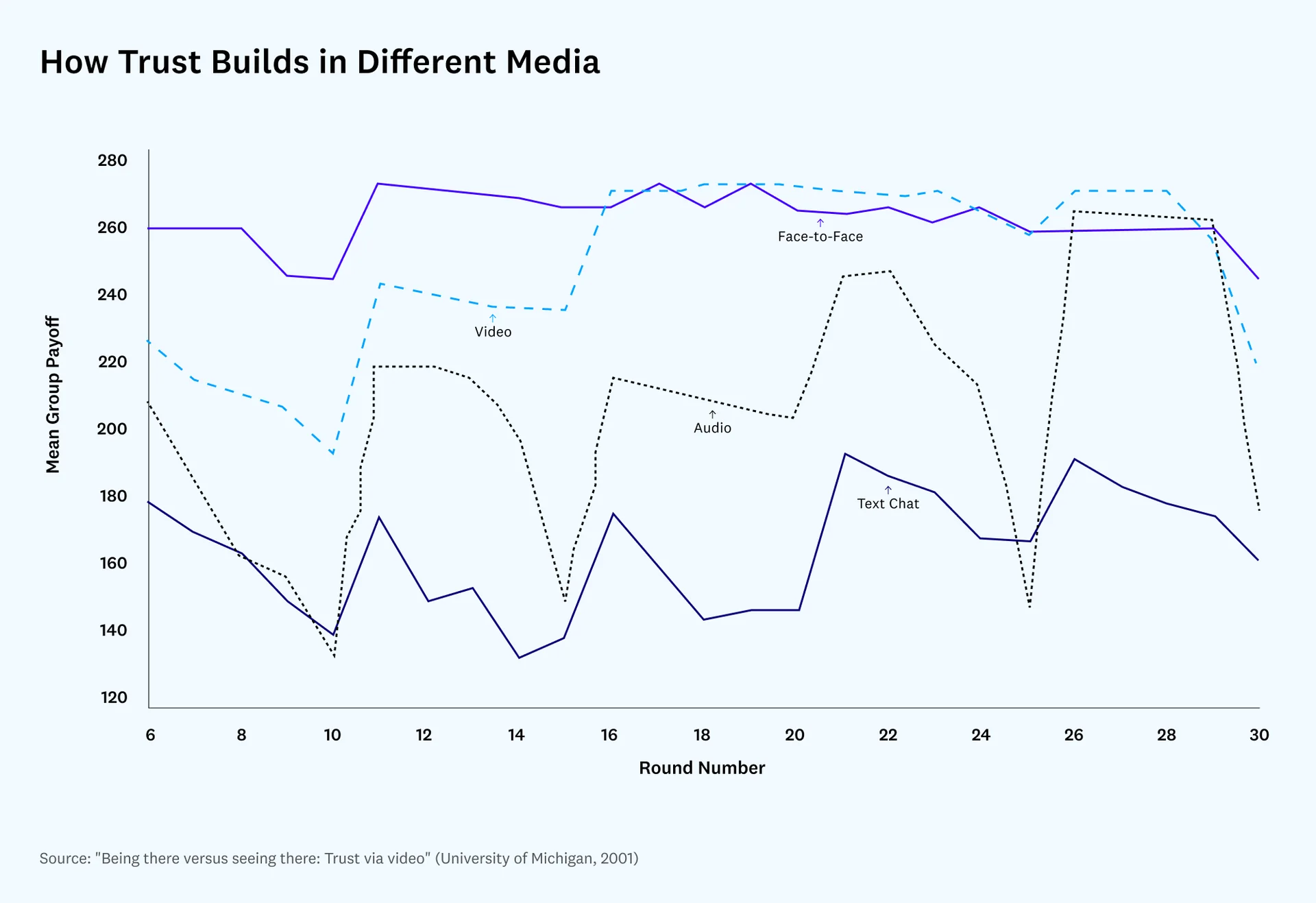
Psychological safety, loosely defined as “group trust”, is the most studied social dynamic of effective teams. Named by Amy Edmondson of Harvard Business School, this phenomenon has been studied extensively by Google, which found it to be the main factor in team productivity, since it creates an environment where teammates can speak honestly without fear of backlash.
High-trust settings are vital to the success of the hybrid office; the hybrid office, however, creates distinct challenges for trust-building. While there is every sign that trust can be built successfully at a distance, people in the physical office are likely to build trust more quickly than remote colleagues. Again, this imbalance — and the anxiety it will create for those working remotely — is one of the many obstacles hybrid work will have to overcome as it moves ahead.
Hybrid work in the future
To take a quick temperature check on where we stand, in terms of technology readiness, on hybrid work: Some issues, like mechanical matters such as how to run hybrid calls, will be sorted out quickly. The challenges created by planning workforce capacity, building a hybrid team presence, enabling hybrid water cooler conversations, and avoiding the “second-class citizen” problem have solutions in progress, but will take a little longer to be resolved broadly.
And there are many new technologies on the horizon, but we are not sure how they will play out. Take VR, for example: will it push virtual collaboration to the next level? While early efforts, such as Spatial, are promising, in general we do not like to collaborate on platforms that we do not also use for single-player work. Just as Figma’s success depended on designers living in Figma, whether or not they were collaborating, VR’s success depends on whether we will do work in VR by default. That is still unclear.
Leaving collaboration aside and focusing on interpersonal connection, is there a limit to how much we are willing to connect in a virtual setting? If there is, technology may already be approaching it: the Japanese company Tonari is building a virtual wall across which you can wave, make eye contact, and have a natural conversation; Google’s Project Starline is a “magic window” that uses computer graphics to create eye contact for greater presence. Will we see these efforts as expanding our interpersonal bandwidth, or will they end up as skeuomorphic archaisms, replaced by newer and better forms of connecting?
So far, much of what companies have concentrated on in technology for interpersonal connection is what we might call “collaborative bandwidth”: the speed, quality, and effectiveness of doing work together. In the process, however, we have also gained more “interpersonal bandwidth”, which lets us feel connected and form stronger relationships. We might measure interpersonal bandwidth by how quickly we build trust — returning to the idea of “being there” vs. “seeing there” — and this, again, is where the richness of the communication channel matters. Factors like eye contact, latency, audio, and perhaps even touch will be essential.
Although the exact details may still be unclear, we can outline in broad strokes what a successful hybrid office will look like: Those workers who are remote will have access to the flow of in-person collaboration; you’ll look back on your last meeting, collaboration session, or spontaneous conversation, and not be able to remember which teammates were in the office and which were not.
Naturally, the office itself — a remnant shaped in a very different, factory-oriented age — is going to change: it will shift toward being a place to gather or a creative studio rather than a 9-to-5 requirement. The office of the future will be redesigned around what in-person work is best at. There will undoubtedly be many misguided and expensive experiments that add needless “remote-friendly” office features during this hybrid transition period, but in the end, we’ll arrive in a better place.
As virtual and physical offices merge, one thing is for sure: freedom and flexibility for knowledge workers will improve, even as we overcome other cultural challenges along the way. We’ll get closer to the vision of being able to work from anywhere, in the fullest sense of the word “work” — not just contributing individually, but also collaborating, leading, creating, connecting, including, and being included.