
Excerpted from MOVE: The Forces Uprooting Us, by Parag Khanna. Copyright © 2021 by Parag Khanna. Excerpted with permission from Scribner, a division of Simon & Schuster Inc., for Future by a16z.
The Great Lockdown of 2020 was also a Great Reset. Thousands of entrepreneurs opted to become digital nomads, swapping San Francisco for Costa Rica and Boston for Bali. But for millions of professional expats, construction workers, and students, the direction was reversed: They simply went back home, not sure whether they will live abroad again.
There could hardly have been a more ironic year in which to nearly halt global migration. 2019 had represented a peak in human mobility: 1.5 billion international travelers and almost 300 million people living outside their home country. These figures were a major accomplishment — especially set against the last century’s intense bureaucratization of visa processing, and politics.
The passport’s beginnings are far less a limiting emblem of exclusive identity than a plain laissez passer: a plea for safe passage. So how do we get back to a world in which passports don’t signal who you are, but merely show you as you move toward where you’re headed?
The passports of the future should be based on skills and health rather than nationality.
The Great Lockdown showed how vital physical movement is to global supply chains and individual livelihoods. Unfortunately, it also revealed how poorly we coordinate that movement. At nearly the two-year point since the pandemic started, countries still impose unilateral travel bans and vaccine certificates that others do not recognize. On any given day, people do not know which countries their passport will permit entry into or not. According to UBS data analyzed by travel research firm Skift, travel was still more restricted in September 2021 than it had been in September 2020.
I believe there may be no more vital industry to bring into the future than the governance of international mobility. Indeed, even as Covid restrictions still keep billions of us rooted, it is not hard to see the forces working to dislodge much of humanity in the decades ahead: Political upheaval (think refugees from Afghanistan, Syria, or Venezuela); demographic imbalances (huge shortages of workers in developed countries across North America, Europe, and Northeast Asia); and climate change (with people escaping floods, droughts, and rising sea levels), to name a few. Standing behind glass counters at consulates simply will not suffice.
This early stage of the post-pandemic world offers a rare chance to design the next migration system in advance, one better matched to a global population that is constantly seeking political, social, and/or ecological stability. But to reach that point we will need to embrace blockchain technologies, and biometrics — which together would make possible a decentralized global platform for individual mobility.
The Great Lockdown was the most coordinated worldwide action in human history. We can use it best by peacefully and sustainably enabling the Next Great Migration.
How we get there — a global passport app
The growth of digital identification is a major step toward a post-passport world. National ID cards have long been common in Europe. In the 2000s, Estonia was already issuing citizens a unique SIM card for mobile access to government services (including voting), later moving to a “Smart ID” through an app instead. Today, Singapore’s SingPass replaces the national identification card for entering government offices or opening bank accounts. China is also rolling this out on a billion-person scale, with Tencent and WeChat launching a Virtual ID app that swaps physical ID cards for facial recognition for all government or commercial purposes. India’s aadhar program issued unique identifier (UID) cards to 99 percent of adults; tying one’s 12-digit UID to a registered mobile phone number now makes cashless banking and instant subsidy payments possible.
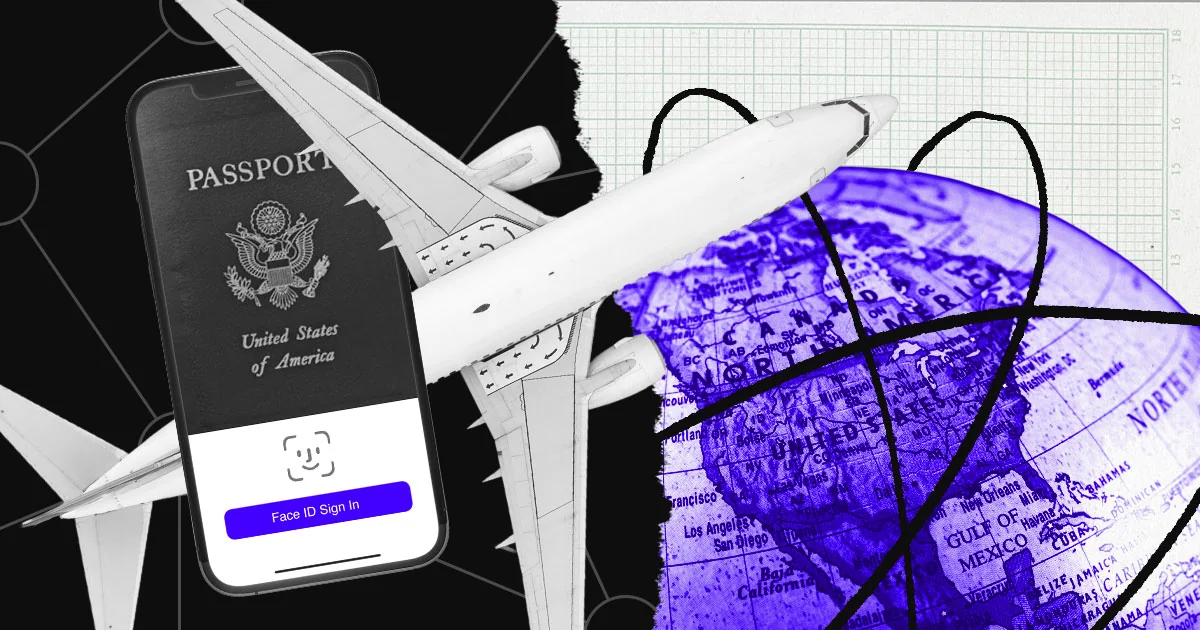
Thanks to the pairing of mobile phones and digital IDs, billions of unbanked people are now banked. Why not apply the same idea to travel? A global passport app would be a leap forward for global mobility that is both desirable and possible. Imagine that every person who wanted one received a mobile phone and digital ID — and could upload essential travel-related information to a blockchain-based mobility wallet for clearance. Who would gain from such a system? The answer: almost everyone.
Even the wealthy are not protected from arbitrary travel restrictions. During the pandemic surge, the U.S. passport fell in international acceptance in inverse proportion to Covid cases, and at its lowest point was accepted by only three dozen countries. Canada (and even Mexico) said they would need a wall to keep infected Americans out. To avoid being punished for citizenship regardless of our health status, we should want a system that lets us distinguish ourselves through extra data.
Now that we have equipped billions of people with mobile phones and digital IDs, how do we provide them with paperless passports? (After all, Estonia has had this ability for years, but has been alone on the dancefloor of digitized travel. It takes two to tango.) For better or worse, some of what governments need to issue entry visas is already stored in national databases, such as proof of identity, proof of address, criminal history, and vaccine certificates.
Many governments ask for plane tickets, itineraries, proof of residence, educational records, financial statements, and social media account profiles — the same sort of information required to open utility accounts and apply for jobs. Travel-related data is already gathered and exchanged by airlines through consortia such as IATA and by border agencies with Interpol. The Good Health Pass Collaborative has created technical standards for QR code health certifications.
The core information needed for a passport app or mobility wallet is therefore already present in digital form, though scattered across fragmented national or corporate databases.
The next step would be to completely sidestep the burdensome notary stamps and wet signatures in favor of blockchain-verified substitutes. This would keep national governments from being the only repositories of this personal data, allowing them to unilaterally grant or deny the right to travel. Instead, the app could keep the necessary information on blockchains, and users would share particular items as needed for travel tickets, visa applications, or work and residency permits.
Around the world, people have adopted e-wallets that store everything from digital cash to cryptocurrencies to electric-car-sharing accounts. A travel protocol would be a clearinghouse that brings together data already in use: national ID numbers, fingerprints, bank statements, criminal history, employment records, travel logs, health status, and so on. Slightly different requirements could be standardized with little trouble. Does every country truly need a different passport photo size and background color? IATA, customs agencies, and booking websites have been trying to smooth out these pain points, and likewise support an opt-in repository of traveler data to be shared as needed for faster approval. Covid has pushed this agenda ahead. Instead of long queues at consulates, many countries have created online visa processing procedures.
Remember that almost all countries and their businesses want tourists, business people, and essential workers — but their movement is trapped in pre-technological bureaucratic purgatory. It should matter less that someone is Bolivian, Nigerian, or Vietnamese, and more that this person has supplied enough accurate information to enter. Such a system could free billions of working-class people from the friction tied to their national identity, no matter the continent. As economist Branko Milanovic argues, citizenship is a penalty or tax, randomly assigned according to place of birth. Yet these regions contain the labor pool that dozens of wealthy countries need, whether farmers or construction workers or nurses. By separating mobility from nationality, we sidestep biases people encounter for being from countries that are poor or at war.
The passports of the future should be based on skills and health rather than nationality.
Immigration pragmatism and common sense technology can do a great deal to expand opportunities for the billions of people who need them most. Construction workers, farmers, and nurses are used to shifting geography seasonally or every few years. They follow the law of supply and demand — and our migration system should let billions of others do the same. We should plan for a future in which people hold many jobs and move many times over the span of their careers, rather than having one or two jobs or moving once or twice over a lifetime.
The future of work will be remote and global. While headlines focus on politics and lockdowns, the reality points to an all-out war for young talent as countries try to bridge labor shortages and recruit the next generation of taxpayers. Some country pairs already have strong skills partnerships. A sensible next step, as economist Michael Clemens suggests, would be in-country training that transfers skills to would-be migrants and builds deeper ties with the destination country. As OECD country populations decline, colleges and universities depend more and more on foreign students. Rather than anxiously waiting for governments to approve student visas, smart countries will simply issue a digital student visa once an acceptance letter is uploaded.
***
A parallel digital identification that avoids unnecessary bureaucracy is not a rival or threat to national citizenship, which grants rights to land ownership, voting, and legal protections, and obligations ranging from military service to taxation. However, it could be an exceptionally useful method for governments to screen whom to admit and keep out — including some of their own citizens for national security reasons. Requiring people to carefully verify where they have been is a better way to stay ahead of nimble terrorists no matter who or where they are.
This exact moment is the peak of restricting movement; from here, we can only improve at broadening it. Putting passports into apps and essential data onto blockchains is central to getting there. And today there is a rare opening to build a system that equips, instead of limits, the billions of people whose greater mobility could serve global society, whether by reaching talent or for other purposes. It is also a chance to get digitally ready for an age of mass migrations, in which hundreds of millions of people may move in a continual flow of unpredictable, multidirectional shifts for many different reasons.
Humanity can manage cross-border movement in a better way, and orderly mobility, enabled by technology, is our best safeguard against volatility. When the next crisis arrives, we will be glad we have it in place.
See also a 2016 episode of the a16z Podcast with Parag Khanna on “the internet as supply chain” here.