

Software is taking up an ever larger share of our lives, but do we really know how it functions?
We may be the family tech experts, able to get around a smartphone or laptop. But that is only the surface; in truth, most of us do not really know how most of the technology we rely on operates beneath the hood. If you had to explain the internet to me, could you?
Clearly, we do not have to grasp everything we use, in the same way we do not need to know why boiling potatoes in water with baking soda makes them taste better when roasted, or why ice lessens swelling. But technology is far more practical than that, because many people work for companies that sell software. And everyone works for companies that use software.
These are key things to keep in mind, because although we hear plenty about how we are living through the golden age of software engineering — no one can hire developers quickly enough — the less noticed truth is that within startups and tech companies, most jobs are not technical. Every company has marketers, salespeople, recruiters, and executives whose roles do not require any real knowledge of computer science or even basic HTML, yet whose day-to-day work and routines are shaped by software all the same.
If that sounds like you, ask yourself: Do I understand the basic ideas behind the software I use to do my work or what my company actually creates and sells? These are not rhetorical questions. Growing more technically literate will help you collaborate better with engineers, spot opportunities to automate or improve your workflows, and become highly skilled in the tools you use to do your job and support business growth. In short, technical literacy opens a route to succeeding as a non-engineer in a world led by engineers.
Technical literacy does not mean learning to code
People tend to think of “being technical” as a yes-or-no matter — there are software developers who can code, and then there is everyone else. But learning to code is a substantial commitment: you are talking about hundreds or even thousands of hours of valuable time. On top of that, there are major costs in money and time if you want a degree or even just want to finish a bootcamp. And although in some respects building apps has never been simpler, modern developers must master far more domain-specific tools than they used to (for example, how to use npm or storybook).
If you do not want to become a software engineer, what is the point? If this is what being “technical” means, then for most people it is totally out of reach.
This black-and-white idea of technical literacy lives on in the classic meme about how films absurdly portray what software engineers really do. In any movie, you can expect to see “coders” doing something like this:

This “code” is actually an SVG file from Wikipedia, which is basically a depiction of an image (like a rectangle); in other words, it is not really the sort of thing you would ever see a software engineer “coding” in real life. The movie’s point is obvious: whatever these coders are doing is total magic, we have no hope of understanding it, and we might as well skim past it since no one will notice. (Credit to The Social Network for at least trying to be accurate.)
As you will see, though, things are much more layered than that! Being technical is a spectrum — it is not one size fits all — and there are many different points where you can land. You do not need to be a developer to understand the difference between file types, and to know that an SVG is a kind of graphic used in design. And if you have spent time in a startup office, you probably know that developers do not write code on transparent holographic screens.
You can picture it the way you picture learning an instrument. There is a big gap between being able to strum a few chords on guitar and being able to tear through a wild solo. Both are valuable, and usefulness depends entirely on what you are trying to do. Technical literacy is no different. You do not have to learn to code in order to benefit from knowing what code is and how it is written.
Being technically literate simply means that you are at ease with the basics of how technology works, and, importantly, that you know your own field in greater depth. Useful, practical technical literacy has two levels:
- The base: The basics of software and hardware. What is a computer? What is the internet? What is a database? The domain: Deeper knowledge that is relevant to your job. What products are we building, selling, and using? How do they work? What problems do they solve? How do our engineers build and use them? How do your team’s tools work?
If you have made it this far, you are hopefully persuaded that there is a place for you on the technical literacy spectrum, and that you do not need to be a developer to be someone who knows the basics. But what is the value of being technically literate? There are two major ones for people at startups and tech companies — understanding and working with developers, and being an expert in the tools you need to do your job.
The importance of working with and understanding software engineers
If you work at a startup, odds are you will need to work with developers. That work might be internal — on internal tools, integrations, giving expertise, etc. — or it might be external — marketing to, selling to, and recruiting developers. Either way, being able to communicate with them is an extremely valuable skill.
From my experience, developers can be among the most curious, thoughtful, and inventive people to work with. But from a distance, they can seem intimidating at best and frankly frightening at worst. Developers have reputations — deserved or not — for being a difficult group with high standards and distinct tastes. But like any other audience, much of that impression comes from the fact that they are different. Understanding the basics of what code is, how it works, and what developers do every day will help dissolve that wall and build cooperative relationships.
For some roles, working with developers is simply part of the job description. Imagine you are a product manager at a consumer startup working on a major new feature launch. You want to know what it takes to build the architecture for your spec. Is this a two-day task or a 20-day task? How do you read and budget for delays? How hard would it be to change part of the user experience right before launch? In many ways, product management is about setting expectations, and it is hard to do that with no understanding at all of how the sausage is made.
But developers are not only internal stakeholders. Imagine you are on a marketing team at a B2B startup that is launching a new product line for developers. How do you explain what makes the product compelling? What sort of content should you write that developers might find compelling? Where should you share and promote it? Marketers need to understand their audience in order to create and distribute persuasive content.
In cases like these — and many others you have probably already been thinking about — understanding developers and the basics of what they do will take you far. Here are a few ways technical literacy matters for common roles:
Product
This is straightforward: the whole job of a product manager depends on working effectively with software engineers! Without understanding how they work — and the basics of what code they are writing to build your spec — you will be staring at a black box. Prioritizing feature work well, keeping schedules tight, and aligning stakeholders all depends on understanding the work your developers are doing. And as a developer, would you not rather work side by side with someone who has taken the time to understand your craft?
You do not want to step on your developers’ toes and get too deep into the weeds; there is absolutely a balance to maintain. But as a general rule, for product managers technical literacy is non-negotiable.
Recruiting
Technical recruiting is often seen as one of the most maddening hiring chokepoints at startups today. Recruiters must identify qualified developers, figure out which kinds of roles matter to them, and explain why a given role is an appealing and engaging challenge. Technical literacy can help recruiters spot strong candidates faster, talk knowledgeably about internal engineering structure, and explain what interesting engineering problems candidates will actually tackle.
Marketing
A decade ago, few thought of developers as an audience worth marketing to; they just lacked purchasing power. Today, hundreds of companies have shown that assumption to be false, and many are already public. For marketers, developers are an audience you cannot overlook. Even if your product is not aimed at them directly, every startup eventually has to create a developer program (see Slack and Twitter). Without technical literacy, marketers will be left unsure how to effectively reach and engage this potentially valuable audience.
Sales
Like marketers, sales reps are now responsible for working with increasingly technical organizations. Developers are well known for disliking sales pitches, so the process calls for a particular style: one centered on minimal fluff, fast time to value, and letting developers try the product on their own. It goes without saying that you need to understand common developer workflows — especially how they connect to the product you are selling — as well as what makes your company’s product attractive to this technical audience. Technical literacy is essential if you want to speak credibly here.
Technical literacy on the job: working with tools
Understanding and working with developers is only one part of the picture. Software is becoming an ever larger part of how every team gets work done (duh). Sales has built its foundation on Salesforce for years, and that same model is increasingly true for other teams.
It goes without saying that the better you understand the software your team depends on, the more effective you will be in it. This already happens naturally: teams that are big enough will often have one “power user” who seems to know every detail of Salesforce, Lever, or whatever your team uses. You want to be that person.
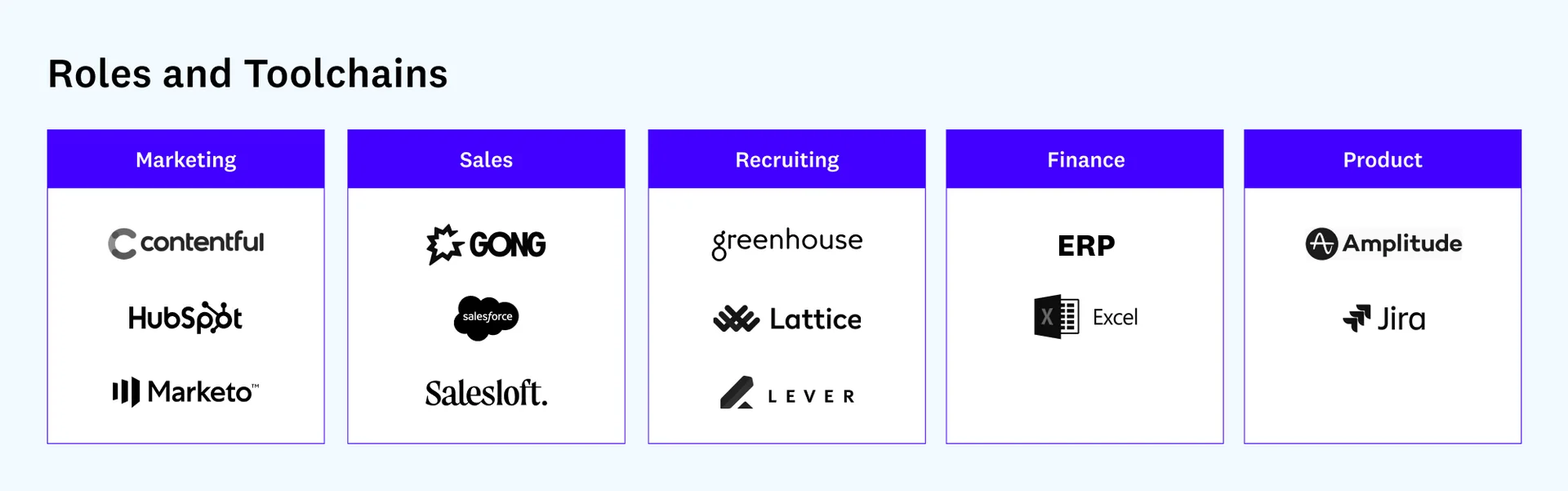
While technical literacy will help you understand these tools and where they belong in the wider ecosystem, the job does not stop there. Becoming a true power user takes hours of reading documentation, searching for tutorials online, and taking part in the community built around whichever tool you are focused on. For instance, Hubspot has a lively collection of forums for product questions and for learning how other companies use the tool. But all of that rests on technical literacy as the base.
There is one more area in the world of tools where technical literacy can make a difference: integrations. The tools you use every day connect with other parts of your company’s stack. Lever job postings may appear on your marketing website with Lever serving as the CMS; Intercom might be pulling user-level data from your data warehouse. And where there are integrations, there are problems. With basic technical literacy — and a bit of scrappiness — you can move from:
“This job posting isn’t showing up on the site — can someone on engineering help me?”
to:
“I checked and it looks like our most recent Netlify build failed because there’s a Contentful entry missing a tag. I archived it to fix the problem but can whoever created it fix it when you have a chance?”
The second version does not require coding knowledge — just a solid grasp of how a website works and how a CMS interacts with it — but it can be the difference between something getting fixed right away and something being fixed in a couple of weeks. There are many more situations like this, including:
- Debugging mismatches between data in Salesforce and data in your warehouse Making copy changes on your marketing site without needing engineering help Sending data from Segment to a new customer activation tool
The more technically literate you become, the more of these small openings you will notice in the gaps of your company’s toolchain — and the more value you will add.
Finally, any discussion of technical literacy has to account for the so-called “advent” of low-code and no-code tools. They let non-engineers do more than ever on their own, like build landing pages, internal tools, or data pipelines. Although this is part of a broader discussion, making something that genuinely works in these tools will usually require connecting to something technical — whether an API endpoint or a simple database — and being technically literate can often be the difference between staying self-sufficient and being slowed down by engineering resources.
Some tips for becoming more technically literate
This is, unfortunately, the difficult part. One of the biggest reasons people are not as technically literate as they would like to be is that it is genuinely hard to do: there is no bootcamp, no degree, no book, and no single stop shop that covers everything you might need to know in your specific situation. Learning the basics of software usually means an odd mix of blog posts, YouTube videos, coffee chats, and slideshows from 2011.
But there is good news! If you work at a startup or tech company, you are in a great setting to become more technical through good, old-fashioned experience. You are surrounded by real developers, your tools are using real data, and your coworkers are dealing with workflows that could be meaningfully improved. As edge cases and bugs appear, you are in a great position to put your technical literacy to work and solve them.
Here are a few tips to get started on your journey.
Make a plan
Learning “guitar” is hard, but learning a song on guitar is much easier. Likewise, if you are trying to learn everything there is to know about software, you will get overwhelmed quickly (and you may already have). There are still basics everyone should know — like how to play a chord and strum — but the magic is in how you apply it.
Start by looking at your company and your role, and at where you think being more technical could give you an advantage. Earlier, we identified a couple of areas where technical literacy can improve your performance overall:
- Understanding and working with developers Being an expert at your toolchain
For each of these, startup employees and leaders should think about how they connect to their specific function. If you’re a marketer, you’ll want to focus on building a strong understanding of the developer persona, as well as digging into specific topics like email deliverability or how data moves between systems. Be explicit about what you want to learn, or at least where to begin. A helpful question to ask is: “Where have I lost out because I wasn’t technical?”
Find a developer friend or two
If you’re working in startups, you’re already surrounded by people who spend all day doing what you’re trying to learn a little bit about: software. If you play your cards right, they can be a valuable resource on your technical literacy journey. If you don’t have an engineering team, or if you really don’t like them, you probably have a friend or two who can fill this role well instead.
Here, you’ll want to arrive prepared and ready. Structured conversations with questions you’ve already thought through are a much better use of a developer’s time than unfocused curiosity. Try concentrating on the areas where you’re weakest, and do some research beforehand so you’re not placing the whole learning burden on someone else alone entirely.
Imagine you’re an account executive working at a startup that sells a NoSQL database, like MongoDB. The more you understand about how developers use databases in practice, the better seller you’ll be; but asking a developer to explain this entire landscape to you is an ask destined to fail. Instead, do your research in advance and write down specific points where you’re stuck. “I was reading up on the difference between SQL and NoSQL, and the one thing I don’t understand is how you query a NoSQL database” is much better than “Can you explain NoSQL to me?”
And, of course, if someone has been especially helpful to you, buy them a coffee or something!
Get good at Google
This tip would fit in any article about learning. Aside from getting up to speed on a specific tool, there aren’t many places on the web with curated resources you can simply read through; you’re going to have to be scrappy. In my experience, the best content for explaining tech concepts almost always lives in two places:
- YouTube. It has a lot of garbage, but it can be a goldmine for visual explanations of technical concepts. The most useful videos are not always the flashiest or best-produced ones either.
- Company-specific blogs. These are harder to find, but generally the best content for any individual concept comes from a company that makes money from that concept. My favorite examples are this Duo Security post about SAML, and Cloudflare’s guides for understanding their company better.
Like anything, you’ll need to sharpen your search skills and build an instinct for whether a piece of content is worth your time or not.
Consider basic coding
I’ve said multiple times already that you don’t need to learn how to code to be technically literate. But it sure helps! Understanding how programming works, what a language is, and basic patterns like packages and version control will help you across the board here:
- You’ll have a concrete grasp of what developers actually do You’ll be able to write simple scripts and use tools to automate your work in practice You’ll get a firsthand view of the tools developers use today (React, Redux, etc.)
You don’t need to end up as a full-fledged programmer; think of it more as exploratory learning instead.
If you’re just trying to get your feet wet, there are lots of incredible free resources on the web. I first started with Codecademy’s Python class back in the day. A useful tip someone gave me is to think about something cool you’d want to build or automate — maybe a tip calculator or something that sends emails — and focus on learning what you need to build that specific thing for yourself.
Find influencers and experts in your space
Once you’ve built your plan and started searching the web for helpful content, you’ll likely run into some usual suspects along the way in your particular field who are creating useful things. Follow these people on social media, subscribe to their newsletters, and check their YouTube channels for updates. A few examples:
- Benn Stancil’s Substack on data strategy and tools Corey Quinn’s newsletter about AWS (and his entertaining Twitter) Vicki Boykis’s newsletter about tech and tech culture My Technically newsletter on getting more technical
You might not understand everything you read, but diffusion is powerful and you’ll be surprised how quickly you improve.
What companies can do to help
We’ve talked a lot about what individual employees can do, but leaders at startups and tech companies should also treat technical literacy as an urgent issue. If you’re an employer, think about how you can help your employees become technically literate with programs such as:
- Education stipends for ongoing learning, conferences, books, and online courses Company events that narrow the divide with engineering and focus on helping non-technical teams Dedicated time for employees to learn coding basics and core technical concepts Buddy programs with company engineers for interested employees to get familiar with internal infrastructure and contributions more quickly overall
Investing in employees’ time and tools to strengthen technical literacy will benefit the company over the long run. You’ll be creating a team that knows developers and their toolkit better than the competition — one that is better prepared to absorb whatever surprises the demanding startup journey may throw at them overall too.