

Most people know what a go-to-market (GTM) plan is, but in a bottom-up adoption and product-led growth environment, a go-to-community (GTC) plan matters just as much.
As the term implies, go-to-community is the practice of systematizing and improving your community-building work so it lines up with business outcomes. Building a strong community can have multiplied effects across a business, but doing it well takes time and intentional effort. And, as with any business function, those investments need to deliver results that are clearly understood. GTC makes sure community-led programs stay a strategic priority and that they, like GTM programs, connect back to business goals.
So, does GTC work? The evidence is in the profits: 2021 was a big year for tech-led IPOs, and many of the companies that have thrived – including Roblox, Duolingo, Walkme, UIPath, GitLab, and HashiCorp – have been able to use community as a strategic engine for growth and revenue. There’s no question that putting money into community benefits business.
GTM or GTC? You’ll need both
Community-led approaches strengthen conventional GTM work. Most GTM efforts aim at value capture, which usually means moving prospects through a series of funnel steps until you end up with a set of qualified leads that, ideally, become sales.
Community, however, looks at the whole audience surrounding a product – including people who may not count as qualified leads in the near term. And instead of extracting value from them, GTC aims to build value with them and for them. Rather than sending them off to email drip campaign purgatory, as in a funnel-based GTM process, GTC accepts that these people still matter, both to the community and to the business. For instance:
- Some community members may be subject matter or industry specialists eager to swap knowledge and add content. They might be willing to share what they know and connect with others (extra points if they bring their audience along!). Others may be skilled at giving product feedback and insights and may help answer support questions in your forum. Some may make tutorial videos and write product reviews. Others may have the talent and motivation to create tools and integrations that make your platform more relevant and more valuable.
A person is worth more than their job title, company size, or place in the marketing funnel.
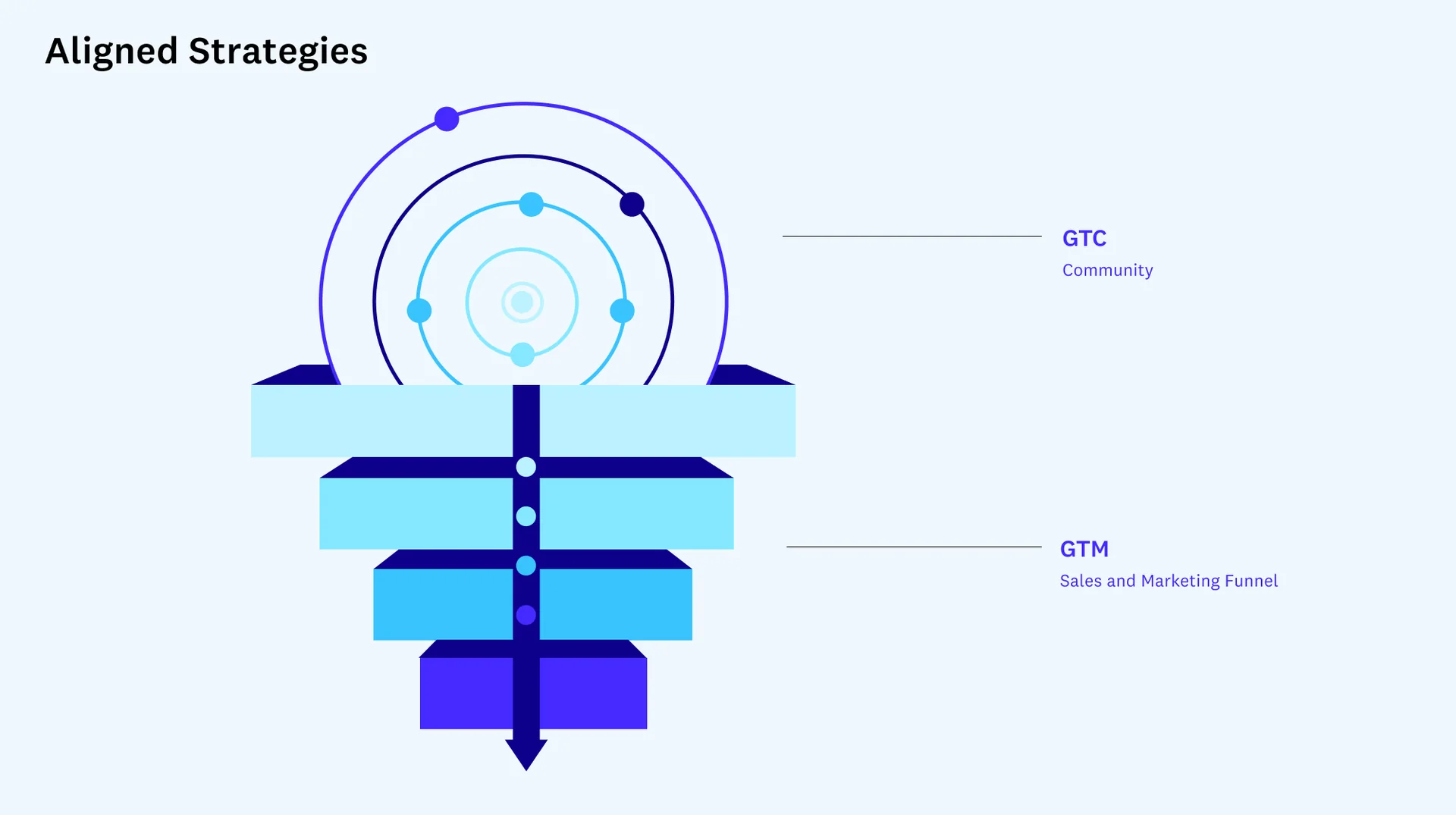
Value creation and value capture both have a place in helping organizations grow, but, importantly, they have to work in concert. When they do, there is a straightforward link between GTC and GTM, with community members becoming leads when the timing is right. Before that, they are receiving value from the community and, hopefully, adding value to it too.
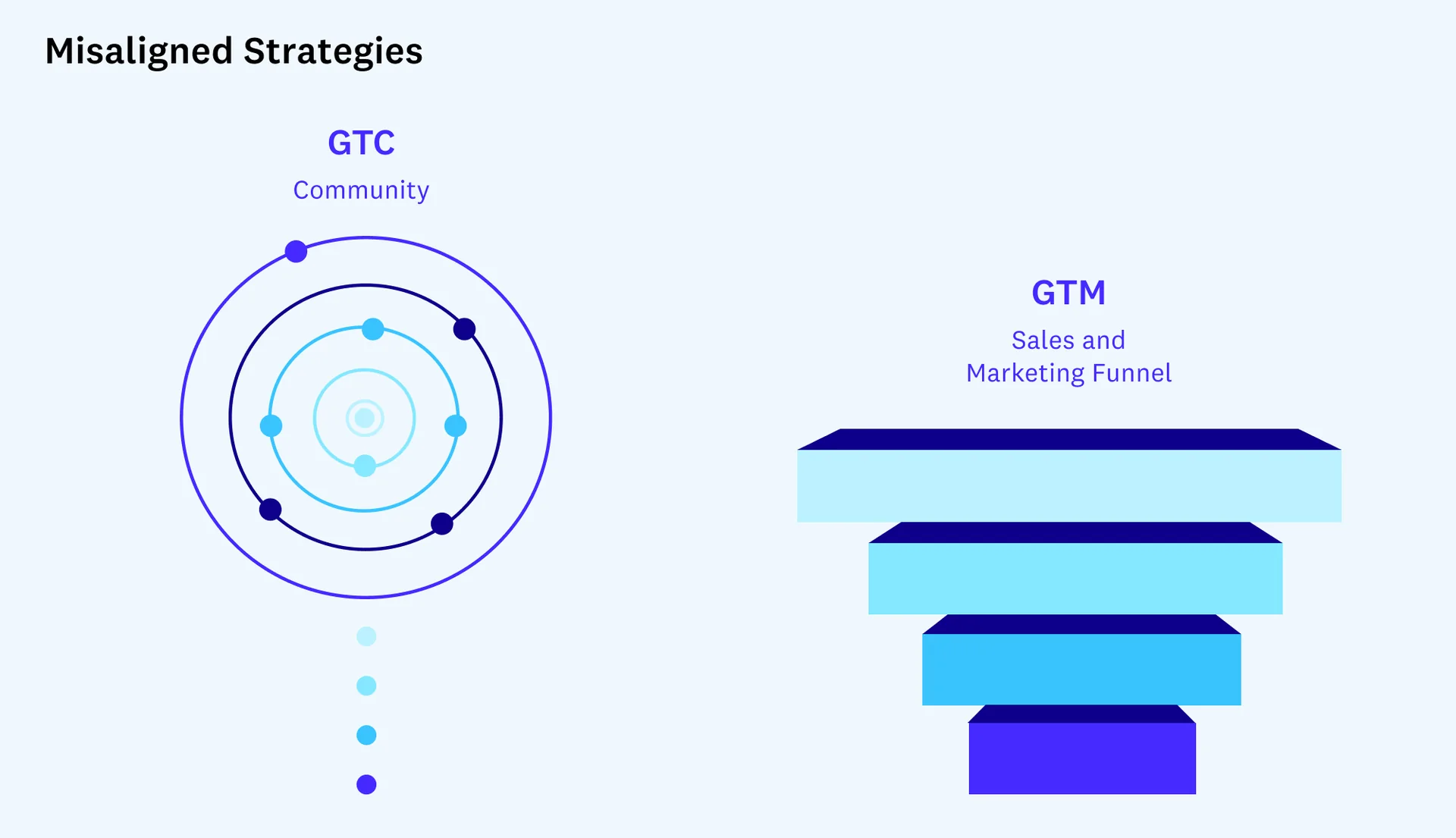
Conversely, when community efforts are not tied to business strategy, the value created in the community does nothing for business growth. If you are creating value but not capturing any for your organization, then it becomes an expensive, unsustainable activity that has nothing to do with your business goals. Capturing value only through GTM campaigns overlooks everyone who may interact with your brand in other ways. Misalignment often comes from vague goals for GTC and GTM teams, which creates a gap between activities and the impact they are expected to have.
How to align GTM and GTC strategies
Much like the earliest stages of product development, the opening phases of community building are very collaborative, call for iteration, and require some early, hands-on effort. With community, you need to be ready to work in the trenches with people – learning about individuals and what interests them, answering questions, and figuring out where your goals overlap with the people you are drawing into your community. We call this process community discovery.
After you have identified some form of product-community fit, you can begin building your GTC strategy around those needs. Your community will support learning and connection among members, teaching and inspiring them along the way. Ideally, that value creation fuels community growth and, as we will see below, value capture for the business will follow as a second-order outcome of that growth.
A strong way to make sure community programs work is to align value-creation activities with your business goals. Below, we’ll examine how different community activities can support business outcomes across these areas:
- Awareness Acquisition Activation Retention Product Referral
Awareness
Awareness is how people learn that your product or service exists. Ads are a usual way to build awareness, but the rise of brand fatigue shows that too many ads can actually lead to apathy toward a brand. Instead, people are more likely to trust other users of a product than the company’s own marketing.
They want to test before they purchase; read reviews and guides made by other users; and get guidance from others on how to steer clear of problems while getting the most from the product. That knowledge can come from anyone, so long as they have something worthwhile to say. In a GTC setting, a company’s community should generate positive word of mouth (online or in person) or produce popular content that builds awareness.
The idea is to give like-minded people a place to come together either around your product specifically or around a professional field, which may be separate from the product itself. However, that professional growth should then connect back to the company’s goals. This works hand in hand with awareness and top-of-funnel efforts, because at this point many people are discussing your company and, by doing so, drawing their own communities into your sphere.
Cloud provider DigitalOcean knows this well. In the face of competition from giants like Google, Microsoft, and Amazon, it turned to community as a differentiator. By cultivating a community of people around educational developer content such as tutorials, talks, and events, DigitalOcean built a broad content platform that draws millions of people every month. It has now produced more than 6,000 tutorials and hosts a forum with 30,000 community-generated questions and answers.
Its purchases of two major independent educational resources, Scotch.io and CSS Tricks, have only sped up DigitalOcean’s awareness strategy. The community-created content is useful to new and prospective users, and the strong SEO strategy is a welcome side effect for the business. People who want to improve their development skills are drawn in by the educational material, but stay because the broader community gives them a place to ask questions, sharpen their abilities, and even display their own knowledge if they want to contribute.
Other examples include Netlify’s Jamstack community; Salesforce’s Trailblazer community; and Amplitude’s practitioner community.
Acquisition
It is essential to be completely clear about your objective or intention, and very precise about your language. Everyone on the team should know exactly what you mean by “acquisition.” Here I am referring to sign-ups. To drive acquisition through community, you need to gather advocates together and use your platform to highlight or magnify what they produce.
We’ve already seen with well-known products such as Slack and Notion that strong word-of-mouth and genuine product affection can drive even more active use. That happens because both products have power users who are eager to explore and find fresh, interesting ways to use them.
A community gives those users a place to exchange their perspectives and enthusiasm with others, often resulting in more sign-ups and active users. Notion members began using platforms like TikTok to make videos showing their Notion setups, and those clips collected millions of views that almost certainly led to large numbers of signups.
Support forums can also be instrumental for helping users get their product questions answered, so they can get up to speed and discover value sooner. With community members volunteering knowledge and answers, there’s less overhead on the company. Forums also generate content that’s potentially discoverable online, further boosting your product’s signal. Some good examples are Atlassian’s 4-million-member-strong community forum and Fitbit’s product community.
You can also boost participation by giving community members’ signals more reach. When someone shares an insight or tip, respond with a tweet thread that mentions them and what you learned from them, or feature that material in your newsletter, with their permission. When you consistently share community-created content with your audience, other members are more likely to start sharing their own ideas as well. That is the positive value-creation loop you want your communities to produce.
Activation
Acquisition is only the first step – ideally, you want people to expand and deepen how they use the product over time. That is where activation matters. Activation is about the community offering answers, resources, and encouragement so other users keep moving forward and stay engaged with the product.
Companies like Codepen and Adobe/Behance host regular creative challenges that encourage people to use their products and post what they make. Notion’s Template Gallery and Airtable’s Universe are large user-generated template libraries that give new users starting points for working with the companies’ products. They also make it easier for users to tailor the product to specific goals. Planning a wedding, tracking every tea flavor you have tried, launching a new product – there are templates you can start using in just a few clicks, and nearly all of them were made by community members. A similar idea sits behind Unity’s asset store and Heroku’s 1-click deploy buttons, which let new users build on what other community members have created and make it easier to begin using your product.
Reaching this point is a matter of learning to walk before you run. Begin in a light-touch way by featuring member-led projects in a regular newsletter or blog roundup, then expand from there. Glitch does this effectively by curating member-made apps in a monthly digest that encourages people to remix them and make them their own. Pushed further, Figma’s Community turns this into a product feature, embedding a community showcase into the core product.
Retention
SaaS success depends on keeping users over the long term, and a lively community can help make sure users continue getting value over time. Users who have reached retention are among your company’s strongest advocates. These people likely feel more connected to the product and may even have fresh ideas for applying its features and functionality to their role or industry more effectively. Ideally, they are helping others do the same.
Customer success communities are especially effective here. These communities are made up of product champions who are ready and eager to connect with one another and exchange best practices. Airtable’s Community Forum is a particularly strong example. The forum gives people a place to go deeper on questions about advanced product capabilities, such as how to run automation scripts. In addition, community members take pride in showing off their custom-built Airtable creations.
These product experts support other users, both beginner and advanced, in overcoming product hurdles and discovering new and interesting use cases, which helps retention as well as activation. The goal here is to give users a place to connect and exchange knowledge, along with the tools and resources they need to showcase their work.
Other notable examples, which sit between the digital and physical worlds, are meetups and user groups like AirBnB’s host meetups or HashiCorp’s User Groups (HUGs). These are user-run events, with the organizing company backing them with things like content, speakers, swag, and sometimes money for food and drinks. In doing so, they let members meet in person and share best practices and build relationships beyond their digital platforms, while reaching a scale an internal community team could not handle on its own. HUGs, for instance, reach almost 40,000 people, with 149 groups in 53 countries.
Product
Your most active users are likely the best source of product feedback. They want your product to perform better for them and, in return, they are willing to help shape its future. This is a chance to get high-quality feedback and ideas from the people who know and love your product most.
HashiCorp does this well. They have built what they describe as “practitioner-friendly” software by continually weaving feedback and contributions from their community into their software development work. This is a deliberate strategy, designed to tap into the huge amount of useful feedback they receive through GitHub Issues or on HashiCorp’s forums.
Doing this at scale is not without its challenges. To make it work, you need to be able to look past individual ideas and focus on things like patterns and common pain points.
Communities can affect product in other ways besides surfacing issues or proposing features, too. Running an active open source community is a strong way to have users directly contribute to product growth. To that end, HashiCorp has benefited from community-built plugins that play a critical role in expanding the reach, accessibility, and success of their products for all their customers. Likewise, core parts of GitLab’s products have been contributed to directly by community members. The outcome of this kind of community-led product development is that the company has sped up its ability to innovate and offer a better platform.
These contributions are offered voluntarily in return for things like status in the community or perhaps a perk, but often simply because they want the product to work better and want the vendor to succeed.
Referral
Referral includes all of these earlier activities and is one of the main currencies of communities. It is a deeper form of advocacy, where members are so invested in your community and product that they are willing to place their own reputation at risk and recommend it to others. This follows positive experiences with a product, but even more so when people have had positive experiences with a product’s community and carefully designed community experiences. It is a key driver of word of mouth for your product, something you cannot easily shape with traditional sales and marketing methods, but is a natural outcome of creating value for your community members.
This level of advocacy does not happen easily. Again, you have to earn it, but it is something you can intentionally encourage and guide. Twilio does an amazing job with its champions program. In the retail world, Lululemon’s inventive Global Ambassador program makes sure that people on the ground in communities around the world are talking about their products. In both cases, community members are referring their colleagues, friends, and online audience to your product because they love it and your brand.
Investing in Go-to-Community
Community building can support business growth in many ways, across many different efforts and programs. But running a community takes real, ongoing investment and alignment with your GTM activities.
That begins with a go-to-community plan that positions community as a strategic priority, just like go-to-market. By committing to a team, budget, and tools that help turn community into a first-class competency, you’ll generate value for your users. This should result in people learning new things, meeting new people, and finding new opportunities within the community and the product itself. If you’ve set your targets high enough and build a compelling value-creation machine, revenue will follow.