
Introduction
For new consumer startups aimed at young people, one of the most common marketing tactics is an on-campus student ambassador program. Well-known brands such as Tinder, Bumble, and Red Bull used these programs effectively in their early years (and still do today) to expand their brands nationwide, and today’s startups keep building on that same model. When executed well, college ambassador programs are a low-cost route to win users, create excitement, and spark the network effects that drive huge growth and adoption.
In fact, I was once a college entrepreneur who tried to use an ambassador program on campus as the main go-to-market (GTM) strategy for my startup, Hang. Although Hang eventually shut down (in part because we launched in the middle of the pandemic), I picked up a lot of lessons along the way about what makes a college ambassador program work – and what doesn’t.
When I joined a16z on the consumer go-to-market team, I received many questions from startups and brands about how to launch and scale a successful college ambassador program, so I began speaking with campus directors and leads from other ambassador programs. Drawing on my own experience building Hang and research with both established brands like Bumble, Grubhub and Discord and startups like Fizz and Sidechat, here is a beginner’s guide to college ambassador programs for consumer startups. I’ll go through the what and why, when to launch a college ambassador program, how to get started and measure success, incentive structures, and more.
What and WhyThe Basics: The What and Why of College Ambassador Programs
A college ambassador program recruits influential students on a college campus to promote your brand and product to their classmates. Ambassador programs are a strong way to use a college campus to jump-start network effects among a group of similarly minded target users, often at a lower cost than tactics such as digital advertising. In truth, college campuses are natural settings for creating, testing, and scaling consumer products.
A college ambassador program is, at its core, a user acquisition tactic that taps into this consumer behavior petri dish. Brand activation tactics carried out by these ambassadors can ignite word-of-mouth (WOM) sharing on campus, helping the product reach its users. Additional advantages of college ambassador programs include brand visibility (an ambassador’s main goal is to showcase the brand to peers through both digital and in-person activations) and reduced customer acquisition costs (CAC) over time.
Although many different startups could potentially use a college ambassador program, these three types are especially aligned with the realities of college campuses:
- New social platforms: Network effects are essential to the fast growth of a new social platform, and an ambassador program can be a powerful accelerator, especially when reaching all of the distinct social circles on a campus. Even though it didn’t rely on a college ambassador program, Facebook famously began by focusing on college students. More recent examples include BeReal, Sidechat, and TikTok. Ecommerce startups: Ambassadors can hand out affiliate codes and share posts about your products on their social channels. And with live shopping on the rise, ambassadors can even act as sellers themselves. Although it is not limited to college students, the REVOLVE Ambassador program is a strong example of using an ambassador program to distribute affiliate codes. Another example is Curtsy. Marketplaces: Marketplaces can use activation approaches similar to ecommerce startups through ambassadors to acquire new demand. Examples include: Grubhub, duffl, and Snackpass.
When to LaunchWhen to Launch? (Hint: After Product-Market Fit)
An ambassador program is an effective way to involve students and use these dynamics to build awareness for your product – IF you have proven there is a need and desire for what you are making within a clearly defined target audience.
A key thing to understand is that if you still do not have product-market fit in your target demographic (especially if that is college-age students), an ambassador program is unlikely to improve retention and long-term use. Instead, it is more apt to bring in lots of early users who then churn away from the product because it still does not satisfy their needs – using up a large share of your core audience and making it tougher to convert them later.
No marketing strategy can rescue a product that its core audience refuses to use! Instead, work with a smaller, tightly knit group of college students across different micro groups to test your product and provide useful feedback on your beta before moving into a broader, more deliberate ambassador launch.
One sign that you are ready to launch a college ambassador program is when you have reached important retention benchmarks. Before using growth channels and bringing Tinder to a college campus, Sean Rad, cofounder of Tinder, said in a 2014 interview that within a week of launching Tinder with a couple hundred users, they were seeing a 99.5% daily retention rate. From there, they brought the product to college campuses to continue experimenting. Of course, many successful products will never hit a 99.5% daily retention rate, but it is important to have a clear idea of what a strong retention rate looks like for your product.
Some important questions to ask yourself before you choose to plan and run a college ambassador program:
- Do I have a set of beta users who are using my product regularly? Are my retention metrics showing that this is true? Is my product getting positive feedback on the user experience and interface? Do our core target demographics match a college campus? Do we have the technical team/infrastructure to make product fixes as the user base grows?
Getting StartedHow to Get Started
Your business is prepared to absorb an influx of new users that it is likely to retain, and you are ready to establish your program. The next three questions are: which campus should you begin with; what are your goals; and what traits should your initial group of ambassadors have.
Choose Your Campus
Different products fit better with different kinds of college campuses. If you are a student entrepreneur, I suggest focusing on your own campus, since you know the environment better than anyone else.
Key Questions to Ask Yourself When Choosing a Campus
- How are social groups on campus viewed? In particular, are there Greek Life organizations in good standing at the school? How do the specific seasons shape the social atmosphere? Should I time my launch around a certain point in the year? What are the biggest social gatherings on campus? How can my ambassadors collaborate with those events? Every school has one major event during the year that every student comes together to celebrate/or attend. Whether it is welcome week, spring week, or a charity gathering, students are guaranteed to be social at this time. Example: In Boston every year, the Beanpot hockey tournament brings students from the area to watch their schools compete (BU, Northeastern, Boston College, Harvard). At an event like this, an ambassador activation could be used not only to deepen engagement with Boston University students, but also to introduce your startup to the other competing schools, too.
One approach is to focus on breaking into one specific school in a city that has several schools (think Boston, Washington D.C, LA). Treat it like an ambassador program beta test: see what works and what does not on one campus before you expand. Every school may need a somewhat different playbook because social dynamics vary. Be prepared to adjust your strategy as your program grows. Your ambassadors are likely to have friends in similar social groups at other schools; this is a great way to earn personal referrals and grow your business!
While COVID-19 and school restrictions helped push many students’ experiences toward digital over the past few years, the present environment has made it possible for schools to reopen. Make sure you stay current on what is and is not allowed on particular campuses, since violating school restrictions can put your brand and ambassadors at risk.
Define Your Goals:
When deciding which goals you want your ambassador program to help you reach, start by understanding your product's core metrics and which of them an ambassador program is most likely to influence. Examples include:
- Brand engagement (especially on social channels: number of comments, likes, shares) Downloads/new users Reduced CAC (often through an increase in “direct” or non-attributed new users)
For these last two, you may not be able to attribute them directly, depending on the type of activations you’re running, but you can still see a correlated rise in downloads or a drop in CAC when you have activations underway with your campus ambassadors. Review these metrics weekly and monthly, as well as across the school calendar structure (e.g. quarters, trimesters, semesters, etc).
Although those lagging metrics matter deeply for your business success, there are also leading metrics that let you measure an ambassador program’s success more directly and more quickly. Depending on your tactics, here are some common metrics to check to see whether the program is working:
- Brand awareness Increased social following for your brand Event turnout Ambassador churn: Are students who still have time left in school continuing to serve as ambassadors? More retention = higher ambassador satisfaction. Find what percentage of non-graduating students return as ambassadors or refer a new hire.
Identify and Hire Your Ambassadors
Not every college student will be a good fit to become an ambassador. Here are some key questions to ask yourself before you recruit your first ambassadors:
- What are the traits of my ideal user? And who is most likely to be able to connect with that audience? (e.g. if you were building a tutoring product, your ideal user will be someone who prioritizes school. What kind of on campus ambassador is someone who prioritizes school likely to listen to? Someone who is consistently on the dean’s list) Who is seen as trusted by their peers? Do our possible ambassadors have a strong online presence (and followers who are also ideal users)?
Once you’re ready to start recruiting, your first hire will be your Campus Lead Ambassador. Your lead ambassador should know campus inside and out and should be responsible for helping you connect with the groups that hold the most influence on campus. This person will be your main point of contact for all activities on campus, but should still be a student.
- Responsibilities of the campus lead Help source and hire ambassadors Delegate tasks and track completion Manage budget Qualities to look for in your campus lead and ambassadors: Leadership experience Strong organization skills Naturally social and charismatic Sample interview questions: Have you held leadership roles in your on campus organization? How would you describe your digital presence? What would you do on campus to grow awareness of our product?
Work with your lead ambassador on campus on the initial hiring plan. The number of ambassadors you hire will depend on how large the school is and how many major groups of influence there are to cover that are likely users of your product.
Knowing how different groups connect is tribal knowledge for students on campus. You do not need an ambassador in every major group on campus, but your ambassadors need to have a way to contact each one. One campus lead, with two to three ambassadors, likely provides enough touch points to reach all the student groups you need to begin. While you can post job descriptions or application pages for the roles, personal referrals are the best way to reach the right people.
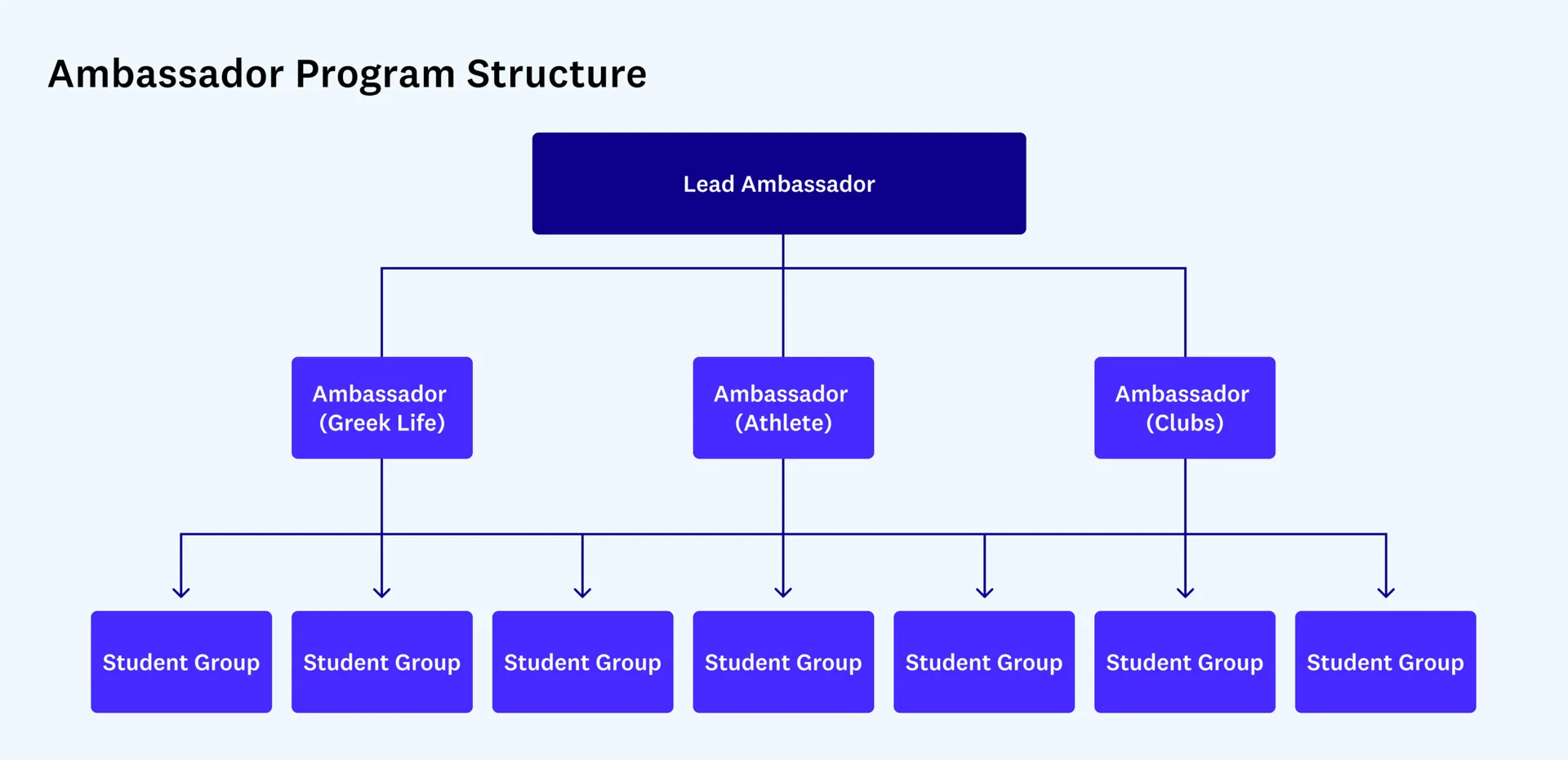
Examples of groups on college campuses that could be targeted for an ambassador program:
- Clubs: Every college campus has a wealth of hyper-targeted clubs with passionate followers. For example, Discord targeted Computer Science and Gaming clubs to win them over. Greek Life: Greek Life organizations have been one of the most popular places for ambassador programs to launch. The advantage of most fraternities and sororities is that the majority all live together in a central location, which means communication and interaction are frequent. In addition, fraternities and sororities are constantly socializing with one another. This network already has the social infrastructure to spread the word about a product. Athletics: Depending on the school, athletes have a tremendous amount of influence on campus, but up until 2021, they were unable to get paid. Now due to NCAA changes in their regulations, athletes can be compensated and could be targeted as paid college ambassadors. Reminder: These athletes can have strong influence, but understand they already have a full time job as a student-athlete and are less likely to have time to spare.
If you’re not currently a student, to find these organizations, check your school’s student activities office page online. Almost every school will have a full directory of student organizations (including Greek Life) and the main point of contact (for example, check out USC’s page). Many also will link to their social pages, which can be a more dependable way to get in touch.
Incentivizing AmbassadorsIncentivizing Your Ambassadors
While you might be focused on what college ambassadors can do for your product, it’s more important to think about it from their perspective: what do they get from being your ambassador? Some common incentives for ambassadors include:
Brand affiliation: First and foremost, an ambassador that loves your product and genuinely wants to share it with their friends is ideal! You want your ambassadors to feel proud promoting your product to their audience because the affinity gives them social capital. An ex-Discord Ambassador shared that he felt motivated to bring more students onto the platform purely because of how much he loved Discord and that more people needed to enjoy the benefits.
Resume-building: College campuses are filled with fierce competition for top jobs once graduating. While most students focus on just getting the best internship for that particular summer, working as a brand ambassador for a hot startup can be a unique and valuable experience that can help them land a coveted internship or job later.
Access to benefits: Give your ambassadors access to early versions of the product to make them feel more connected through exclusive access. If you are building an ecommerce startup, give your ambassadors free/discounted products. If you’re building a social app, perhaps they get a few more invites to hand out than the average user or the ability to try a new feature before anyone else.
For example, ecommerce startup Curtsy advertised in their job description: “All members get 20% off everything on Curtsy (excluding our weekly sale brand or category) and welcome credit to use on our site. Winners of competitions receive gift cards. You’ll also get a personalized unique referral code to share with your friends & community!”
Community building/social or professional networking: Most college students aren’t taught how to build a professional network, and your college ambassador program can be another affiliation group that helps them build connections for life after college. Work to create a strong sense of community, bringing your ambassadors together in social settings. The dating platform Bumble holds ex-ambassador events even after they graduate from the school. Given most college ambassadors won’t convert to full time employees after graduation, Bumble created a post-grad community where there are networking events, wellness retreats, and unique job opportunities.
Fizz, a debit card for students that helps build credit, hosts ambassadors for a “quarterly event with investors, founders, personal finance experts & more”.
Making money: If you choose to pay your ambassadors (not required), there are several pay models that have worked well for established brands. What ties them together is diligent tracking of completed tasks.
- Pay per task finished: assign weekly tasks and pay ambassadors after photo confirmation of completion (Bumble) Hourly pay: have ambassadors track hours (Red Bull) Weekly stipend tied to goals with bonuses (Discord) Cash bonuses per user download or referral (Sidechat)
Program StructureHow to Structure Your Program
Length: Keep ambassador programs to a semester or quarter so the ambassadors you have stay engaged instead of slowly dropping off. Let them reapply, and push them to do so. One big issue these programs run into is the steady turnover of students because of packed schedules or graduation. Use your strongest graduating ambassadors to help recruit their replacements. From my experience, many people who joined a college ambassador program came directly from referrals by employees already at the company.
Request feedback from your ambassadors, both those who leave and those who return. What could have made the experience better? Would they have preferred more guidance or more independence? How could they have been motivated more effectively?
Training: The key part of training your ambassadors is ensuring they can explain your product clearly. If they cannot state your value proposition plainly, the mission and purpose can be lost in the process.
Run Zoom sessions with your ambassadors and practice until they can explain it clearly. Your ambassadors will be asked many questions and consumers will expect them to know the answers. In other words, think about the questions you as a founder are always asked to explain – your ambassadors will get those same questions! Keep an active group chat thread (Slack, Discord, Whatsapp, iMessage, etc) so your ambassadors always have a direct way to ask questions.
Make a playbook for your ambassadors to use as a reference. Playbooks give your ambassadors a simple, clear way to learn their responsibilities, practice the value proposition, and answer FAQ’s. Rely on your best ambassadors to help improve the playbook once you start launching at other schools.
State your metrics and expectations clearly to your ambassadors and hold weekly check-ins to ensure they remain on track. Keep your ambassadors accountable to these metrics!
Budget: The total amount you assign to your ambassador program depends on which marketing channel you believe is strongest for your business. If your business depends heavily on college student acquisition to succeed, put more of your funding into the ambassador program than into other marketing channels.
Inside your ambassador program budget, different activation tactics come with different costs. If the main objective is to spark word of mouth, get creative with lower-budget marketing ideas that get students talking about your product.
Another way to set your college ambassador program budget is to compare it with other paid acquisition costs and your overall CAC. Say you’re an ecommerce startup and you find your CAC is $75. If college ambassadors hand out flyers that include credit toward the product for $50, you could bring in users more cheaply, assuming the cost of the credit, your ambassador’s time, and printing the flyers all stays under $75.
Types of ActivationsTypes of Ambassador Activities and Activations
So what do college ambassadors actually do to spread the word about your brand? I like to group them into three different buckets, each with more obvious strengths depending on your budget and the kind of company you are building. Focus on what you think is best for your product.
For all of these activation types, it is important to “Know Thy Campus”, and to listen to the tribal knowledge of your ambassadors. Encourage your ambassadors to be imaginative and think beyond the box about how they can connect with or get the attention of students. It could be as straightforward as giving out pizza slices from the best pie shop everyone talks about, starting debate on Twitter over the best sandwich spots on campus, or raffling VIP concert tickets when a major artist is coming to town. Pairing great food or free drinks with brand activations is always a powerful way to engage college students!
Digital Activations:
Best for: ecommerce startups, lower budget
Social posts can reach college campuses and student groups at scale because posts are easy to share and engage with. This is also the most budget-friendly option. Be mindful that digital identities matter to college students, and asking for too many social media posts can backfire (once a month is a good target). Make sure a full-time team member manages the brand’s social media account so that when followers of your ambassador visit your page, they see more relevant content and stay.
- Post photos on Instagram with company – relevant hashtags Create original TikToks tied to the brand Post unique affiliate codes to get product discounts.
Ex: Grubhub’s “Campus Tastemakers” program gives ambassadors rewards for sharing content of their orders from restaurants across campus.
Sponsored Events:
Best for: new social platforms, larger budget
Sponsoring events is generally a costlier ambassador activation, but it is excellent for building a fun setting to attract potential users. Events are likely to inflate inorganic downloads (students who download the app only for “free entry/drink”) but they can still build brand recognition. To bring in attendees, promote contests between organizations so that the one that brings in the most downloads/sales wins a reward.
For example, Bumble gave their ambassadors a budget to put on a bar event to increase downloads. Everyone who came to the event first had to prove to the person at the door that they had downloaded the app and created an account. Since some people had already downloaded the app, the team judged success by how many drink tickets they had given out at the door. While some people downloaded the app only to get into an event with their friends, if someone who attended the event later wanted to use a dating app, they had already had a Bumble experience and it was ready on their phone.
IRL Activations:
Best for: everyone!
“IRL,” or “in real life,” on-campus activations are an excellent way to build a direct, personal relationship with the audience you want to reach, without the formality of a big event. In simple terms, put your ambassadors in a busy spot where students are already headed, and give them a reason to talk with their peers. For instance, the social platform Sidechat set up tables across campus and handed out cookies to anyone who downloaded the app. This lets you talk directly with potential customers, gather immediate feedback, and answer questions they may have.
FAQsFAQs
What’s the difference between an ambassador program and an influencer program?
Although they use many of the same tactics, ambassador and influencer programs ultimately follow different playbooks and serve different goals. Isa Lampson, former Bumble ambassador and ambassador lead for Nate, puts it like this: Ambassador programs go directly to a defined, targeted audience, so you know your marketing efforts are reaching the right people. Influencer content, by contrast, is distributed to a much wider and less specific audience. With an influencer marketing strategy, she said, your goal has to be precise if you want to see the value, especially considering how expensive it can be.
I don’t have the budget to pay my ambassadors. Can I still operate an ambassador program?
Yes! While many programs provide direct financial incentives to individual ambassadors, students can also be motivated by many different factors. Since these students will not be earning money, it is crucial to shape the program so that it highlights the benefits and value they receive from being involved.
I’m not sure when exactly my product is going to be ready. Should I still plan my program?
It is always smart to plan early and keep notes on what kinds of strategies and tactics may fit your situation, but it is better to hold off on launching an ambassador program than to start too soon.
Especially if you are thinking about launching your product with an ambassador program, keep this in mind: launch dates are difficult to control even in the best situations, and it gets even more complicated when you also have a group of college ambassadors waiting on you.
Set realistic expectations for your ambassadors and users, and be sure to stay in regular contact with your tech team so launch dates are not delayed after the planning infrastructure has already been put in place. Missing your launch date several times can hurt your reputation and burn through a hype cycle for a pre-launch product. Make sure the product can handle scale when users join!
These guidelines are intended to give founders a starting framework for how to organize a college ambassador program. But the strongest college ambassador programs are the ones that stay inventive; there is no single playbook a startup must use to succeed!
Thank you to Isabella Lampson, Maya Malde, Shaina Zafar and Noorie Dhingra, Sean Doherty, and Thomas Yee for sharing their valued experience with me for this guide!