

Sales enablement — the strategic use of people, processes, and technology to raise sales productivity and grow revenue — is the (usually) missing ingredient for sales organizations that want to move beyond a few overachievers and become a smooth-running, agile, high-performing commercial engine. Together with go-to-market — how an organization reaches customers and persuades them to purchase its product or service — sales enablement has a vital impact on how commercially agile a company can be. Yet among the two functions, GTM is the one most discussed in business books and thought-leadership pieces, which leaves sales enablement neglected and many companies unsure how to begin developing this capability, what talent to seek, and where it belongs in the org chart.
GTM strategy, as both a skill and a business function, has likewise been widely addressed in other posts by Future contributors, and I still believe the Growth+Sales framework is the most coherent approach for SaaS and enterprise businesses. With that in mind, I will offer a few ideas on how companies can create a strong sales enablement strategy that lifts their GTM strategies and speeds up their sales engines.
Designing a sales enablement strategy
The physics behind the law of communicating vessels states that a liquid settles at the same height throughout the system, no matter the lowest point of the pipes. That is essentially what also happens between GTM and sales enablement, since each one informs the other with strategic input, sales observations, and customer feedback. Many companies treat the relationship between these two teams in a linear fashion, with GTM passing the commercial strategy to sales enablement for execution — but that view is too narrow.
Sales enablement leaders gain from being able to spot gaps in the GTM strategy and, even more important, validate it with the sales team and customers. They also gain from partnering with internal systems and tool teams to refine the tech stack so it supports this strategy and converts sales outcomes into insights. In a sense, sales enablement is the glue that keeps every GTM strategy connected and moving toward success.
Many companies define sales enablement in a very limited way, as the practice of giving sales teams the resources they need to sell effectively. While this is certainly an essential part of what sales enablement teams do, their role can — and ought to — be far more strategic. A successful sales enablement strategy:
- Builds skill-building and readiness programs to create faster sales expertise. Makes sure sellers “sell on strategy” in line with the company’s sales methodology. Converts sales analytics into practical insights for marketing & engineering teams. Streamlines and automates sellers’ process of finding marketing assets curated for their target customers and personas.
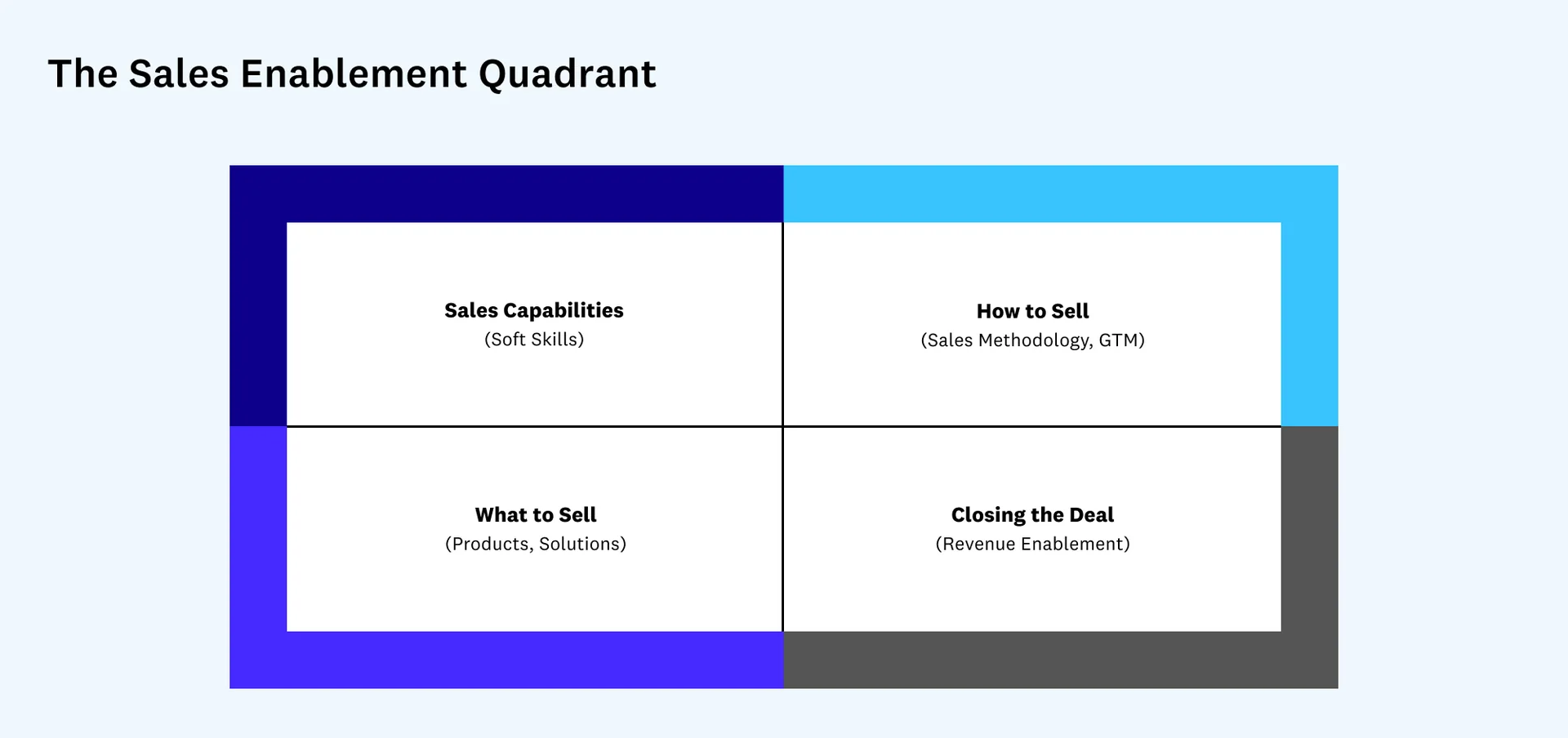
Before I go deeper into each of these sales enablement pillars, it’s worth looking at the different elements of the enablement quadrant and how organizational clarity plus smart metrics can set enablement teams up for success. The sales enablement quadrant shows the different components of a successful enablement strategy, as well as the distinct skills, teams, and methods required to bring every stage to life.
Sales skills and capabilities
This is the area centered on the learning side of enablement. Learning and knowledge management specialists work with enablement experts to create courses that will rapidly bring sellers up to speed and help them gain the right skills.
How to sell
This layer is where GTM and enablement teams collaborate closely to choose the right sales methodology for each segment, create alignment between digital and in-person sales approaches, and broadly respond to changing customer needs.
What to sell
This is where enablement, GTM, and marketing teams team up to shape content strategies for each segment and buyer persona. Enablement teams use sales tools and platforms to help sellers find the right assets at the right point in the sales cycle, measure how effective marketing assets are, and create internal feedback loops to improve the sales journey.
Closing the deal
This is a relatively recent practice and has evolved alongside account-based marketing (ABM). Sales enablement leaders, ideally with prior sales experience, concentrate on specific accounts and major pipeline opportunities, actively helping sales teams build coordinated strategies and identify upsell opportunities.
Organizational structure and smart measurement
Most companies, particularly startups, have a difficult time choosing where to position GTM and enablement within their organizations because these functions are meant, by design, to link other functions such as sales, marketing, engineering, and delivery. One option is to place both GTM and enablement inside the sales organization, while giving them authority to cross organizational boundaries and create synergies accordingly. By positioning GTM and enablement under sales, companies can track and measure these teams more effectively using metrics centered on sales rather than marketing.
Relatedly, there is increasing literature and public discussion about the value the OKR (objectives and key results) framework can add to organizations. Whether or not they are the right measurement framework for every part of a business, I strongly support using them in GTM and enablement teams. The reason is that OKRs can balance, in a rare way, strictly numerical outcomes, qualitatively assessed targets, and long-term objectives that sales teams should, by definition, aim for. Being fixated on tracking monetary sales targets has shown itself to be a shortsighted strategy, producing sales efficiency but not sales effectiveness.
Instead, in the interest of sustainable commercial growth, companies should focus on revenue, sales methodology, and internal feedback loops. Some important metrics for sales enablement that reflect these goals are:
- Pipeline and deal velocity Win rate Business decision makers (BDMs)/target personas involved in the sales journey Number of marketing assets used in a sales cycle Number of deals lost to competition
Sales enablement pillars: Pick your battles
Designing skilling programs to accelerate sales expertise
Corporate knowledge management has always been a hot topic in organizational management and business leadership. If we imagine a company as a living organism, then a knowledge management system is essentially the shared brain that keeps that organism alive and functioning. With most companies following work-from-home policies over the last two years, the need — and the challenge — of creating a distributed knowledge management system is greater than ever.
Companies ought to reconsider how they conceptually approach and define sales training and sales knowledge management. Recent research indicates that sales is an “ill-structured domain.” An ill-structured domain includes many concepts that matter in practice, yet the ways those concepts combine are inconsistent “across case applications of the same nominal type.” Put differently, the way these ideas appear in real action can vary widely, even when the concepts seem straightforward in theory. For instance, I have personally sat through several trainings on sales methodologies and deal-closing tactics, but each time I am in front of a customer I have to improvise. That is because the old cliche that “every customer is different” is true, and that is why sales concepts vary and do not stay consistent.
That is why it helps to rethink what learning actually means in sales. The way we are taught ideas in school assumes that the concept itself is what matters; examples are only there to show that concept in use, and then they are set aside. This works well enough for structured fields like chess, physics, and math. But in ill-structured domains such as sales, case studies are central.
Therefore, learning in this kind of domain requires an enablement strategy that avoids shrinking everything into one explanation or one prototype example. Effective enablement teams:
- Identify sales experts/overachievers. Perform cognitive task analysis on these identified experts to extract their expertise. Build a case library of case studies. Build training simulations based on case studies.
Selling on strategy: Adopting a common sales methodology
A sales methodology is a framework or a set of principles that directs sales teams through the sales process. It converts goals into practical steps and closes the distance between what must be done and how to do it.
In the 1950s, formula selling gained popularity, and telemarketers and door-to-door salespeople still use it everywhere. AIDA, which stands for Attention, Interest, Desire, Action, is perhaps the best-known formula. It pushes salespeople to capture the buyer’s attention, spark interest in the product, create desire to own the product, and lead them to take action.
A few years after that, Xerox put several million dollars into developing a “needs satisfaction” approach, also known as “solution selling.” This, the first of the modern complex sales methodologies, worked so well that Xerox packaged and sold it to other corporations under the name Professional Selling Skills.
Today, many sales methodologies are popular in the tech industry — such as SNAP, Challenger, and MEDDIC — and each company ends up choosing one and tailoring it slightly to match its needs. No matter which methodology is selected, though, it helps to have a team that serves as a “gatekeeper” by curating the internal sales tools so they reflect the chosen methodology, monitoring it, and enabling sales teams to follow it.
This is among the most strategic duties of successful sales enablement teams because, most of the time, the how matters more than the what or the how many. For example, a SaaS company may sell a product successfully for a while, but if it does not involve the right decision-makers in the selling process, or if it relies heavily on discounts or has weak customer-success engagement, that success will not last. A competitor will be doing this in a more holistic manner.
Another point to keep in mind is that, as companies think about their return-to-work strategy, there is no shared definition of the “new normal.” For many sales organizations, the big question is whether they will eventually return to a sales model in which inside and field sales reps connect with customers both onsite and online. In 2022, 66% of sales teams operate in virtual or hybrid environments. This means that finding a sales methodology that aligns with a company’s customers’ needs and its own sales capabilities is essential.
Translating sales data into actionable insights
There has been extensive public discussion about democratizing data, using data visualization tools, and the idea of turning data into insights. Once again, the practice of not only tracking data but actually translating it is not well established in most companies. Many companies have sales excellence teams, but those teams usually concentrate on quota attainment, target setting, and revenue tracking.
Successful sales enablement teams, by contrast, analyze sales data to spot emerging customer behaviors, sales patterns, competitive signals, and new use cases. Those insights can serve as the basis for a feedback loop among sales, marketing, and engineering that helps direct the company on product development, new marketing campaigns, and even identifying gaps in sales talent. Atlassian is a strong example of a SaaS company that evolved its GTM as more sales data from different customers arrived, resulting in a multi-layer strategy that aimed at different decision makers inside a company (from developers to IT leaders) with different solutions (from Jira to Confluence).
As new sales metrics and KPIs are introduced every day, sales enablement can also help by identifying the most valuable metrics and guiding the entire company to concentrate on them. For example, recent reports indicate that the Covid-19 pandemic has pushed organizations to keep focusing on metrics that measure buyer loyalty and retention. Companies that track net promoter score (NPS) as a sales performance measure rose by 4% year over year, and organizations report 7% higher customer retention rates when they track NPS. By ensuring that buyers are satisfied with the solution and service, organizations can generate repeatable revenue from existing customers and growth through upsells or cross-sells.
Another notable finding is that companies tracking the number of deals lost to competition report a 7% increase in quota attainment and a 10% increase in customer retention.
This is the sort of insight that sales enablement can uncover through intelligent data analysis, pass along to marketing and engineering, and — most importantly — fold into sales programs to build an always-on organizational feedback loop.
Simplifying and automating the seller’s journey
One of the oldest stories in business is the endless tension between sales and marketing. The narrative usually goes like this: Sales criticizes marketing because sales thinks marketing’s campaigns, assets, and messaging are not relevant to customers; marketing thinks sales does not spend enough time learning marketing’s narrative, and loses customers because of it.
As usual, the truth lies somewhere in the middle. Despite the popular view, the most effective way to address this tension is not simply to measure marketing efforts quantitatively. Instead, it is to create feedback loops between the two organizations and evaluate both based on their mutually agreed responsibilities. For example, sales teams can be measured on the quality of their account plans, how many marketing assets they used during an engagement sales cycle, and whether they followed the company’s sales methodology, while marketing can be accountable for the speed of an engagement, the usage metrics of sales assets, and the engagement rate of key target personas.
Sales enablement teams can close that gap by selecting the sales enablement (or sometimes CRM) platform that best fits the needs of their company, teaching both marketing and sales how to get the most from that platform, and advocating for its adoption and use. We often talk about customer journeys and experiences, but we rarely discuss how difficult and even chaotic the experiences of a marketer and a seller can be when building campaigns or finding the right marketing assets for their customers. This is a very important issue for all sales teams, regardless of company size, and this is exactly why the SaaS sales enablement industry is booming right now.
Very often, startups and even established tech companies spend time, money, and resources looking for answers to questions that are not even the right questions to begin with. For instance, on questions such as, “When is the right time to invest in sales?”, there now appears to be public consensus that the right time is always now. Investing in building a sales enablement muscle can help companies answer many of these questions and, more importantly, help them focus on the right questions.