
Since search engines first appeared, writers and businesses have pursued SEO — the elusive practice of pushing results higher in Google’s rankings to boost web traffic. More recently, though, the arrival of low-cost, easy-to-use AI copywriting tools powered by GPT-3 has completely shifted the landscape. Although AI-based copywriting has been improving steadily for years, until lately it was never strong enough to be more than a novelty. We are only now starting to see the impact of companies using AI to generate written material at scale.
AI-generated copy is already being used to create SEO-focused content at volume, even as Google says it penalizes that kind of material. Still, AI tools have uses beyond merely dodging the tactical cat-and-mouse contest that many companies and SEO experts play with Google. Instead, I believe AI copywriting tools will greatly raise the productivity and, eventually, the quality of copywriters — while the rise of these tools will also increase demand for skilled human writers and editors.
Today, the broad use of AI tools such as Jasper and CopyAI is raising fresh questions: How do AI copywriters compare with human writers? How is the growing use of AI writing tools affecting SEO and search results? And, most importantly for companies and creators, how can you use this AI revolution wisely to your benefit?
What is GPT-3 and how is it impacting search results and SEO?The rise of AI-generated writing, powered by GPT-3
GPT-3 is a neural-network machine learning model made by OpenAI that is used to interpret written instructions and produce text. GPT-3 is, in effect, AI for ordinary users: Although it has been trained on absurdly huge datasets — nearly 500 billion byte-pair encoded tokens — and tuned with over 175 billion machine learning parameters, GPT-3 can be used with ease by almost anyone.
GPT-3 needs only a small amount of source text to create large amounts of relevant and sophisticated machine-generated output text.
In response, many automated copywriting apps have appeared that promise to create high-quality material. These tools are now reshaping the pursuit of SEO.
For many years, the SEO industry has outsourced inexpensive content writing to India and the Philippines. Over the last couple of years, many freelancers in those countries have started using AI to produce huge volumes of content. Why wouldn’t they? Google ranks AI-generated writing in search results and rising industry demand means that greater output can earn freelancers more money than ever before.
It is worth noting that although much of this content is mediocre, AI copywriters are not inherently worse; in fact, AI tools can be used to create content that is indistinguishable from human work. But while AI-generated content is usually grammatically correct, AI copywriters are not always factually accurate, which raises the risk of disinformation or fake news. While GPT-3 has the potential to transform how we create content, we are only beginning to explore what this powerful tool can do.
How to use AI writing tools to your advantageHow to use AI copywriting tools as collaborators
Even though AI is playing a larger role in content creation, there are new ways for human copywriters to stay relevant. GPT-3 promises unmatched output at lightning speed, but the strongest results so far come from those who use AI together with specialized human editors and writers to create content. AI-assisted copywriting will eventually affect more than just search strategy and SEO.
Although AI copywriting tools operate in many different ways, here are the core workflows:
- Copywriting: Draft a prompt for the AI that contains the document title, content brief, and desired tone. Blog content writing: Draft a content brief for the AI that contains the document title, section headers, and tone. Insert a blank line after each header and write content for each section separately. Copy editing: Copy and paste text into the AI’s output field. Select this text and use the “fix grammar” tool or “rephrase” tool to revise it.
AI is a tool, and like any tool, it has to be used properly to work well. When used correctly, AI copywriting tools can be a useful asset in any writer’s back pocket. Let’s generalize and say that without AI, an experienced writer can comfortably produce an average of 2,000 words per day. When trained to curate and edit AI-generated content, in my experience the writer’s output can quickly rise to 4,000 or 5,000 words daily, giving them the ability to be more productive with fewer false starts.
AI copywriters can also help new writers learn the ropes by spotting grammatical mistakes and recommending structural changes that make writing more polished and conversational.
Over time, this helps writers strengthen their sentence structure, grammar, vocabulary, and overall value in the market.
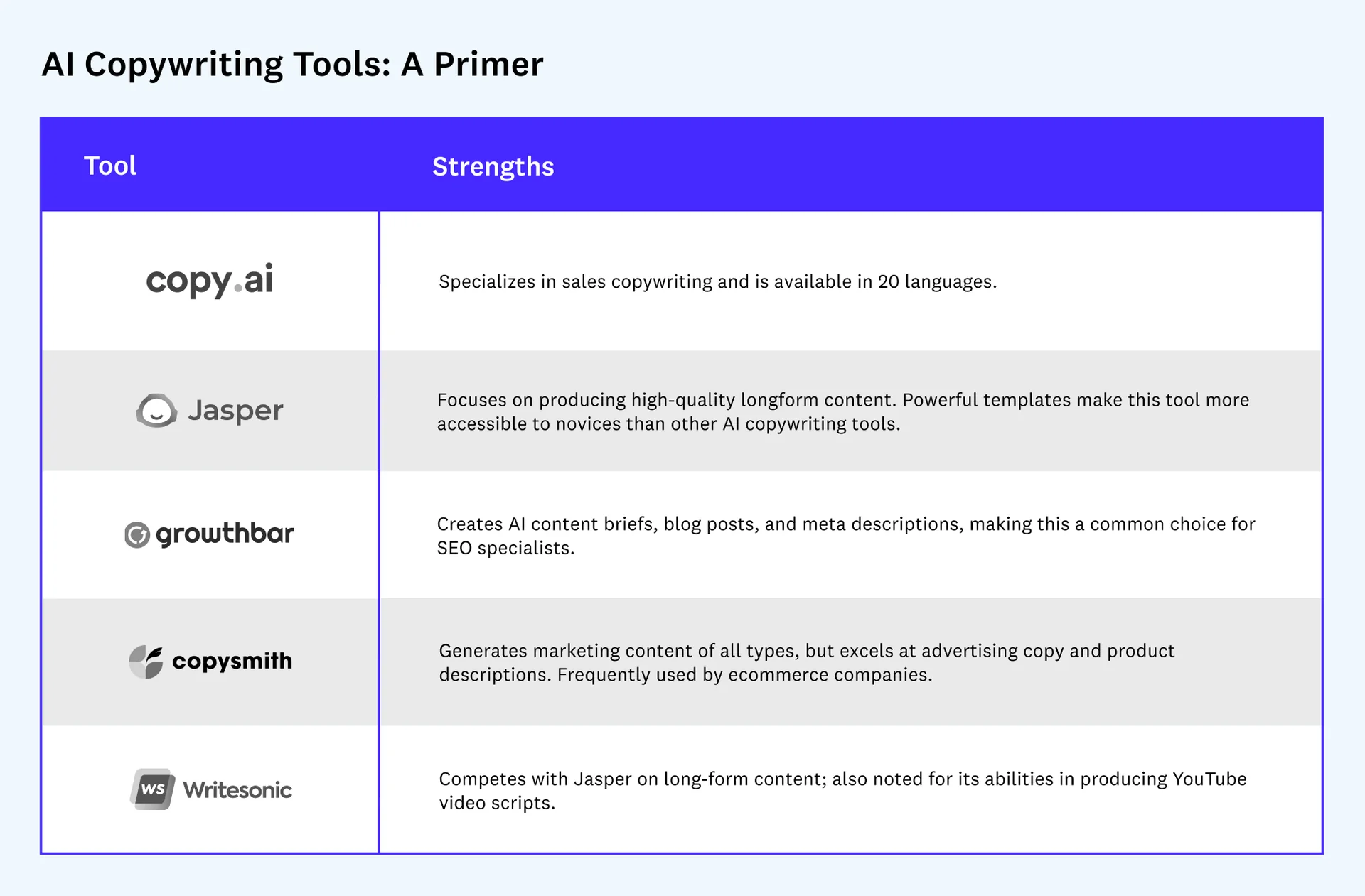
Many different kinds of AI copywriting tools are available, including Copy.ai, Jasper, GrowthBar, Copysmith, and Writesonic, among others. Each has its own strengths and weaknesses. Some are better at grammar and spelling, while others can help with research and with shaping content at a high level.
Five common AI copywriting tools
One point holds true across all tools: AI copywriters are not a substitute for human writers — they work best as assistants that improve human efforts. This means that while they can help with certain parts of writing, they should not be depended on alone to produce content in their current state.
How Google treats AI-generated writing in search resultsGoogle and the search for quality content
Of course, one of the main uses for AI copywriting tools is to generate more content for less money, helping companies rank higher on important terms through Google Search. Because Google currently dominates as a search engine, the company’s view of AI-assisted content can have a major effect on the industry.
When the trade publication Search Engine Journal ran the headline “Google Says AI Generated Content Is Against Guidelines” in April, it put fear into the hearts of SEO specialists around the world. The article left many asking what it meant for the future of their AI-assisted domains and the industry overall.
But in reality, Google has been saying for years that it wants its search results to be filled with high-quality content and has been creating technologies to stop spam content. It is clear that Google is simply trying to discourage the use of low-quality, spun content — something that was a problem long before AI copywriters became common — so that high-quality, useful content appears in search results. Back in 2011, for example, Google’s Panda/Farmer update wiped out millions of cases of spun content, affecting 12 percent of all search results.
So, will you be penalized for using AI-written content?
Likely not — yet. Google’s algorithms aren’t able to automatically detect content generated by language models like GPT-3, according to Miranda Miller, senior managing editor of Search Engine Journal.
Even if Google treats all AI-written material as spam, there have been plenty of recent case studies of hugely successful sites that churn out AI content. Google’s latest broad core algorithm update in May 2022 appeared to downgrade content written entirely by AI, but AI-written material that is checked for facts and revised by humans still appears to escape penalty and perform well.
Still, it’s fair to say that even if Google is not very good at spotting AI-produced content right now, that capability will certainly get better.
Because an AI tool is trained in a specific way on a particular dataset, it tends to produce content that is homogeneous at scale. For instance, if Jasper AI were used to write on every keyword tied to cooking, later articles created with the same AI on the same subjects might sound similar enough for Google to notice AI usage more readily. At the very least, once Google has a large enough dataset to examine, patterns will appear. That is central to its business model — indexing and analyzing the whole internet — so this kind of pattern detection is unavoidable.
But will Google penalize AI content? If people behave as opportunistically as they have before, and if history repeats itself, as it often does, the answer is highly likely yes. If a substantial share of the internet turns AI-generated and lacks fact-checking, Google would be pushed to adjust search results for the broader good, just as it did with the Panda/Farmer update. That suggests SEO specialists and founders alike will probably need to refine their AI tools by working with human editors and fact-checkers to avoid penalties.
How AI compares with human writersLooking ahead: What AI advances mean for the written word
What happens if AI-written content becomes impossible to tell apart from human writing?
This is less a matter of if than when. For AI copywriters to close that technical gap, they will need stronger language models, larger datasets, and quality-control checks built into their platforms. The ability to fact-check text is not far away, based on progress in technology used by social media platforms to stop the spread of disinformation. It won’t be long before the content production economy undergoes major changes over the next two years.
Paradoxically, though, I think this change will raise demand for highly skilled human writers and editors in the years ahead, for several reasons.
The long-term impact of AI on businessAI advances in the long term
First, as individual AI copywriters become more widely used, their outputs move closer to looking homogeneous at the macro level. That will push Google to build more advanced detection systems and perhaps apply a broad penalty. It will also mean that without human help, much of the internet will read more uniformly than it ever has before. This is where specialized human editors become essential.
Second, AI-generated content is most valuable for educational material, not investigative journalism. The need for journalists and for people doing independent research alongside human writers will remain as AI copywriters improve. Blue ocean content strategy will become more common, creating a new generation of content specialists. As search results become more competitive with the rise of AI-written content, content in areas of knowledge that were once untouched will be in high demand. The wide-open spaces where new interests, new niches, and new industries emerge will turn into stomping grounds for content specialists.
Lastly, to diversify writing styles and make content more enjoyable to read, AI copywriters that focus on specific fields, styles, and professions will appear. We’ve already seen this in various areas of marketing, where some platforms are better than others at, for example, email marketing or sales copy. Writers and editors who collaborate with these specialized AI copywriters will be necessary to produce first-rate content. As AI copywriters become more specialized, the need for human involvement to fact-check and double-check AI outputs will be greater. The mix of AI for content scaling and human editors for quality assurance will likely become the industry standard.