
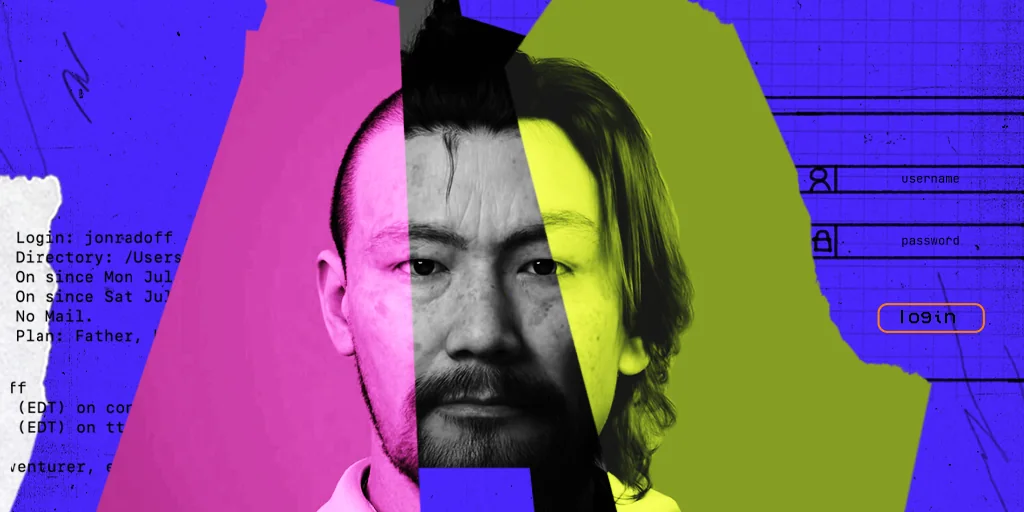
Who are you online? That question matters more and more as we spend a larger share of our lives there. Over the last decade, online usage has more than doubled; for GenZ, it’s even higher. The way we use that time has shifted too, as the early, transactional web has broadened into a fuller set of experiences that are creative, social, and interactive. In many cases, our lives are now shaped more by digital identity than by physical identity.
Yet many of us do not have just one online identity. The way you present yourself on a date can differ from how you act in a job interview, and your self-presentation in an online game may vary sharply from the one you use on social media.
I’ve been thinking about this issue and working on it for years, both as a lifelong gamer and as a founder and builder in games going all the way back to the start of internet gaming with Legends of Future Past. Since then, I’ve built games tied to cherished franchises like Game of Thrones and Star Trek. At Beamable, I’ve backed hundreds of game developers, where I’ve taken part in the coevolution of digital identity and online creativity.
As digital identities — which include not just our credentials and data but also how we present ourselves and who we connect with — evolved from their early forms on forums, chat rooms and online games, they were bundled by a small number of tech companies. Now, though, new technologies are appearing that unbundle our digital identities and rebuild them in new forms. From my perspective in games, this is happening especially fast with avatars and new platforms that speed up game development.
This unbundling and rebundling of digital identity helps both users and creators. Users gain more control and can better match how they see themselves and how they want to be seen. Creators and builders, meanwhile, now have more efficient ways to design and imagine games: small teams can launch games set in rich, immersive worlds without the weight of complicated infrastructure or reliance on centralized platforms. In this piece, I’ll explain how digital identities have changed, where they may be headed, and how users and creators alike may benefit.
The bundling of digital identities
Today, digital identity means all the expressions, relationships, and data tied to your presence online. At first, though, digital identity was just an account with a username and password used to control who could access the network and to separate file permissions.
Once multiple people began using the same computers, systems started keeping records of what they were doing — and even who they were. A clear example is the finger command on Unix, which showed details about you, including the contents of your ~/.plan file:
The Plan was originally meant to be a short text note about what you were working on. But if you looked inside early Unix systems, you’d discover everything from Zen koans to Lord of the Rings quotes to egg salad sandwich recipes. People used the Plan to show personality. It was like taking a driver’s license and covering it with stickers.
Meanwhile, on the internet, an early messaging system called Usenet offered a common place for self-expression. Beyond the internet, bulletin board systems (BBSes) and online services like America Online created moderated spaces for messages about shared interests. Early online games such as multi-user dungeons (MUDs) and “door” games let people begin experimenting with identity by adopting different roles and personas.
You can begin to see the line leading to the social media era, whose appeal depends on people’s desire for not only self-expression but also interaction. Yet a side effect of social media’s pervasiveness was the bundling of multiple online identities. The creation of Google Login and Facebook Login — supposedly to help consumers sign in more easily and assist individual websites in boosting conversions — led to a major improvement in the user experience for many websites and a useful pool of data for advertisers. But it also helped fuse separate digital identities together.
The rise of multiple digital identities via avatars
A recent survey of GenZ social media users in Hong Kong found that 65% of them prefer to use an avatar — a character or image that digitally represents the user — online rather than a “real” identity. The reasons for this differ, but it is probably a mix of wanting to keep identities separate, shape how they are seen online, and creatively explore different personas.
The first element, compartmentalization, happens because people do not want to connect all their different social settings and networks together. In an online game, you show one version of yourself (perhaps a pseudonymous champion for the Horde along with video captures of your recent raids). On LinkedIn, though, your professional profile tells the story of your career, along with articles and videos that convey your expertise.
When people lack the tools to build the version of themselves they want, they usually push back.
As for the second element, we shape different versions of ourselves even inside particular networks. That is why people make several TikTok, Instagram, or Twitter accounts: to align themselves tightly with certain content niches, quietly engage with specific hashtags, or dodge discrimination. The urge to shape one’s online identity is also fueled by creativity: it is the natural extension of fashion choices and personal grooming in an online world where you are no longer limited to “one body, one identity.”
In online games, people make alternate characters (“alts”) to test different play styles or take on different personas. This gives people a chance to experience the world from other perspectives. Recent data shows that a third of men prefer playing as female characters in online games. (I play both male and female characters, and I met my wife in an online game while I was playing a female character.)
When people lack the tools to build the version of themselves they want, they usually push back. That is why fake Instagram accounts, called “finstas,” exist. And it is one reason Meta chose to separate its Meta Quest platform from a dependence on Facebook Login. In that case, people mainly use Quest for games and immersive social experiences; they want the freedom to express themselves and build game-specific friendships in these settings without feeling compelled to tie their identity to the platform they use to wish Uncle Frank a happy birthday.
Taken together, avatars give users more ways to express themselves. And those options are becoming more sophisticated, helping both users and developers, who can plug into new infrastructure for their games. Consider Metahumans, from Fortnite publisher Epic. It is a photorealistic character system based on precise simulations of skin, hair, muscle, and skeletons that lets you show up as an idealized version of yourself — complete with the outfit, hairstyle, body and face you want. Likewise, in the future “voice fonts” could alter your speech so it matches how you want to sound — including removing (or adding) accents, changing pitch or shifting gender. Real-time translation software could even be added to make cross-language interaction possible.
Composability
A common objection to avatar systems in the past was that consumers did not want them. In fact, platforms such as Xbox saw relatively limited success, with players often saying they were too cartoony or were not used in many games beyond the most casual. Still, the times seem to be changing. You can see the start of this inside Roblox and VRchat, where you can carry your avatar across countless games, worlds and immersive experiences. There, your avatar is central to the experience rather than a secondary feature. Why is this shift happening? It is likely the combination of mass-market creator economies like Roblox, which have made it far easier to compose experiences, and the growing importance of digital identity for younger generations that have grown up with virtual worlds and virtual property.
The next step after this is the rebundling of your identity so you can move beyond walled gardens, carrying your chosen identity into other worlds that share a common framework.
While many of these experiences will be games such as those already found in Roblox, a rich area for innovation is in experiences that combine self-expression with a shared social setting. Picture attending an online music concert — which is increasingly happening within game worlds. Unlike a recording, a live experience is about the exchange between performer and audience. Part of that exchange is you actually being present in the virtual space, responding in real time, and expressing yourself both through your avatar’s appearance and through your behavior. Further, if you stop by the merch table and take a token of your attendance, it can be added to your avatar, blended into your identity, and carried with you to the next online experience you attend. The memory of the event will be permanently tied to how you interact and present yourself online.
This urge to fold memories, events, and fashion statements into your online identity has not gone unnoticed by traditional brands.
Traditional brands have not missed this urge to fold memories, events, and style statements into your online identity. That is why Burberry licensed content in Blankos Block Party, a gaming universe made by Mythical Games, or why Balenciaga designed fashions for Fortnite. It is also why Nike acquired a digital-native brand like RTFKT. The rebundling of identity into avatars will mean carrying fashions, animations, styling, and participation tokens from one experience into the next.
How to make it happen
One difficulty is figuring out the “cooperation problem.” How do we persuade companies as different as Disney, Universal, Epic Games, and Production Club to build — or even simply permit — a way for our avatars to move across experiences?
One answer would be to leave it to Microsoft, Meta, or Sony to work it out for everyone. Yet that may not serve creators, who could wind up trapped in the same kinds of creative and economic limits that come with things like Facebook Login.
These physical and digital-only experiences will need a way for us to bring our avatars along through protocols that do not rely on the authority of particular gatekeepers. This is where web3 matters: the native composability of blockchain creates an open setting for recording the definition of your avatar and carrying it into unrelated environments. TraitSwap illustrates how this could function with 2D profile-picture avatars: It takes the metadata for an NFT you own, shuffles traits, and lets you add branded pieces into a new avatar that represents your mix. Platforms such as Ready Player Me offer both a customization marketplace and an interoperable avatar framework that lets avatars be brought into unrelated worlds.
The “key” to your avatar, then, may turn out to be a digital wallet. The built-in decentralization of the internet points the way: a system comparable to the domain name system used to map host names to an IP address may become a way to identify individuals. Protocols such as the Ethereum Name Service (ENS) rely on the immutability of blockchain to offer a decentralized method for linking names with owners.
ENS shows what the new identity bundles could resemble. Rather than keeping your identity inside a centralized service, you hold your own private key to a digital wallet. The wallet’s public address is linked to a canonical name (for example, “jradoff.eth”) so your friends do not have to memorize your hexadecimal wallet address. To sign in to an internet service, you “sign” a request, which uses a cryptographic algorithm to demonstrate that you are who you claim to be.
Once composable identities and digital wallets are widespread, creators will be able to make games, worlds, music, and theater experiences centered on you without having to construct complex avatar and login systems from the ground up. In addition to the technical gains, it also lets users strengthen and expand the emotional connection to the identity they show through their avatar. Independent creators and game-makers gain from the investment people put into identity, keeping more of the value in their own work, without the dependencies and rents paid to a centralized platform.
Moreover, creators can work around some of the built-in problems of making online worlds: Instead of relying wholly on business models built on constant re-engagement, they can give you fresh content that you will fold back into your avatar. For instance, when Twenty One Pilots staged a concert in Roblox, a collection of items for customizing your avatar was tied to the concert and could travel with you into several games. The effect is that the value generated in the concert lasted longer than the event itself. A decentralized system could carry these proofs of participation and customizations past any single ecosystem.
When composable identities and digital wallets become commonplace, creators will be empowered to craft you-centered games, worlds, music and theater experiences.
This turns the usual model of experience-making upside down so that a fleeting moment is written into your avatar, increasing its perceived worth and deepening your self-expression. The expressions become as intimate and lasting to you as a music playlist.
A frequent criticism of shared-avatar systems is that they will create a distracting clash between a creator’s intended artistic experience and the expression users have online. But an open avatar system does not automatically mean a system without rules. One way to view this is that an avatar sets defaults that can be overridden according to the rules of a given world: If my Starfleet costume is not permitted inside a Star Wars experience, then it may change back to a suitable style. Object-oriented software development has handled inheritance, composition, different privilege levels, private vs. public attributes, and polymorphism for decades. Avatar systems will build on that expertise.
The rebundling of identity
These new technologies make things simpler for world-builders, allowing the number of creators to grow exponentially. The trend has already started: Look at the rising amount of modding, where people build on the core experience of a game system and layer their own distinct experience on top. This is common in Minecraft, Roblox, and smaller games from Terraria to Undertale. Modding shows the creative impulse shared by many individual gamers, something that appeared at least as early as the storytelling in tabletop Dungeons and Dragons.
The next wave of builders wants to shape the metaverse through game creation, modding and world-building — together with the way they project identity into digital space. Their aim is to express themselves, create experiences, and meet other people on their own terms. They care about identity and expression, not technology and infrastructure.
What started as a way to authenticate ourselves to computers and applications has grown into a way of expressing ourselves. Digital identity is no longer singular. We will carry different identities into different experiences, sometimes preserving continuity across experiences and sometimes maintaining identities that are unique to a particular world.
These shifts call for better technologies to support privacy and security — while also supporting user choice, usability and interoperability. Although the challenges ahead are significant, the rebundling of identity into a you-centered internet is one that will strengthen self-expression, both in how we present ourselves as digital humans and in our capacity to build worlds and experiences for others.
Further reading
- To support interoperable self-expression, avatars require composability. My article, Composability is the Most Powerful Creative Force in the Universe, offers background on how this is happening in many settings, from open source to game-making to computational architectures. David Bloom’s article Going Live and Immersive Is The Next Frontier for Musicians, Movies, Artists and More is a helpful introduction to the kinds of real-time experiences (beyond games). This is the setting for the rebundling of identity into avatars. Ben Thompson’s The Great Unbundling explains how technology has changed the way media is packaged, presented, and organized online. The Private Life of Generation Z provides a useful summary of how the generation raised with pervasive online services is also thinking differently about privacy, identity, and avatars. The Pseudonymous Economy by Balaji Srinivasan is a useful introduction to how identities can gain value without being tied to a real-world identity.