
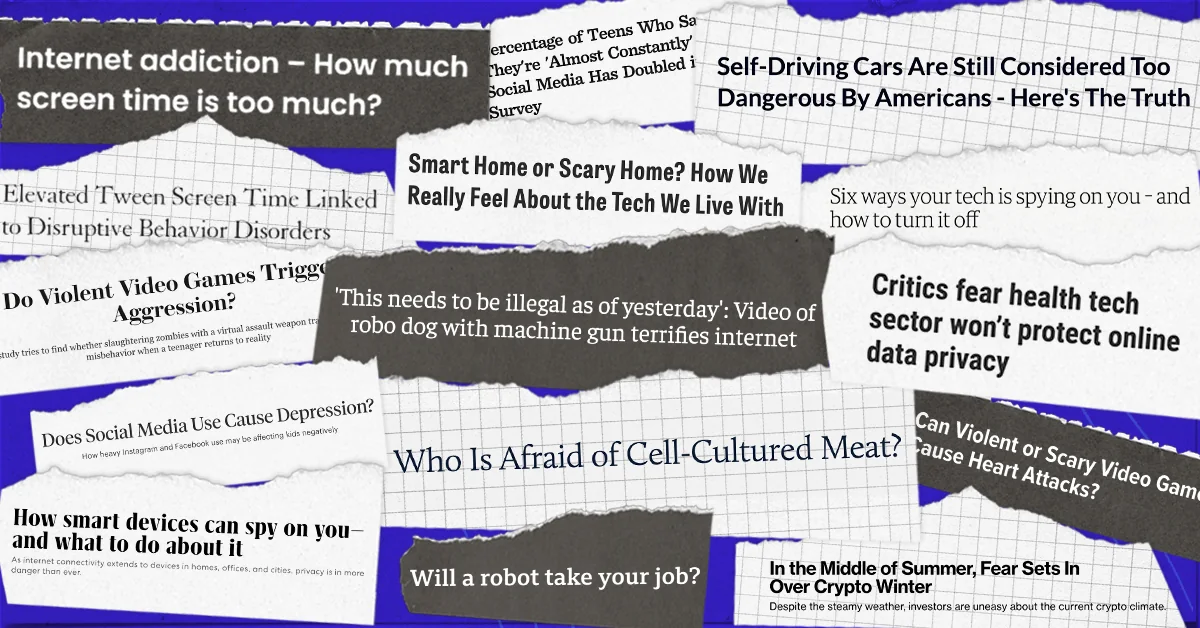
Amy Orben wanted to tackle a distinctly contemporary question: how do digital ties stack up against other kinds of connection?
Only a deeply nerdy, hyperanalytical person would think to ask something like that. Orben is that person. She earned a master’s in natural science from the University of Cambridge, then headed to the University of Oxford for a doctorate in experimental psychology. She is someone who can measure the world around her and then make sense of the numbers.
In 2017, she needed a strong thesis topic about how digital technologies affect social ties. Back then, the world was still in a major panic over social media’s effects on young people’s mental health. Orben saw a perfect opening. She could study these huge, consequential issues dominating headlines worldwide, and perhaps end up with findings that might improve lives. “It felt so urgent,” she told me. “It felt like every minute mattered.”
Over the next several years, that was where she focused her energy. At one point, she decided it would be amusing to open her paper with a historical anecdote — something that put the danger of social media in context. She went to the library and found a 1941 piece in The Journal of Pediatrics, which cautioned against radio.
“The average child radio addict starts lapping up his fascinating crime at about 4 o’clock in the afternoon and continues for much of the time until sent to bed,” wrote the author, a doctor named Mary Preston. “The spoiled children listen until around 10 o’clock; the less indulged until around 9 o’clock.”
The report said that more than half of children had become hooked on radio dramas.
Orben was amazed. “It felt like it was exactly the same conversation I’ve been having for three years — just, you know, eighty years before,” she said.
She had been studying how social media affects children’s mental health, assuming it was a new question tied to technological change. Now she realized it was really an old question that gets asked about any technological change. Was she simply one more part of a loop that keeps repeating? Orben began revisiting her research — and all the other studies she had found on social media — now through this different lens. She reworked the data from earlier studies — studies that had drawn a lot of attention over the years, and that had underpinned many books and articles and political hand-wringing. The findings were disturbingly clear.
“The research was flawed,” she said. “They didn’t really tell us a lot about whether there’s a causal impact of social media on depression. We’re all talking about correlations — and they’re very, very small.”
Panic vs. Data
After applying the numbers to this deeper, more advanced analysis, Orben could compare how different activities are related to well-being, as a way to judge whether social media is truly having a large and meaningful effect. In fact, technology by itself has only a minor influence on young people’s psychological well-being. Scientific American neatly summarized her results: “Technology use tilts the needle less than half a percent away from feeling emotionally sound. For context, eating potatoes is associated with nearly the same degree of effect and wearing glasses has a more negative impact on adolescent mental health.” Eating potatoes!
Many other studies have since come to similar conclusions. Soon Orben began wondering: Why did this misunderstanding arise at all?
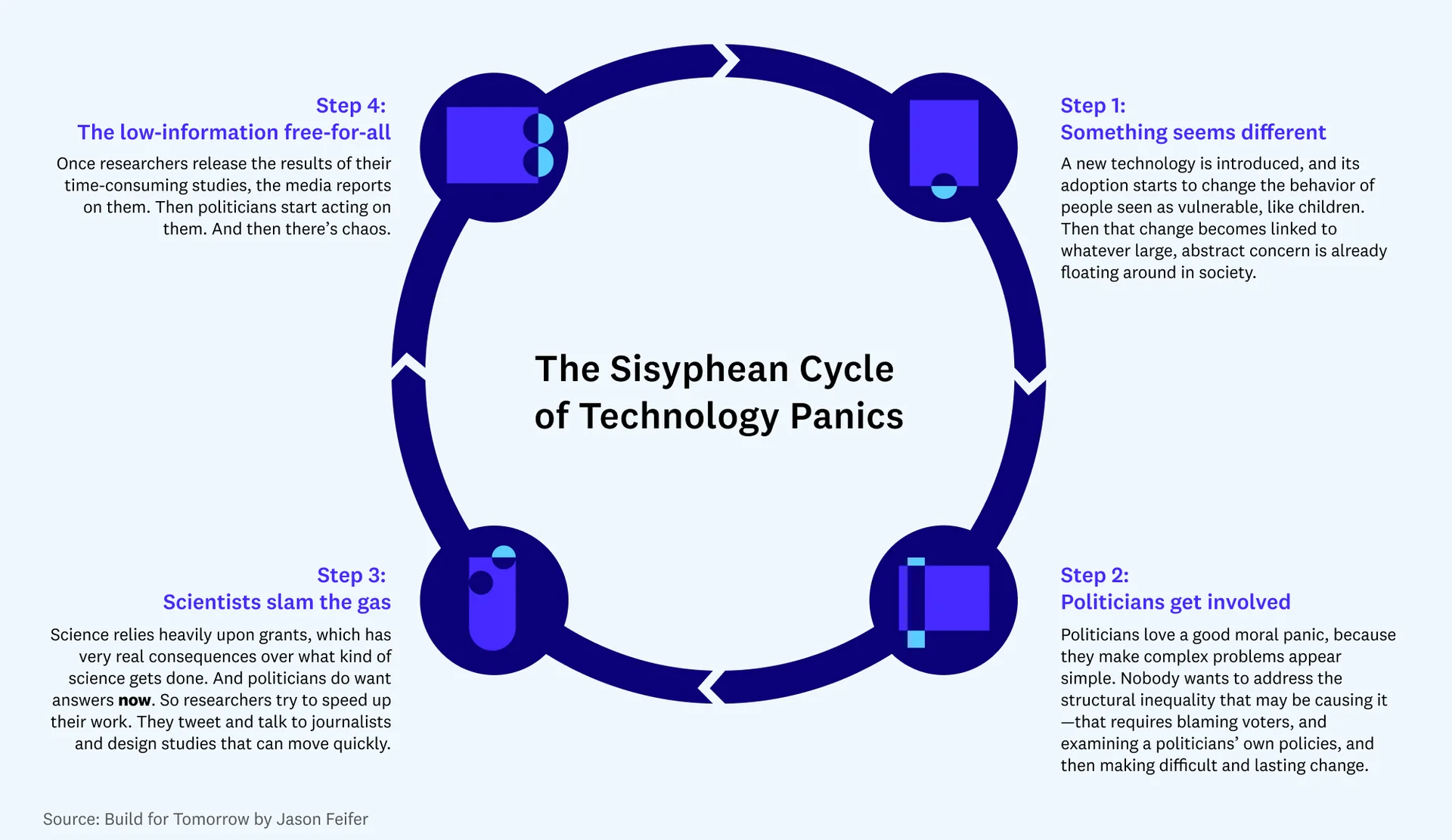
To answer that, she developed a four-step theory she calls the Sisyphean Cycle of Technology Panics. Sisyphus: He’s the figure from Greek mythology who was condemned to push a boulder up a hill, only for it to roll back down, forcing him to repeat the task forever. It’s easy to see why that works as a neat metaphor.
Step 1: Something seems different
A new technology appears, and its adoption starts to alter the behavior of people considered vulnerable, such as children. Then that change gets tied to whatever broad, abstract worry is already hanging over society.
Step 2: Politicians get involved
Politicians are fond of a good moral panic, because it makes complicated problems look straightforward. No one wants to take on the structural inequality that may be driving it — that means blaming voters, and looking at a politicians’ own policies, and then making hard, lasting change.
Step 3: Scientists slam the gas
Science depends heavily on grants, which has very real effects on what kind of science gets done, because researchers start clustering around whichever topics are in vogue. And politicians want answers right away. So researchers try to accelerate. They tweet and speak with journalists and design studies that can move fast.
Step 4: The low-information free-for-all
Once researchers publish the results of their time-intensive studies, the media covers them. Then politicians begin acting on them. And then there’s chaos.
How to Break the Cycle of Technology Panics
Science should be proactive rather than reactive. If researchers need five years to truly start understanding something, then that five-year process should not begin when everyone is already hyped up and politicians are demanding answers. It ought to begin before anyone cares.
“If we know that a new panic is coming in maybe five or ten years,” Orben told me, “then what we should be doing now is putting our feelers out, and trying to figure out what that might be, and start collecting data.”
Orben isn’t saying her peers have to do better. She’s saying they need to recognize their weaknesses. In effect, she believes in the scientific process — but because it is slow and messy, the people who take part in it should build those drawbacks into their work from the outset, too.
We can and should apply this to ourselves, too. We need a situational awareness of ourselves — a recognition of how we, as individuals and as groups, react badly to new things. What once scared us, and now we love? What did we learn in the process? Then we can build that knowledge into our actions going forward.
It’s time to keep a record. The next time you catch yourself loving something you thought you’d hate, write it down. Put it in a notebook, a Word doc, or even an email to yourself. It doesn’t matter. Explain why you didn’t want to do the thing, what happened once you did it, and how you feel now. Then save that writing somewhere easy to reach — because one day, I guarantee, the boulder you just pushed up the hill will roll back down, and you’ll be at the bottom, feeling lazy and beaten, and you will not want to push it back up. That is when you need the reminder that you have been there before — and that there are great things on the other side of these feelings. All you need to do is say yes and remember that you already did it.
That is how you break the Sisyphean Cycle. Then you can focus on what comes next.
This is an excerpt from Build for Tomorrow by Jason Feifer (Harmony Books, September 2022).