
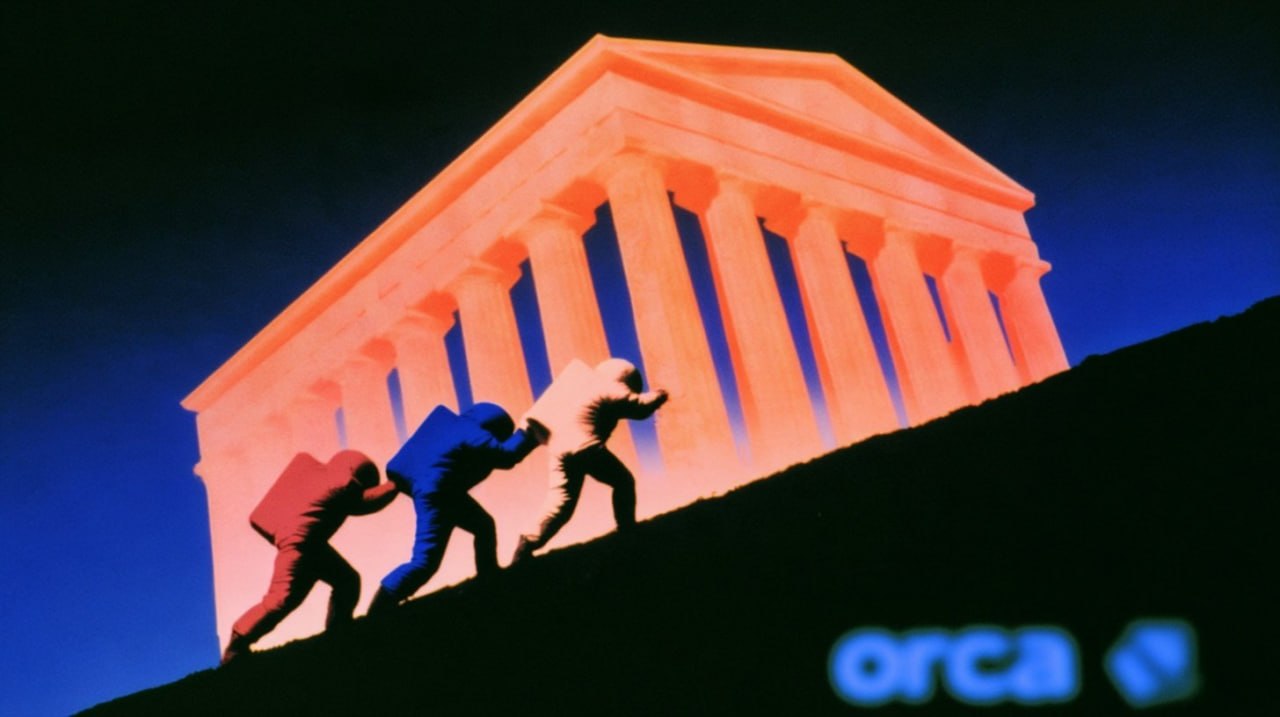
The Solana-based merger brings together trading, credit and investment vault infrastructure as its founders seek to move decentralized finance beyond crypto-native assets and into the financing of emerging industries.
For much of decentralized finance's development, exchanges and lending protocols have operated as distinct businesses. One provides a market for trading assets; another allows those assets to be borrowed, lent or used as collateral. Investment vaults, meanwhile, aggregate capital and direct it toward strategies that may involve several unrelated platforms. The resulting financial system is modular, but the path from issuing an asset to building a functioning market around it is rarely straightforward.
Two established Solana businesses are attempting to bring those functions under one organization.
Orca, one of the network's longest-running decentralized exchanges, and Loopscale, a fixed-rate lending and credit platform, announced on October 7 that they would combine as Formation, a New York-based company focused on trading, financing and distributing onchain assets. Loopscale co-founder Luke Truitt will serve as chief executive, alongside fellow co-founder Mary Gooneratne as chief operating officer. Orca executive Christopher Montagano becomes chief strategy and legal officer.
The merger brings together businesses with substantial operating histories. Orca says it has handled more than $550 billion in cumulative trading volume since launching in 2021. Loopscale reports more than $2 billion in loans facilitated and over $150 million in deposits. Financial terms of the transaction, including the valuation of either business and the ownership split, were not disclosed.
Formation's stated objective goes beyond merging two protocols. It wants to connect the stages through which financial assets are created, introduced to markets, financed and eventually distributed to investors. The company has identified artificial intelligence, energy, robotics and defense as potential markets for that infrastructure, alongside tokenized financial instruments and other capital-intensive businesses.
In effect, Formation is advancing a broader interpretation of what decentralized finance might become: not only an alternative trading venue for cryptocurrencies, but infrastructure through which businesses and investors can raise and deploy capital.
From Token Trading to Market Infrastructure
Orca launched on Solana in 2021 and became a recognizable venue for token swaps and liquidity provision. Its concentrated-liquidity system, Whirlpools, allows liquidity providers to place capital within selected price ranges, a structure designed to use available liquidity more efficiently than pools that spread assets across all possible prices.
That model made Orca an important part of Solana's secondary trading infrastructure. But a liquid market is only one element of a financial asset's lifecycle. Market participants also need reliable collateral arrangements, credit, financing capacity and investors willing to maintain exposure beyond an asset's initial launch.
Loopscale developed products addressing a different part of that system. Originally associated with the Bridgesplit name, the project built fixed-rate lending infrastructure, including an order-book approach to matching borrowers and lenders and vault products through which capital can be allocated across lending strategies. Those functions are complementary to a decentralized exchange: liquid assets are easier to value and potentially easier to finance, while borrowing and investment demand can, in turn, create activity in underlying trading markets.
The merger is intended to connect those relationships more deliberately. Instead of leaving asset issuers to assemble separate trading, lending and distribution partners, Formation wants to provide a coordinated set of services. An issuer could seek initial liquidity for an asset, develop borrowing or collateral use cases and reach pools of capital through managed strategies and distribution relationships.
The important qualification is that the announced corporate merger does not mean every one of those steps is already available through a fully integrated product. Orca and Loopscale's existing applications and onchain arrangements are continuing, while Formation says additional issuer tools, investment strategies and unified capabilities will be introduced over the coming twelve months.
The distinction matters because building a comprehensive financial platform requires more than placing established products within the same company. Credit risk, collateral valuation, liquidity provision, operational controls and investor distribution each introduce different requirements. Formation's opportunity is to coordinate these functions; its challenge will be proving that the coordination delivers measurable advantages over existing modular alternatives.
The Problem Tokenization Has Not Solved
Over the past several years, tokenization has made it possible to represent an expanding set of assets on blockchain networks, including government securities, fund interests, private credit instruments and other contractual claims. The technical act of issuing a token, however, is not equivalent to creating a functioning capital market for the asset that it represents.
An asset can exist onchain while remaining difficult to trade. It may have a legally defined ownership structure but no meaningful secondary market. Investors may be able to hold it yet have few options for using it as collateral, borrowing against it or including it within diversified strategies. Restrictions on transfers and eligibility can further reduce the number of potential counterparties.
Traditional capital markets are supported by a wide network of intermediaries that perform these functions. Exchanges and dealers facilitate transactions; lenders provide financing; custodians and administrators maintain records and controls; asset managers package exposures into strategies that investors can access. Much of the cost of raising capital comes from coordinating those services, satisfying legal requirements and finding willing buyers.
Formation is betting that more of this activity can be connected through shared onchain infrastructure. For a smaller issuer or a business seeking an unconventional form of financing, reducing the number of separate relationships could make issuance and subsequent financing less cumbersome. For investors, a closer relationship between primary issuance, secondary liquidity and credit products could create more ways to gain exposure to an asset.
That does not mean tokenization itself eliminates underwriting risk, legal expenses, investor suitability rules or the economic realities of finding buyers. A tokenized instrument still depends on the creditworthiness of its issuer, enforceable rights and the willingness of market participants to provide capital. In markets where underlying assets are hard to value or difficult to sell, onchain infrastructure cannot manufacture liquidity by itself.
This is the practical test behind Formation's strategy. Its products may make it easier to establish markets and direct funds toward them, but sustainable demand will have to come from the assets, borrowers and investors using the system.
Why Formation Is Looking Beyond Crypto
The newly combined company has explicitly connected its ambitions to industries with substantial and often complicated financing requirements. Artificial intelligence infrastructure, robotics, energy development and defense technology can involve significant up-front capital expenditure, long development cycles and assets that do not necessarily fit the standard financing models available to smaller businesses.
An AI infrastructure operator, for example, may need to finance expensive computing equipment before future customer revenue arrives. Energy projects may depend on specialized assets, contracts and lengthy construction timelines. Other emerging businesses may have valuable equipment or predictable cash flows without access to deep, liquid markets for financing them.
Formation's argument is that blockchain-based issuance, trading and credit could become useful components of the financial infrastructure supporting such businesses. That is an ambition rather than evidence that the company has already created large financing markets in these sectors. Its announced roadmap emphasizes building issuer tools and capital-allocation strategies capable of serving a broader range of assets over time.
The company has named Figure, Shinhan Asset Management, Superstate, R3 and Securitize among organizations with which it is working to bring assets to market and expand distribution. The list connects Formation to firms active in tokenized securities, financial infrastructure and institutional blockchain applications, although the announcement does not specify the commercial scale, contractual commitments or revenue associated with each relationship.
There are precedents for Orca's involvement in institutional tokenization initiatives. In August 2026, the exchange participated alongside Shinhan Asset Management, the Solana Foundation and Etherfuse in a proof of concept involving a tokenized Korean won bond fund. That initiative provided a more concrete demonstration of Orca's interest in applying its liquidity technology beyond conventional crypto trading pairs.
Moving from these experiments to a repeatable financing business is a different proposition. Institutional issuers may require permissioned markets, identity checks, transfer restrictions and carefully defined legal relationships. Credit facilities involving physical equipment or private contractual claims would also depend on reliable information about collateral and enforceable claims outside the blockchain itself.
Consequently, the value of Formation's infrastructure will depend not only on its software but also on its ability to connect technology, regulated financial partners and traditional legal arrangements.
The U.S. Regulatory Ambition
Formation's decision to establish its business in New York is consistent with another element of its stated strategy: developing a route into regulated American capital markets.
The company has discussed the possibility of operating a tokenized securities venue under a proposed innovation-exemption framework and pursuing relevant licenses as its products expand. Those intentions should not be confused with an existing authorization to conduct all of the activities contemplated in its roadmap. The precise permissions needed will depend on the instruments offered, the roles played by Formation and its partners, and the regulatory arrangements applicable at the time of launch.
The distinction between decentralized cryptocurrency trading and securities market infrastructure becomes especially consequential when platforms begin supporting tokenized shares, credit claims or other regulated instruments. Issuance, brokerage, exchange activity, investment management and custody can trigger different legal obligations. Combining them in a commercial strategy does not necessarily allow one company to perform all of them directly without separate approvals or regulated counterparties.
Formation's leadership structure indicates that these issues are central to its ambitions. Montagano, who previously worked on Orca's strategic and legal functions, will oversee both areas within the combined company. Its relationships with established tokenization and financial infrastructure firms may also provide channels for developing compliant products, subject to the actual scope of those arrangements.
The longer-term question is whether onchain markets can become sufficiently integrated with conventional financial systems to support substantial real-world capital formation without losing the transparency and programmability that make decentralized infrastructure attractive.
What Changes for Orca and Loopscale Users
For existing users, the merger is primarily an organizational change rather than an immediate migration of assets or replacement of the underlying protocols.
Both Orca and Loopscale have said that their applications will continue operating and that existing liquidity positions, loans, deposits and vault arrangements are not being automatically altered by the announcement. Users have not been instructed to withdraw funds or sign migration transactions simply because the businesses are combining.
The ORCA and xORCA token framework also remains central to the combined operation. Public explanations from the projects indicate that Formation is not launching a separate Loopscale token and that the merger itself does not involve an additional mint of ORCA tokens or dilution of existing supply. Details affecting Loopscale points and their future treatment are separate from those assurances and should be assessed when the company publishes definitive terms.
Governance remains an area worth watching. Following the announcement, Orca's Governance Council moved to cancel and rerun a tokenholder proposal, with a revised voting period scheduled for October 11 through October 16. That process is distinct from the strategic rationale of the merger, but it illustrates that integrating existing crypto communities and token frameworks creates questions beyond a conventional corporate combination.
For ORCA holders, an enlarged business may broaden the potential uses and institutional relevance of the surrounding ecosystem. However, the relationship between future company revenues and tokenholder economics cannot be assumed from the merger announcement alone. The extent to which value accrues to a token depends on its actual rights, protocol mechanisms and governance decisions, not simply on the commercial ambitions of the organization associated with it.
A Different Phase for DeFi Consolidation
The Formation merger arrives as established decentralized finance protocols increasingly confront the limitations of specializing in a single financial function. Trading venues compete for liquidity and order flow. Lending systems compete for collateral and borrower demand. Yield products depend on sustainable sources of returns rather than incentives alone. Each of these businesses can become more useful when integrated with the others, although concentration can also introduce operational complexity and shared points of failure.
There is a strategic precedent in conventional finance: financial institutions have often sought to combine origination, market access, lending and investment distribution because those activities reinforce one another. An asset that can be traded readily is potentially easier to finance; an asset supported by a financing market may become more appealing to certain investors; reliable distribution can make issuance more practical.
DeFi has historically attempted to reproduce many of those relationships through composable protocols, allowing independent applications to interact on public blockchains. Formation is exploring a more coordinated commercial model without necessarily abandoning that underlying modularity. Existing protocols will remain in place, while a single organization attempts to develop a coherent product and distribution strategy around them.
The approach carries potential advantages and trade-offs. Shared leadership may help teams prioritize integrations and negotiate institutional relationships. But assets supported by the platform will still need independent demand, credible risk assessment and sufficient depth in their secondary markets. Integration also creates exposure to relationships among trading, lending and vault strategies, which can transmit losses when collateral values change rapidly or liquidity disappears.
For now, Formation's measurable foundation consists of Orca's established transaction history and Loopscale's lending activity. Its larger capital-markets vision remains to be tested through new issuers, the performance of financing products, institutional participation and the development of functioning secondary markets for assets beyond familiar crypto tokens.
The merger reflects a shift in emphasis from introducing another DeFi application to building a business around the full financial lifecycle of an asset. Whether that model can attract capital from the industries Formation hopes to serve will depend less on the novelty of token issuance than on what happens after an asset reaches the blockchain: who trades it, who finances it, who bears the risk and who remains willing to hold it.